Business

Proforma Invoice for Service Exports: Indian Freelancer Playbook

Content
share on
Contents
Share On

Key takeaways

  • A proforma invoice is a formal, pre-delivery quote that helps international clients approve scope, price, and payment terms, and it supports RBI/GST documentation later.
  • Include complete business and client details, a unique proforma number and date, precise service descriptions, currency, payment method, validity, and bank or virtual account information.
  • Export of services is zero-rated under GST when you furnish an LUT, so you don’t charge GST; add a clear GST/LUT statement on the proforma.
  • Use the proforma to anchor your workflow: approval, delivery, commercial invoice, payment, INR settlement, and e-FIRA issuance.
  • Avoid vague scopes, missing PAN/GSTIN, unclear currency, incomplete bank fields, no validity period, and mismatches between proforma and commercial invoice.
  • Platforms like Karbon Business give USD, GBP, EUR virtual accounts, quick INR settlement, and automatic e-FIRA to keep you compliant.
  • Manage forex risk with shorter payment windows, advances, and conversion timing; build buffers for longer projects.
  • Document scope changes with revised proformas and explicit approvals, then match your final commercial invoice accordingly.

What is a Proforma Invoice for Service Exports?

A proforma invoice is a preliminary bill you send before delivering services. It looks like an invoice, but it’s a detailed quote that sets expectations on scope, price, currency, and terms.

Unlike a commercial invoice, it doesn’t demand payment for completed work. It informs your client’s procurement process, and it lays the groundwork for compliance once funds arrive. For a complete side-by-side comparison, see Proforma vs Commercial invoice.

For Indian freelancers, the proforma secures scope clarity, helps clients raise POs or budget approvals, and establishes the documentary trail behind the remittance that later maps to your commercial invoice and e-FIRA.

Essential information to include in your proforma invoice

  • Your business details: Legal name exactly as per PAN, address in India, PAN, GSTIN if registered, email, phone.
  • Client details: Legal name, full address with country, contact person and email.
  • Invoice identification: Unique proforma number, issue date, label “Proforma Invoice,” and a consistent numbering system (e.g., PI/2026/001).
  • Service description: Specific deliverables, quantities, timelines, inclusions/exclusions; unit price and total. Be concrete, not generic.
  • Currency and payment terms: Quote the currency clearly (USD, GBP, EUR) and specify due dates, advances, milestones, and late fees if any.
  • Preferred payment method: Share virtual account details if you use Karbon Business (ACH, SEPA, FPS, or wires), so clients can vendor onboard you faster.
  • Export declaration and GST/LUT note: Add a zero-rated statement and confirm LUT status; reference the relevant notifications.
  • Validity period: Usually 30 days, to protect against forex swings.
  • Bank/virtual account fields: USD wires need account, routing/ABA, SWIFT/BIC; EUR needs IBAN and BIC; GBP needs account number, sort code, and SWIFT where required.
  • Compliance cues: “e-FIRA will be issued upon receipt of payment” to signal remittance documentation will be available.

GST treatment on service exports and LUT

Export of services is zero-rated when the supplier is in India, the recipient is outside India, place of supply is outside India, and payment comes in convertible forex. With an LUT in place, you invoice at 0% GST and still keep input tax credit eligibilities intact. Learn how to furnish one in LUT for zero-rated services.

Recommended note on your proforma: “Export of service under LUT. No GST applicable.”

If you haven’t furnished an LUT, you’d otherwise pay IGST and claim a refund later, which strains cash flow. Furnish your LUT annually, then note your GST/LUT status clearly on invoices and proformas.

How proforma invoices fit into your payment workflow

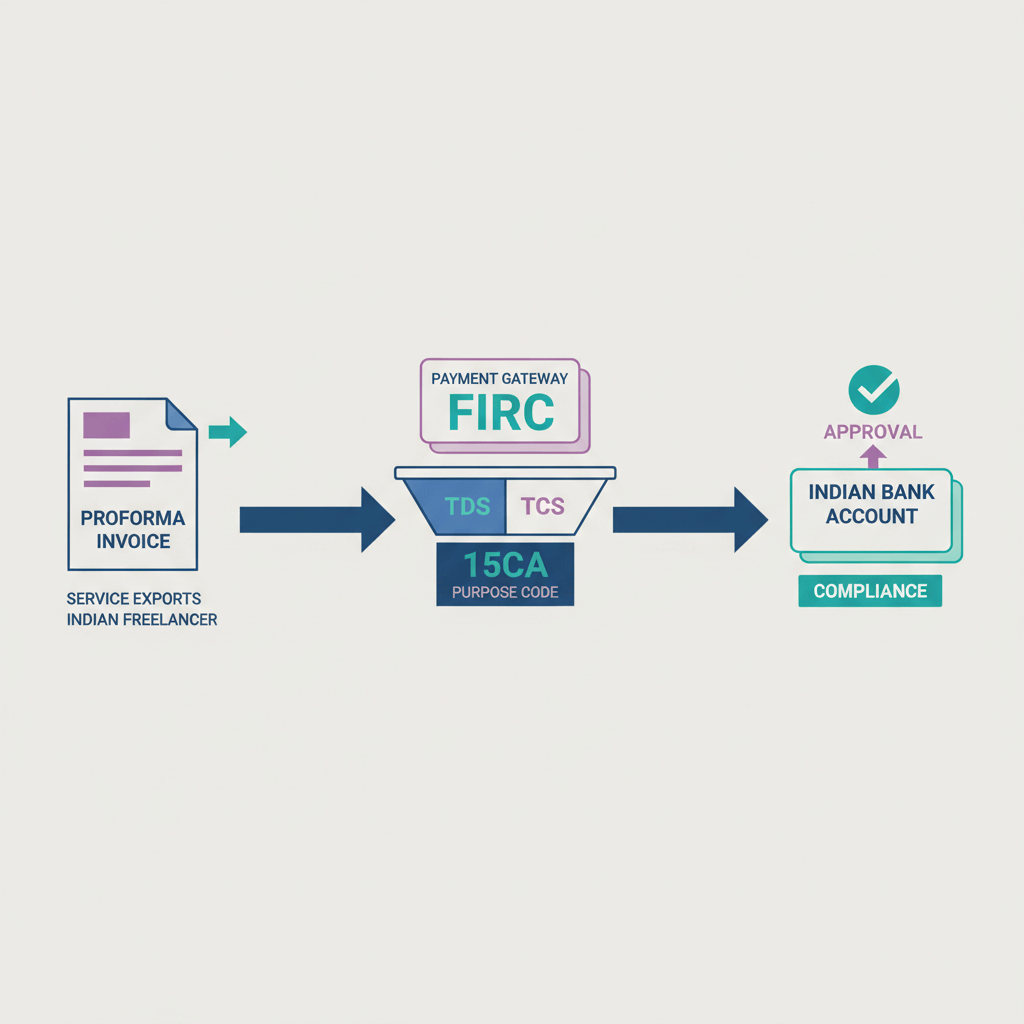
  1. Client agrees on scope and price, requests a proforma for internal approvals.
  2. You send the proforma; their finance team sets up a vendor profile, PO, and budget.
  3. You start or complete the work per the agreement.
  4. You issue the commercial invoice referencing the proforma number.
  5. Client pays via ACH/SEPA/FPS or SWIFT wires.
  6. You mark the invoice paid once the funds reach your account or virtual account.
  7. INR settles to your Indian bank within 24–48 hours on platforms like Karbon Business.
  8. e-FIRA generates automatically and you file GST export reporting accordingly.

A precise proforma reduces questions, avoids PO mismatches, and keeps your payment chain smooth from start to finish.

Common mistakes freelancers make with proforma invoices

  • Vague scopes: “Consulting” or “design services” won’t pass procurement checks; specify deliverables, quantities, and timelines.
  • Missing PAN/GSTIN: PAN is mandatory; include GSTIN if registered.
  • No currency: Always write “USD 5,000” or “5,000 USD,” not just “5,000.”
  • Incorrect GST notes: Add a clear export/LUT statement; don’t just drop GST silently.
  • No validity period: Without it, forex movement can erode margins.
  • Incomplete bank fields: Missing SWIFT/BIC, IBAN, sort code, or routing causes failures.
  • Mismatched commercial invoice: Keep amounts and descriptions consistent or document change orders.
  • Ignoring client templates: Ask for any required PO fields or cost breakdowns early.
  • Overly casual language: Keep tone professional; finance teams expect standard business phrasing.

Tools and platforms for receiving international payments

  • Karbon Business: Virtual USD/GBP/EUR/CAD accounts, local rails acceptance, mid-market FX, flat platform fee, 24–48 hour INR settlement, automatic e-FIRA.
  • Other options: Wise, Payoneer, PayPal, or bank wires, but compare fees, FX spreads, and compliance support carefully.

For compliant, faster settlements with export documentation, India-focused platforms often provide a smoother experience.

Sample proforma invoice template for service exports

[Your Name/Business Name]
[Your Address], [City, State, PIN], India
PAN: [Your PAN] | GSTIN: [Your GSTIN or “Not Applicable”]
Email: [Your Email] | Phone: [Your Phone]

PROFORMA INVOICE
Invoice No.: PI/2026/001 | Date: Jan 15, 2026 | Valid Until: Feb 14, 2026

Bill To: [Client Legal Name], [Client Address], [City, Country]

Scope & pricing
- Item 1: WordPress website development including 5 custom pages, contact form, and mobile responsive design as per spec dated Jan 10, 2026 — Qty: 1, Unit: USD 3,000, Total: USD 3,000
- Item 2: Logo design with 3 concepts and 2 revision rounds — Qty: 1, Unit: USD 800, Total: USD 800
Total: USD 3,800

Payment terms: 50% advance (USD 1,900) upon acceptance of this proforma, 50% (USD 1,900) on completion.

Payment details: USD account/virtual account fields with account number, routing/ABA, SWIFT/BIC; include IBAN/BIC or sort code for EUR/GBP as applicable.

GST/LUT note: “Export of service under LUT. No GST applicable.”
Compliance: “e-FIRA will be issued within 24 hours of payment receipt.”

Authorized Signatory: [Name] | Date: [Date]

Prefer a ready format? See Create compliant invoices for exports in India for layout and checklist tips.

Tax filing and documentation requirements

  • Income tax: Report foreign income in INR using TT buying or RBI reference rate on the receipt date; keep proformas, commercial invoices, payment proofs, and e-FIRA.
  • GST returns: Report zero-rated exports in GSTR‑1 and GSTR‑3B under the export sections, noting LUT/bond as applicable.
  • RBI/FEMA: Store e-FIRA by financial year; it’s your official foreign inward remittance advice for audits and reconciliations. For quick clarity on documents, see e-FIRA/FIRC documents demystified.

Best practices for international client communication

  • Send proformas within 24 hours when requested; approvals often hinge on your speed.
  • Clarify vague scope upfront, then lock terms in the proforma.
  • Proactively explain zero-rated GST and LUT to non-Indian finance teams.
  • Confirm receipt, note next steps, and ask about PO or format requirements.
  • Use email for scope, pricing, and payments to preserve an audit trail.
  • Follow up on delayed payments professionally with references to proforma and commercial invoice numbers.

Currency considerations and forex risk management

  • Shorten payment windows or offer early payment discounts to reduce exposure.
  • Collect advances on larger projects to lock part of the rate earlier.
  • Hold foreign currency briefly where allowed and convert at favorable moments.
  • Track broad USD/INR trends and build small buffers into long-duration quotes.

For USD-specific steps and fee comparisons, explore Receive USD in India.

Handling scope changes and revised proforma invoices

  • Document changes via email and issue a clearly labeled revised proforma (e.g., PI/2026/001‑R1).
  • Get explicit acceptance before expanding work.
  • Ensure the final commercial invoice matches the last accepted proforma.
  • If revisions become frequent, improve discovery and scoping, or set change-order rules.

Conclusion

A strong proforma invoice is more than paperwork; it’s your project’s financial backbone. Include complete details, precise scope, currency and terms, GST/LUT notes, and accurate payment fields. Align it to your workflow, communicate clearly, manage forex risk, and use platforms like Karbon Business for fast INR settlement with automatic e-FIRA. The result is fewer delays, cleaner compliance, and professional credibility that turns first-time clients into long-term relationships.

FAQ

Do I need GST to raise a proforma for a US client as a freelancer in India?

If you export services and furnish an LUT, you can issue proformas and invoices without charging IGST, while reporting the supply as zero-rated. Add a note like “Export of service under LUT. No GST applicable.” For step-by-step guidance, see LUT for zero-rated services.

What should I write about GST on my proforma invoice for export of services?

Is a proforma invoice enough for Indian banks when inward remittance arrives?

A proforma establishes commercial intent, but banks usually reconcile the payment against your final commercial invoice. Keep both ready. If your bank asks for clarifications, use the checklist in Compliance holds: Clear Bank Inward Remittance in 24–48 Hours.

Which purpose code should I use for freelance IT or SaaS services when I get paid?

For non‑SOFTEX IT services, many freelancers use P0802 where applicable, but confirm with your bank. Learn practical examples in RBI’s P0802 Purpose Code and see the broader list in RBI Purpose Codes Overview.

How do I share bank or virtual account details with an international client safely?

Use a secure PDF proforma or an invoicing tool and include required fields only. For easier vendor onboarding, many freelancers share virtual USD/GBP/EUR details via Karbon Business, which also automates e-FIRA after payment.

What if my client pays in GBP or EUR—will SEPA or Faster Payments work to get money in India?

Clients can pay into your local EUR/GBP virtual accounts via SEPA or Faster Payments, then you settle INR to your Indian bank. This approach is faster and cheaper than direct international wires. Explore corridor tips in UK corridor: GBP payments and SEPA vs SWIFT for EUR.

How do I handle SWIFT fees and intermediary charges so my payout isn’t short?

Ask your client to use OUR charges so you don’t bear intermediary fees, or prefer local rails (ACH/SEPA/FPS) to cut costs. Get a clean breakdown in SWIFT fee breakdown India, and consider virtual accounts via Karbon Business for lower net fees.

Can I add advance payment terms on the proforma to reduce forex risk?

Yes. For larger projects, use 50% advance, 50% on completion, or milestone billing. This locks part of the exchange rate early and improves cash flow. State advances clearly in the proforma under “Payment terms.”

What if a wire gets stuck—how do I track and resolve it fast?

Ask your client for the UETR and MT103 details, then trace via SWIFT gpi. Identify compliance or intermediary holds quickly and share invoice/proforma proof. See fixes in SWIFT troubleshooting: Stuck transfers.

Is e-FIRA mandatory for my tax filings, and how do I get it?

e-FIRA is the RBI‑compliant proof of foreign inward remittance and is essential for audits and reconciliations. With Karbon Business, e-FIRA typically generates automatically within 24 hours of claiming a payment. For document differences, read e-FIRA/FIRC documents demystified.

Does a proforma invoice need a PO number from the client to get me paid?

Many enterprise clients require a PO number to release funds; ask early if they need it on your proforma and commercial invoice. If they do, include the PO field and keep descriptions consistent across both documents.

What’s the easiest way to share USD details and get ACH instead of expensive card payments?

Provide local USD receiving details and politely nudge clients toward ACH over cards to cut fees. A common setup is virtual USD accounts via Karbon Business; see ACH pros and routing fields in Receive USD in India.

Will my bank reject the remittance if the commercial invoice doesn’t match the proforma?

Banks and finance teams expect alignment. If scope changed, issue a revised proforma and ensure your final commercial invoice mirrors it. Store emails confirming acceptance for clean reconciliation later.

Key takeaways

  • A proforma invoice is a formal, pre-delivery quote that helps international clients approve scope, price, and payment terms, and it supports RBI/GST documentation later.
  • Include complete business and client details, a unique proforma number and date, precise service descriptions, currency, payment method, validity, and bank or virtual account information.
  • Export of services is zero-rated under GST when you furnish an LUT, so you don’t charge GST; add a clear GST/LUT statement on the proforma.
  • Use the proforma to anchor your workflow: approval, delivery, commercial invoice, payment, INR settlement, and e-FIRA issuance.
  • Avoid vague scopes, missing PAN/GSTIN, unclear currency, incomplete bank fields, no validity period, and mismatches between proforma and commercial invoice.
  • Platforms like Karbon Business give USD, GBP, EUR virtual accounts, quick INR settlement, and automatic e-FIRA to keep you compliant.
  • Manage forex risk with shorter payment windows, advances, and conversion timing; build buffers for longer projects.
  • Document scope changes with revised proformas and explicit approvals, then match your final commercial invoice accordingly.

What is a Proforma Invoice for Service Exports?

A proforma invoice is a preliminary bill you send before delivering services. It looks like an invoice, but it’s a detailed quote that sets expectations on scope, price, currency, and terms.

Unlike a commercial invoice, it doesn’t demand payment for completed work. It informs your client’s procurement process, and it lays the groundwork for compliance once funds arrive. For a complete side-by-side comparison, see Proforma vs Commercial invoice.

For Indian freelancers, the proforma secures scope clarity, helps clients raise POs or budget approvals, and establishes the documentary trail behind the remittance that later maps to your commercial invoice and e-FIRA.

Essential information to include in your proforma invoice

  • Your business details: Legal name exactly as per PAN, address in India, PAN, GSTIN if registered, email, phone.
  • Client details: Legal name, full address with country, contact person and email.
  • Invoice identification: Unique proforma number, issue date, label “Proforma Invoice,” and a consistent numbering system (e.g., PI/2026/001).
  • Service description: Specific deliverables, quantities, timelines, inclusions/exclusions; unit price and total. Be concrete, not generic.
  • Currency and payment terms: Quote the currency clearly (USD, GBP, EUR) and specify due dates, advances, milestones, and late fees if any.
  • Preferred payment method: Share virtual account details if you use Karbon Business (ACH, SEPA, FPS, or wires), so clients can vendor onboard you faster.
  • Export declaration and GST/LUT note: Add a zero-rated statement and confirm LUT status; reference the relevant notifications.
  • Validity period: Usually 30 days, to protect against forex swings.
  • Bank/virtual account fields: USD wires need account, routing/ABA, SWIFT/BIC; EUR needs IBAN and BIC; GBP needs account number, sort code, and SWIFT where required.
  • Compliance cues: “e-FIRA will be issued upon receipt of payment” to signal remittance documentation will be available.

GST treatment on service exports and LUT

Export of services is zero-rated when the supplier is in India, the recipient is outside India, place of supply is outside India, and payment comes in convertible forex. With an LUT in place, you invoice at 0% GST and still keep input tax credit eligibilities intact. Learn how to furnish one in LUT for zero-rated services.

Recommended note on your proforma: “Export of service under LUT. No GST applicable.”

If you haven’t furnished an LUT, you’d otherwise pay IGST and claim a refund later, which strains cash flow. Furnish your LUT annually, then note your GST/LUT status clearly on invoices and proformas.

How proforma invoices fit into your payment workflow

  1. Client agrees on scope and price, requests a proforma for internal approvals.
  2. You send the proforma; their finance team sets up a vendor profile, PO, and budget.
  3. You start or complete the work per the agreement.
  4. You issue the commercial invoice referencing the proforma number.
  5. Client pays via ACH/SEPA/FPS or SWIFT wires.
  6. You mark the invoice paid once the funds reach your account or virtual account.
  7. INR settles to your Indian bank within 24–48 hours on platforms like Karbon Business.
  8. e-FIRA generates automatically and you file GST export reporting accordingly.

A precise proforma reduces questions, avoids PO mismatches, and keeps your payment chain smooth from start to finish.

Common mistakes freelancers make with proforma invoices

  • Vague scopes: “Consulting” or “design services” won’t pass procurement checks; specify deliverables, quantities, and timelines.
  • Missing PAN/GSTIN: PAN is mandatory; include GSTIN if registered.
  • No currency: Always write “USD 5,000” or “5,000 USD,” not just “5,000.”
  • Incorrect GST notes: Add a clear export/LUT statement; don’t just drop GST silently.
  • No validity period: Without it, forex movement can erode margins.
  • Incomplete bank fields: Missing SWIFT/BIC, IBAN, sort code, or routing causes failures.
  • Mismatched commercial invoice: Keep amounts and descriptions consistent or document change orders.
  • Ignoring client templates: Ask for any required PO fields or cost breakdowns early.
  • Overly casual language: Keep tone professional; finance teams expect standard business phrasing.

Tools and platforms for receiving international payments

  • Karbon Business: Virtual USD/GBP/EUR/CAD accounts, local rails acceptance, mid-market FX, flat platform fee, 24–48 hour INR settlement, automatic e-FIRA.
  • Other options: Wise, Payoneer, PayPal, or bank wires, but compare fees, FX spreads, and compliance support carefully.

For compliant, faster settlements with export documentation, India-focused platforms often provide a smoother experience.

Sample proforma invoice template for service exports

[Your Name/Business Name]
[Your Address], [City, State, PIN], India
PAN: [Your PAN] | GSTIN: [Your GSTIN or “Not Applicable”]
Email: [Your Email] | Phone: [Your Phone]

PROFORMA INVOICE
Invoice No.: PI/2026/001 | Date: Jan 15, 2026 | Valid Until: Feb 14, 2026

Bill To: [Client Legal Name], [Client Address], [City, Country]

Scope & pricing
- Item 1: WordPress website development including 5 custom pages, contact form, and mobile responsive design as per spec dated Jan 10, 2026 — Qty: 1, Unit: USD 3,000, Total: USD 3,000
- Item 2: Logo design with 3 concepts and 2 revision rounds — Qty: 1, Unit: USD 800, Total: USD 800
Total: USD 3,800

Payment terms: 50% advance (USD 1,900) upon acceptance of this proforma, 50% (USD 1,900) on completion.

Payment details: USD account/virtual account fields with account number, routing/ABA, SWIFT/BIC; include IBAN/BIC or sort code for EUR/GBP as applicable.

GST/LUT note: “Export of service under LUT. No GST applicable.”
Compliance: “e-FIRA will be issued within 24 hours of payment receipt.”

Authorized Signatory: [Name] | Date: [Date]

Prefer a ready format? See Create compliant invoices for exports in India for layout and checklist tips.

Tax filing and documentation requirements

  • Income tax: Report foreign income in INR using TT buying or RBI reference rate on the receipt date; keep proformas, commercial invoices, payment proofs, and e-FIRA.
  • GST returns: Report zero-rated exports in GSTR‑1 and GSTR‑3B under the export sections, noting LUT/bond as applicable.
  • RBI/FEMA: Store e-FIRA by financial year; it’s your official foreign inward remittance advice for audits and reconciliations. For quick clarity on documents, see e-FIRA/FIRC documents demystified.

Best practices for international client communication

  • Send proformas within 24 hours when requested; approvals often hinge on your speed.
  • Clarify vague scope upfront, then lock terms in the proforma.
  • Proactively explain zero-rated GST and LUT to non-Indian finance teams.
  • Confirm receipt, note next steps, and ask about PO or format requirements.
  • Use email for scope, pricing, and payments to preserve an audit trail.
  • Follow up on delayed payments professionally with references to proforma and commercial invoice numbers.

Currency considerations and forex risk management

  • Shorten payment windows or offer early payment discounts to reduce exposure.
  • Collect advances on larger projects to lock part of the rate earlier.
  • Hold foreign currency briefly where allowed and convert at favorable moments.
  • Track broad USD/INR trends and build small buffers into long-duration quotes.

For USD-specific steps and fee comparisons, explore Receive USD in India.

Handling scope changes and revised proforma invoices

  • Document changes via email and issue a clearly labeled revised proforma (e.g., PI/2026/001‑R1).
  • Get explicit acceptance before expanding work.
  • Ensure the final commercial invoice matches the last accepted proforma.
  • If revisions become frequent, improve discovery and scoping, or set change-order rules.

Conclusion

A strong proforma invoice is more than paperwork; it’s your project’s financial backbone. Include complete details, precise scope, currency and terms, GST/LUT notes, and accurate payment fields. Align it to your workflow, communicate clearly, manage forex risk, and use platforms like Karbon Business for fast INR settlement with automatic e-FIRA. The result is fewer delays, cleaner compliance, and professional credibility that turns first-time clients into long-term relationships.

FAQ

Do I need GST to raise a proforma for a US client as a freelancer in India?

If you export services and furnish an LUT, you can issue proformas and invoices without charging IGST, while reporting the supply as zero-rated. Add a note like “Export of service under LUT. No GST applicable.” For step-by-step guidance, see LUT for zero-rated services.

What should I write about GST on my proforma invoice for export of services?

Is a proforma invoice enough for Indian banks when inward remittance arrives?

A proforma establishes commercial intent, but banks usually reconcile the payment against your final commercial invoice. Keep both ready. If your bank asks for clarifications, use the checklist in Compliance holds: Clear Bank Inward Remittance in 24–48 Hours.

Which purpose code should I use for freelance IT or SaaS services when I get paid?

For non‑SOFTEX IT services, many freelancers use P0802 where applicable, but confirm with your bank. Learn practical examples in RBI’s P0802 Purpose Code and see the broader list in RBI Purpose Codes Overview.

How do I share bank or virtual account details with an international client safely?

Use a secure PDF proforma or an invoicing tool and include required fields only. For easier vendor onboarding, many freelancers share virtual USD/GBP/EUR details via Karbon Business, which also automates e-FIRA after payment.

What if my client pays in GBP or EUR—will SEPA or Faster Payments work to get money in India?

Clients can pay into your local EUR/GBP virtual accounts via SEPA or Faster Payments, then you settle INR to your Indian bank. This approach is faster and cheaper than direct international wires. Explore corridor tips in UK corridor: GBP payments and SEPA vs SWIFT for EUR.

How do I handle SWIFT fees and intermediary charges so my payout isn’t short?

Ask your client to use OUR charges so you don’t bear intermediary fees, or prefer local rails (ACH/SEPA/FPS) to cut costs. Get a clean breakdown in SWIFT fee breakdown India, and consider virtual accounts via Karbon Business for lower net fees.

Can I add advance payment terms on the proforma to reduce forex risk?

Yes. For larger projects, use 50% advance, 50% on completion, or milestone billing. This locks part of the exchange rate early and improves cash flow. State advances clearly in the proforma under “Payment terms.”

What if a wire gets stuck—how do I track and resolve it fast?

Ask your client for the UETR and MT103 details, then trace via SWIFT gpi. Identify compliance or intermediary holds quickly and share invoice/proforma proof. See fixes in SWIFT troubleshooting: Stuck transfers.

Is e-FIRA mandatory for my tax filings, and how do I get it?

e-FIRA is the RBI‑compliant proof of foreign inward remittance and is essential for audits and reconciliations. With Karbon Business, e-FIRA typically generates automatically within 24 hours of claiming a payment. For document differences, read e-FIRA/FIRC documents demystified.

Does a proforma invoice need a PO number from the client to get me paid?

Many enterprise clients require a PO number to release funds; ask early if they need it on your proforma and commercial invoice. If they do, include the PO field and keep descriptions consistent across both documents.

What’s the easiest way to share USD details and get ACH instead of expensive card payments?

Provide local USD receiving details and politely nudge clients toward ACH over cards to cut fees. A common setup is virtual USD accounts via Karbon Business; see ACH pros and routing fields in Receive USD in India.

Will my bank reject the remittance if the commercial invoice doesn’t match the proforma?

Banks and finance teams expect alignment. If scope changed, issue a revised proforma and ensure your final commercial invoice mirrors it. Store emails confirming acceptance for clean reconciliation later.

The views expressed in the blogs on this page are solely the opinions of the authors and do not constitute expert advice. While we strive to provide accurate and up-to-date information, we make no representations or warranties of any kind, express or implied, about the completeness, accuracy, reliability, suitability or availability with respect to the website or the information, products, services, or related graphics contained on the website for any purpose. Any reliance you place on such information is therefore strictly at your own risk. We disclaim any liability for any loss or damage including without limitation, indirect or consequential loss or damage, or any loss or damage whatsoever arising from loss of data or profits arising out of, or in connection with, the use of this website.

Find out how we can help you today!

Speak to our foreign payment specialist
Whatsapp-color Created with Sketch.
Whatsapp:
+91 74117 02726
Email:
sales@karboncard.com
Address:
Ground Floor, Karbon Business, 1st Stage Rd, Binnamangala, Hoysala Nagar, Indiranagar, Bengaluru, Karnataka 560038

Find out how we can help you today!

Speak to our foreign payment specialist
Whatsapp-color Created with Sketch.
Whatsapp:
+91 74117 02726
Email:
sales@karboncard.com
Address:
Ground Floor, Karbon Business, 1st Stage Rd, Binnamangala, Hoysala Nagar, Indiranagar, Bengaluru, Karnataka 560038

Latest from our blogs

Latest from our blogs

View All
× Save 50% - Start Now