Business

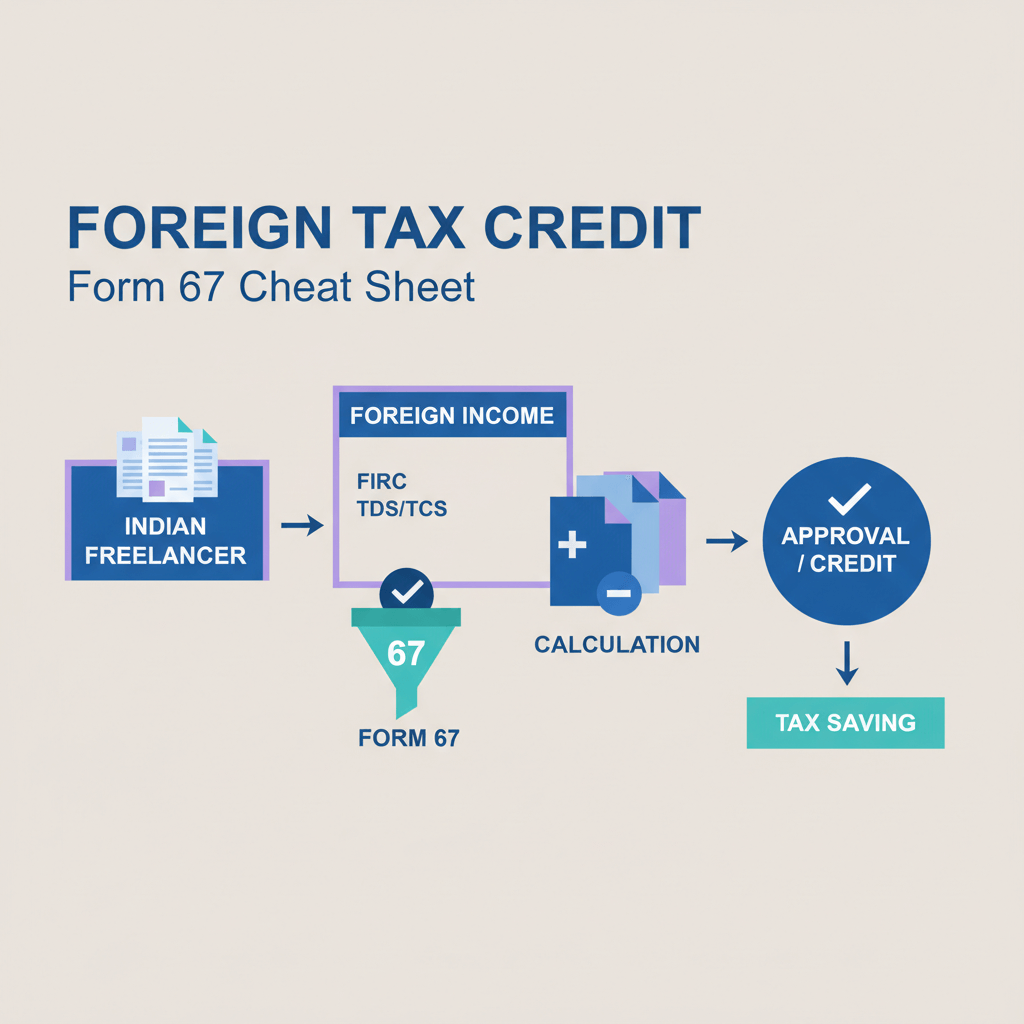
Foreign Tax Credit: Form 67 Cheat Sheet for Indian Freelancers

Content
share on
Contents
Share On

Key takeaways

  • Foreign Tax Credit, FTC, lets Indian residents offset income tax paid abroad against Indian tax on the same income, claimed through Form 67.
  • File Form 67 before or along with your ITR, then mirror the numbers in Schedule FSI and Schedule TR, timing is critical.
  • FTC is only for foreign income tax, not for VAT, GST, social security, penalties, or platform fees.
  • The allowable credit is the lower of foreign tax actually paid, and Indian tax on that same income.
  • Maintain invoices, e-FIRA, foreign tax certificates like 1042-S, and FX conversion proofs for at least six years.

What is the Foreign Tax Credit, FTC, in India?

Foreign tax credit is a mechanism that lets you offset the tax already paid abroad against your Indian income tax on the same income. It exists to prevent double taxation on your overseas earnings, so you keep more of what you earned.

The legal foundation sits in two places. Section 90 applies when India has a Double Taxation Avoidance Agreement, DTAA with the other country, and Section 91 applies when there is no treaty. Rule 128 explains the procedure, including computation and documentation.

Only foreign income tax qualifies. No credit is allowed for penalties, interest, VAT, GST, sales taxes, or social security. For example, US self employment tax does not qualify, only income tax withheld on the same income qualifies.

For additional context, see this concise TaxBuddy explainer on Form 67 and DTAA.

Who can claim Foreign Tax Credit, eligibility?

You must be a resident of India for tax purposes. If you are ordinarily resident and earn professional income from foreign sources, for example Upwork projects, consulting retainers, royalties, or development contracts paid by clients abroad, you are typically eligible, provided the income is taxable in India and tax was also paid abroad on the same income.

You are not eligible if you are non resident for the year, if the income is not taxable in India, if no foreign income tax was actually paid, or if the foreign levy is an indirect tax like VAT.

For a practical walkthrough, review the ClearTax guide to Form 67.

Before you start, determine your tax position

First, confirm residential status. Most freelancers who live and work in India will be resident, based on the 182 day or 60, 120, plus 365 day rules. If you split time between countries, check the latest guidance.

Second, choose the correct return form. Freelancers generally use ITR 3 under Profits and Gains of Business or Profession. ITR 4 under presumptive taxation can complicate FTC, consult your CA before using it.

Third, gather records early. Invoices, foreign tax certificates like US Form 1042 S, bank statements showing credits, and e FIRA for each remittance will anchor your claim.

For more prep tips, see the practical XFlow guide on Form 67.

Step by step, claiming Foreign Tax Credit

Step 1: Gather all required documents

Collect invoices, contracts or statements of work, payment confirmations, and e FIRA. Obtain proof of foreign tax, for example tax certificates, payment challans, or withholding forms like 1042 S. Keep digital and physical copies.

Step 2: Check whether a tax treaty applies

If the client’s country has a treaty with India, Section 90 applies, otherwise Section 91 grants unilateral relief. This choice influences computation and disclosures, confirm with your CA.

Step 3: Compute your Indian taxable income

Aggregate foreign revenue, subtract eligible business expenses like software subscriptions, internet, coworking rent, accounting fees. Convert foreign currency to INR using the RBI reference, TT buying rate under Rule 115, based on your accounting method’s recognition date.

Step 4: Calculate the foreign tax credit

The credit equals the lower of foreign tax paid, and Indian tax on that income. Convert foreign tax to INR using the TT buying rate on the date of deduction or payment, as per Rule 128, then compare with Indian tax on that segment of income.

Step 5: File Form 67 on the income tax e filing portal

You must file Form 67 before or along with your ITR. Enter country wise details, nature of income, foreign tax in foreign currency and INR, and attach supporting certificates. For reference, consult the official Form 67 user manual.

File Form 67 before your ITR, then mirror the same numbers in your return. Treat the deadline as non negotiable.

Step 6: Complete the relevant schedules in your ITR

Report foreign income in Schedule FSI, claim relief in Schedule TR. Ensure the figures match Form 67 exactly. Pay any balance tax, then file ITR within the due date.

Step 7: Keep records safe for at least six years

Store invoices, contracts, payment proofs, e FIRA, foreign tax certificates, FX rate proofs, your Form 67, and ITR acknowledgments for six years, audits can revisit old years.

Worked examples with simple numbers

Example A, DTAA country, USA, Upwork client
Your fee is 5,000 USD, US withholding is 10 percent, 500 USD. At 83 INR per USD, gross is 4,15,000 INR. After 1,15,000 INR expenses, profit is 3,00,000 INR. At a 20 percent slab, Indian tax is 60,000 INR. Foreign tax equals about 41,500 INR. FTC is lower of 41,500 and 60,000, therefore 41,500 INR. Net Indian tax on this income is 18,500 INR.

Example B, no DTAA country
Profit is 1,50,000 INR. Indian tax is 30,000 INR. Foreign tax paid converts to 10,000 INR. FTC is 10,000 INR, you pay 20,000 INR in India.

Example C, zero foreign tax withheld
A UK client pays the full amount after you provide correct forms. No foreign tax means no FTC, you compute Indian tax on full profit.

For broad context, see this primer on tax on foreign income for Indian freelancers.

Deadlines, limits, and practical nuances

  • File Form 67 before filing your ITR for the year, or before a belated ITR. Late filing risks denial of the credit.
  • Excess FTC cannot be carried forward, if foreign tax exceeds Indian tax on that income, the excess lapses.
  • If you later get a foreign tax refund, reduce your Indian FTC and, if needed, revise your return, or pay the difference.

What taxes qualify for FTC, and what does not?

  • Qualifies: Income tax withheld or paid abroad on the same income, in the same period, supported by official certificates.
  • Does not qualify: VAT, GST, sales tax, digital services levies, penalties, interest, social security, or platform fees.

Documentation checklist for freelancers

  • Commercial records: PAN, invoices, contracts, statements of work, bank statements, e FIRA for each remittance.
  • Tax records: Foreign tax certificates, 1042 S where applicable, tax payment proofs abroad, FX screenshots for RBI rates, ledgers of income and expenses.
  • Compliance notes: If you hold any foreign bank accounts or assets, disclose in Schedule FA. Inward remittances alone are not assets, but balances kept abroad are reportable.

Common mistakes to avoid when claiming FTC

  • Filing Form 67 after submitting the ITR.
  • Claiming credit for VAT, GST, or social security contributions.
  • Using the wrong FX rate or the wrong date for conversion, use TT buying rate on the deduction or payment date.
  • Mismatch between Form 67, Schedule FSI, and Schedule TR.
  • Ignoring Section 91 when there is no treaty.
  • Mixing personal expenses with business deductions.

How to reduce foreign withholding upfront, double taxation relief tips

  • Submit tax residency evidence. For US clients or platforms, file W 8BEN and, where needed, share a tax residency certificate and Form 10F, treaty rates can lower or eliminate withholding.
  • Clarify place of services. Many countries tax only locally sourced services. If all work is done from India, clarify this in contracts and invoices after consulting a cross border tax advisor.
  • Prefer payment routes with clean documentation. Platforms that issue formal withholding statements simplify future FTC claims.

How Karbon Business simplifies compliance for freelancers

Karbon Business auto generates e FIRA within 24 hours of every inward remittance, which the tax department accepts as proof for Form 67 and ITR reconciliation. The platform provides virtual USD, GBP, EUR, and CAD accounts, enabling local ACH, FPS, SEPA style receipts that settle in INR within 24 to 48 hours at mid market Xe rates with zero FX markup.

You can hold foreign currency for up to 60 days before conversion, which helps with cash flow, FX planning, and simpler bookkeeping. Clean digital trails, instant statements, and transparent pricing mean your CA gets the exact paperwork they need, exactly when they need it.

For trade enablement context, see this export incentive overview.

Choosing the right tools for cross border payments and compliance

Karbon Business offers multi currency receiving details, fast INR settlement, a flat fee model, and automatic e FIRA for every remittance. Wise Business provides multi currency accounts at competitive transfer costs, though India specific compliance may require extra steps. Payoneer is popular for marketplace earnings, fees and FX vary. PayPal is widely accepted, often with higher fees and less favorable INR conversion. Razorpay X International focuses on inward remittances with India friendly compliance workflows.

Choose based on client geography, volume, and how much you value automated compliance documentation like e FIRA.

Final thoughts, taking control of your tax position

FTC is a legal right, not a loophole. With early preparation, accurate FX conversions, timely Form 67 filing, and precise ITR schedules, claiming relief becomes routine. Start early, maintain impeccable records, and work with a CA who understands cross border freelancing. Every rupee saved from double taxation is a rupee reinvested in your craft.

Disclaimer: This article is for information only, not tax, legal, or financial advice. Rules change, verify the latest provisions with a qualified CA and official circulars before acting.

FAQ

My US client deducted 10 percent tax from my invoice, how do I avoid double taxation in India?

Claim Foreign Tax Credit by filing Form 67 before your ITR, then reflect the same data in Schedule FSI and Schedule TR. Compute the credit as the lower of foreign tax paid and Indian tax on that income. Keep the 1042 S, e FIRA, invoices, and bank credits ready. Platforms like Karbon Business help by giving you e FIRA within 24 hours, which strengthens your documentation.

Is Form 67 mandatory if I earned foreign income but no foreign tax was deducted?

No, Form 67 is required only when you have actually paid foreign income tax and want to claim a credit. If no foreign tax was withheld, simply report the income in ITR 3 or your applicable form, pay Indian tax, and skip Form 67.

What is the deadline to file Form 67, and can I still get FTC if I file a belated return?

File Form 67 before or along with your ITR. For a belated return under Section 139, 4, Form 67 must still be filed before submitting that belated ITR. Best practice, file it early, then complete the ITR with matching numbers.

There is no DTAA with my client’s country, can I still claim FTC under Section 91?

Yes, Section 91 provides unilateral relief even without a treaty. The method remains similar, document foreign tax paid, convert to INR using the TT buying rate on the deduction date, and claim the lower of foreign tax and Indian tax on the same income.

Which foreign exchange rate should I use while filling Form 67 and my ITR schedules?

Use the RBI TT buying rate as per Rule 128 for converting foreign tax on the date it was deducted or paid. For income recognition, use Rule 115, based on the date received or accrued as per your accounting method. Keep screenshots or official references as proof.

Can I claim FTC for PayPal fees, Upwork fees, or platform charges deducted from my payout?

No, commercial fees are not taxes. FTC applies only to foreign income tax. Platform fees reduce your revenue or are deductible business expenses, but they do not count as foreign tax for credit.

If I receive payments through Karbon Business, how does it help with Form 67 and FTC?

Karbon Business issues e FIRA for every inward remittance within 24 hours, which the tax department accepts as proof of foreign receipts. Clear statements, transparent FX, and organized records make it easier to reconcile amounts in Form 67, Schedule FSI, and Schedule TR, reducing queries during processing.

I filed my ITR first and forgot to submit Form 67, can I fix this and still get the credit?

If you filed the ITR without Form 67, the FTC claim can be denied. You should file Form 67 immediately, then file a revised return before the due window closes. Act quickly, attach all proper proofs, and align every figure across Form 67 and your ITR schedules.

My US platform gave me a 1099 instead of 1042 S, can I still claim FTC?

1099 is generally for US persons. Non residents usually receive 1042 S for federal withholding. If you mistakenly received 1099, contact the platform to correct your tax status and issue 1042 S if tax was withheld. For FTC, you need valid proof of foreign income tax. Meanwhile, maintain bank credits, contracts, and e FIRA, for example via Karbon Business, to support the claim.

Do I need to report foreign accounts in Schedule FA if I use a USD or EUR receiving account provided by Karbon Business?

Schedule FA is required if you hold foreign assets or accounts. If the solution provides local receiving details but funds settle in India and you do not maintain a foreign balance beyond permitted timelines, Schedule FA may not apply. If you actually hold money abroad, for example a foreign bank account or wallet balance, you must report it. Consult your CA with your specific setup.

Can I claim FTC if I use presumptive taxation under Section 44ADA or 44AD?

FTC can be claimed with presumptive schemes, however operationally it becomes tricky to attribute Indian tax to the foreign income portion. Many freelancers stick to ITR 3 for clarity when claiming FTC. Discuss the trade offs with your CA before choosing presumptive routes.

How can I reduce foreign withholding upfront, for example with US clients or platforms?

Submit W 8BEN, add your Indian TRC and Form 10F where relevant, and cite treaty provisions so withholding reduces to zero or a lower rate. Structure contracts to clarify services performed from India. Use payment platforms that provide formal documentation and e FIRA, for example Karbon Business, to keep your compliance audit ready.

What documents should I keep ready for any future tax scrutiny of my FTC claim?

Maintain invoices, contracts, bank statements, e FIRA, foreign tax certificates like 1042 S, FX conversion proofs for the exact dates, Form 67 acknowledgment, and ITR with Schedule FSI and TR. Keep these for at least six years, neatly organized and easily retrievable.

Key takeaways

  • Foreign Tax Credit, FTC, lets Indian residents offset income tax paid abroad against Indian tax on the same income, claimed through Form 67.
  • File Form 67 before or along with your ITR, then mirror the numbers in Schedule FSI and Schedule TR, timing is critical.
  • FTC is only for foreign income tax, not for VAT, GST, social security, penalties, or platform fees.
  • The allowable credit is the lower of foreign tax actually paid, and Indian tax on that same income.
  • Maintain invoices, e-FIRA, foreign tax certificates like 1042-S, and FX conversion proofs for at least six years.

What is the Foreign Tax Credit, FTC, in India?

Foreign tax credit is a mechanism that lets you offset the tax already paid abroad against your Indian income tax on the same income. It exists to prevent double taxation on your overseas earnings, so you keep more of what you earned.

The legal foundation sits in two places. Section 90 applies when India has a Double Taxation Avoidance Agreement, DTAA with the other country, and Section 91 applies when there is no treaty. Rule 128 explains the procedure, including computation and documentation.

Only foreign income tax qualifies. No credit is allowed for penalties, interest, VAT, GST, sales taxes, or social security. For example, US self employment tax does not qualify, only income tax withheld on the same income qualifies.

For additional context, see this concise TaxBuddy explainer on Form 67 and DTAA.

Who can claim Foreign Tax Credit, eligibility?

You must be a resident of India for tax purposes. If you are ordinarily resident and earn professional income from foreign sources, for example Upwork projects, consulting retainers, royalties, or development contracts paid by clients abroad, you are typically eligible, provided the income is taxable in India and tax was also paid abroad on the same income.

You are not eligible if you are non resident for the year, if the income is not taxable in India, if no foreign income tax was actually paid, or if the foreign levy is an indirect tax like VAT.

For a practical walkthrough, review the ClearTax guide to Form 67.

Before you start, determine your tax position

First, confirm residential status. Most freelancers who live and work in India will be resident, based on the 182 day or 60, 120, plus 365 day rules. If you split time between countries, check the latest guidance.

Second, choose the correct return form. Freelancers generally use ITR 3 under Profits and Gains of Business or Profession. ITR 4 under presumptive taxation can complicate FTC, consult your CA before using it.

Third, gather records early. Invoices, foreign tax certificates like US Form 1042 S, bank statements showing credits, and e FIRA for each remittance will anchor your claim.

For more prep tips, see the practical XFlow guide on Form 67.

Step by step, claiming Foreign Tax Credit

Step 1: Gather all required documents

Collect invoices, contracts or statements of work, payment confirmations, and e FIRA. Obtain proof of foreign tax, for example tax certificates, payment challans, or withholding forms like 1042 S. Keep digital and physical copies.

Step 2: Check whether a tax treaty applies

If the client’s country has a treaty with India, Section 90 applies, otherwise Section 91 grants unilateral relief. This choice influences computation and disclosures, confirm with your CA.

Step 3: Compute your Indian taxable income

Aggregate foreign revenue, subtract eligible business expenses like software subscriptions, internet, coworking rent, accounting fees. Convert foreign currency to INR using the RBI reference, TT buying rate under Rule 115, based on your accounting method’s recognition date.

Step 4: Calculate the foreign tax credit

The credit equals the lower of foreign tax paid, and Indian tax on that income. Convert foreign tax to INR using the TT buying rate on the date of deduction or payment, as per Rule 128, then compare with Indian tax on that segment of income.

Step 5: File Form 67 on the income tax e filing portal

You must file Form 67 before or along with your ITR. Enter country wise details, nature of income, foreign tax in foreign currency and INR, and attach supporting certificates. For reference, consult the official Form 67 user manual.

File Form 67 before your ITR, then mirror the same numbers in your return. Treat the deadline as non negotiable.

Step 6: Complete the relevant schedules in your ITR

Report foreign income in Schedule FSI, claim relief in Schedule TR. Ensure the figures match Form 67 exactly. Pay any balance tax, then file ITR within the due date.

Step 7: Keep records safe for at least six years

Store invoices, contracts, payment proofs, e FIRA, foreign tax certificates, FX rate proofs, your Form 67, and ITR acknowledgments for six years, audits can revisit old years.

Worked examples with simple numbers

Example A, DTAA country, USA, Upwork client
Your fee is 5,000 USD, US withholding is 10 percent, 500 USD. At 83 INR per USD, gross is 4,15,000 INR. After 1,15,000 INR expenses, profit is 3,00,000 INR. At a 20 percent slab, Indian tax is 60,000 INR. Foreign tax equals about 41,500 INR. FTC is lower of 41,500 and 60,000, therefore 41,500 INR. Net Indian tax on this income is 18,500 INR.

Example B, no DTAA country
Profit is 1,50,000 INR. Indian tax is 30,000 INR. Foreign tax paid converts to 10,000 INR. FTC is 10,000 INR, you pay 20,000 INR in India.

Example C, zero foreign tax withheld
A UK client pays the full amount after you provide correct forms. No foreign tax means no FTC, you compute Indian tax on full profit.

For broad context, see this primer on tax on foreign income for Indian freelancers.

Deadlines, limits, and practical nuances

  • File Form 67 before filing your ITR for the year, or before a belated ITR. Late filing risks denial of the credit.
  • Excess FTC cannot be carried forward, if foreign tax exceeds Indian tax on that income, the excess lapses.
  • If you later get a foreign tax refund, reduce your Indian FTC and, if needed, revise your return, or pay the difference.

What taxes qualify for FTC, and what does not?

  • Qualifies: Income tax withheld or paid abroad on the same income, in the same period, supported by official certificates.
  • Does not qualify: VAT, GST, sales tax, digital services levies, penalties, interest, social security, or platform fees.

Documentation checklist for freelancers

  • Commercial records: PAN, invoices, contracts, statements of work, bank statements, e FIRA for each remittance.
  • Tax records: Foreign tax certificates, 1042 S where applicable, tax payment proofs abroad, FX screenshots for RBI rates, ledgers of income and expenses.
  • Compliance notes: If you hold any foreign bank accounts or assets, disclose in Schedule FA. Inward remittances alone are not assets, but balances kept abroad are reportable.

Common mistakes to avoid when claiming FTC

  • Filing Form 67 after submitting the ITR.
  • Claiming credit for VAT, GST, or social security contributions.
  • Using the wrong FX rate or the wrong date for conversion, use TT buying rate on the deduction or payment date.
  • Mismatch between Form 67, Schedule FSI, and Schedule TR.
  • Ignoring Section 91 when there is no treaty.
  • Mixing personal expenses with business deductions.

How to reduce foreign withholding upfront, double taxation relief tips

  • Submit tax residency evidence. For US clients or platforms, file W 8BEN and, where needed, share a tax residency certificate and Form 10F, treaty rates can lower or eliminate withholding.
  • Clarify place of services. Many countries tax only locally sourced services. If all work is done from India, clarify this in contracts and invoices after consulting a cross border tax advisor.
  • Prefer payment routes with clean documentation. Platforms that issue formal withholding statements simplify future FTC claims.

How Karbon Business simplifies compliance for freelancers

Karbon Business auto generates e FIRA within 24 hours of every inward remittance, which the tax department accepts as proof for Form 67 and ITR reconciliation. The platform provides virtual USD, GBP, EUR, and CAD accounts, enabling local ACH, FPS, SEPA style receipts that settle in INR within 24 to 48 hours at mid market Xe rates with zero FX markup.

You can hold foreign currency for up to 60 days before conversion, which helps with cash flow, FX planning, and simpler bookkeeping. Clean digital trails, instant statements, and transparent pricing mean your CA gets the exact paperwork they need, exactly when they need it.

For trade enablement context, see this export incentive overview.

Choosing the right tools for cross border payments and compliance

Karbon Business offers multi currency receiving details, fast INR settlement, a flat fee model, and automatic e FIRA for every remittance. Wise Business provides multi currency accounts at competitive transfer costs, though India specific compliance may require extra steps. Payoneer is popular for marketplace earnings, fees and FX vary. PayPal is widely accepted, often with higher fees and less favorable INR conversion. Razorpay X International focuses on inward remittances with India friendly compliance workflows.

Choose based on client geography, volume, and how much you value automated compliance documentation like e FIRA.

Final thoughts, taking control of your tax position

FTC is a legal right, not a loophole. With early preparation, accurate FX conversions, timely Form 67 filing, and precise ITR schedules, claiming relief becomes routine. Start early, maintain impeccable records, and work with a CA who understands cross border freelancing. Every rupee saved from double taxation is a rupee reinvested in your craft.

Disclaimer: This article is for information only, not tax, legal, or financial advice. Rules change, verify the latest provisions with a qualified CA and official circulars before acting.

FAQ

My US client deducted 10 percent tax from my invoice, how do I avoid double taxation in India?

Claim Foreign Tax Credit by filing Form 67 before your ITR, then reflect the same data in Schedule FSI and Schedule TR. Compute the credit as the lower of foreign tax paid and Indian tax on that income. Keep the 1042 S, e FIRA, invoices, and bank credits ready. Platforms like Karbon Business help by giving you e FIRA within 24 hours, which strengthens your documentation.

Is Form 67 mandatory if I earned foreign income but no foreign tax was deducted?

No, Form 67 is required only when you have actually paid foreign income tax and want to claim a credit. If no foreign tax was withheld, simply report the income in ITR 3 or your applicable form, pay Indian tax, and skip Form 67.

What is the deadline to file Form 67, and can I still get FTC if I file a belated return?

File Form 67 before or along with your ITR. For a belated return under Section 139, 4, Form 67 must still be filed before submitting that belated ITR. Best practice, file it early, then complete the ITR with matching numbers.

There is no DTAA with my client’s country, can I still claim FTC under Section 91?

Yes, Section 91 provides unilateral relief even without a treaty. The method remains similar, document foreign tax paid, convert to INR using the TT buying rate on the deduction date, and claim the lower of foreign tax and Indian tax on the same income.

Which foreign exchange rate should I use while filling Form 67 and my ITR schedules?

Use the RBI TT buying rate as per Rule 128 for converting foreign tax on the date it was deducted or paid. For income recognition, use Rule 115, based on the date received or accrued as per your accounting method. Keep screenshots or official references as proof.

Can I claim FTC for PayPal fees, Upwork fees, or platform charges deducted from my payout?

No, commercial fees are not taxes. FTC applies only to foreign income tax. Platform fees reduce your revenue or are deductible business expenses, but they do not count as foreign tax for credit.

If I receive payments through Karbon Business, how does it help with Form 67 and FTC?

Karbon Business issues e FIRA for every inward remittance within 24 hours, which the tax department accepts as proof of foreign receipts. Clear statements, transparent FX, and organized records make it easier to reconcile amounts in Form 67, Schedule FSI, and Schedule TR, reducing queries during processing.

I filed my ITR first and forgot to submit Form 67, can I fix this and still get the credit?

If you filed the ITR without Form 67, the FTC claim can be denied. You should file Form 67 immediately, then file a revised return before the due window closes. Act quickly, attach all proper proofs, and align every figure across Form 67 and your ITR schedules.

My US platform gave me a 1099 instead of 1042 S, can I still claim FTC?

1099 is generally for US persons. Non residents usually receive 1042 S for federal withholding. If you mistakenly received 1099, contact the platform to correct your tax status and issue 1042 S if tax was withheld. For FTC, you need valid proof of foreign income tax. Meanwhile, maintain bank credits, contracts, and e FIRA, for example via Karbon Business, to support the claim.

Do I need to report foreign accounts in Schedule FA if I use a USD or EUR receiving account provided by Karbon Business?

Schedule FA is required if you hold foreign assets or accounts. If the solution provides local receiving details but funds settle in India and you do not maintain a foreign balance beyond permitted timelines, Schedule FA may not apply. If you actually hold money abroad, for example a foreign bank account or wallet balance, you must report it. Consult your CA with your specific setup.

Can I claim FTC if I use presumptive taxation under Section 44ADA or 44AD?

FTC can be claimed with presumptive schemes, however operationally it becomes tricky to attribute Indian tax to the foreign income portion. Many freelancers stick to ITR 3 for clarity when claiming FTC. Discuss the trade offs with your CA before choosing presumptive routes.

How can I reduce foreign withholding upfront, for example with US clients or platforms?

Submit W 8BEN, add your Indian TRC and Form 10F where relevant, and cite treaty provisions so withholding reduces to zero or a lower rate. Structure contracts to clarify services performed from India. Use payment platforms that provide formal documentation and e FIRA, for example Karbon Business, to keep your compliance audit ready.

What documents should I keep ready for any future tax scrutiny of my FTC claim?

Maintain invoices, contracts, bank statements, e FIRA, foreign tax certificates like 1042 S, FX conversion proofs for the exact dates, Form 67 acknowledgment, and ITR with Schedule FSI and TR. Keep these for at least six years, neatly organized and easily retrievable.

The views expressed in the blogs on this page are solely the opinions of the authors and do not constitute expert advice. While we strive to provide accurate and up-to-date information, we make no representations or warranties of any kind, express or implied, about the completeness, accuracy, reliability, suitability or availability with respect to the website or the information, products, services, or related graphics contained on the website for any purpose. Any reliance you place on such information is therefore strictly at your own risk. We disclaim any liability for any loss or damage including without limitation, indirect or consequential loss or damage, or any loss or damage whatsoever arising from loss of data or profits arising out of, or in connection with, the use of this website.

Find out how we can help you today!

Speak to our foreign payment specialist
Whatsapp-color Created with Sketch.
Whatsapp:
+91 74117 02726
Email:
sales@karboncard.com
Address:
Ground Floor, Karbon Business, 1st Stage Rd, Binnamangala, Hoysala Nagar, Indiranagar, Bengaluru, Karnataka 560038

Find out how we can help you today!

Speak to our foreign payment specialist
Whatsapp-color Created with Sketch.
Whatsapp:
+91 74117 02726
Email:
sales@karboncard.com
Address:
Ground Floor, Karbon Business, 1st Stage Rd, Binnamangala, Hoysala Nagar, Indiranagar, Bengaluru, Karnataka 560038

Latest from our blogs

Latest from our blogs

View All
× Save 50% - Start Now