



Key takeaways
- Most SWIFT delays come from incorrect beneficiary details, intermediary routing issues, or compliance holds, each has a specific, fast fix if you know who to contact and what to send.
- Use UETR tracking to pinpoint the exact bank holding your funds, then act with targeted documents and escalation.
- Insist on OUR charges so intermediary banks do not shave fees off your credit, this also keeps your e-FIRA aligned with your invoice.
- Cut off times, weekends, public holidays, and batch processing routinely add 1 to 2 business days, plan transfers early in the week and day.
- Prepare a compliance pack, invoice, contract, PAN, client details, purpose code P0802, and submit proactively for first time or large payments.
- Consider local rails via virtual accounts as a default, ACH, SEPA, FPS, to bypass SWIFT entirely for recurring clients.
- Platforms like Karbon Business provide local collection accounts, fast INR settlement, automatic e-FIRA, and mid-market FX with zero markup.
Quick Primer: How a SWIFT payment actually moves
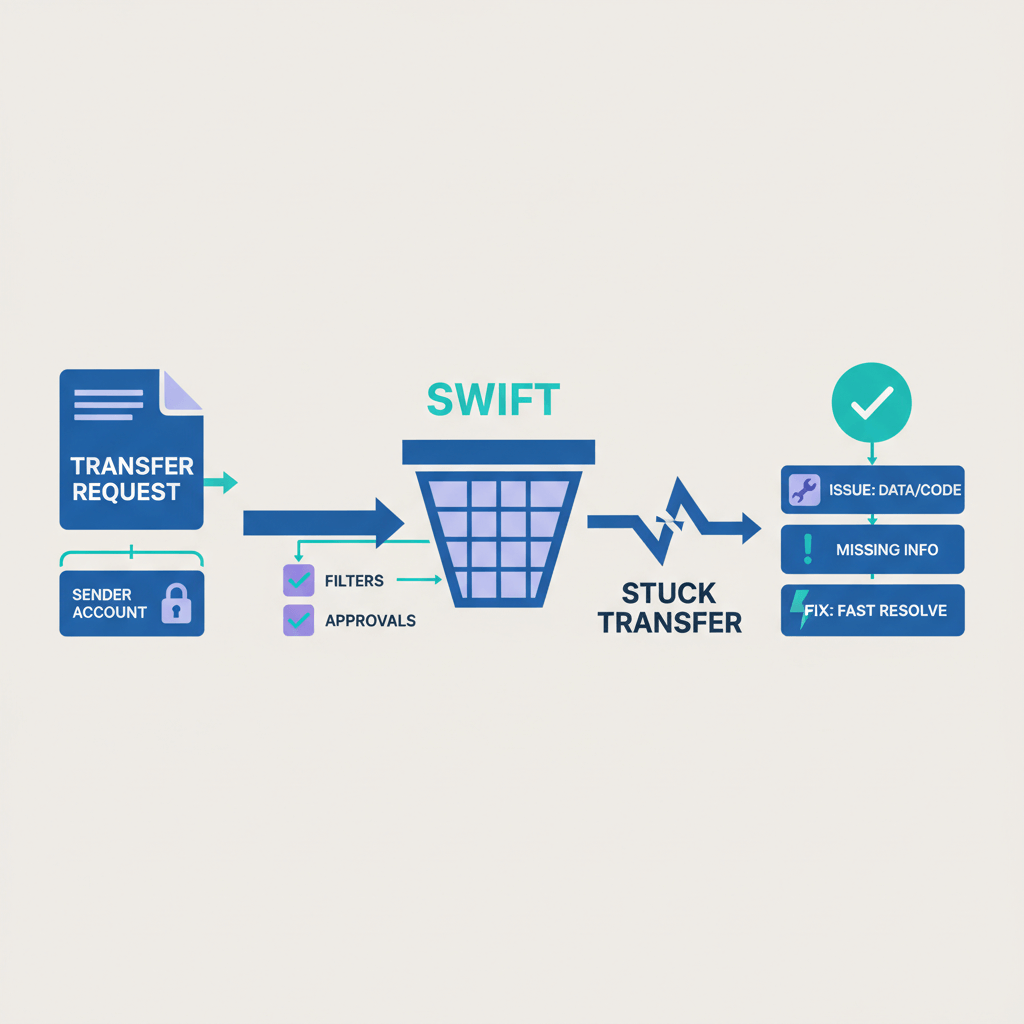
SWIFT is a secure messaging network, not the money rails. Think of it like WhatsApp for banks, the actual funds move through correspondent banks while instructions travel via an MT103 message. Sender banks, intermediary banks, and your beneficiary bank each touch the payment, every hop can add time and friction.
Small errors snowball: a name mismatch, a wrong SWIFT or BIC, or misconfigured routing fields 56A and 57A can detour or bounce the transfer. Charges settings matter too, OUR means you get the full amount, while SHA or BEN can lead to short credits.
Assuming smooth processing, typical timelines are three to five business days, but cut off times, weekends, and public holidays across countries extend that window, as explained in this overview of a SWIFT wire transfer.
The core question: Why SWIFT transfers get stuck and how to fix
Incorrect beneficiary details
Symptoms: UETR shows rejected or returned, no credit after three days. Your bank may or may not notify you.
Who to contact: The sender’s bank must issue an amendment or recall.
Documents needed: Bank statement or cancelled cheque with your exact registered name, account number, SWIFT or BIC, IFSC. Screenshots from your bank app help.
Resolution time: One to three days if caught early, longer if funds already bounced. More on timelines in this guide to a SWIFT wire transfer.
Intermediary bank routing problems
Symptoms: UETR stays “in transit” at one hop for days, your bank has no record because it has not arrived.
Who to contact: The sender’s bank must liaise with the intermediary that owns the route.
Documents needed: MT103 showing fields 56A and 57A for routing clarity.
Resolution time: Two to four days, or avoid entirely by using direct corridors. See options in freelancer payment methods in India for overseas clientele.
Compliance hold
Banks screen for AML, sanctions, and source of funds. First time clients or large amounts face extra checks.
Symptoms: Status reads pending compliance or on hold, remittance desk asks for documents.
Who to contact: Your beneficiary bank’s inward remittance or forex desk.
Documents needed:
- Invoice, matching amount and services
- Contract or SOW, proof of relationship
- PAN card
- Client’s company details and website
- Correct purpose code, typically P0802
Resolution time: One to five days after submission. Practical tips here: how to receive international payments in India.
Cut off times, weekends, and batch processing
Symptoms: Pending with no hop progress, no specific error.
Who to contact: Sender and beneficiary banks to confirm operational queues.
Documents needed: None, it is a waiting game.
Resolution time: One to two business days once windows reopen. Plan around cut offs, as covered in freelancer payment methods in India for overseas clientele.
Charges setting, BEN or SHA leading to short credits
Symptoms: You are credited less than invoiced, UETR shows success but amount is lower.
Who to contact: Beneficiary bank for a fee trail, intermediaries often deduct en route.
Documents needed: MT103 field 71A proves the charges instruction.
Resolution time: Recovery is rare, prevention is key by mandating OUR, see this explainer on a SWIFT wire transfer.
Currency conversion hops or large amount triggers
Symptoms: Extended processing at an intermediary handling FX or extra scrutiny for high value, first time flows.
Who to contact: Intermediary or your bank’s forex desk.
Documents needed: Invoice and basic KYC.
Resolution time: Two to three days, see how to receive international payments in India.
Bank outages or manual processing queues
Symptoms: UETR stalled for days without updates.
Who to contact: All banks in the chain, escalate with references.
Documents needed: UETR and MT103.
Resolution time: One to three days once systems recover. More operational nuance in freelancer payment methods in India for overseas clientele.
Decoding statuses: what “swift transfer pending” means
In transit means the payment is moving between banks, if it lingers beyond 48 hours at one hop, suspect routing. Processing can indicate FX or compliance checks. On hold signals a specific blocker, usually compliance. Always pair the status with location via UETR, as explained in this SWIFT wire transfer overview.
Pending at the sender suggests funds are not released, pending at an intermediary points to a correspondent snag, pending at your beneficiary bank is usually local compliance or FX. Track and act accordingly.
UETR tracking: the fastest way to locate the hold
UETR is your end to end tracking ID for SWIFT gpi payments, like a courier tracking number for your money. Each bank updates the status against the same UETR.
How to get it: Ask your client for the UETR and MT103 confirmation as soon as they send the payment.
How to track: Use your bank’s UETR tracker, the public gpi portal, or call the forex desk with the code. If self service is unavailable, email your relationship manager.
Key statuses: Sent, Received, Credited, On hold. If an intermediary shows on hold, the sender’s bank or the intermediary must resolve. If your bank shows on hold, submit documents immediately. More tracking context here: SWIFT wire transfer.
Step by step resolution playbook
Step 1: Ask your client for the UETR and MT103, check field 50K, 59, 56A, 57A, 71A. See this checklist in wire transfer from USA to India.
Step 2: Verify exact beneficiary details and ensure OUR charges were selected.
Step 3: Track the UETR to identify which bank currently holds the payment.
Step 4: If held at your bank, submit invoice, contract, PAN, client details, services description, and purpose code P0802, and request e-FIRA on credit, as outlined in how to receive international payments in India.
Step 5: If held at an intermediary, have the sender’s bank contact that intermediary with the UETR and MT103, update routing if needed.
Step 6: If beneficiary details are wrong, ask the sender’s bank to issue a swift amendment or recall, earlier is cheaper and faster, more detail in wire transfer from USA to India.
Step 7: Escalate by timeline: day 3 check in, day 5 escalate both sides, day 7 formal complaint and involve the intermediary if UETR shows the hold. Additional escalation tips in freelancer payment methods in India for overseas clientele.
Email subject lines you can copy:
Payment Pending – Need UETR and MT103
SWIFT Payment on Hold – UETR [ID]
Compliance Documents for Inward Remittance – UETR [ID]
Prevention checklist for freelancers
- Share exact beneficiary details with a bank generated PDF or screenshot to avoid typos, see the prep list in wire transfer from USA to India.
- Mandate OUR charges on invoices and contracts, explained in this SWIFT wire transfer guide.
- Include remittance info like invoice number and purpose code P0802 in payment instructions, per how to receive international payments in India.
- Pre-send a compliance pack for first time or large payments to your bank’s remittance desk.
- Prefer local rails via virtual accounts for ACH, SEPA, FPS as outlined in freelancer payment methods in India for overseas clientele.
- Request UETR on day one and track daily.
- Escalate early if pending persists beyond three to five business days, guidance in freelancer payment methods in India for overseas clientele.
India specific context and compliance
RBI and FEMA rules require a clear remittance purpose and documentation, wrong purpose codes or vague descriptions trigger holds. A concise refresher on flows, fees, and codes is here: SWIFT wire transfer.
Your bank must issue an e-FIRA after credit, critical for GST and taxes, see the compliance checklist in how to receive international payments in India. Intermediary fee deductions complicate e-FIRA reconciliation, another reason to insist on OUR.
First time payments from new countries or large amounts face enhanced due diligence, plan for up to a week and send complete documents upfront. Purpose codes matter, most freelancers use P0802, verify with your bank, more examples in the SWIFT wire transfer explainer.
Alternatives to reduce SWIFT friction
Local rails like ACH, SEPA, and FPS eliminate intermediaries and settle faster. Virtual account providers give you local details without opening foreign bank accounts, an approach discussed in freelancer payment methods in India for overseas clientele and how to receive international payments in India. Payment links work well for smaller tickets, see how to receive international payments as a freelancer.
Popular options Indian freelancers use include:
- Karbon Business offers USD, GBP, EUR, and CAD local details, 24 to 48 hour INR settlement, automatic e-FIRA within 24 hours, flat 1% platform fee, zero FX markup at mid-market rates, and currency holding up to 60 days. RBI and FEMA compliant, ISO/IEC 27001:2022 certified.
- Wise Business, multi-currency accounts with local rails, mid-market FX, transparent percentage fees.
- Payoneer, virtual accounts for US, EU, UK, marketplace integrations, corridor based fees and conversion spreads.
- PayPal, easy but comparatively expensive for cross-border, with potential holds.
- RazorpayX International, local settlement and links depending on corridor.
- Others like Tazapay, OFX, WorldFirst, Revolut Business, each with different fees and features.
The key idea: SWIFT is a tool, not the only one. For recurring clients, local rails save days of waiting and reduce fees, as illustrated in how to receive international payments as a freelancer.
How Karbon Business helps
Karbon Business lets your clients pay locally, ACH in the US, FPS in the UK, SEPA in Europe, bypassing SWIFT’s intermediaries, fees, and routing issues. You claim funds and receive INR in 24 to 48 hours, e-FIRA arrives within 24 hours, FX uses the mid-market Xe.com rate with zero markup, and pricing is a simple 1% platform fee.
You can hold currency up to 60 days to time conversions, all under RBI and FEMA rules, with ISO/IEC 27001:2022 security. Support replies fast, and if a client insists on SWIFT, the team helps you track UETR and coordinate with banks, a practical extension of the playbook described in freelancer payment methods in India for overseas clientele.
Glossary of terms
Intermediary bank: A correspondent that routes payments when sender and beneficiary banks lack a direct link, more context in wire transfer from USA to India.
UETR: The end to end tracking ID for gpi payments, see SWIFT wire transfer.
MT103: The standard SWIFT payment message with fields for sender, beneficiary, routing, and charges, overview in SWIFT wire transfer.
OUR, SHA, BEN: Fee allocation instructions, explained in the SWIFT wire transfer guide.
Compliance hold: Temporary freeze while AML and KYC checks complete, background in SWIFT wire transfer.
SWIFT gpi: Enhanced SWIFT with faster processing and UETR tracking, outlined in SWIFT wire transfer.
e-FIRA: Bank certificate confirming receipt of foreign funds, crucial for taxes, more in how to receive international payments in India.
Purpose code: RBI code that categorizes the inbound payment, P0802 is common for services.
ACH, SEPA, FPS: US, EU, and UK local transfer systems that settle faster than SWIFT for domestic style payments.
Next steps: your action plan
- Save this guide, next time a payment lags you have the playbook and templates ready.
- Set up local currency accounts, evaluate Karbon Business and similar platforms for ACH, SEPA, FPS collection.
- Update invoices and contracts to mandate OUR charges and request UETR on payment.
- Prepare a compliance pack template, invoice, contract or SOW, PAN, service description.
- Contact your bank within three business days of a pending status with UETR and MT103.
- Keep a simple payment log to spot corridor and bank patterns, then optimize.
Your invoices represent your hard work. With UETR tracking, clear documentation, and smarter rails, you can make on time, full value payments the default rather than the exception.
FAQ
My SWIFT transfer to India is showing “swift transfer pending” for 5 days, as a freelancer what should I do first?
Ask your client for the UETR and MT103, verify your exact beneficiary name, account number, and SWIFT or BIC, ensure charges are OUR, then track the UETR to identify which bank is holding it. If your beneficiary bank is on hold, email invoice, contract, PAN, client details, and purpose code P0802 to the inward remittance desk. If an intermediary is holding it, have the sender’s bank push the route. If you face this repeatedly, consider collecting via ACH or SEPA using a platform like Karbon Business to bypass SWIFT.
How much time does it usually take for a SWIFT payment from the US to credit my Indian bank account?
Three to five business days is typical if details and routing are correct and there are no holidays or cut off issues. If it crosses five business days, escalate with UETR tracking. For faster and more predictable timelines, many Indian freelancers collect via ACH into a USD account on Karbon Business, then receive INR in 24 to 48 hours.
Which purpose code should I use for freelance services, software, design, or consulting in India?
Most service freelancers use P0802, “Other business services.” Some marketing services may use P0803. Always ensure the purpose matches the actual service, mismatches can trigger compliance holds. When in doubt, confirm with your bank’s remittance desk before funds arrive.
Why did I receive less money than my invoice after a SWIFT transfer, and how do I stop these deductions?
Likely the sender chose SHA or BEN charges, letting intermediaries deduct routing fees. You can request a fee trail from your bank, but recovery is rare. Prevent this by mandating OUR charges in your invoice and contract so you receive the full amount. Platforms like Karbon Business also avoid intermediary deductions by using local rails instead of SWIFT.
What is UETR and how do I track my international payment with it in India?
UETR is a unique end to end tracking ID for SWIFT gpi payments. Ask your client for it when they send the transfer, then use your bank’s UETR tracker or call the forex desk to see each hop. If any hop shows “on hold,” that bank needs documents or routing action. If your bank is the holder, submit invoice, contract, PAN, client details, and a brief description of services.
My client’s bank says the payment is with an intermediary bank, how can I get it released faster?
Share the UETR and MT103 with your client, fields 56A and 57A reveal routing. The sender’s bank must contact the intermediary to release or re route. Ask for a direct corridor if available. Meanwhile, you can inform your bank so they watch for the incoming credit.
Do Indian banks ask for documents for every SWIFT receipt, or only sometimes?
It depends on your profile and history. First time, high value, or unusual pattern payments often trigger compliance. Keep a ready pack with invoice, contract or SOW, PAN, client’s website, and a short service description. Submitting proactively can reduce delays by days. Some freelancers maintain a client wise folder and notify the bank before funds arrive.
How do I get e-FIRA for my foreign receipt, and why does it not match my invoice sometimes?
Your bank issues e-FIRA shortly after credit, request it from the remittance or forex desk, or download if your bank supports self service. If intermediaries deducted fees due to SHA or BEN, the e-FIRA will reflect a lower amount than your invoice, complicating GST and accounts. This is why OUR charges are essential, or collect via local rails through Karbon Business to avoid such deductions.
Is it better to accept payments via PayPal or SWIFT or a platform like Karbon Business for B2B clients?
For high value B2B invoices, PayPal can be expensive due to percentage fees and FX spread, SWIFT can be slow and opaque, while local rails via platforms like Karbon Business use ACH, SEPA, FPS for speed, transparency, automatic e-FIRA, and mid-market FX. Choose based on client location, invoice size, and urgency.
Can I avoid SWIFT altogether when most of my clients are in the US and UK?
Yes, set up local USD and GBP account details via a virtual account provider. Your clients pay you via ACH or FPS domestically, funds reach your INR account in 24 to 48 hours after you claim them. This approach, offered by Karbon Business, reduces delays, fees, and compliance friction compared to multi hop SWIFT transfers.
What should I write in my invoice to prevent SWIFT payment issues from international clients?
Add “All bank charges to be borne by sender (OUR)” and request the UETR after payment. Include your exact bank registered name, account number, IFSC, SWIFT or BIC, and ask the client to include the invoice number and purpose code P0802 in the payment memo. Share a bank generated PDF or screenshot of your account details to avoid typos.
How do I escalate if my bank support is slow, any template I can use?
Email the inward remittance desk with the subject “Compliance Documents for Inward Remittance – UETR [ID]” and attach invoice, contract, PAN, and client details, plus a short services note. For intermediary holds, have your client email their bank “SWIFT Payment on Hold – UETR [ID]” asking to confirm routing and release. If unresolved by day seven, file a formal complaint with both banks and include UETR and MT103 references.
