

Key takeaways
- A forward contract locks today’s exchange rate for a future export receipt, it protects your margins from USD, GBP, or EUR swings against INR.
- Use forwards when margins are thin, cash cycles are long, or pricing cannot be changed easily, partial and layered hedging keeps flexibility.
- Booking is simple, estimate exposure, share documents, get bank quotes, confirm, then settle when funds arrive.
- Total cost includes the natural forward premium or discount, the bank’s spread, and any modification charges for early delivery, extension, or cancellation.
- Match tenor to your actual Days Sales Outstanding, option dated forwards add a flexible window when payment timing is uncertain.
- Stay compliant with RBI rules, hedge only genuine export exposures, maintain e-FIRA, invoices, shipping bills, and confirmations together.
- For short cycles, holding currency up to 60 days with platforms that offer zero FX markup can complement forwards and reduce costs.
What is a forward contract? Understanding the basics
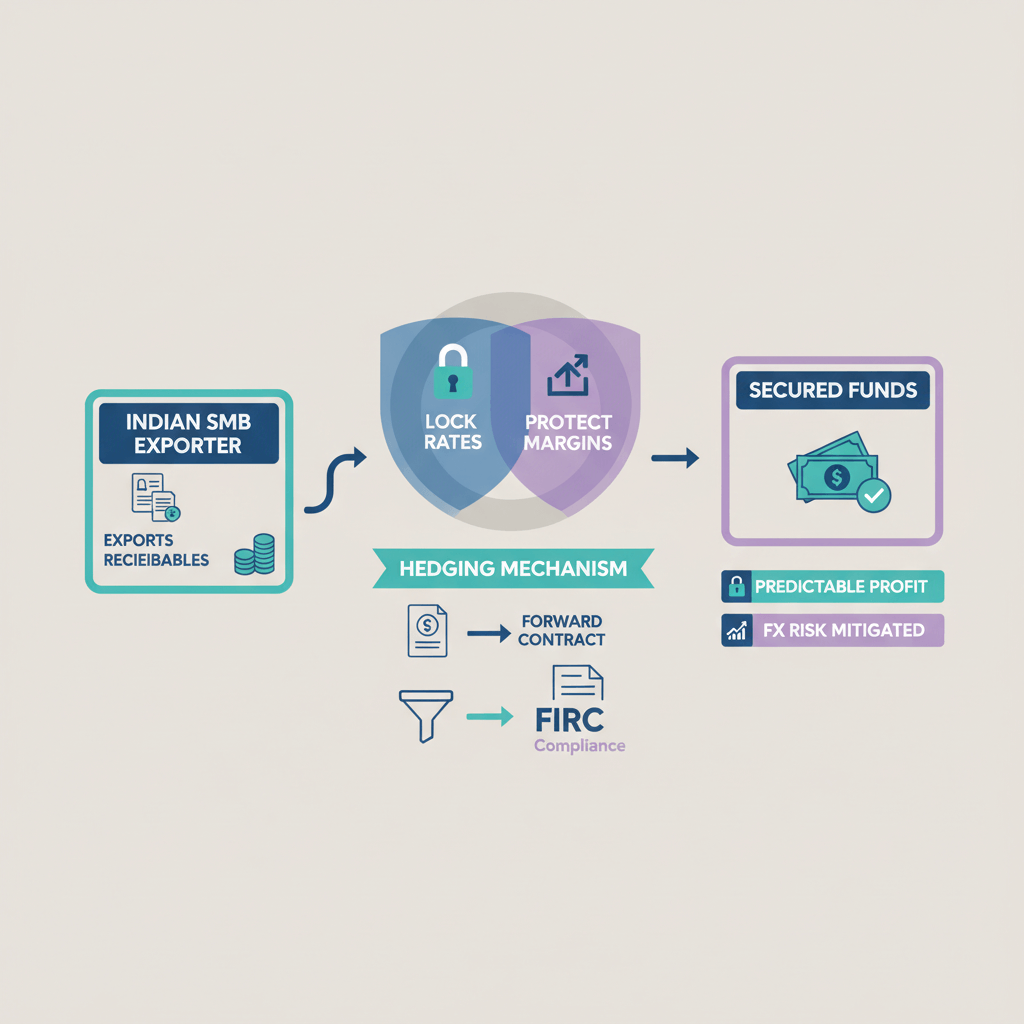
A forward contract is a simple agreement with your bank to exchange a fixed amount of foreign currency for rupees on a future date at a rate you lock today. It is a price guarantee, not a bet, and it is designed to protect confirmed export receivables from currency moves.
Imagine an apparel exporter in Ludhiana with a confirmed GBP 40,000 invoice due in three months. Spot GBPINR is 105.50, the bank quotes a three month forward at 106.25. You now know you will receive about INR 42.5 lakh, regardless of market swings. That certainty is what a forward delivers.
Remember: The rate you lock equals spot plus or minus the forward premium or discount, which primarily reflects interest rate differentials between India and the foreign currency’s country.
How a forward contract works for Indian exporters
Forwards in India must cover genuine export exposures, purchase orders, invoices, or shipments. Tenors typically range from a few weeks to 12 months. You can hedge fully or partially, via two common structures.
- Fixed date forward: Settlement on a specific date.
- Option dated forward: A settlement window, for example day 80 to day 100, helpful when client payment dates vary.
If a client pays early, you can request early delivery. If they delay, you can extend or roll the contract through a swap. At maturity, the bank nets incoming USD or GBP against the booked forward, then credits your INR account at the locked rate.
Who should hedge their foreign exchange risk?
Hedge proactively if your net margin is smaller than typical 60 to 120 day FX volatility, if your clients resist price changes, if your cash cycle is long, or you lack a natural hedge from foreign currency expenses. A 2 to 3 percent currency move can erase a large chunk of an 8 percent margin.
Hedge lightly, or use alternatives if you invoice in INR, if you have meaningful USD or EUR costs that offset receipts, if payment cycles are short, or if you can hold currency briefly and wait for better rates.
- Laddering example: Hedge 40 percent at order win, 30 percent at shipment, keep 30 percent open.
- Profit protection: Hedge only the margin portion, leave cost recovery unhedged.
- Netting: If you have imports in USD, hedge only exports minus imports.
How to book a forward contract, step by step
Step one, estimate your exposure. Identify currency, amount, expected payment date, and the worst case INR if you do not hedge, so you can compare with a forward rate.
Step two, gather documents, purchase order, commercial invoice, shipping documents if available, and KYC. Ensure the bank has set a basic FX or derivative line for you.
Step three, contact your bank’s treasury desk, specify tenor, amount, and fixed date or date range for an option dated forward.
Step four, compare quotes across banks. Spreads vary, even 10 to 20 paise per dollar becomes meaningful on USD 50,000.
Step five, confirm the deal, the bank emails a confirmation slip, store it carefully.
Step six, track the payment timeline, notify the bank early if payment is ahead or behind schedule, so they can arrange early delivery, extension, or rollover.
Step seven, settle on receipt, the bank nets the currency, credits INR at the booked rate.
Tip: If payment timing is uncertain, an option dated forward costs slightly more, yet it can save you higher rollover charges later.
Understanding the costs of forward contracts for SMB exporters
- Forward premium or discount: Driven by interest differentials, this is not a fee, it is part of the mathematical forward rate.
- Bank margin or spread: Often 5 to 25 paise per unit, wider for smaller tickets or weaker relationships.
- Modification costs: Early delivery, extension, rollover, or cancellation can add costs, especially if market rates have moved against your contract.
- Possible upfront margin: Some banks ask smaller firms for a cash margin or limit holdback.
Illustration: Expected USD 50,000 in three months, spot 83.00, forward premium 0.80, bank margin 0.20, all in forward equals 83.60. You lock INR 41.8 lakh. If the order cancels and spot is 82.20, you pay the roughly 1.40 per dollar difference plus fees. Two week delays usually mean a small swap cost, often 10 to 20 paise per dollar.
Watch out for hidden thresholds, some banks have minimums like USD 25,000. Frequent cancellations can reduce future limits. Missing document deadlines can force premature closures at poor rates.
Compliance and documentation requirements
RBI allows forwards strictly for genuine exposures. Every contract must be backed by purchase orders, invoices, or shipping bills. You must book via an Authorized Dealer Category I bank, and banks report utilization and cancellations to RBI.
Hedging limits for SMBs often tie to existing credit lines. Larger exporters may have board approved policies and separate limits, yet most smaller firms operate within their primary bank relationship.
On accounting, AS 11 or Ind AS 109 can apply. End of period mark to market may be needed, realized gains or losses on settlement are business income or expense. Consult your CA for correct recognition.
Each export remittance should carry an e-FIRA, essential for GST refunds, incentives, and tax records. Platforms like Karbon Business generate e-FIRA within 24 hours of payment, which reduces compliance workload.
Practical playbooks for SMB exporters
- Layered hedging: Hedge 30 to 50 percent at PO, 20 to 30 percent at shipment, keep a buffer for upside or to match USD costs.
- Tenor matching: Align maturity with actual DSO, if your average is 75 days, avoid 120 day forwards unless justified.
- Netting exposure: Hedge exports minus imports, lower notional saves cost and tracking effort.
- Budget rate discipline: Set a conservative annual rate, hedge portions whenever market or forward rates meet or exceed it.
- Simple governance: Define who can book, approval thresholds, and maintain a weekly exposure tracker with open invoices and booked forwards.
Alternatives and complements to forward contracts
Short term currency holding: When cycles are under 60 days, receive and hold USD, GBP, EUR, or CAD, then convert within the window. Platforms like Karbon Business allow holding up to 60 days with zero forex markup on mid market rates, which is powerful for frequent small invoices.
Invoicing adjustments: Negotiate shorter terms, ask partial advances, or add a modest currency fluctuation clause with long term clients.
Currency options: Pay an upfront premium for the right, not the obligation, to exchange at a set rate. Useful if you want downside protection without surrendering upside, though cost and complexity make options less common for SMBs.
Faster collections: Better invoicing, proactive follow ups, and early payment discounts reduce exposure time and lower risk.
Combine tools smartly, for example, hedge 50 percent to lock a floor, hold the rest for up to 30 to 60 days to seek better conversion, then tighten terms on the next order.
Common mistakes to avoid when using forward contracts
- Over hedging: Booking more than the real exposure turns hedging into speculation, risks losses and regulatory issues.
- Locking 100 percent too far ahead on a fixed date: You lose flexibility, and any shift in payment date triggers costs.
- Ignoring spreads: Not comparing bank quotes can cost tens of thousands of rupees on mid sized tickets.
- Missing documentation: Late or incomplete paperwork can force closures at spot.
- Tenor mismatch: Use realistic DSO data, not optimistic expectations.
Quick checklist before you book your next forward
- Define exposure, currency, amount, expected date, confirm client commitment.
- Set a hedge ratio and budget rate that protects your margin.
- Pick the right tenor, consider an option dated window if timing is uncertain.
- Get at least two bank quotes, compare all in rates including spreads.
- File invoice, shipping bill, and deal confirmation together, update your tracker.
- After settlement, review P and L impact and refine your playbook.
Bringing it all together, when and how to use forward contracts
A forward contract for SMB exporters in India is a practical tool to turn volatile receivables into predictable INR cash flows. It is most valuable when margins are thin, payment cycles are long, and you cannot easily pass currency moves to clients.
Adopt a disciplined, numbers first approach, quantify exposure, choose partial and layered hedges, match tenor to actual realization, and use option dated forwards when timing is fuzzy. Negotiate bank spreads, keep documentation tight, and pair forwards with better invoicing terms, faster collections, and short term currency holding where it fits.
Platforms like Karbon Business can streamline the operational side of cross border payments, with multi currency virtual accounts, mid market conversions with zero FX markup and a transparent platform fee, e-FIRA within 24 hours, and the ability to hold foreign currency up to 60 days. These capabilities complement a forward strategy, giving you speed, compliance, and flexibility.
Do not let currency volatility erase hard won margins. Use forwards intelligently, keep governance simple, and build a repeatable system that protects your profits while you focus on growth.
FAQ
How do freelancers in India receive USD payments without high forex cuts?
You can use a platform that offers mid market conversions with zero FX markup and a transparent platform fee, for example Karbon Business credits INR at the true rate and shows a flat platform charge, which reduces the effective cut versus typical bank spreads.
Is it better to hold dollars for a few weeks or convert immediately?
If your cash flow allows and the window is under 60 days, holding in a multi currency account gives you flexibility to convert on better days. Karbon Business lets you hold USD, GBP, EUR, and CAD up to 60 days, which is useful for freelancers and small exporters who invoice frequently.
What is the difference between booking a forward and just waiting for a good rate?
A forward locks a guaranteed INR rate today for a future payment, while waiting keeps you fully exposed to market moves. For thin margins or larger invoices, many freelancers and SMBs lock a portion via forward, then keep a portion open or held for short periods.
Forward contract ka minimum kitna hota hai for small invoices?
Minimums depend on the bank, many start around USD 10,000 to 25,000. If your tickets are smaller, consider partial hedging at the invoice batch level, or use short term holding with Karbon Business instead of a formal forward.
Client ne payment delay kar diya, forward ka kya karein?
Immediately call the bank’s treasury desk, request a rollover or extension. Costs are manageable when handled early. Maintaining an option dated forward in the first place helps avoid such charges if payment dates are uncertain.
What documents are required to stay compliant for international payments?
Keep purchase orders, invoices, shipping bills, forward confirmations, and e-FIRA for each inward remittance. Karbon Business auto generates e-FIRA within 24 hours, which helps with GST refunds and tax filings.
Bank rates are varying a lot, how do I ensure I am not overpaying on conversion?
Ask for the all in rate, compare at least two quotes, and check the difference from mid market. Platforms like Karbon Business use mid market rates with zero FX markup, so you only see a clear platform fee.
Can a freelancer hedge small project invoices, ya sirf big exporters karte hain?
Banks usually prefer forwards from registered exporters with documentary proof and minimum sizes. Freelancers with small tickets can combine invoices to meet thresholds, or use short term currency holding on Karbon Business as a simpler alternative.
USD me payment aaya, kya main thoda INR me convert karu aur baaki hold karu?
Yes, a split approach works well, convert enough to meet INR expenses, hold the rest for up to 30 to 60 days if your platform allows, Karbon Business supports this, giving you tactical flexibility without committing to a forward.
Forward book karne ka cost kaise calculate karu, aur kya yeh worth hota hai?
Total cost equals forward premium or discount plus the bank’s spread plus any modification fees. If expected adverse moves are bigger than the cost, it is worth it. Example, if you risk a 2 percent move and hedging costs about 0.5 percent, hedging protects your margin effectively.
Paypal ya marketplace se payout aata hai, kya mujhe e-FIRA milega automatically?
It depends on the provider and the banking partner. With Karbon Business, every inward remittance gets an e-FIRA automatically, which simplifies compliance for freelancers and agencies serving overseas clients.
Client GBP me pay karta hai, mujhe INR ki planning kaise karni chahiye?
Estimate your payable dates and INR needs, hedge a portion via forward if the cycle is long, keep some GBP held for up to 60 days if you have flexibility, and convert in tranches. This blended approach balances certainty and potential upside.