Business

Treasury ops: The 10-Minute FX Exposure Tracker for SMBs

Content
share on
Contents
Share On

Key takeaways

  • A lightweight FX exposure report helps Indian SMBs and freelancers see receivables, payables, and timing gaps clearly, so currency swings do not surprise your margins.
  • Natural hedging, by matching foreign currency receivables with payables in the same currency and time window, cuts conversion costs and reduces risk.
  • A simple template with aging buckets, probability weighting, and scenario analysis can be updated in about 10 minutes each week.
  • Scenario planning shows the rupee impact of + or − moves before they hit your bank balance, which improves decision making.
  • Keeping e-FIRA, invoices, and reconciliation files organized makes RBI and FEMA compliance painless while you manage FX exposure.

What FX exposure actually means for small businesses

FX exposure is the risk that currency movements change the rupee value of your foreign transactions. For most SMBs, the most important piece is transaction exposure, the cash flows you can point to on your invoice tracker and bill schedule. The window between invoicing, getting paid, and converting to INR is where gains or losses appear.

Indian export oriented SMBs often face amplified risks when collection delays stretch, because timing uncertainty widens the risk window. There is also a compliance layer in India, every inward remittance needs an e-FIRA for audit and tax filing. So an FX exposure report protects both your margin and your paperwork.

You do not need a treasury desk, you need a consistent way to see what you are owed, what you owe, and when the money moves.

Inside the FX exposure template, what you get

The free template is an Excel or Google Sheets file designed for real world use by one person wearing many hats. You paste data in, the sheet does the rest.

  • Data Import: Paste open invoices and bills, no integrations required.
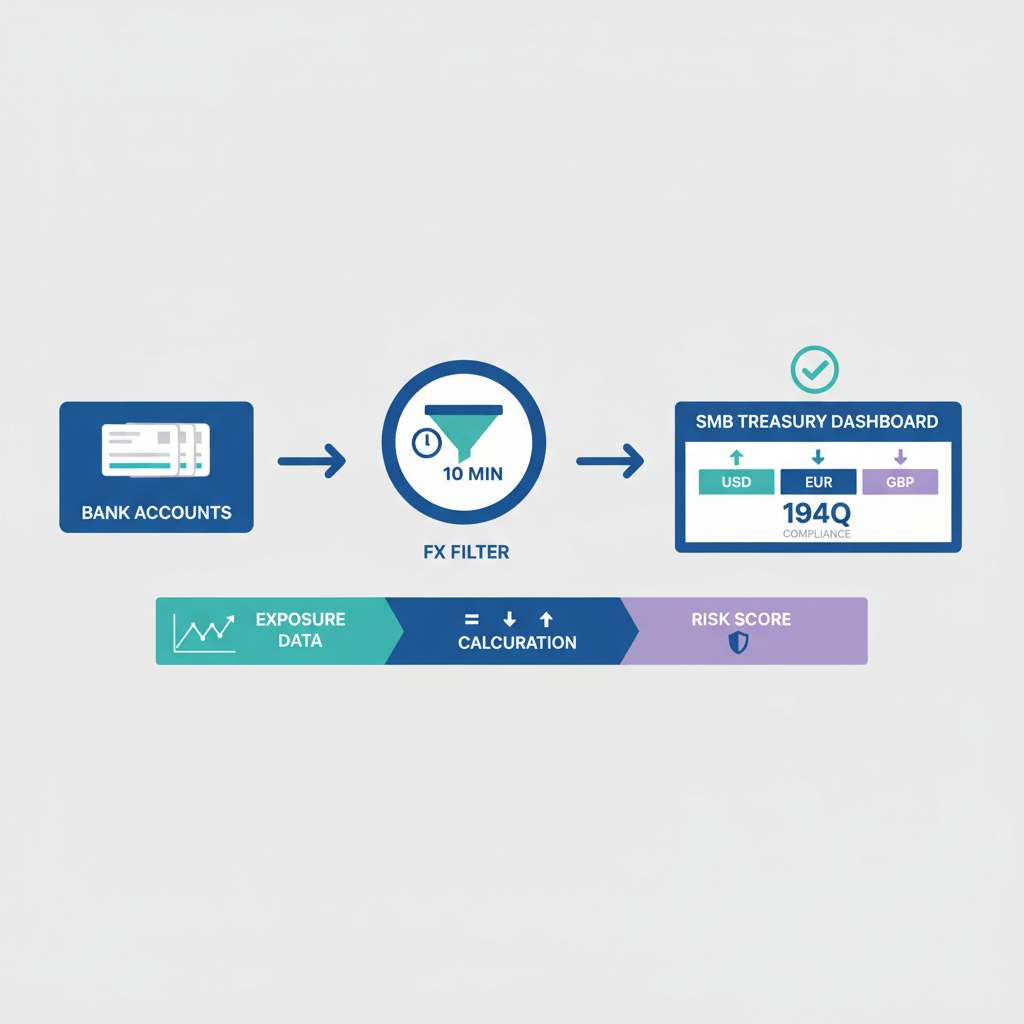
  • Receivables vs Payables Overview: A dashboard shows your net position by currency, at a glance you see if you are long USD or short EUR.
  • Currency Buckets: Separate columns for USD, EUR, GBP, CAD, and more, which highlights concentration risk.
  • Aging Buckets: 0 to 30, 31 to 60, 61 to 90, and over 90 days, so older items get extra scrutiny.
  • Net Exposure Calculation: Offsets receivables against payables in the same currency and time window, your first natural hedge.
  • Scenario Analysis: What if the rupee moves by 1, 3, or 5 percent, see gains or losses instantly.
  • Action Plan and Notes: Log what you will hold, offset, or convert now, with owner and status.

Each row captures counterparty, currency, exposure type, amount, due date, probability, expected rate, current mid market rate, INR equivalent, planned action, owner, and status. Effective FX forecasting relies on clear field definitions and probability weighting, which the template bakes in.

Step by step, complete the template in 10 minutes

Step one, collect open receivables and payables

List every unpaid invoice in USD, EUR, GBP, and more, then list your foreign currency bills, like SaaS, freelancers, and vendors. Example, a $10,000 Upwork invoice due in 15 days, a €3,500 retainer due in 40 days, and a $1,200 Adobe bill due in 10 days.

Step two, classify and add due dates with probability

Mark each line as receivable or payable, add expected payment dates, then add a probability. Reliable recent invoices can be 100 percent, a 60 day overdue item might be 70 percent. Probability weighting prevents over hedging and keeps estimates realistic.

Step three, group by currency and aging

Once you paste, the template buckets by currency and time, then converts to INR using a mid market rate reference. You can read this from your payment platform or a public rate source.

Step four, net receivables against payables

Subtract payables from receivables within the same currency and time bucket. If you have $10,000 receivable in 15 days and a $1,200 payable in 10 days, your net 0 to 30 day USD exposure is $8,800 long. Natural hedges through receivables vs payables matching reduce conversion costs and FX risk for Indian SMBs.

Step five, run scenario analysis

Test +3 percent, −3 percent moves. If you are long USD and the rupee weakens, the INR you realize rises, if it strengthens, it falls. Scenarios make the impact visible before you act.

Step six, draft actions

  • Hold USD to offset a near term payable.
  • Convert only the net surplus to INR if you need liquidity.
  • Wait if your view is that the rupee will weaken in your favor.

Write decisions in the action column, assign an owner, and mark status.

Step seven, export the summary

The sheet outputs a one page snapshot showing net exposure, aging, scenario impacts, and actions. Save it, share it, and move on.

Total weekly time, about 10 minutes once your invoices and bills are tracked.

Deep dive, why receivables vs payables order matters

Every time you convert dollars to rupees, then rupees back to dollars, you pay fees and spreads. If you have both USD coming in and USD going out, keep the inbound USD and pay outbound in USD, a natural hedge that removes extra conversions.

Real example: A creative agency earns $15,000 monthly, pays $4,000 in SaaS. They used to convert everything to INR, then buy USD back. After tracking, they held $4,000 in USD and converted only the net $11,000, saving fees across 24 avoided conversions in a year.

Timing conversions to match due dates reduces slippage and FX costs, especially when you can hold currency for 30 to 60 days. If you have no EUR payables but receive EUR, convert in planned tranches rather than in a rush.

Turn the template into a monthly FX risk report for leadership

Create a simple pack your team can read in two minutes.

  • Executive summary: One paragraph with net exposure by currency and timing gaps.
  • KPI tiles: Net exposure in FCY and INR, average days to convert, percent naturally hedged, last month realized FX P&L.
  • Heatmap: Currency by aging bucket so old big items stand out.
  • Scenario table: Base, +1, +3, +5 percent, and reverse, with P&L impact.
  • Action log: What you converted, what you are holding, and what you will do next.

Set thresholds to streamline decisions, for instance, any net exposure over $10,000 in one currency triggers a hedge discussion, anything under $2,000 auto converts unless a matching payable is due within 15 days.

Mini example walkthrough, a realistic SMB scenario

Rates today: USD 83.00, EUR 90.00.

Receivables: $20,000 in 30 days, €5,000 in 10 days.
Payables: $12,000 in 35 days.

Net: USD +$8,000 long, about ₹6.64 lakh, EUR +€5,000 long, about ₹4.5 lakh.

Scenarios: If the rupee depreciates by 3 percent, INR value rises by about ₹33,420 across both exposures, if it strengthens by 3 percent, that is a similar loss.

Actions: Hold $8,000 to pay SaaS directly, convert €5,000 on receipt unless EUR strengthens further, or wait briefly if you expect INR to weaken.

Common mistakes to avoid

How Karbon Business streamlines this workflow

Karbon Business gives you dedicated virtual accounts in USD, GBP, EUR, and CAD, so funds land in the right currency bucket, and you can hold up to 60 days for natural hedging. Conversions run at zero markup mid market rates, settlement to your Indian bank takes 24 to 48 hours once you claim, and an e-FIRA is generated automatically. Mobile and WhatsApp updates keep your balances and receivables visible between template updates.

Compliance checklist for Indian SMBs

  • Attach e-FIRA for every inward remittance: Keep one per transaction, these documents are essential for audit trails and tax filing under FEMA guidelines.
  • Maintain invoice copies and payment confirmations: Link every FX transaction to the underlying export of service.
  • Reconcile monthly: Match your conversion log to bank statements and e-FIRA records before month end.
  • Retain records for seven years: Use cloud storage with clean naming.

Next steps, download and start tracking today

Download the FX exposure template in Excel or Google Sheets, paste open invoices and bills, net receivables against payables, and run scenarios. In one week, you will have your first monthly report ready. If you manage multiple currencies, set up virtual USD, GBP, EUR, or CAD accounts, pair live balances with your template, and let automated e-FIRA keep compliance stress free.

Currency risk does not have to be chaos, with a clear system and 10 minutes a week, you can protect margins and sleep better.

FAQ

How often should freelancers or small agencies in India update their FX exposure sheet?

Update weekly for data freshness, and finalize a shareable monthly report. Weekly refresh captures shifting payment dates, collection status, and live rates, while a monthly pack is enough for leadership and tax prep. If you receive funds via platforms like Karbon Business, you can align your update cadence with payout cycles for even tighter control.

What is the simplest way to match my USD receivables with my USD expenses so I save on conversion fees?

List all open USD invoices and USD bills with due dates, then net by time bucket. Hold incoming USD to pay upcoming USD bills first, and convert only the surplus to INR. Many Indian freelancers use virtual USD accounts from platforms like Karbon Business to receive and hold dollars for up to 60 days, which makes this natural hedging easy.

Client pays late, rupee moved against me, how do I quantify the impact quickly?

Use the scenario section of your sheet. Enter the original rate you budgeted and the current mid market rate, the difference multiplied by your net receivable shows the FX gain or loss. If you track probability weights and aging, you will also see which overdue invoices are driving the swing.

I have only receivables in EUR, no EUR expenses, should I convert immediately or wait?

If you need INR liquidity, convert on receipt. If cash flow allows, convert in tranches, for example 50 percent now, 50 percent in 2 weeks, and review rate moves. Use your scenarios to set guardrails, like convert remaining if EUR/INR drops by 1.5 percent from today. Platforms such as Karbon Business let you hold EUR briefly and convert at zero markup mid market rates, which helps you stick to a plan.

What probability should I assign to milestone based invoices from overseas clients?

Start with a simple scale, 100 percent for reliable clients under 30 days, 80 percent for 31 to 60, 60 percent for 61 to 90, and 50 percent for over 90. Adjust by client history and contract terms. Add notes like “milestone sign off pending,” so you remember why a weight is lower when you review next week.

Bank rates seem worse than what I see on Google, how do I benchmark correctly?

Always benchmark to a mid market rate from a neutral source, then compare the executed rate to that benchmark to see the true spread. If your platform offers zero markup mid market conversions, like Karbon Business, your INR outcome should match the template closely, which improves predictability.

Can I manage FX exposure without derivatives, forwards, or options?

Yes, most Indian freelancers and SMBs can manage with natural hedging, timing, and small tranches. The template helps you net receivables and payables, plan conversion windows, and set scenario based triggers. Derivatives add complexity and cost, so consider them only when volumes and predictability justify it.

What documents do I need to stay compliant for foreign payments I receive for services?

Keep e-FIRA for every inward remittance, the invoice and scope of work, payment confirmations, and your monthly reconciliation. If your payment provider auto issues e-FIRA, for example Karbon Business, store those PDFs in a dated folder and link the file name to your invoice number for fast audits.

How do I handle SaaS expenses in USD when my clients pay me in GBP or EUR?

Track exposures by currency, do not mix them. If you are long EUR and have USD payables, decide whether to convert EUR to USD for the bill or to INR, based on your cash needs and rate view. If you open multi currency accounts, you can receive in GBP or EUR, then convert only the amount needed to USD at a favorable time.

What is a practical trigger to decide when to convert foreign currency to INR?

Use thresholds like, convert if net exposure in one currency exceeds your monthly INR payroll, or if the rate moves 1 to 2 percent against your base case. Combine this with due date proximity, for instance convert 7 days before a bill if you do not have a matching receivable arriving in time.

Will one spreadsheet really be enough if my monthly international revenue is under ₹1 crore?

Yes, for most freelancers and SMBs a structured sheet with aging, probability, netting, and scenarios is sufficient. When your cross border volumes get large or you add complex hedges, you can move to a treasury tool. Until then, a clear template plus an account that supports holding foreign currency, such as Karbon Business, covers the essentials.

How do WhatsApp or mobile notifications from my payment platform help with FX management?

Real time alerts let you update your sheet quickly when funds arrive or when a conversion settles, which keeps your net exposure and action log current. If your platform, like Karbon Business, notifies you of receipts and e-FIRA readiness, your compliance checklist stays on track without chasing the bank.

Key takeaways

  • A lightweight FX exposure report helps Indian SMBs and freelancers see receivables, payables, and timing gaps clearly, so currency swings do not surprise your margins.
  • Natural hedging, by matching foreign currency receivables with payables in the same currency and time window, cuts conversion costs and reduces risk.
  • A simple template with aging buckets, probability weighting, and scenario analysis can be updated in about 10 minutes each week.
  • Scenario planning shows the rupee impact of + or − moves before they hit your bank balance, which improves decision making.
  • Keeping e-FIRA, invoices, and reconciliation files organized makes RBI and FEMA compliance painless while you manage FX exposure.

What FX exposure actually means for small businesses

FX exposure is the risk that currency movements change the rupee value of your foreign transactions. For most SMBs, the most important piece is transaction exposure, the cash flows you can point to on your invoice tracker and bill schedule. The window between invoicing, getting paid, and converting to INR is where gains or losses appear.

Indian export oriented SMBs often face amplified risks when collection delays stretch, because timing uncertainty widens the risk window. There is also a compliance layer in India, every inward remittance needs an e-FIRA for audit and tax filing. So an FX exposure report protects both your margin and your paperwork.

You do not need a treasury desk, you need a consistent way to see what you are owed, what you owe, and when the money moves.

Inside the FX exposure template, what you get

The free template is an Excel or Google Sheets file designed for real world use by one person wearing many hats. You paste data in, the sheet does the rest.

  • Data Import: Paste open invoices and bills, no integrations required.
  • Receivables vs Payables Overview: A dashboard shows your net position by currency, at a glance you see if you are long USD or short EUR.
  • Currency Buckets: Separate columns for USD, EUR, GBP, CAD, and more, which highlights concentration risk.
  • Aging Buckets: 0 to 30, 31 to 60, 61 to 90, and over 90 days, so older items get extra scrutiny.
  • Net Exposure Calculation: Offsets receivables against payables in the same currency and time window, your first natural hedge.
  • Scenario Analysis: What if the rupee moves by 1, 3, or 5 percent, see gains or losses instantly.
  • Action Plan and Notes: Log what you will hold, offset, or convert now, with owner and status.

Each row captures counterparty, currency, exposure type, amount, due date, probability, expected rate, current mid market rate, INR equivalent, planned action, owner, and status. Effective FX forecasting relies on clear field definitions and probability weighting, which the template bakes in.

Step by step, complete the template in 10 minutes

Step one, collect open receivables and payables

List every unpaid invoice in USD, EUR, GBP, and more, then list your foreign currency bills, like SaaS, freelancers, and vendors. Example, a $10,000 Upwork invoice due in 15 days, a €3,500 retainer due in 40 days, and a $1,200 Adobe bill due in 10 days.

Step two, classify and add due dates with probability

Mark each line as receivable or payable, add expected payment dates, then add a probability. Reliable recent invoices can be 100 percent, a 60 day overdue item might be 70 percent. Probability weighting prevents over hedging and keeps estimates realistic.

Step three, group by currency and aging

Once you paste, the template buckets by currency and time, then converts to INR using a mid market rate reference. You can read this from your payment platform or a public rate source.

Step four, net receivables against payables

Subtract payables from receivables within the same currency and time bucket. If you have $10,000 receivable in 15 days and a $1,200 payable in 10 days, your net 0 to 30 day USD exposure is $8,800 long. Natural hedges through receivables vs payables matching reduce conversion costs and FX risk for Indian SMBs.

Step five, run scenario analysis

Test +3 percent, −3 percent moves. If you are long USD and the rupee weakens, the INR you realize rises, if it strengthens, it falls. Scenarios make the impact visible before you act.

Step six, draft actions

  • Hold USD to offset a near term payable.
  • Convert only the net surplus to INR if you need liquidity.
  • Wait if your view is that the rupee will weaken in your favor.

Write decisions in the action column, assign an owner, and mark status.

Step seven, export the summary

The sheet outputs a one page snapshot showing net exposure, aging, scenario impacts, and actions. Save it, share it, and move on.

Total weekly time, about 10 minutes once your invoices and bills are tracked.

Deep dive, why receivables vs payables order matters

Every time you convert dollars to rupees, then rupees back to dollars, you pay fees and spreads. If you have both USD coming in and USD going out, keep the inbound USD and pay outbound in USD, a natural hedge that removes extra conversions.

Real example: A creative agency earns $15,000 monthly, pays $4,000 in SaaS. They used to convert everything to INR, then buy USD back. After tracking, they held $4,000 in USD and converted only the net $11,000, saving fees across 24 avoided conversions in a year.

Timing conversions to match due dates reduces slippage and FX costs, especially when you can hold currency for 30 to 60 days. If you have no EUR payables but receive EUR, convert in planned tranches rather than in a rush.

Turn the template into a monthly FX risk report for leadership

Create a simple pack your team can read in two minutes.

  • Executive summary: One paragraph with net exposure by currency and timing gaps.
  • KPI tiles: Net exposure in FCY and INR, average days to convert, percent naturally hedged, last month realized FX P&L.
  • Heatmap: Currency by aging bucket so old big items stand out.
  • Scenario table: Base, +1, +3, +5 percent, and reverse, with P&L impact.
  • Action log: What you converted, what you are holding, and what you will do next.

Set thresholds to streamline decisions, for instance, any net exposure over $10,000 in one currency triggers a hedge discussion, anything under $2,000 auto converts unless a matching payable is due within 15 days.

Mini example walkthrough, a realistic SMB scenario

Rates today: USD 83.00, EUR 90.00.

Receivables: $20,000 in 30 days, €5,000 in 10 days.
Payables: $12,000 in 35 days.

Net: USD +$8,000 long, about ₹6.64 lakh, EUR +€5,000 long, about ₹4.5 lakh.

Scenarios: If the rupee depreciates by 3 percent, INR value rises by about ₹33,420 across both exposures, if it strengthens by 3 percent, that is a similar loss.

Actions: Hold $8,000 to pay SaaS directly, convert €5,000 on receipt unless EUR strengthens further, or wait briefly if you expect INR to weaken.

Common mistakes to avoid

How Karbon Business streamlines this workflow

Karbon Business gives you dedicated virtual accounts in USD, GBP, EUR, and CAD, so funds land in the right currency bucket, and you can hold up to 60 days for natural hedging. Conversions run at zero markup mid market rates, settlement to your Indian bank takes 24 to 48 hours once you claim, and an e-FIRA is generated automatically. Mobile and WhatsApp updates keep your balances and receivables visible between template updates.

Compliance checklist for Indian SMBs

  • Attach e-FIRA for every inward remittance: Keep one per transaction, these documents are essential for audit trails and tax filing under FEMA guidelines.
  • Maintain invoice copies and payment confirmations: Link every FX transaction to the underlying export of service.
  • Reconcile monthly: Match your conversion log to bank statements and e-FIRA records before month end.
  • Retain records for seven years: Use cloud storage with clean naming.

Next steps, download and start tracking today

Download the FX exposure template in Excel or Google Sheets, paste open invoices and bills, net receivables against payables, and run scenarios. In one week, you will have your first monthly report ready. If you manage multiple currencies, set up virtual USD, GBP, EUR, or CAD accounts, pair live balances with your template, and let automated e-FIRA keep compliance stress free.

Currency risk does not have to be chaos, with a clear system and 10 minutes a week, you can protect margins and sleep better.

FAQ

How often should freelancers or small agencies in India update their FX exposure sheet?

Update weekly for data freshness, and finalize a shareable monthly report. Weekly refresh captures shifting payment dates, collection status, and live rates, while a monthly pack is enough for leadership and tax prep. If you receive funds via platforms like Karbon Business, you can align your update cadence with payout cycles for even tighter control.

What is the simplest way to match my USD receivables with my USD expenses so I save on conversion fees?

List all open USD invoices and USD bills with due dates, then net by time bucket. Hold incoming USD to pay upcoming USD bills first, and convert only the surplus to INR. Many Indian freelancers use virtual USD accounts from platforms like Karbon Business to receive and hold dollars for up to 60 days, which makes this natural hedging easy.

Client pays late, rupee moved against me, how do I quantify the impact quickly?

Use the scenario section of your sheet. Enter the original rate you budgeted and the current mid market rate, the difference multiplied by your net receivable shows the FX gain or loss. If you track probability weights and aging, you will also see which overdue invoices are driving the swing.

I have only receivables in EUR, no EUR expenses, should I convert immediately or wait?

If you need INR liquidity, convert on receipt. If cash flow allows, convert in tranches, for example 50 percent now, 50 percent in 2 weeks, and review rate moves. Use your scenarios to set guardrails, like convert remaining if EUR/INR drops by 1.5 percent from today. Platforms such as Karbon Business let you hold EUR briefly and convert at zero markup mid market rates, which helps you stick to a plan.

What probability should I assign to milestone based invoices from overseas clients?

Start with a simple scale, 100 percent for reliable clients under 30 days, 80 percent for 31 to 60, 60 percent for 61 to 90, and 50 percent for over 90. Adjust by client history and contract terms. Add notes like “milestone sign off pending,” so you remember why a weight is lower when you review next week.

Bank rates seem worse than what I see on Google, how do I benchmark correctly?

Always benchmark to a mid market rate from a neutral source, then compare the executed rate to that benchmark to see the true spread. If your platform offers zero markup mid market conversions, like Karbon Business, your INR outcome should match the template closely, which improves predictability.

Can I manage FX exposure without derivatives, forwards, or options?

Yes, most Indian freelancers and SMBs can manage with natural hedging, timing, and small tranches. The template helps you net receivables and payables, plan conversion windows, and set scenario based triggers. Derivatives add complexity and cost, so consider them only when volumes and predictability justify it.

What documents do I need to stay compliant for foreign payments I receive for services?

Keep e-FIRA for every inward remittance, the invoice and scope of work, payment confirmations, and your monthly reconciliation. If your payment provider auto issues e-FIRA, for example Karbon Business, store those PDFs in a dated folder and link the file name to your invoice number for fast audits.

How do I handle SaaS expenses in USD when my clients pay me in GBP or EUR?

Track exposures by currency, do not mix them. If you are long EUR and have USD payables, decide whether to convert EUR to USD for the bill or to INR, based on your cash needs and rate view. If you open multi currency accounts, you can receive in GBP or EUR, then convert only the amount needed to USD at a favorable time.

What is a practical trigger to decide when to convert foreign currency to INR?

Use thresholds like, convert if net exposure in one currency exceeds your monthly INR payroll, or if the rate moves 1 to 2 percent against your base case. Combine this with due date proximity, for instance convert 7 days before a bill if you do not have a matching receivable arriving in time.

Will one spreadsheet really be enough if my monthly international revenue is under ₹1 crore?

Yes, for most freelancers and SMBs a structured sheet with aging, probability, netting, and scenarios is sufficient. When your cross border volumes get large or you add complex hedges, you can move to a treasury tool. Until then, a clear template plus an account that supports holding foreign currency, such as Karbon Business, covers the essentials.

How do WhatsApp or mobile notifications from my payment platform help with FX management?

Real time alerts let you update your sheet quickly when funds arrive or when a conversion settles, which keeps your net exposure and action log current. If your platform, like Karbon Business, notifies you of receipts and e-FIRA readiness, your compliance checklist stays on track without chasing the bank.
The views expressed in the blogs on this page are solely the opinions of the authors and do not constitute expert advice. While we strive to provide accurate and up-to-date information, we make no representations or warranties of any kind, express or implied, about the completeness, accuracy, reliability, suitability or availability with respect to the website or the information, products, services, or related graphics contained on the website for any purpose. Any reliance you place on such information is therefore strictly at your own risk. We disclaim any liability for any loss or damage including without limitation, indirect or consequential loss or damage, or any loss or damage whatsoever arising from loss of data or profits arising out of, or in connection with, the use of this website.

Find out how we can help you today!

Speak to our foreign payment specialist
Whatsapp-color Created with Sketch.
Whatsapp:
+91 74117 02726
Email:
sales@karboncard.com
Address:
Ground Floor, Karbon Business, 1st Stage Rd, Binnamangala, Hoysala Nagar, Indiranagar, Bengaluru, Karnataka 560038

Find out how we can help you today!

Speak to our foreign payment specialist
Whatsapp-color Created with Sketch.
Whatsapp:
+91 74117 02726
Email:
sales@karboncard.com
Address:
Ground Floor, Karbon Business, 1st Stage Rd, Binnamangala, Hoysala Nagar, Indiranagar, Bengaluru, Karnataka 560038

Latest from our blogs

Latest from our blogs

View All
× Save 50% - Start Now