

Key takeaways
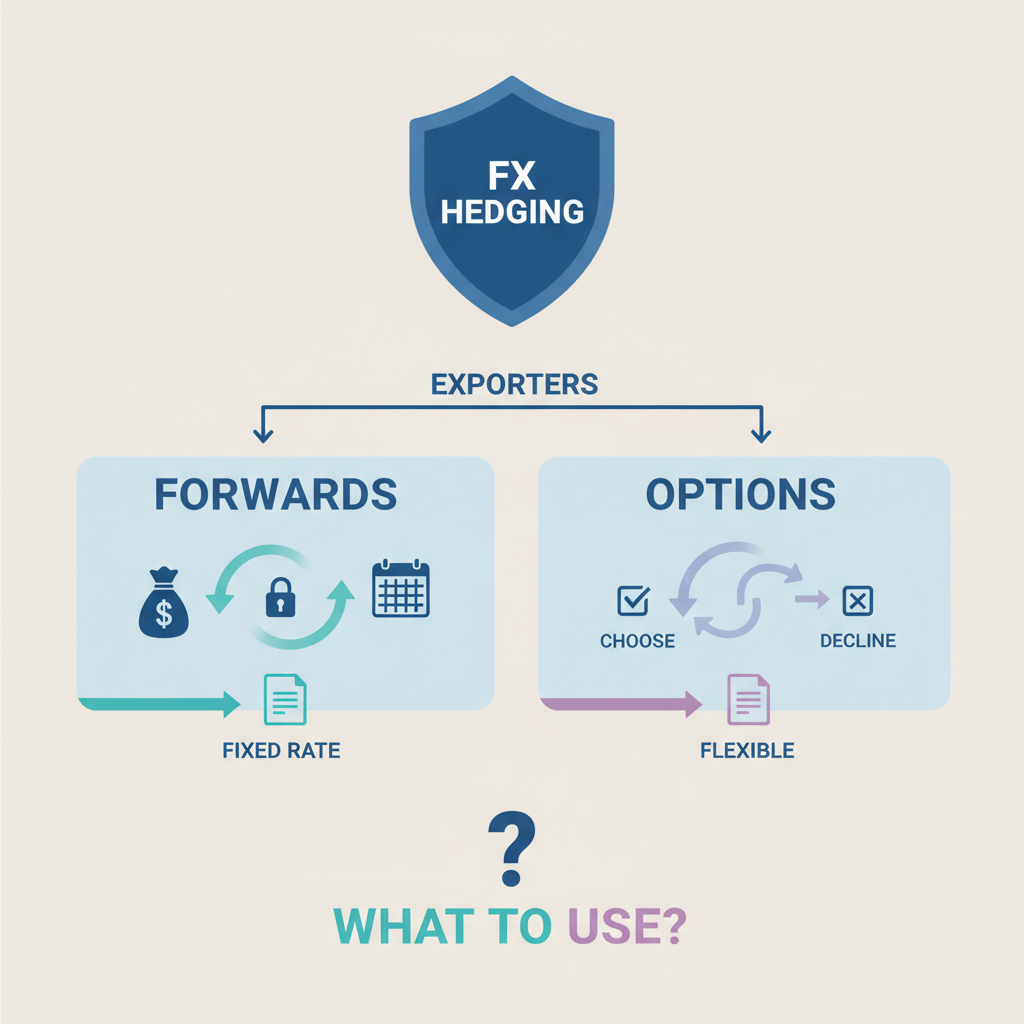
- Forwards lock a future exchange rate with no upfront premium, options cost a premium but preserve upside, choose based on certainty of cash flows, margin sensitivity, and volatility.
- Use forwards for confirmed invoices and fixed dates, use options or collars for bids, tenders, or variable milestones, and blend both in a layered program.
- Operational hedging matters, hold foreign currency for 30 to 60 days, batch conversions, and use platforms like Karbon Business for multi currency collection and auto e FIRA.
- Typical bank forward spreads run 0.06% to 0.12%, three month at the money USD put options are often 0.96% to 1.8% of notional, compare total outcomes, not just headline rates.
- Scenario testing is key, a simple 83.00 to 85.00 move can flip which hedge wins, so run numbers before booking.
- Stay compliant with RBI and FEMA, tie hedges to genuine exposure, keep documentation, and file e FIRA promptly.
- Avoid common mistakes, hedging uncertain exposure fully, misaligned tenors, ignoring all in costs, not netting import payables against export receivables.
- Learn the basics of forex hedging for exporters, then tailor to your order book and cash flow.
Understanding FX Risk for Indian Exporters
Transaction risk starts the moment you quote in USD, EUR, GBP, or CAD and ends only when funds land. Between those dates, exchange rates move, sometimes gently, sometimes sharply, and the impact can erase margins or force awkward renegotiations.
- Proforma invoices that take 60 to 90 days to convert into confirmed purchase orders
- Milestone based IT payments that land on different dates
- Platform payouts from Upwork, PayPal, or Stripe that vary week to week
- Seasonal exports where settlement trails harvest by months
- Capital goods contracts with 6 to 9 month payment cycles
A two percent adverse move can wipe out a five percent operating margin. Hedging protects margins, stabilizes cash flow, and helps with lender covenants. For fundamentals, see forex hedging for exporters.
Hedge to quote confidently, deliver consistently, and grow without currency surprises.
How Forward Contracts Work
A forward contract is an agreement with your bank to exchange a fixed amount of foreign currency at a predetermined rate on a future date. If you want to understand why exporters value a guaranteed forex rate, this is it, certainty.
The forward rate equals spot plus forward points, which reflect the interest rate difference between INR and the foreign currency. If INR rates are higher than USD, forward points are usually negative, which means the forward USD, INR rate is lower than spot. Tenors typically range from one to twelve months, with window or flexible forwards available.
What you need to book a forward:
- Proof of export exposure, invoice, PO, or contract
- A relationship with an Authorized Dealer Category I bank
- RBI and FEMA compliant documentation
- Potential margin or credit lines depending on mark to market and your profile
Costs come via the embedded spread, possible margin calls if rates move against you, cancellation or rollover fees if timing shifts, and the opportunity cost of missing favorable moves.
Pros
- Absolute protection, known INR receipts
- Simple mechanics, widely available, no upfront premium
Cons
- No upside, limited flexibility, possible margin calls
For a broader primer, review this currency hedging strategy for exporters.
How Currency Options Work
An option gives you the right, not the obligation, to exchange at a fixed strike by a specific date. A USD exporter typically buys a USD put, protecting against INR strength while keeping unlimited upside if USD strengthens. See bank offerings under ICICI Bank trade service, forex.
Types:
- European options, exercise on maturity
- American options, exercise any time till maturity
- Zero cost collars, buy a put, sell a call, reduce premium, accept a cap
You pay an upfront premium that depends on volatility, tenor, strike, and spot. At maturity, exercise if in the money, otherwise let it lapse and convert at spot. Costs include the premium, wider bid ask in options, and possible structuring fees.
Pros
- Downside protection with upside preserved
- Flexibility if orders do not materialize, you can let expire
- Useful when volatility is high and upside probability is meaningful
Cons
- Upfront cash premium, more complex payoffs
- Sometimes higher minimum sizes at banks
FX Option vs Forward, Head to Head
| Factor | Forward Contract | Currency Option |
|---|---|---|
| Downside Protection | Absolute, locked rate | Capped at strike, upside open |
| Cost Structure | Embedded spread, possible margin | Explicit premium, possible structuring fees |
| Cash Flow Impact | No premium outlay upfront | Premium paid upfront |
| Certainty of Receivable | Best for confirmed orders, fixed dates | Best for bids, variable amounts or timing |
| Volatility Environment | Efficient in low volatility | Valuable in high volatility |
| Simplicity and Access | Simpler, widely available | More complex, sometimes minimum sizes |
| Liquidity and Rollover | Roll with charges, less flexible | Let expire if not needed, more flexible |
The right choice depends on cash flow certainty, margin buffer, and complexity tolerance. For an external perspective, compare approaches in forward trade vs option trade.
Real World Use Cases for Indian Exporters
Goods exporters with confirmed orders and tight margins
Textiles, engineering, auto components with firm POs and fixed dates, margins near three to seven percent.
Strategy: Hedge 60 percent to 90 percent with forwards, layered by expected payment dates. Leave 10 percent to 40 percent open or use shorter tenors to keep some upside.
Bids, tenders, volatile order books
Pharma tenders, seasonal crops, EPC quotes where timing is uncertain.
Strategy: Use options or zero cost collars, protect against INR strength, retain upside, and if the order does not convert, let the option expire.
Service exporters and freelancers
Small, frequent receipts through platforms, amounts vary and timing is irregular.
Strategy: Operational hedging works well, hold balances for 30 to 60 days and batch conversions, see currency holding and hedging in India. For predictable larger milestones, consider partial forwards. Micro tickets under two thousand dollars are often impractical for forwards, consolidate first.
Platforms like Karbon Business offer virtual USD, EUR, GBP, and CAD accounts, hold for up to 60 days, convert at mid market with zero FX markup, and auto generate e FIRA.
Long sales cycles or high USD volatility
Strategy: Layer hedges to project milestones, for example 50 percent at contract signing with six month forward, 30 percent at first delivery with three month hedge, 20 percent near final delivery using short tenor options.
Importers with natural hedges
Strategy: Net USD payables against receivables first, hedge only the residual. This reduces cost and simplifies treasury. See this exporter hedging guide for context.
Understanding Costs with Real Examples
Scenario: Spot 83.00, three month forward 83.60, three month USD put at 83.00 costs 1.0 INR per USD. Exposure, 10,000 USD due in three months.
| Spot at Maturity | Forward at 83.60 | Option, strike 83.00, premium 1.0 | Unhedged, spot |
|---|---|---|---|
| 82.0 | 8,36,000 INR | 8,30,000 INR, net 8,20,000 after premium | 8,20,000 INR |
| 83.0 | 8,36,000 INR | 8,30,000 INR, net 8,20,000 after premium | 8,30,000 INR |
| 85.0 | 8,36,000 INR | Do not exercise, 8,50,000 INR, net 8,40,000 after premium | 8,50,000 INR |
Takeaways:
- Forward wins when INR strengthens or stays flat
- Option preserves most upside if USD strengthens
- Compare net INR across scenarios, not just headline rates
For fundamentals, revisit forex hedging for exporters.
Choosing the Right Strategy, A Decision Checklist
- Certainty, fixed orders and dates lean forward, uncertain bids and milestones lean option
- Margin sensitivity, thin margins prefer forward, higher margins can accept option premium for upside
- Cash flow, if you can pay premium use options, if not use forwards and plan for margin
- Volatility, high volatility strengthens the case for options, low volatility suits forwards
- Complexity, keep it set and forget with forwards, or manage scenarios and Greeks with options
- Policy, blend both in a layered framework, forwards for 50 to 80 percent confirmed, options for uncertain
More context in this exporter hedging guide.
Step by Step, Executing Hedges in India
Step 1, Documentation
- Invoice, PO, or contract, plus KYC and board resolution if required
- Hedges must match genuine exposure per FEMA
Step 2, Book a forward
- Source quotes from multiple banks, confirm tenor, amount, and all in rate
- Understand cancellation, rollover, and margin terms, obtain written confirmation
Step 3, Buy an option
- Discuss tenor, strike, vanilla versus collar, request premium quotes
- Consider collars or participating forwards if premium is high, ensure FEMA compliance
Step 4, Post trade management
- Monitor mark to market, margin, settlement timing, and exercise decisions
- Coordinate e FIRA and reconciliation of receipts versus hedges
Step 5, Stay compliant
- Maintain contracts, confirmations, exposure proofs, and settlement records
- Refer to Hedging and speculation for foundational concepts
Inward Remittance Platforms for Exporters and Freelancers
- Karbon Business, virtual USD, GBP, EUR, CAD accounts, hold up to 60 days, convert at mid market with zero FX markup, auto e FIRA in 24 hours, INR settlement in 24 to 48 hours
- Wise Business, multi currency accounts and low cost transfers, limited derivatives
- Payoneer, popular for platform payouts, check FX markups
- PayPal, wide acceptance, higher fees and spreads, limited hedging
- RazorpayX International, compliant collections for Indian entities, limited derivatives
Common Mistakes to Avoid
- Hedging 100 percent of uncertain exposure, use options instead
- Misaligned tenors that force rollovers, match hedge to expected receipt date
- Ignoring all in costs, compare outcomes across multiple spot scenarios
- No written policy, define a simple blend of forwards, options, and operational hedging
- Not netting natural hedges, offset USD payables against receivables
- Frequent tiny conversions that rack up fees, batch conversions after holding 30 to 60 days
For more, see this exporter hedging guide.
Recap and Next Steps
Forwards deliver certainty for confirmed receivables. Options deliver flexibility and upside for uncertain exposure. Most exporters blend both, and freelancers lean on operational hedging through multi currency accounts.
Your next steps
- Audit receivables by certainty, tenor, and amount
- Compute break even INR to protect margins
- Get forward and option quotes, run scenario comparisons at pessimistic, base, and optimistic spots
- Write a simple hedging policy, review quarterly
- Streamline inward remittances with a multi currency account, for example Karbon Business, to hold 30 to 60 days and convert at mid market
Balance certainty with flexibility, protect margin today, keep upside for tomorrow.
FAQ
How can I receive USD from a foreign client in India without losing too much in fees?
Use a multi currency collection account that lets you hold USD and convert at the mid market rate, then withdraw in INR. For example, Karbon Business offers virtual USD accounts, zero FX markup at mid market, a flat platform fee, and auto e FIRA for compliance.
Which platform is better for freelancers in India to get paid from Upwork or direct clients, PayPal, Wise, or Karbon Business?
It depends on your priorities. If you want wide acceptance, PayPal is simple but fees and spreads are higher. If you prioritize lower conversion costs, Wise is competitive for spot conversions. If you want to hold balances for 30 to 60 days, convert at mid market with zero markup, and get auto e FIRA, Karbon Business is designed for freelancers and agencies.
Can I hold USD for some time and convert when the rate is better, or will RBI rules stop me?
RBI permits exporters to hold foreign currency in collection accounts for a limited period before conversion. Platforms like Karbon Business allow holding up to 60 days, which supports operational hedging while staying compliant. Always keep documentation and convert within permitted timelines.
What is e FIRA and why do freelancers keep asking banks for it?
e FIRA, Foreign Inward Remittance Advice, is proof that foreign funds were received for export of services or goods. It is needed for compliance, audit, and at times for GST or incentive claims. A platform like Karbon Business auto generates e FIRA within 24 hours, saving time and back and forth with banks.
How do I decide between converting USD instantly versus batching invoices once a month?
Batching reduces per transaction fees and smooths your average FX rate. If cash flow permits, hold receipts for 30 to 60 days, then convert in larger tranches. This approach, operational hedging, is easy with a multi currency account such as Karbon Business, which lets you time conversions without paying FX markup.
Are forwards or options practical for freelancers with invoice sizes like 500 to 2,000 dollars?
Banks often have minimum sizes for derivatives, which makes small tickets impractical. Freelancers usually rely on operational hedging, hold and batch convert. If you have predictable larger milestones, for example above ten thousand dollars, partial forwards via your bank can make sense.
How do I get the best USD to INR rate, should I watch the market every day?
Chasing daily highs is stressful and unreliable. Instead, average in. Hold for a short window, for example 30 to 60 days, and convert in batches. Platforms that convert at mid market, like Karbon Business, remove FX markup so you only focus on timing, not hidden spreads.
Is there any TCS, GST, or tax issue when I bring international freelancing income into India?
Service export proceeds are generally not subject to GST when received in convertible foreign exchange with proper documentation. TCS applies to outward remittances, not inward. You still need to report income for tax, keep e FIRA and invoices. Consult your CA for your specific case.
My client pays in EUR or GBP, can I collect in those and convert to INR later?
Yes, multi currency accounts allow EUR and GBP collection with local rails in many markets. You can hold balances and convert to INR when you prefer. Karbon Business supports EUR and GBP receiving accounts and mid market conversions, which helps you manage volatility.
What is the simplest hedging method for a solo freelancer who hates complex finance stuff?
Operational hedging, hold foreign currency for a short time, then batch convert. No complex contracts, no premiums, just timing your conversions. Use a platform like Karbon Business to hold up to 60 days, convert at mid market, and get e FIRA automatically.
If a client cancels a project midway, will it create any FX problem for me?
If you did not book a derivative, there is no hedge to unwind. If you booked a forward for a specific amount and date, you may need to cancel or roll it, which can cost money. Freelancers prefer operational hedging for this reason, it is flexible when projects shift.
How fast can I get INR into my bank account after conversion from USD on a fintech platform?
Settlement timelines vary. With Karbon Business, INR settlement is typically 24 to 48 hours after conversion, and e FIRA is generated within 24 hours, which keeps cash flow and compliance smooth.