Business

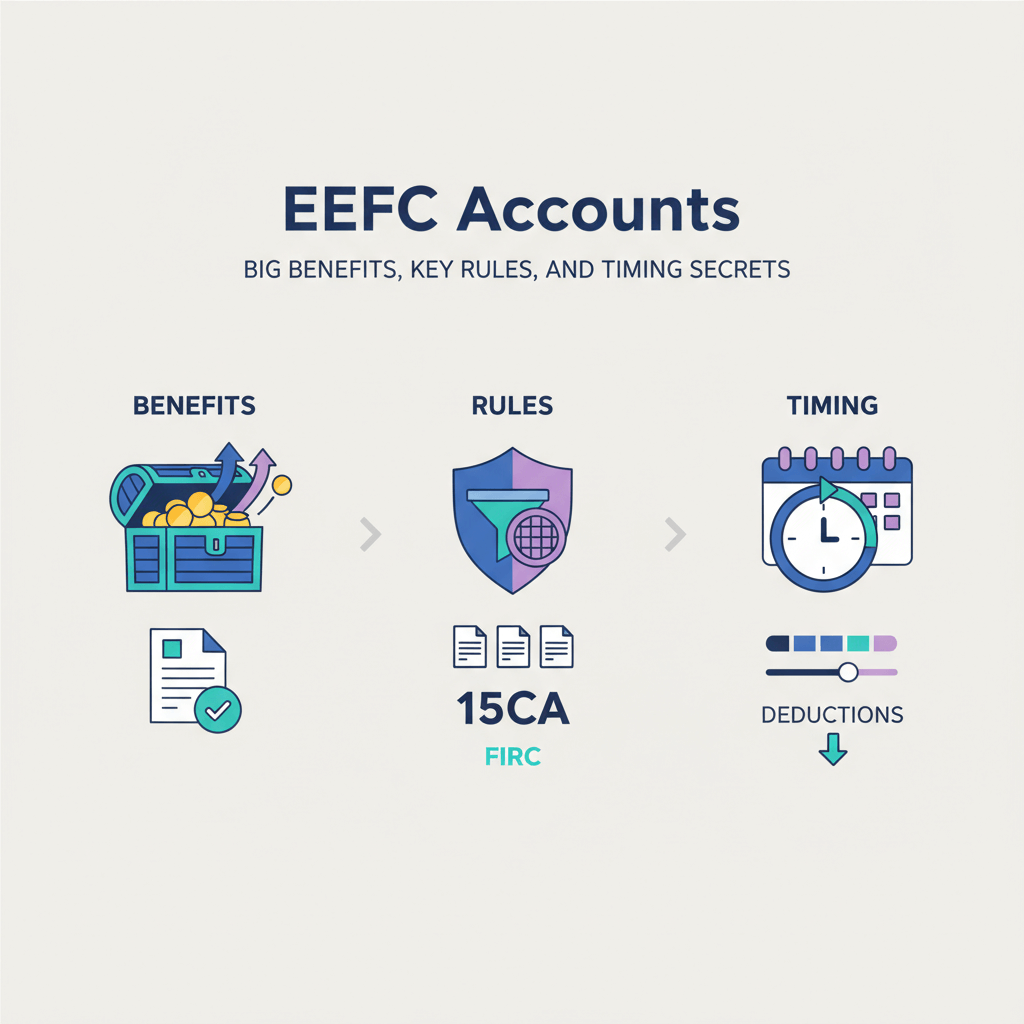
EEFC Accounts: Big Benefits, Key Rules, and Timing Secrets

Content
share on
Contents
Share On

Key takeaways

  • An EEFC account lets Indian exporters and freelancers hold export earnings in foreign currency, giving control over when to convert to INR, see a concise primer here on the what is EEFC account basics.
  • Eligibility covers resident exporters of goods and services, including freelancers and sole proprietors, with more on EEFC account meaning, eligibility, benefits.
  • Key benefits include a natural hedge against forex volatility, no double conversions for overseas spends, and cleaner compliance with e-FIRA trail.
  • Rules are RBI and FEMA driven, allowed credits are export proceeds and related refunds, allowed debits are current account foreign payments and permitted capital transactions, see this plain English overview of the EEFC account framework.
  • There is no forced conversion percentage and practical holding flexibility, but bank fees and spreads still matter, check current nuances in these EEFC account FAQs 2024.
  • Use EEFC when inflows and outflows match in currency, and when you want timing flexibility, otherwise consider fintech alternatives like Karbon Business for fast INR settlement.
  • Always maintain documentation, invoices, Softex, e-FIRA, and correct purpose codes, and reconcile monthly to stay audit ready.

What Is an EEFC Account? Understanding the EEFC Account Meaning

An EEFC account, Exchange Earners' Foreign Currency, is a non interest bearing current account in foreign currency with an Authorized Dealer Category I bank in India. It allows you to retain 100% of export earnings in USD, EUR, GBP, or other freely convertible currencies, and convert to INR only when you decide. For a concise reference, see this explainer on what is EEFC account.

In practice, you credit export proceeds directly, spend on approved foreign payments, and time INR conversion for better rates under FEMA. Imagine a Bengaluru based developer receiving $5,000, with an EEFC account those dollars remain dollars, you can pay AWS in USD and pick a better day to convert, a simple shift that can protect margins.

EEFC is about control and clarity, you choose when to convert, you keep a clean compliance trail, and you avoid unnecessary round trip FX.

Most major banks, HDFC, ICICI, SBI, Axis, offer EEFC accounts. The account does not pay interest, but the flexibility and operational simplicity can outweigh that trade off.

Who Can Open an EEFC Account? Eligibility Criteria Explained

Eligible users are resident exporters of goods and services, companies, LLPs, partnerships, sole proprietors, freelancers, and professionals who earn foreign currency from exports or services like software development, design, marketing, consulting, or training. A helpful overview of EEFC account meaning, eligibility, benefits clarifies the edge cases.

Non eligible cases typically include SEZ units with their own regimes, and pure foreign salary unrelated to export activity. Banks require standard KYC, PAN, Aadhaar, address proof, GST if applicable, IEC for goods, proof of export activity, invoices, contracts, Softex for IT services.

Policies vary by bank, some branches are more freelancer friendly, others demand a longer track record. If you are new with small receipts, consider starting with a fintech to build history, then open an EEFC account when volumes scale.

EEFC Account Benefits and Rules: What Exporters Need to Know

Benefits of an EEFC Account for Exporters

  • Natural hedge against volatility. Hold foreign currency and convert when rates move in your favor, that timing can add up meaningfully over a year.
  • No double conversions. Pay SaaS, ads, cloud, travel, or contractors directly in foreign currency, skipping INR to FX to INR loops.
  • Operational ease. Receive in USD, pay in USD, keep accounting tidy, your CA gets cleaner books.
  • Built in compliance. Banks issue e-FIRA for each inward remittance, which simplifies tax filing and audits.

EEFC Account Rules in Plain Language

  • Permitted credits. 100% of export proceeds for goods or services, professional fees, consultancy income, and related refunds. Domestic rupee receipts, gifts, and unrelated salary are not allowed.
  • Permitted debits. Imports, services and subscriptions, international contractor payments, travel, and permitted capital transactions under FEMA, personal transfers outside business scope are not allowed.
  • No interest. You trade interest income for timing flexibility.
  • Currencies. USD, EUR, GBP, and other freely convertible options as offered by your bank, sometimes under one multi currency EEFC.
  • Conversion to INR. When ready, you convert at the bank’s TT selling rate, which is interbank plus a spread, compare and negotiate spreads.
  • Documentation linkages. Every credit and debit should map to invoices, Softex where applicable, and correct FEMA purpose codes.

These rules flow from RBI and FEMA, if your inflows and outflows are genuine export activity, you will find operations straightforward.

Understanding EEFC Account Limits: Retention, Time, and Transaction Rules

Retention limit. You may retain 100% of eligible export earnings in foreign currency, earlier forced conversion percentages are not applicable now.

Time limit. No strict RBI holding period under current norms, though some banks prefer periodic conversion of idle balances. Clarify your bank’s practice upfront.

Transaction limits. Credits must be export linked, debits follow current account rules under FEMA, everyday use cases include tools, cloud, ads, travel, and contractor payouts. For a practical roundup, scan these EEFC account FAQs 2024.

Bank specific nuances. Minimum balances, remittance fees, and FX spreads vary, read the fee sheet carefully.

Funds cannot move from your INR savings into EEFC, and EEFC to INR requires conversion at the bank’s rate.

When to Use an EEFC Account: A Decision Guide for Freelancers and Exporters

  • Recurring same currency expenses. Earn in USD and spend in USD, EEFC becomes a natural fit and removes round trip FX costs.
  • Desire to time conversions. If you expect rates to move, holding for weeks or months can improve net realization.
  • Meaningful monthly volumes. Fees make sense when receipts are steady, for example $2,000 per month and above.
  • Need for formal documentation. e-FIRA and realization certificates help with tax filings and credit underwriting.

Skip EEFC if receipts are small or infrequent, bank spreads and fees outweigh savings, or you value speed and digital onboarding, in such cases a fintech can be more convenient. For foundational context, revisit this guide on what is EEFC account.

Practical Examples for Indian Service Exporters and Freelancers

  • Freelance developer. Receive $5,000, pay $1,500 in USD for cloud and subcontractors, convert only the rest once, you save spread and gain timing flexibility.
  • Marketing agency with UK clients. Earn in GBP, spend in GBP on ads and freelancers, pay directly from GBP balance, convert surplus at better moments.
  • EU focused consultant. Hold EUR to fund travel and tools, bring back the remainder when the rate improves.

How to Open and Operate an EEFC Account: A Step by Step How To Guide

Step 1: Shortlist your bank. Compare Authorized Dealer Category I options, read fee schedules and supported currencies, a quick scan of the best EEFC account criteria helps frame questions for the branch.

Step 2: Gather documents. PAN, masked Aadhaar, address proof, GST if applicable, IEC for goods, export invoices and contracts, Softex for IT services, supporting bank statements and online profiles if you are a freelancer.

Step 3: Apply. Online or branch, complete KYC and FEMA declarations, onboarding usually takes three to seven working days.

Step 4: Pick currencies. Start with your primary currency, add others as needed.

Step 5: Link invoicing and accounting. Update invoice payment instructions with EEFC details, set up foreign currency ledgers in your accounting software.

Operating Tips for Daily Use

  • Match each credit to an invoice and fetch e-FIRA within 24 hours, file month wise.
  • Attach vendor invoices or receipts to every debit, keep purpose codes accurate.
  • Set a conversion policy, for example convert a portion monthly for INR expenses, and hold the rest for hedging.
  • Monitor spreads quarterly, negotiate if your effective markup drifts higher than your target.
  • Track currency exposure in a simple sheet, define trigger rates for conversion and review weekly, more practical pointers in this EEFC account meaning, eligibility, benefits overview.

Costs, Forex Spreads, and Operational Gotchas to Watch Out For

  • Bank fees. Outward SWIFT fees and correspondent charges add up, check maintenance charges and minimum balance clauses.
  • FX spreads. The real cost is the gap to mid market, compute your effective spread on each conversion and compare across banks.
  • Reconciliation time. Budget time each month for mapping invoices, Softex, and e-FIRA.
  • FX risk. Holding foreign currency means mark to market swings, define guardrails and stick to them.
  • Opportunity cost. EEFC pays no interest, avoid parking large idle balances without a purpose.
  • Documentation gaps. Stay current on Softex and e-FIRA to avoid last minute scramble, see the latest practitioner notes in these EEFC account FAQs 2024.

Alternatives and Complements: EEFC Accounts vs. Fintech Platforms

Fintech platforms offer fast onboarding, transparent pricing, and quick INR settlement. Karbon Business focuses on Indian freelancers and service exporters with virtual USD, GBP, EUR, and CAD accounts, local collection rails, up to 60 day holding for light hedging, auto e-FIRA, and a flat fee model. Wise Business offers multi currency accounts with low conversion costs and mid market rates. Payoneer, RazorpayX International, Tazapay, and PayPal serve varied cross border needs across invoices and marketplaces. For context on the RBI concept, read this primer on the Exchange Earners' Foreign Currency account.

Where Karbon Business Fits for Freelancers

Karbon Business gives clients an easy way to pay you via local rails, you can hold foreign currency for short windows, and receive INR in 24 to 48 hours, with e-FIRA delivered automatically, ideal when you want speed and compliance, without bank branch friction.

Combining EEFC and Fintech: A Hybrid Strategy

Use a fintech for small, frequent receipts where speed matters, route larger or less frequent payments to EEFC when you want extended holding and direct foreign payments. This blend balances cost, control, and convenience.

Compliance Checklist: Keeping Your EEFC Account Clean and Audit Ready

  • File Softex on time for software or IT exports, keep acknowledgments handy.
  • Archive invoices, e-FIRA, and realization certificates in year wise folders.
  • Use accurate FEMA purpose codes on every outward remittance.
  • Respond to KYC refresh requests promptly to avoid freezes.
  • Reconcile monthly, every credit needs an invoice and e-FIRA, every debit needs a bill and purpose code.
  • Consult your CA for capital account transactions that might require prior approval.
  • Report exports correctly for GST and compute income tax on realized amounts with your CA, a quick refresher is here on the evolving EEFC account practices.

FAQ

EEFC account hai, Upwork ya direct client se USD aaya toh kya main INR convert kiye bina hold kar sakta hoon?

Haan, EEFC account me aap 100 percent export earnings USD me hold kar sakte ho, INR conversion aapki marzi se hoga, isse forex timing control me aata hai, foreign tools and contractors ko directly USD me pay karna bhi easy ho jata hai.

Freelancer hoon, company nahi, kya mere naam par EEFC account open ho jayega?

Yes, resident sole proprietor ya individual freelancer bhi EEFC open kar sakte hain, bank KYC, invoices, contracts, aur agar IT services hai toh Softex ki copy maangta hai, track record dikhana helpful hota hai.

Karbon Business use kar raha hoon, phir bhi EEFC account banana zaroori hai kya?

Zaroori nahi, agar aapko fast INR settlement, transparent fee, aur short holding window chahiye, Karbon Business kaafi hota hai, lekin agar aap long holding chahte ho, ya direct USD me bade vendors ko pay karte ho, toh EEFC useful rahega, dono ko hybrid tarike se bhi use kiya ja sakta hai.

Bank ka TT selling rate kya hota hai, aur mujhe kis cheez par negotiate karna chahiye?

TT selling rate bank ka forex conversion rate hota hai jo interbank mid rate par unka spread add karke banta hai, aap spread par negotiate kar sakte ho, monthly volumes badhane par relationship manager se better markup mil sakta hai.

EEFC account me interest milta hai kya, idle balance rakhna sahi hai?

Nahi, EEFC non interest bearing hai, isliye bahut bada idle balance rakhne se opportunity cost hoti hai, typically working capital ke 30 se 60 din ke liye rakkho, baaki INR me convert karke FDs ya liquid funds me deploy kar sakte ho.

SaaS tools, ads, aur cloud bills ko EEFC se direct pay kar sakta hoon kya?

Haan, permitted debits me tools, cloud, ads, international contractors, travel wagaira aate hain, yeh sab direct foreign currency me pay karo, double conversion cost bachegi, reconciliation me invoice attach karna na bhulo.

Softex aur e-FIRA kis liye chahiye, freelancer ke liye bhi mandatory hai kya?

e-FIRA bank deta hai as proof of inward remittance, tax filing me kaam aata hai, Softex IT or software exports ke liye applicable hota hai, agar aap software services export karte ho toh Softex file karna best practice hai.

Mere inflows chhote hain, $300 ya $500 kabhi kabhi aata hai, EEFC open karna worth hai?

Aise cases me fintech jaise Karbon Business better hota hai, onboarding fast, INR 24 se 48 ghante me milta hai, fees simple hoti hai, jab receipts $2,000 per month ke upar stable ho jayein, tab EEFC consider karo.

Kya main apne savings account se INR lekar EEFC account me deposit kar sakta hoon?

Nahi, EEFC credits sirf export linked foreign currency receipts se aate hain, INR se EEFC me credit allowed nahi hai, EEFC se INR me fund lane ke liye conversion required hota hai.

Multi currency handling kaise hota hai, ek EEFC me USD, EUR, GBP sab rakh sakta hoon?

Kaafi banks multi currency EEFC allow karte hain, kuch banks separate sub accounts banate hain, opening ke time par clarify karo ki aapko kaun si currencies chahiye, statements and reconciliation accordingly set karo.

Forex risk kaise manage karun, har baar best rate kaise pakdu?

Perfect timing mushkil hota hai, simple policy banao, jaise mahine ke end me 50 percent convert karna, baaki next month tak hold karna, trigger rates define karo, for example USD INR 83.50 par convert karna, aur us plan par consistent raho.

Karbon Business aur EEFC ko saath me kaise use karu, koi practical workflow batayein?

Smaller retainers aur ad hoc invoices Karbon Business se lo, INR jaldi mil jayega, quarterly large projects ya planned foreign spends EEFC me lo, USD me hold karke direct vendors ko pay karo, isse speed, cost, aur control ka balance milta hai.

Key takeaways

  • An EEFC account lets Indian exporters and freelancers hold export earnings in foreign currency, giving control over when to convert to INR, see a concise primer here on the what is EEFC account basics.
  • Eligibility covers resident exporters of goods and services, including freelancers and sole proprietors, with more on EEFC account meaning, eligibility, benefits.
  • Key benefits include a natural hedge against forex volatility, no double conversions for overseas spends, and cleaner compliance with e-FIRA trail.
  • Rules are RBI and FEMA driven, allowed credits are export proceeds and related refunds, allowed debits are current account foreign payments and permitted capital transactions, see this plain English overview of the EEFC account framework.
  • There is no forced conversion percentage and practical holding flexibility, but bank fees and spreads still matter, check current nuances in these EEFC account FAQs 2024.
  • Use EEFC when inflows and outflows match in currency, and when you want timing flexibility, otherwise consider fintech alternatives like Karbon Business for fast INR settlement.
  • Always maintain documentation, invoices, Softex, e-FIRA, and correct purpose codes, and reconcile monthly to stay audit ready.

What Is an EEFC Account? Understanding the EEFC Account Meaning

An EEFC account, Exchange Earners' Foreign Currency, is a non interest bearing current account in foreign currency with an Authorized Dealer Category I bank in India. It allows you to retain 100% of export earnings in USD, EUR, GBP, or other freely convertible currencies, and convert to INR only when you decide. For a concise reference, see this explainer on what is EEFC account.

In practice, you credit export proceeds directly, spend on approved foreign payments, and time INR conversion for better rates under FEMA. Imagine a Bengaluru based developer receiving $5,000, with an EEFC account those dollars remain dollars, you can pay AWS in USD and pick a better day to convert, a simple shift that can protect margins.

EEFC is about control and clarity, you choose when to convert, you keep a clean compliance trail, and you avoid unnecessary round trip FX.

Most major banks, HDFC, ICICI, SBI, Axis, offer EEFC accounts. The account does not pay interest, but the flexibility and operational simplicity can outweigh that trade off.

Who Can Open an EEFC Account? Eligibility Criteria Explained

Eligible users are resident exporters of goods and services, companies, LLPs, partnerships, sole proprietors, freelancers, and professionals who earn foreign currency from exports or services like software development, design, marketing, consulting, or training. A helpful overview of EEFC account meaning, eligibility, benefits clarifies the edge cases.

Non eligible cases typically include SEZ units with their own regimes, and pure foreign salary unrelated to export activity. Banks require standard KYC, PAN, Aadhaar, address proof, GST if applicable, IEC for goods, proof of export activity, invoices, contracts, Softex for IT services.

Policies vary by bank, some branches are more freelancer friendly, others demand a longer track record. If you are new with small receipts, consider starting with a fintech to build history, then open an EEFC account when volumes scale.

EEFC Account Benefits and Rules: What Exporters Need to Know

Benefits of an EEFC Account for Exporters

  • Natural hedge against volatility. Hold foreign currency and convert when rates move in your favor, that timing can add up meaningfully over a year.
  • No double conversions. Pay SaaS, ads, cloud, travel, or contractors directly in foreign currency, skipping INR to FX to INR loops.
  • Operational ease. Receive in USD, pay in USD, keep accounting tidy, your CA gets cleaner books.
  • Built in compliance. Banks issue e-FIRA for each inward remittance, which simplifies tax filing and audits.

EEFC Account Rules in Plain Language

  • Permitted credits. 100% of export proceeds for goods or services, professional fees, consultancy income, and related refunds. Domestic rupee receipts, gifts, and unrelated salary are not allowed.
  • Permitted debits. Imports, services and subscriptions, international contractor payments, travel, and permitted capital transactions under FEMA, personal transfers outside business scope are not allowed.
  • No interest. You trade interest income for timing flexibility.
  • Currencies. USD, EUR, GBP, and other freely convertible options as offered by your bank, sometimes under one multi currency EEFC.
  • Conversion to INR. When ready, you convert at the bank’s TT selling rate, which is interbank plus a spread, compare and negotiate spreads.
  • Documentation linkages. Every credit and debit should map to invoices, Softex where applicable, and correct FEMA purpose codes.

These rules flow from RBI and FEMA, if your inflows and outflows are genuine export activity, you will find operations straightforward.

Understanding EEFC Account Limits: Retention, Time, and Transaction Rules

Retention limit. You may retain 100% of eligible export earnings in foreign currency, earlier forced conversion percentages are not applicable now.

Time limit. No strict RBI holding period under current norms, though some banks prefer periodic conversion of idle balances. Clarify your bank’s practice upfront.

Transaction limits. Credits must be export linked, debits follow current account rules under FEMA, everyday use cases include tools, cloud, ads, travel, and contractor payouts. For a practical roundup, scan these EEFC account FAQs 2024.

Bank specific nuances. Minimum balances, remittance fees, and FX spreads vary, read the fee sheet carefully.

Funds cannot move from your INR savings into EEFC, and EEFC to INR requires conversion at the bank’s rate.

When to Use an EEFC Account: A Decision Guide for Freelancers and Exporters

  • Recurring same currency expenses. Earn in USD and spend in USD, EEFC becomes a natural fit and removes round trip FX costs.
  • Desire to time conversions. If you expect rates to move, holding for weeks or months can improve net realization.
  • Meaningful monthly volumes. Fees make sense when receipts are steady, for example $2,000 per month and above.
  • Need for formal documentation. e-FIRA and realization certificates help with tax filings and credit underwriting.

Skip EEFC if receipts are small or infrequent, bank spreads and fees outweigh savings, or you value speed and digital onboarding, in such cases a fintech can be more convenient. For foundational context, revisit this guide on what is EEFC account.

Practical Examples for Indian Service Exporters and Freelancers

  • Freelance developer. Receive $5,000, pay $1,500 in USD for cloud and subcontractors, convert only the rest once, you save spread and gain timing flexibility.
  • Marketing agency with UK clients. Earn in GBP, spend in GBP on ads and freelancers, pay directly from GBP balance, convert surplus at better moments.
  • EU focused consultant. Hold EUR to fund travel and tools, bring back the remainder when the rate improves.

How to Open and Operate an EEFC Account: A Step by Step How To Guide

Step 1: Shortlist your bank. Compare Authorized Dealer Category I options, read fee schedules and supported currencies, a quick scan of the best EEFC account criteria helps frame questions for the branch.

Step 2: Gather documents. PAN, masked Aadhaar, address proof, GST if applicable, IEC for goods, export invoices and contracts, Softex for IT services, supporting bank statements and online profiles if you are a freelancer.

Step 3: Apply. Online or branch, complete KYC and FEMA declarations, onboarding usually takes three to seven working days.

Step 4: Pick currencies. Start with your primary currency, add others as needed.

Step 5: Link invoicing and accounting. Update invoice payment instructions with EEFC details, set up foreign currency ledgers in your accounting software.

Operating Tips for Daily Use

  • Match each credit to an invoice and fetch e-FIRA within 24 hours, file month wise.
  • Attach vendor invoices or receipts to every debit, keep purpose codes accurate.
  • Set a conversion policy, for example convert a portion monthly for INR expenses, and hold the rest for hedging.
  • Monitor spreads quarterly, negotiate if your effective markup drifts higher than your target.
  • Track currency exposure in a simple sheet, define trigger rates for conversion and review weekly, more practical pointers in this EEFC account meaning, eligibility, benefits overview.

Costs, Forex Spreads, and Operational Gotchas to Watch Out For

  • Bank fees. Outward SWIFT fees and correspondent charges add up, check maintenance charges and minimum balance clauses.
  • FX spreads. The real cost is the gap to mid market, compute your effective spread on each conversion and compare across banks.
  • Reconciliation time. Budget time each month for mapping invoices, Softex, and e-FIRA.
  • FX risk. Holding foreign currency means mark to market swings, define guardrails and stick to them.
  • Opportunity cost. EEFC pays no interest, avoid parking large idle balances without a purpose.
  • Documentation gaps. Stay current on Softex and e-FIRA to avoid last minute scramble, see the latest practitioner notes in these EEFC account FAQs 2024.

Alternatives and Complements: EEFC Accounts vs. Fintech Platforms

Fintech platforms offer fast onboarding, transparent pricing, and quick INR settlement. Karbon Business focuses on Indian freelancers and service exporters with virtual USD, GBP, EUR, and CAD accounts, local collection rails, up to 60 day holding for light hedging, auto e-FIRA, and a flat fee model. Wise Business offers multi currency accounts with low conversion costs and mid market rates. Payoneer, RazorpayX International, Tazapay, and PayPal serve varied cross border needs across invoices and marketplaces. For context on the RBI concept, read this primer on the Exchange Earners' Foreign Currency account.

Where Karbon Business Fits for Freelancers

Karbon Business gives clients an easy way to pay you via local rails, you can hold foreign currency for short windows, and receive INR in 24 to 48 hours, with e-FIRA delivered automatically, ideal when you want speed and compliance, without bank branch friction.

Combining EEFC and Fintech: A Hybrid Strategy

Use a fintech for small, frequent receipts where speed matters, route larger or less frequent payments to EEFC when you want extended holding and direct foreign payments. This blend balances cost, control, and convenience.

Compliance Checklist: Keeping Your EEFC Account Clean and Audit Ready

  • File Softex on time for software or IT exports, keep acknowledgments handy.
  • Archive invoices, e-FIRA, and realization certificates in year wise folders.
  • Use accurate FEMA purpose codes on every outward remittance.
  • Respond to KYC refresh requests promptly to avoid freezes.
  • Reconcile monthly, every credit needs an invoice and e-FIRA, every debit needs a bill and purpose code.
  • Consult your CA for capital account transactions that might require prior approval.
  • Report exports correctly for GST and compute income tax on realized amounts with your CA, a quick refresher is here on the evolving EEFC account practices.

FAQ

EEFC account hai, Upwork ya direct client se USD aaya toh kya main INR convert kiye bina hold kar sakta hoon?

Haan, EEFC account me aap 100 percent export earnings USD me hold kar sakte ho, INR conversion aapki marzi se hoga, isse forex timing control me aata hai, foreign tools and contractors ko directly USD me pay karna bhi easy ho jata hai.

Freelancer hoon, company nahi, kya mere naam par EEFC account open ho jayega?

Yes, resident sole proprietor ya individual freelancer bhi EEFC open kar sakte hain, bank KYC, invoices, contracts, aur agar IT services hai toh Softex ki copy maangta hai, track record dikhana helpful hota hai.

Karbon Business use kar raha hoon, phir bhi EEFC account banana zaroori hai kya?

Zaroori nahi, agar aapko fast INR settlement, transparent fee, aur short holding window chahiye, Karbon Business kaafi hota hai, lekin agar aap long holding chahte ho, ya direct USD me bade vendors ko pay karte ho, toh EEFC useful rahega, dono ko hybrid tarike se bhi use kiya ja sakta hai.

Bank ka TT selling rate kya hota hai, aur mujhe kis cheez par negotiate karna chahiye?

TT selling rate bank ka forex conversion rate hota hai jo interbank mid rate par unka spread add karke banta hai, aap spread par negotiate kar sakte ho, monthly volumes badhane par relationship manager se better markup mil sakta hai.

EEFC account me interest milta hai kya, idle balance rakhna sahi hai?

Nahi, EEFC non interest bearing hai, isliye bahut bada idle balance rakhne se opportunity cost hoti hai, typically working capital ke 30 se 60 din ke liye rakkho, baaki INR me convert karke FDs ya liquid funds me deploy kar sakte ho.

SaaS tools, ads, aur cloud bills ko EEFC se direct pay kar sakta hoon kya?

Haan, permitted debits me tools, cloud, ads, international contractors, travel wagaira aate hain, yeh sab direct foreign currency me pay karo, double conversion cost bachegi, reconciliation me invoice attach karna na bhulo.

Softex aur e-FIRA kis liye chahiye, freelancer ke liye bhi mandatory hai kya?

e-FIRA bank deta hai as proof of inward remittance, tax filing me kaam aata hai, Softex IT or software exports ke liye applicable hota hai, agar aap software services export karte ho toh Softex file karna best practice hai.

Mere inflows chhote hain, $300 ya $500 kabhi kabhi aata hai, EEFC open karna worth hai?

Aise cases me fintech jaise Karbon Business better hota hai, onboarding fast, INR 24 se 48 ghante me milta hai, fees simple hoti hai, jab receipts $2,000 per month ke upar stable ho jayein, tab EEFC consider karo.

Kya main apne savings account se INR lekar EEFC account me deposit kar sakta hoon?

Nahi, EEFC credits sirf export linked foreign currency receipts se aate hain, INR se EEFC me credit allowed nahi hai, EEFC se INR me fund lane ke liye conversion required hota hai.

Multi currency handling kaise hota hai, ek EEFC me USD, EUR, GBP sab rakh sakta hoon?

Kaafi banks multi currency EEFC allow karte hain, kuch banks separate sub accounts banate hain, opening ke time par clarify karo ki aapko kaun si currencies chahiye, statements and reconciliation accordingly set karo.

Forex risk kaise manage karun, har baar best rate kaise pakdu?

Perfect timing mushkil hota hai, simple policy banao, jaise mahine ke end me 50 percent convert karna, baaki next month tak hold karna, trigger rates define karo, for example USD INR 83.50 par convert karna, aur us plan par consistent raho.

Karbon Business aur EEFC ko saath me kaise use karu, koi practical workflow batayein?

Smaller retainers aur ad hoc invoices Karbon Business se lo, INR jaldi mil jayega, quarterly large projects ya planned foreign spends EEFC me lo, USD me hold karke direct vendors ko pay karo, isse speed, cost, aur control ka balance milta hai.
The views expressed in the blogs on this page are solely the opinions of the authors and do not constitute expert advice. While we strive to provide accurate and up-to-date information, we make no representations or warranties of any kind, express or implied, about the completeness, accuracy, reliability, suitability or availability with respect to the website or the information, products, services, or related graphics contained on the website for any purpose. Any reliance you place on such information is therefore strictly at your own risk. We disclaim any liability for any loss or damage including without limitation, indirect or consequential loss or damage, or any loss or damage whatsoever arising from loss of data or profits arising out of, or in connection with, the use of this website.

Find out how we can help you today!

Speak to our foreign payment specialist
Whatsapp-color Created with Sketch.
Whatsapp:
+91 74117 02726
Email:
sales@karboncard.com
Address:
Ground Floor, Karbon Business, 1st Stage Rd, Binnamangala, Hoysala Nagar, Indiranagar, Bengaluru, Karnataka 560038

Find out how we can help you today!

Speak to our foreign payment specialist
Whatsapp-color Created with Sketch.
Whatsapp:
+91 74117 02726
Email:
sales@karboncard.com
Address:
Ground Floor, Karbon Business, 1st Stage Rd, Binnamangala, Hoysala Nagar, Indiranagar, Bengaluru, Karnataka 560038

Latest from our blogs

Latest from our blogs

View All
× Save 50% - Start Now