



Key takeaways
- International credit card spends made while you are physically overseas are currently exempt from TCS, following the government’s postponement of credit-card-to-LRS linkage, as explained in this ClearTax update.
- The LRS TCS exemption threshold is now ₹10 lakh per financial year; amounts above this can attract TCS depending on purpose and documentation, as detailed in this Bajaj Finserv explainer.
- Overseas tour packages booked from India continue to attract TCS today—card or no card—per this Razorpay guide.
- LRS allows up to USD 250,000 annually for permitted purposes; see this overview of the scheme in Karbon Business’s LRS guide.
- TCS is a credit against your final tax, not an extra tax. You can claim it back in your ITR; here’s a step-by-step on claiming TCS in ITR.
- Track your PAN-level aggregation and check 26AS/AIS quarterly to verify entries, per this Razorpay note.
- If card-LRS linkage is later enforced, spends above ₹10 lakh would generally attract 20% TCS (5% for education/medical with proofs), as summarized in this Bajaj Finserv summary.
- Whenever available, choose INR billing via Indian resellers to avoid LRS classification; see examples in this Razorpay guide.
- For receiving international payments compliantly, Indian freelancers can consider Karbon Business for multi-currency accounts, quick INR settlement, and e-FIRA.
- Always maintain documentation to access concessional rates and smooth refunds, as emphasized in this Bajaj Finserv explainer.
TCS on international credit card spend: current rules, LCS linkage, and practical examples
If you’re a freelancer paying for AWS credits, design tools, or online courses, you’ve likely wondered whether your international credit card subscriptions now attract TCS. The short answer is reassuring: international credit card spending made while physically overseas is currently exempt from TCS, thanks to the government’s deferral of card-to-LRS linkage as noted here: TCS status on international credit cards.
But the longer answer is more nuanced. LRS linkage remains under review. Meanwhile, overseas tour packages booked from India do attract TCS, per Razorpay’s guide. Understanding how TCS works, the thresholds, and what could change is critical for freelancers managing cross-border tools and travel.
What is TCS and why it exists
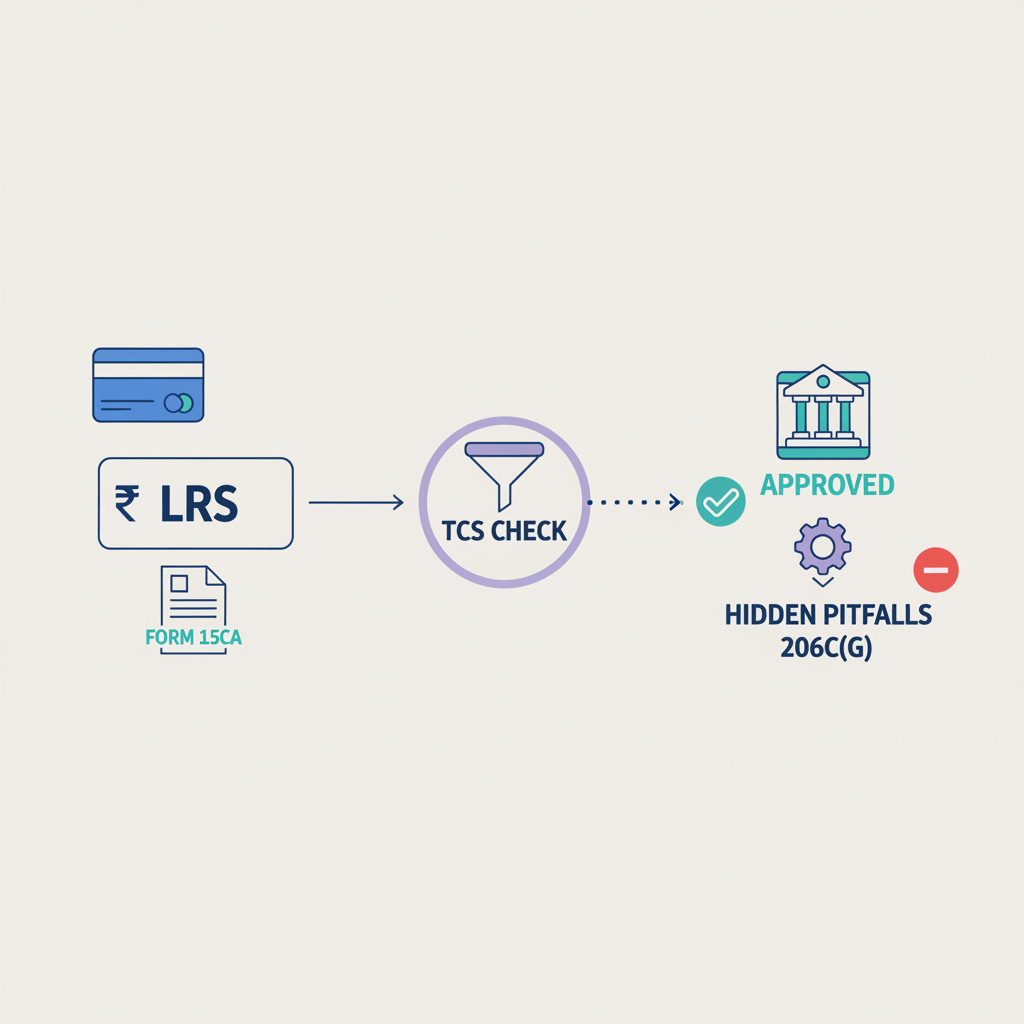
TCS (Tax Collected at Source) under Section 206C(1G) is a prepaid tax mechanism. Banks collect it upfront on eligible foreign remittances and deposit it with the government. It’s credited against your final tax—if TCS collected exceeds your tax liability, you get a refund. A concise overview is available in this Wise explainer on TCS and foreign remittance.
Think of TCS as an advance on your tax bill, not an extra tax.
Thresholds and rates: the core rules
Under the RBI’s Liberalised Remittance Scheme, Indian residents can remit up to USD 250,000 annually for permitted purposes; see this LRS guide for context. As of Budget 2025, the TCS exemption threshold rose to ₹10 lakh per financial year, as summarized by Bajaj Finserv.
- Education funded by a specified loan: 0.5% TCS on amounts above ₹10 lakh.
- Self-funded education: Nil up to ₹10 lakh; 5% on the excess.
- Medical treatment: Nil up to ₹10 lakh; 5% on the excess.
- Overseas tour packages: 5% up to ₹10 lakh; 20% above that, collected by the tour operator at booking, per Razorpay’s breakdown.
- Other purposes (gifts, investments, property): Nil up to ₹10 lakh; 20% on the excess.
The critical aggregation rule
Your ₹10 lakh threshold is cumulative across all banks and purposes under your PAN. You don’t get separate limits for education, medical, and investments—everything aggregates. A clear explainer is here: PAN-level aggregation for LRS TCS.
Example: ₹6 lakh (education) in June + ₹5 lakh (property deposit) in November = ₹11 lakh total. The ₹1 lakh excess in “other purposes” can attract 20% TCS.
Understanding LRS linkage: what bringing credit cards under LRS means
Budget 2023–24 proposed treating international credit card transactions as LRS remittances. If enforced, every foreign currency card charge would count toward your ₹10 lakh limit and, above it, typically attract 20% TCS. See this summary: 20% TCS on international credit card spends (proposal).
Current status: The classification of international credit card use while overseas as LRS is postponed. No TCS on such spends till further orders, per this ClearTax update. This does not affect TCS on tour packages booked from India, as noted by Razorpay.
Why the deferral? Operational complexity and cash flow impact have been cited; see context here: Card-to-LRS deferral context.
“No TCS shall be applicable on expenditure through international credit card while being overseas till further order.” — Government clarification cited by ClearTax
How TCS on credit card foreign spend would work if enforced
What counts as foreign spend? Any transaction settled in non-INR or with a merchant outside India, including DCC. Domestic INR invoices by Indian entities do not count. Practical distinctions are covered in this Razorpay guide.
- Bank tracking: Cumulative by PAN, across all cards and issuers—no separate limits per bank, as clarified by ClearTax.
- Collection timing: At settlement, typically within 2–3 business days; TCS appears in 26AS for ITR, per this mechanics explainer.
- Supplementary/joint cards: Usually aggregate under the primary holder’s PAN; confirm with your issuer. See notes here: Supplementary card aggregation.
Practical examples
Example 1: Freelancer paying ₹1 lakh for SaaS tools. Under current rules: no TCS while overseas. If linkage is enforced: counts toward ₹10 lakh; still no TCS if total stays below threshold. Reference: Razorpay clarifications.
Example 2: Developer spends ₹9.5 lakh across cloud and SaaS. Under current rules: no TCS. If enforced: still under ₹10 lakh—no TCS. Context: Razorpay.
Example 3: Same developer adds ₹1.5 lakh conference, total ₹11 lakh. If enforced: 20% TCS on excess ₹1 lakh = ₹20,000; creditable in ITR. Threshold reference: Bajaj Finserv.
Example 4: Tuition ₹25 lakh, self-funded. If enforced: nil up to ₹10 lakh; 5% on ₹15 lakh = ₹75,000. Loan-funded rate would be 0.5%. Rates per Bajaj Finserv.
Example 5: Tour package ₹8 lakh booked from India. 5% TCS = ₹40,000, collected by the tour operator today. Details: Bajaj Finserv.
Example 6: INR reseller vs USD parent billing. INR-billed by an Indian reseller avoids LRS and TCS; USD-billed could count if linkage is enforced. See examples in Razorpay’s guide.
Example 7: Corporate card vs personal card. Corporate card spends track to company PAN; personal card to your PAN. Limits do not combine. Aggregation explained by ClearTax.
How to manage, verify, and claim TCS
Where to check: Your card statement and your 26AS/AIS on the ITR portal show TCS entries. How it appears is discussed in this ClearTax guide.
Claiming credit in ITR: Use Schedule TCS and enter values exactly as in 26AS; a step-by-step is here: TCS refund/credit process. Excess TCS becomes a refund post processing.
Quarterly checks: Best practice is to verify 26AS every quarter to catch mismatches early, per Razorpay’s recommendation.
- Common fixes: Link PAN to all cards; follow up if 26AS doesn’t show a bank-reported TCS in 30–45 days; provide education/medical proofs to access concessional rates; request consolidated spend reports across cards. Resources: ClearTax mechanics.
Edge cases and clarifications
- Education/medical documentation: Keep invoices, admission letters, and hospital records; see requirements in Bajaj Finserv’s explainer.
- Nepal/Bhutan, DCC: Transactions settled in non-INR can still be foreign spends; see notes in Razorpay and MoneyHop’s guide.
- Forex/debit cards: Prepaid forex load counts as remittance; subsequent spends draw down the loaded amount, per ClearTax.
- NRIs/NRE/NRO: Rules differ; consult your bank/CA—overview here: ClearTax on NRI remittances.
- HUFs/minors: Separate PAN, separate limits for HUFs; minor cards usually map to guardian PAN; more in MoneyHop’s note.
Impact and tips for freelancers
Typical spend bands: SaaS (₹2–5L), cloud (₹3–8L), courses (₹1–3L), events (₹1–2L). Many hover near ₹10L. Plan proactively.
- Purpose tagging and records: Keep your own ledger by category; helps fix misclassified TCS. See purpose-wise rate reference.
- Single-card strategy: Concentrate spends to track the threshold; verify quarterly via 26AS as Razorpay suggests.
- Stagger big renewals: Split across financial years where feasible; more tips in MoneyHop’s guide.
- Prefer INR billing: Where available, opt for Indian resellers to avoid LRS, per Razorpay.
- Cash flow buffer: If linkage is enforced, TCS is upfront; refunds arrive post ITR processing—timelines in ClearTax’s guide.
Tools for receiving international payments
If you’re receiving client payments from abroad, consider dedicated platforms. Karbon Business offers multi-currency accounts (USD, GBP, EUR, CAD), local transfers, 24–48 hour INR settlement, auto e-FIRA, and a flat 1% platform fee with zero FX markup—built for Indian freelancers. Alternatives include Wise Business, Payoneer, PayPal, and RazorpayX; compare fees and settlement times for your use case.
Important disclaimer
This guide reflects the regulatory status as of January 2026. Card-to-LRS linkage is postponed, not scrapped. Always cross-check latest circulars and your 26AS/AIS. Source recaps: TCS/LRS status, thresholds and rates, and LRS overview.
FAQ
Is TCS on my international credit card spend active today or not?
No, as of January 2026, TCS on international credit card spends made while you are physically overseas is postponed. You should not see TCS for such spends. Tour packages booked from India still attract TCS. Keep checking your 26AS and CBDT updates for any change, as summarized here: current TCS status.
What is the ₹10 lakh TCS threshold and how does it work for freelancers?
The first ₹10 lakh of eligible foreign remittances in a financial year is exempt from TCS; amounts above it can attract TCS depending on purpose. This threshold is cumulative per PAN across all banks and cards. See details in this explainer and aggregation notes in this guide.
If I spend ₹8–9 lakh annually on SaaS and cloud using my card, will I be charged TCS?
Not under current rules for overseas spends. Even if card-LRS linkage is enforced later, you’re still below ₹10 lakh, so no TCS would apply unless your total crosses the threshold. Reference: practical scenarios.
How do I check if any TCS got deducted accidentally on my card?
Check your monthly card statement for a separate TCS line item and verify your 26AS/AIS on the Income Tax portal. If a bank collected TCS, it should reflect in 26AS within 30–45 days. Steps are outlined here: verify TCS in 26AS.
Can I get a refund of TCS if my income is below the taxable limit?
Yes. TCS is a credit. File your ITR and claim it under Schedule TCS. Any excess over your final tax is refunded to your bank account. See a simple walkthrough here: claiming TCS credit in ITR.
What’s the difference between TCS on direct outward remittances vs card spends?
Direct bank remittances above ₹10 lakh attract TCS today at applicable rates. Card spends would attract TCS only if and when the government enforces card-to-LRS linkage. Both would aggregate under the same ₹10 lakh PAN-level limit. Read more here: TCS on foreign remittance and here: LRS aggregation.
Do supplementary cards used by my spouse count toward my ₹10 lakh limit?
Yes, if the supplementary card maps to your PAN, those spends aggregate into your limit. Confirm mapping with your issuer to avoid surprises. More on aggregation: ClearTax guide.
I’m an NRI using an NRE account—does this TCS rule still apply to me?
NRI remittance rules differ from resident rules. NRE accounts hold foreign income and may be treated differently under LRS/TCS. Consult your bank/CA for your case. Background: NRI remittance overview.
I pay for an online course $500 per month; will I be charged 5% TCS for education?
Not currently for overseas card spends. If linkage is enforced in future and your total annual foreign spends exceed ₹10 lakh, education spends over the threshold would attract 5% (0.5% if funded via a specified education loan), subject to documentation. See rate bands in this explainer.
I booked a ₹9 lakh Europe tour from an Indian company—how much TCS?
5% on ₹9 lakh, i.e., ₹45,000, collected by the tour operator at booking. You can claim it in your ITR as a credit. Reference: tour package TCS.
How can I avoid sudden TCS cash-flow hits if rules change mid-year?
Track cumulative spends monthly, prefer INR-billed resellers for large subscriptions, and stagger big renewals across financial years. Quarterly check your 26AS. If you receive export income, streamline cash flows with platforms like Karbon Business that offer quick INR settlement and e-FIRA, so refunds and taxes are easier to manage.
Which platform is good for receiving international client payments to India with compliance sorted?
Many freelancers prefer Karbon Business for multi-currency accounts (USD, GBP, EUR, CAD), local collection, 24–48 hour INR settlement, and automatic e-FIRA, all with a transparent 1% platform fee and zero FX markup. It helps keep inbound compliance clean while you manage outbound card spends and any TCS obligations separately.
