



Key takeaways
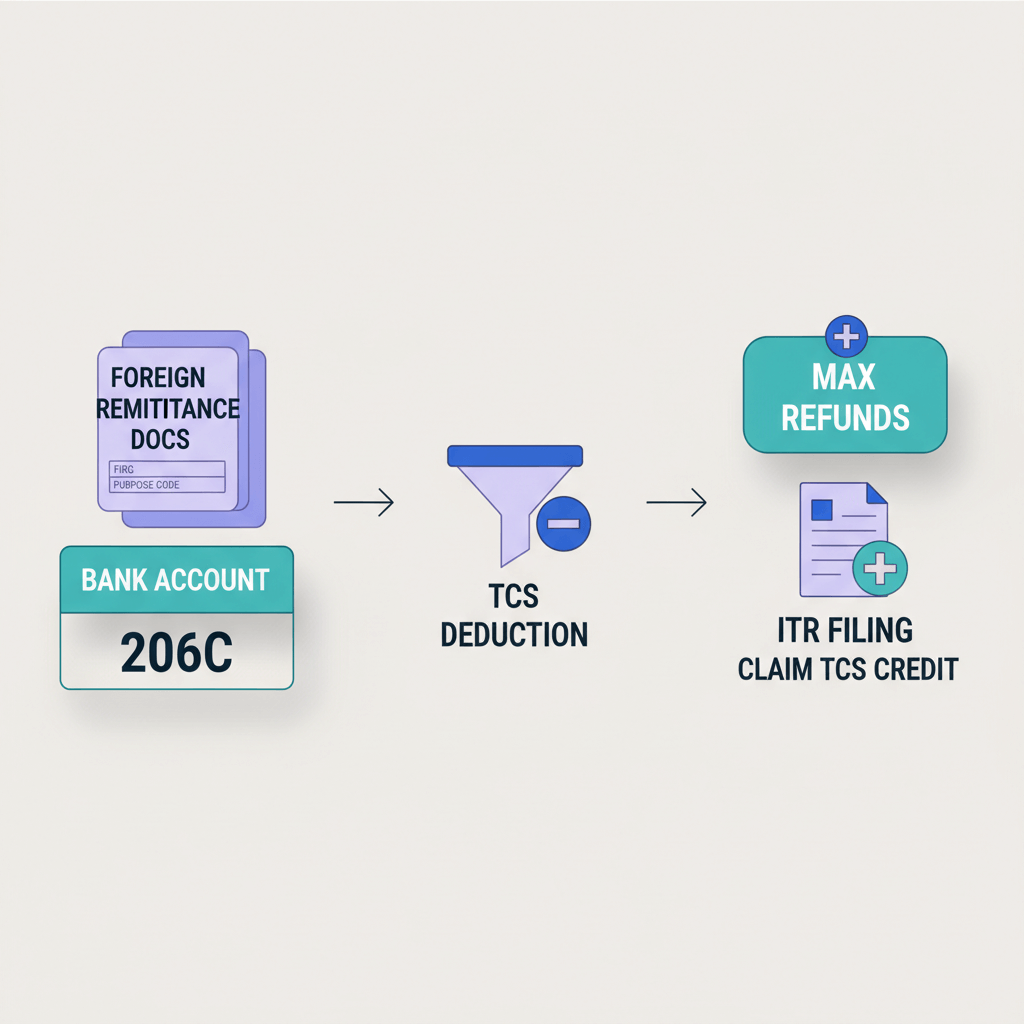
- TCS on outward foreign remittance under LRS is an advance tax, you can claim it as credit in your ITR and get a refund if your liability is lower.
- From FY 2025-26, the annual threshold is INR 10 lakh, 0% on education via approved loans, 5% on education or medical beyond the threshold, 20% on other LRS purposes once you cross the threshold.
- Inbound client payments do not attract TCS, this guide applies only to outward remittances you send abroad.
- Use ITR-3 if you are a freelancer, claim TCS in the Taxes Paid, TCS tab, under section 206C(1G), verify entries against Form 26AS, Part F.
- Refunds typically arrive within 7 to 45 days after e-verification, delays occur if AIS or 26AS mismatches exist or your bank account is not pre-validated.
- Check purpose codes on remittances, incorrect classification can change TCS rates, get your bank to fix errors before filing.
- Keep bank challans, Form 27D, 26AS and AIS proofs, and invoices for at least six years, strong records make compliance painless.
- For a broader context, see full TCS overview and latest changes, and tax on foreign remittance.
Who needs to claim TCS credit and why it matters
This guide is for freelancers, consultants, and solo founders who use bank outward remittances for foreign expenses. Maybe you paid for Adobe subscriptions, sent money to relatives abroad, booked an international training course, or transferred funds for a business trip. Banks deduct TCS on these outward remittances, which locks up your cash until you claim credit in your ITR, recovering this money helps keep your cash flow healthy.
Important clarification: inbound payments from foreign clients, the money you receive for your work, do not attract TCS. When clients pay you via platforms or bank transfers, there is no TCS, this guide covers only outward remittances under LRS, when you send money abroad. For background, see tax on foreign remittance.
Understanding TCS on foreign remittance under LRS
TCS is an advance income tax that banks and authorised dealers collect on your behalf when you send money abroad under RBI’s Liberalised Remittance Scheme. It is not a penalty or an extra charge, think of it as a prepayment of your income tax, which you can claim back when filing your return.
Current TCS thresholds and rates, applicable from FY 2025-26 onwards:
- The annual threshold is INR 10 lakh, TCS applies only if your total outward remittances in a year exceed this amount.
- 0% on education expenses funded through loans from specified institutions under section 80E.
- 5% on education or medical expenses, not loan funded, exceeding the threshold.
- 20% on all other LRS purposes, software subscriptions, gifts, travel packages, investments, or maintenance of relatives abroad, after crossing the threshold.
- Most overseas credit card spends are currently excluded from TCS, this provision has been postponed until further notice.
For a plain language explainer, see TCS on foreign remittance, and for policy context, review the full TCS overview and latest changes.
What qualifies as LRS foreign remittance? Cumulative outward bank transfers for permitted purposes during the financial year count toward the threshold. Direct credit card payments may not qualify as LRS remittances, depending on your bank’s classification, always check your bank’s categorisation. If you remit 6 lakh in July and 5 lakh in January, that is 11 lakh total, TCS applies on the excess 1 lakh at the applicable rate.
Documents you will receive include a bank TCS challan or acknowledgement, entries in Form 26AS, and sometimes Form 27D, the TCS certificate.
How to claim TCS credit on foreign remittance in your ITR, step-by-step
Claiming TCS credit is straightforward once you know where to click and what to enter.
Choose the right ITR form:
- ITR-1 for salaried individuals with simple income sources.
- ITR-2 for those with capital gains, no business income.
- ITR-3 for freelancers and consultants with business or professional income.
For education remittance nuances, see TCS on foreign remittance, education.
Preparation checklist:
- Ensure your PAN, used for the remittance, is linked to Aadhaar and active.
- Pre-validate your bank account in the e-filing portal, refunds rely on this step.
- Verify that your TCS appears in Form 26AS or the AIS.
Steps on the Income Tax e-Filing Portal:
- Login to incometax.gov.in.
- Go to e-File, Income Tax Returns, File Income Tax Return.
- Select the Assessment Year, for example AY 2025-26 for FY 2024-25, choose ITR-3 if applicable, and use pre-fill.
- Fill income schedules, freelancers should complete business or professional income.
- Open the Taxes Paid section, click the TCS tab.
- If auto-populated, verify amounts and collector details.
- If manual entry is needed, add Collector TAN, TCS amount, year of collection, and section code 206C(1G).
- Review total tax liability, the system subtracts TDS, advance tax, and TCS credits, excess becomes refund.
- E-verify using Aadhaar OTP, net banking, or other approved methods.
Example: you remit INR 15 lakh for travel and subscriptions, your bank collects TCS at 20% on the excess above 10 lakh, that is 5 lakh, TCS collected is INR 1 lakh. Your tax liability is INR 80,000, TCS credit offsets it, you receive INR 20,000 as refund. For reference, read TCS on foreign remittance, tax.
Tip: if AIS shows entries that 26AS does not, acknowledge or correct via AIS feedback, then file or revise your return once data aligns.
Where to see TCS details in Form 26AS
Form 26AS is your consolidated tax statement. To view TCS:
- Login to incometax.gov.in.
- Go to e-File, View Form 26AS, or access via TRACES.
- Open Part F, Details of Tax Collected at Source.
- Check Collector TAN, collector name, TCS amount, date, booking status.
Cross-check against AIS or TIS under Services, Annual Information Statement. If mismatches exist, use the AIS feedback mechanism, or wait for your bank’s quarterly update. For a refresher, see TCS on foreign remittance.
Refund timeline and what to expect
Typical timeline: 7 to 45 days after e-verification, assuming matching data and a pre-validated bank account. Faster processing often happens outside peak season.
Quarterly TCS reporting matters: banks deposit TCS by the 7th of the following month, file Form 27EQ by the 15th after quarter end, 26AS updates one to two months later, a March remittance may reflect only by May or June.
Track refund status in My Account, Refund or Demand Status. If delayed, raise a grievance. For a practical view, check TCS on foreign remittance, tax.
Common issues when claiming TCS credit and how to fix them
- TCS not showing in 26AS or AIS: wait for quarterly updates, request Form 27D or a copy of your bank’s 27EQ filing, escalate via TRACES if needed.
- PAN or TAN mismatch: ask the bank to correct and refile, claim once 26AS reflects the fix.
- Wrong section code: TCS on foreign remittance is under 206C(1G), revise ITR if you entered another section.
- Multiple banks: enter each TCS entry separately with each Collector TAN.
- Refund not credited: pre-validate the bank account, ensure name and account match PAN records, e-verify your return.
- AIS and 26AS mismatch: respond via AIS feedback, then file or revise when aligned.
- Inbound vs outward confusion: TCS applies only to outward remittances, inbound client payments do not attract TCS.
Edge cases and special situations for freelancers
- Purpose code matters: banks tag LRS transfers by purpose, S0101 for education, S0201 for medical, S0301 for travel, rates vary by code. Verify and correct if needed, refer to the purpose code list for outward remittance.
- Travel packages vs direct bookings: travel packages via bank remittance usually attract TCS beyond the threshold, direct card bookings may be outside TCS, confirm with your bank.
- Software subscriptions: bank wires can attract TCS, international credit card payments may not, check whether TCS was actually collected.
- No tax liability: if income is below the taxable threshold, you will receive the full TCS amount as refund.
For NRI taxation context that often intertwines with freelancer flows, see NRI remittance taxation.
Compliance and record keeping checklist
Maintain records for at least six years:
- Bank TCS challans or acknowledgements.
- Form 27D if issued.
- Form 26AS and AIS screenshots or PDFs.
- Invoices, payment proofs, and purpose declarations for each remittance.
- Collector TANs for each bank, to cross-reference entries.
Good documentation ensures quick filing and easy resolution if scrutiny occurs. For quick reminders, revisit TCS on foreign remittance.
Tools and platforms to simplify international payments for freelancers
Receiving money from foreign clients is separate from outward remittances. When you need a reliable inbound solution, explore options and choose what aligns with your volume and compliance needs.
- Karbon Business, see Karbon Business, offers virtual business accounts in USD, GBP, EUR, and CAD, local transfers, INR settlement in 24 to 48 hours, automatic e-FIRA in 24 hours, a flat 1% platform fee with zero FX markup at mid-market rates, and the ability to hold foreign currency up to 60 days.
- Wise Business, Payoneer, PayPal, and RazorpayX International are common alternatives with different fees and features.
Inbound payments do not attract TCS, optimise receivables separately from managing outward remittance compliance.
A quick note for Karbon Business users
If you use Karbon Business to receive client payments, inbound transfers do not attract TCS. Karbon generates e-FIRA within 24 hours, useful for ITR filing and compliance. Handle outward expenses, subscriptions, travel, or gifts, via bank remittances, TCS applies only to those outward LRS transfers.
Final thoughts, getting your money back without stress
Claiming TCS credit on foreign remittance in your ITR is simpler than it looks. Verify TCS in Form 26AS, Part F, enter details under section 206C(1G) in the TCS tab, e-verify your return, and track refund status. Most refunds arrive within 7 to 45 days, mismatches are solvable through AIS feedback or bank corrections. Keep records tight, file on time, and escalate grievances when needed, your hard earned money should not remain locked up.
For further reading, check TCS on foreign remittance, education and the Razorpay explainer on TCS for foreign remittance.
Pro move: plan your LRS spends, keep totals under the annual threshold where practical, and ensure purpose codes are accurate, that alone can save real money and stress.
FAQ
How to claim TCS credit in ITR if I am a freelancer sending money abroad for software subscriptions?
Use ITR-3, go to Taxes Paid, TCS, verify entries against Form 26AS, Part F, or add manually with your bank’s Collector TAN and section 206C(1G). The credit will offset your tax liability, excess becomes a refund.
My bank deducted TCS on outward remittance, but 26AS shows unmatched, what should I do?
Wait for it to change to matched after the bank files Form 27EQ and the department processes it, if it remains unmatched, ask your bank to correct the PAN or TAN and provide Form 27D, then claim in your ITR.
What is the TCS threshold now, will small transfers trigger TCS?
The threshold is INR 10 lakh per financial year, small transfers below the threshold do not attract TCS, once cumulative remittances exceed the threshold, applicable rates kick in.
Do international credit card payments for tools like Figma or AWS attract TCS?
Most overseas card spends are currently outside TCS scope, classification can vary by bank, check your statement. If TCS was not collected, there is nothing to claim for those transactions.
I paid for an overseas course, some part via education loan, some via savings, how does TCS apply?
Education funded via approved loans is 0%, amounts you pay beyond the threshold from savings are 5%, claim whatever TCS the bank collected in your ITR under 206C(1G).
Which ITR form should freelancers choose to claim TCS, ITR-1 or ITR-3?
Freelancers generally use ITR-3 because it covers business or professional income, ITR-1 does not support such income, filing ITR-3 ensures the TCS tab and schedules work correctly.
Can I get full TCS refund if my income is below taxable limit this year?
Yes, if your total tax liability is zero after deductions, the entire TCS amount shows as refund, make sure your bank account is pre-validated and e-verify your return for timely credit.
My remittance purpose was wrongly tagged by the bank, will the TCS rate change, how to fix?
Purpose codes drive rates, ask your bank to correct the code, S0101 for education, S0201 for medical, S0301 for travel, then ensure 26AS reflects the correct TCS before filing.
How do I receive international client payments without worrying about TCS, any platform suggestions?
Inbound payments do not attract TCS, for a streamlined experience, Indian freelancers often use Karbon Business for USD or EUR receiving accounts, quick INR settlement, and automatic e-FIRA.
What documents should I keep ready if the tax department asks for proof of TCS credit?
Maintain bank challans, Form 27D if available, Form 26AS and AIS screenshots, invoices and purpose declarations, and Collector TAN references for each bank, these support your claim fully.
How fast are ITR refunds for TCS credits, can I track status easily?
Refunds generally arrive within 7 to 45 days post e-verification, track status in the e-filing portal under Refund or Demand Status, raise a grievance if delays exceed typical timelines.
If I use Karbon Business to receive client payments in USD, do I have to report anything special for TCS?
No TCS on inbound funds, report your professional income normally in ITR-3, use the e-FIRA that Karbon Business provides for compliance documentation, claim TCS only on outward remittances under LRS.
I sent money abroad from two banks this year, how to add TCS entries correctly?
Add each bank’s TCS entry separately in the TCS tab, with the specific Collector TAN and amounts, verify both entries in 26AS, Part F, before filing.
What if AIS shows TCS but 26AS does not, should I still claim?
Use AIS feedback to confirm the entry, you can proceed with claim if details are correct, be ready to revise once 26AS updates, keep bank challans and Form 27D as backup.
Does booking a travel package via bank wire trigger TCS compared to booking tickets on an international card?
Travel packages via bank remittance generally fall under LRS and can attract TCS beyond the threshold, direct card bookings may be outside TCS, check your bank’s classification before claiming.
Can I offset both TDS and TCS together against my total tax, any special steps?
Yes, the portal nets your total tax against TDS, advance tax, and TCS credits automatically, just ensure all entries are accurate, especially section 206C(1G) for TCS on outward remittance.
