

Key takeaways
- Indian creators on Patreon can withdraw via PayPal or bank transfer through Payoneer, with total timelines of roughly 5 to 10 business days end-to-end.
- For higher INR per USD, Payoneer bank transfer usually beats PayPal thanks to lower FX spread and clearer e-FIRA or FIRC documentation.
- Always track the effective conversion rate against the mid-market rate, for example on Xe.com, to spot hidden costs.
- Keep compliance airtight: obtain an e-FIRC or e-FIRA document, and record purpose code P0802 for creative services.
- Batch withdrawals, choose USD as settlement, and avoid double conversions to reduce fees.
- Use PayPal for speed on small amounts, Payoneer for better rates on larger payouts, and consider Karbon Business for non-Patreon client payments at a flat 1% with mid-market FX and auto e-FIRA.
- Verify names, PAN, and bank details match across Patreon, PayPal or Payoneer, and your bank to prevent payout rejections.
Understanding your Patreon payout India options
Creators in India don’t get direct Stripe ACH. Your two practical routes are PayPal and bank transfer via Payoneer. Both require you to meet a minimum balance, usually $10+, and you can choose automatic monthly payouts or manual withdrawals. If you change a payout method, Patreon adds a short security hold, typically around five days, before releasing funds. For official mechanics, see How payouts work.
From request to rupees in hand, expect roughly a week to ten days. Patreon first processes the payout, then your provider routes funds to your Indian bank. Your earnings accrue in USD unless you change currency. The INR conversion happens at payout, and the rate depends entirely on your chosen method.
For compliance, treat Patreon income as export of services under FEMA. Secure an e-FIRC or e-FIRA document from your provider or bank, ensure PAN and Aadhaar are linked, and record purpose code P0802 for creative services. Name mismatches across Patreon, your payout account, and your bank can trigger holds or rejections. Also see Payouts guide for creators outside of the US.
PayPal vs transfer: which withdrawal method wins for Indian creators?
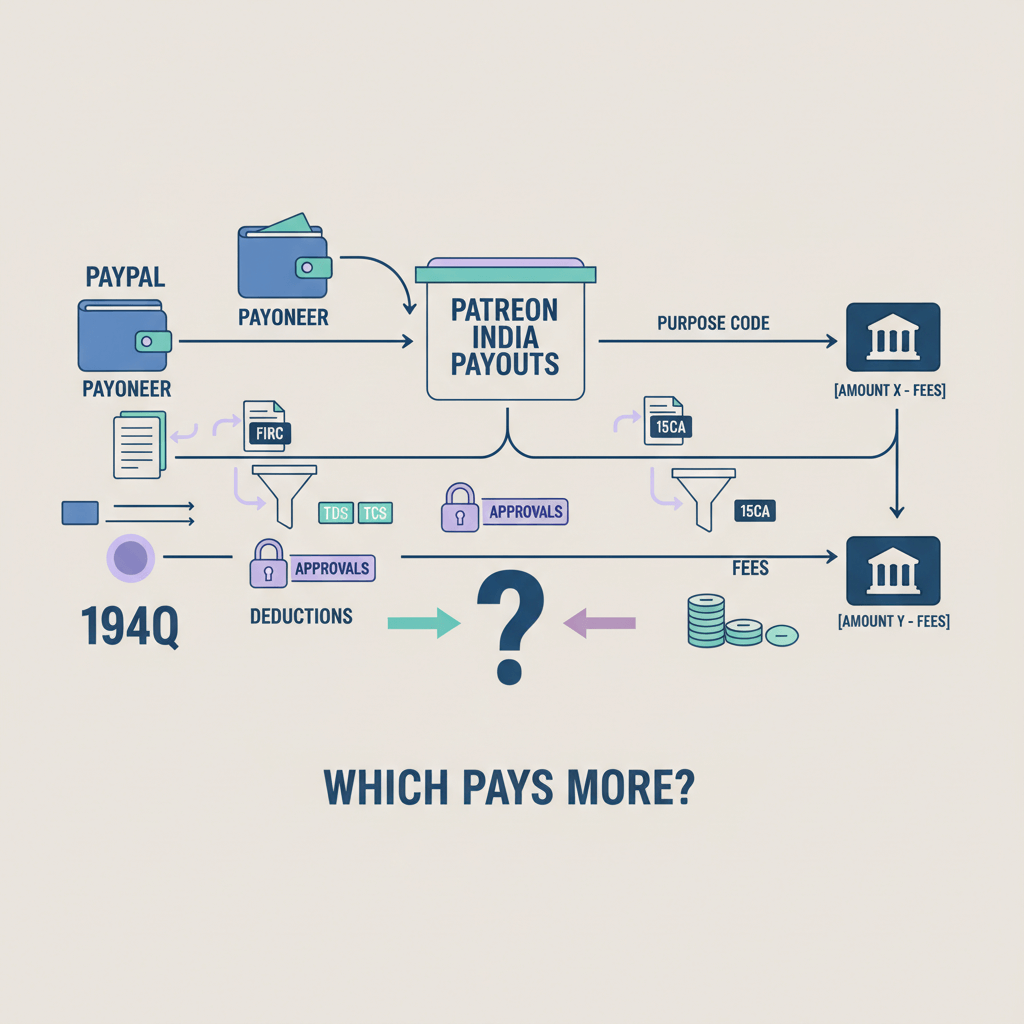
PayPal is quick and familiar, often paying out within 1 to 3 days after Patreon releases funds. It’s convenient for small, frequent withdrawals. However, expect a hefty FX markup, usually 2% to 4% above mid-market, plus cross-border and withdrawal fees. KYC has tightened, which can mean periodic holds. Clean e-FIRC trails can be harder to obtain.
Payoneer bank transfer usually offers better conversion and smoother compliance because funds arrive as a standard international remittance. Many creators like the option to hold USD and convert later. Downsides include a withdrawal fee and occasional intermediary bank charges, and the process can take 3 to 7 days.
Rule of thumb: PayPal wins on speed for small, urgent payouts, while Payoneer wins on total value for larger, planned withdrawals.
Example: On a $1,000 gross month, you might net $850 to $900 after Patreon’s platform and processing fees. If you then use PayPal, you could end up with about ₹75,000 to ₹78,000. With Payoneer, you might receive ₹78,500 to ₹80,000. That’s a ₹2,000 to ₹5,000 difference per month, compounding as your payouts grow. For updated payout mechanics and timelines, see Payouts guide for creators outside of the US.
Breaking down fees and conversion costs
Platform-level fees: Patreon takes its platform fee before payout. Depending on your plan, that’s 5% to 12%, plus around 2.9% processing. These are unavoidable. For upcoming changes, check the official note on standard platform fee.
PayPal: Expect cross-border fees (often 4.4% + fixed) and a 3% to 4% currency spread versus the mid-market rate. A small bank withdrawal fee may apply when you move funds to your Indian account.
Payoneer: Typical spread of 0.5% to 2% plus a withdrawal fee. Watch for intermediary SWIFT charges and any incoming wire fee your Indian bank applies.
Pro tip: Don’t let funds convert USD → EUR → INR. Double conversions quietly erode your INR. Keep it USD straight to INR. For payout basics, see How payouts work.
Step by step: setting up your Patreon payout India account
Setting up PayPal for Patreon payouts
Create or verify an Indian PayPal account, complete export KYC, and map purpose code P0802. Check if your country is supported in PayPal supported countries. Inside Patreon, go to Settings → Billing → Add PayPal, and confirm via the verification email. Test with a small payout first to catch name or bank issues. Save statements to assist your bank in issuing e-FIRC if PayPal does not auto-provide it.
Setting up Payoneer for bank transfer
Open a Payoneer account with valid ID, proof of address, and Indian bank details. Ensure your Payoneer name matches your bank name exactly. In Patreon, Settings → Billing → Add Payoneer, then request payout. After funds land, download your Payoneer transaction record and obtain e-FIRA from your bank if needed. For official payout setup steps, see Paying out your earnings.
Tip: Batch withdrawals to reduce fixed-fee impact, and keep PAN, Aadhaar, and names consistent across all systems.
Optimizing conversion rates to maximize your INR
- Batch withdrawals monthly, not weekly, so flat fees bite less.
- Stick to USD settlement end-to-end, then convert to INR only once.
- Time payouts on weekdays, ideally early in the week, to avoid weekend lag and poorer off-hour rates.
- Measure your effective rate against the mid-market rate on Xe.com. If spread exceeds ~2% to 3%, reconsider timing or provider.
- Hold USD judiciously in Payoneer if you’re waiting for a stronger INR day, staying within FEMA norms and your CA’s guidance.
- Set a minimum withdrawal threshold ($50, $100, or more) to keep fee percentage low.
- Keep a simple tracker mapping Patreon USD, net received, INR credited, and effective rate for each payout. For official payout context, revisit Payouts guide for creators outside of the US.
Troubleshooting common Patreon payout India problems
Account holds or KYC checks: Keep screenshots of your Patreon page, content samples, and patron communications ready. Respond quickly to lift holds faster.
Name mismatches: Align your legal name across Patreon, PayPal or Payoneer, and your bank down to spacing and initials before retrying the payout.
Missing e-FIRC or e-FIRA: Check your payout dashboard for documents, then contact your bank’s FX team with transaction details and request the certificate. RBI compliance supports your request.
Unexpected fee deductions: Compare breakdowns from Patreon, your provider, and your bank. Intermediary bank fees can appear as separate deductions. Raise a ticket with transaction IDs if figures seem off.
Sanctions or compliance flags: Ensure all KYC is complete and the purpose code is P0802. If needed, ask Patreon support to share payout proof. See How payouts work for documentation touchpoints.
Delays beyond 10 business days: Confirm dispatch with Patreon, confirm receipt with PayPal or Payoneer, then request an inward remittance trace from your bank.
Exploring alternatives for non-Patreon client payments
If you also earn from direct clients, sponsors, or commissions, you can decouple from Patreon’s limited options. Among India-first solutions, Karbon Business offers virtual USD, GBP, EUR, and CAD accounts so clients pay you locally, then funds settle to INR in 24 to 48 hours at the mid-market rate with a flat 1% fee, zero FX markup, and auto e-FIRA within 24 hours. You can hold currency briefly to time conversion, and manage everything in one dashboard.
Alternatives include Wise Business, Payoneer for direct invoicing, PayPal for client preference, Razorpay X International, Tazapay, OFX, WorldFirst, or Revolut Business (availability varies). Match the tool to your workflow, payout sizes, and compliance needs. For a creator-centric overview, see this primer on how to receive payments on Patreon.
Quick decision framework: choosing your best withdrawal method
- Lowest fees + clean compliance: Pick Payoneer bank transfer, especially for $100+ payouts.
- Speed for small amounts: Use PayPal when cash flow is urgent.
- Mixed income streams: Route Patreon via Payoneer, client payments via Karbon Business or a similar India-first solution.
- Just starting out: Begin with PayPal, switch to Payoneer as payouts grow. Recheck fees every quarter.
FAQ
Which is better for Patreon payout India, PayPal or Payoneer?
For most Indian creators, Payoneer bank transfer gives better INR per USD due to lower FX spread and clearer e-FIRA or FIRC. PayPal can still make sense if you need speed on small payouts, say under $100, and value immediate availability over a few percentage points in fees.
How do I calculate the real exchange rate I am getting on my Patreon withdrawals?
Divide the INR that hit your bank by the USD that left Patreon, then compare with the mid-market rate on a tool like Xe at the time of conversion. If your effective rate is 2% to 4% below mid-market, you are paying a typical wallet spread; Payoneer often narrows that gap. Maintain a simple sheet to track this monthly.
Do I need an e-FIRC or e-FIRA for filing my ITR on Patreon income?
Yes, your Patreon earnings count as export of services, so keep an e-FIRA or e-FIRC per inward remittance. Payoneer usually makes this easier; with PayPal, you may need to request it through your bank. Having these documents speeds up CA review and reduces compliance queries.
What purpose code should I use for Patreon creator income to India?
Use purpose code P0802, generally mapped to creative and digital services. Ensure the payout provider captures it correctly to avoid bank compliance flags and to keep your export documentation tidy for audit trails.
Can I hold USD for a few days and convert when INR improves?
Yes, platforms like Payoneer allow holding USD briefly. Stay within FEMA norms and your provider’s policy, and consult your CA if you plan on holding large balances or spanning a financial year-end. Timing conversion by even 0.50 INR can add up on bigger withdrawals.
Is there any way to get mid-market FX on client payments outside Patreon?
Yes, consider India-first platforms. For example, Karbon Business offers mid-market FX with a flat 1% fee and auto e-FIRA, which is often 2% to 4% cheaper than typical wallets. Use Payoneer for Patreon, and Karbon for client invoices to optimize overall.
My payout is stuck due to name mismatch, what to do?
Make your legal name identical across Patreon, PayPal or Payoneer, and your bank, including middle names and spacing. Update documents, wait for verification to complete, then retry. If funds bounced, ask your provider’s support for the exact error code and next steps.
How fast will money reach my Indian bank once I withdraw from Patreon?
Budget 3 to 10 business days in total. Patreon takes 3 to 5 days to process; PayPal or Payoneer then take 1 to 5 days to credit your bank. PayPal is usually faster but pricier; Payoneer is slower but tends to pay more in INR.
What is the ideal withdrawal amount and frequency to reduce fees?
Batch monthly if possible. Flat fees dilute on larger amounts, and percentage-based fees hurt less relative to total. Many creators set a personal threshold of $100 to $500 per withdrawal to keep the effective fee percentage low.
Can I receive Patreon money directly to my Indian bank without PayPal or Payoneer?
Patreon currently routes India payouts via PayPal or Payoneer. Direct local bank transfer is not supported. For non-Patreon earnings, you can use alternatives like Karbon Business to receive client payments with local collection accounts and quick INR settlement.
How do I avoid double conversion and hidden spreads on my payouts?
Always keep settlement currency as USD until the final leg, avoid converting USD to a third currency like EUR, and withdraw at market-active times on weekdays. Track your effective rate versus mid-market; if spread creeps up beyond 3%, consider switching methods.
Is PayPal okay for high-value Patreon withdrawals or should I switch?
As payout size grows, PayPal’s percentage-based fees and FX spread compound the loss. Most Indian creators switch to Payoneer for $200+ payouts to improve INR outcomes. Keep PayPal as a backup for urgent, small withdrawals and use Payoneer for planned, larger sums.