Business

Etsy Payouts to India: Stop Losing Money to Fees

Content
share on
Contents
Share On

Key takeaways

  • Set your Etsy shop currency to USD to avoid Etsy’s extra 2.5% currency conversion fee when payouts go to Payoneer in USD.
  • Expect three potential cost layers: Etsy transaction and processing fees, Etsy’s currency conversion (if any), and Payoneer’s USD to INR conversion plus withdrawal fees.
  • Etsy pays Indian sellers every Monday, 11:30 AM ET, 9 PM IST, then Payoneer takes 1 to 3 business days to credit INR to your bank, plan cash flow around this fixed settlement schedule.
  • Batch larger withdrawals from Payoneer to reduce repeated withdrawal fees and get better control of timing.
  • Keep your GSTIN valid, identity verified, and bank details correct, or Etsy may place holds or suspend payouts.
  • Download Etsy CSVs, Payoneer statements, and bank records monthly to reconcile fees, FX, and export documentation (FIRC/e-FIRA).
  • For non Etsy international payments or invoices, consider flexible platforms like Karbon Business for faster settlement, multi currency holding, and automatic e-FIRA.

How Etsy payouts work for Indian sellers

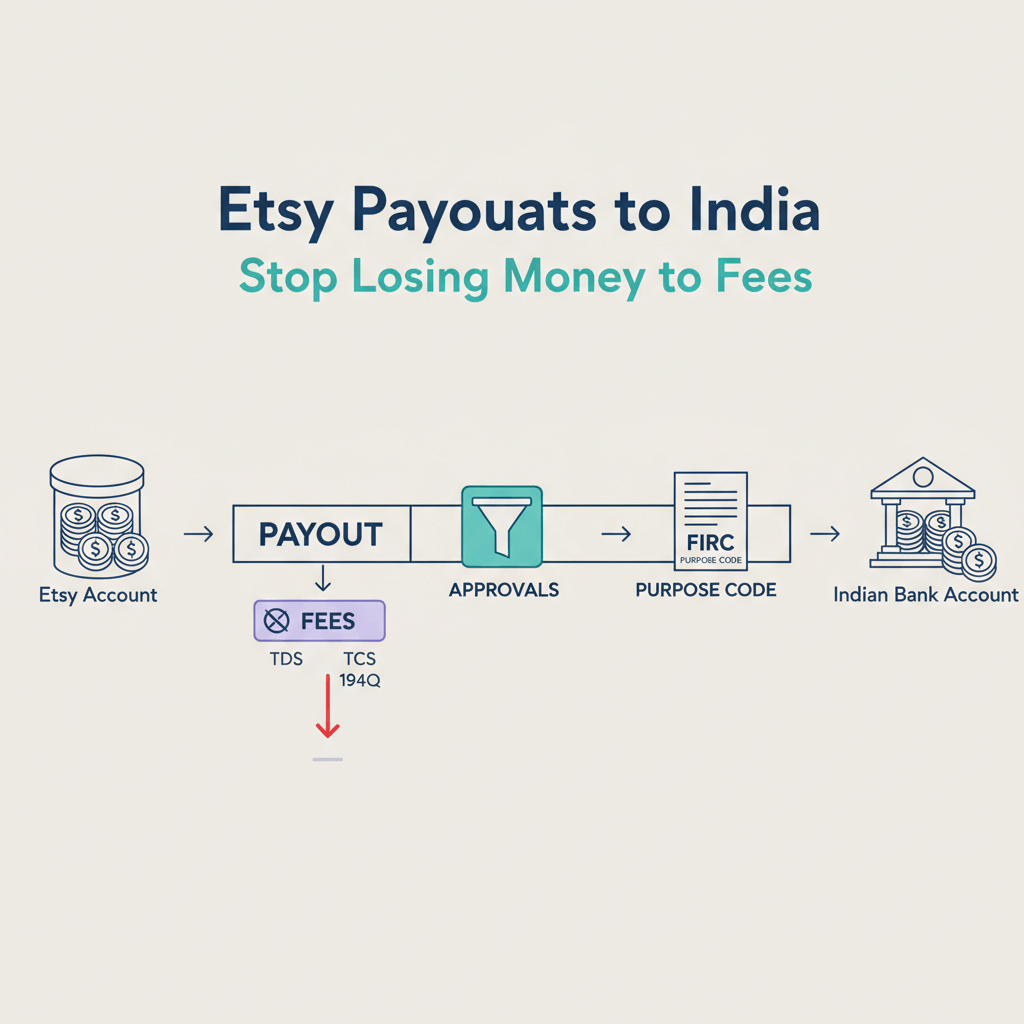
Your buyer pays in their local currency, Etsy settles into your shop currency, fees get deducted, then Etsy forwards USD to your Payoneer account, finally Payoneer converts USD to INR and credits your Indian bank. Each stop can chip away at your earnings, especially when conversions stack.

Your Shop Payment Account shows gross sales minus Etsy’s 6.5% transaction fee, which applies to item price, shipping, and gift wrap. The available balance is what you can expect to move into Payoneer, after processing charges and any currency conversion Etsy applies.

If your shop currency doesn’t match your payout currency, which for India is always USD, Etsy charges an extra 2.5% on the converted amount. New sellers can also see verification holds, especially if your GSTIN is invalid or missing, which freezes cash flow until corrected.

Pro tip: Keep your GSTIN and identity documents up to date, and double check bank details to avoid failed deposits and unnecessary delays.

Official reference: How to Accept Payments as a Seller in India.

Setting up your Etsy payment account India (step by step)

All Indian sellers must use Etsy Payments linked to Payoneer, and Etsy charges a one time $10 setup fee to activate. You’ll need a valid GSTIN under the regular scheme, your PAN, bank details, and identity documents.

  • In Shop Manager, go to Finances, Payment settings, then click Enroll in Etsy Payments.
  • Sign up with or link your Payoneer account. Etsy will only send USD to Payoneer for India based sellers.
  • Add your Indian bank account inside Payoneer. This is where your INR arrives after conversion.
  • Choose your shop currency carefully. To avoid the 2.5% Etsy currency conversion, set your shop to USD so your shop currency matches your payout currency.
Common mistakes to avoid: Invalid GSTIN, mismatched bank details, and listing in INR while payouts are in USD, which triggers Etsy’s 2.5% conversion fee.

Official reference: How to Accept Payments as a Seller in India.

Payout fees: what gets deducted and when

Fees stack in this order: Etsy takes the 6.5% transaction fee and a processing fee of 5% plus ₹25, then if your shop currency differs from USD, Etsy applies a 2.5% conversion fee. After that, Payoneer applies its own conversion and withdrawal fees when moving USD to INR.

Fee TypeRate/DetailsApplied ByExample on $100 Sale
Transaction6.5% of order totalEtsy$6.50
Processing5% + ₹25Etsy~$5.30
Currency Conversion2.5% if shop currency ≠ USDEtsy$2.50 (if INR shop)
Regulatory OperatingVariesEtsyApplied on order total
Withdrawal/ConversionVaries by providerPayoneer1% to 2% typical

On a $100 sale, you might lose $14.30 to Etsy before Payoneer converts. Add Payoneer’s 1% to 2% and you’re near a 15% total haircut if you stack conversions. Batch withdrawals to reduce repeated fees.

  • Confirm Etsy charges in your Payment settings.
  • Check current Payoneer fees in India for USD to INR conversions.
  • Download Etsy payment CSVs to see exact FX rates and fee deductions applied.

Official reference: What are the Fees and Taxes for Selling on Etsy.

Currency conversion: how to avoid losing 2 to 3% margin

Conversion touchpoints: display currency for the buyer, shop currency to USD for payout, and USD to INR via Payoneer. The second and third are where you pay.

  • Set your shop currency to USD to eliminate Etsy’s 2.5% currency conversion fee.
  • Hold USD in Payoneer when the rupee is weak, then convert when rates improve, if it fits your risk tolerance.
  • Batch fewer, larger transfers for better fee efficiency.
Think: buyer pays USD, shop set to USD, Etsy pays USD to Payoneer, Payoneer converts to INR, fewer leaks, cleaner flow.

Official reference: Currency Conversion Fees.

Settlement schedule: timelines, holds, and cash flow planning

Etsy pays every Monday, 11:30 AM ET, 9 PM IST, in USD to Payoneer. Payoneer then takes 1 to 3 business days to settle INR to your bank, depending on bank hours and holidays. New sellers can expect verification holds and document checks that delay initial payouts.

  • Plan expenses around a Monday payout, plus 1 to 3 days for bank credit.
  • Reconcile monthly using Etsy CSVs, Payoneer statements, and bank records.
  • Expect delays around US or Indian public holidays.

Official reference: How to Accept Payments as a Seller in India.

Worked examples (India specific scenarios)

Scenario A: USD shop, US buyers, payout in INR

$100 sale in USD. Etsy deducts 6.5% ($6.50), plus 5% + ₹25 (~$5.30). No Etsy currency conversion since shop currency matches USD. Payoneer converts $88.20 to INR at the current rate, then charges ~1% to 2% withdrawal and FX. You net roughly ₹7,200 to ₹7,250 at ₹83/USD. Total fee impact: ~10% to 12%.

Scenario B: INR shop, global buyers, payout in INR

$100 equivalent sale, shop set to INR. Etsy applies 6.5% and 5% + ₹25, plus a 2.5% currency conversion when preparing USD payout. Payoneer converts USD to INR and charges fees. You lose an extra 2.5% versus the USD shop setup.

Scenario C: Split audience (US and EU buyers)

Shop set to USD for most listings, a few EUR listings as needed. You avoid the 2.5% Etsy conversion on the bulk of sales, and accept small conversion costs on non USD orders. Overall, you keep more margin than running the entire shop in INR.

Official reference: Currency Conversion Fees.

Compliance for Indian sellers (FIRA/FIRC, GST, and bookkeeping)

Track every payout. Etsy provides sales and payout CSVs, Payoneer provides USD receipt and INR credit statements. You will need FIRC/e-FIRA for each inbound payout; Payoneer can provide this.

Guide: e-FIRA/FIRC documents guide.

  • Match Etsy “available for deposit” amounts to USD received in Payoneer.
  • Match INR bank credits to Payoneer’s conversion statement.
  • Record refunds, chargebacks, and reserves separately.
Keep GSTIN valid inside Etsy, or payouts may be suspended until fixed.

Official reference: How to Accept Payments as a Seller in India.

When to consider alternatives for non Etsy payments

If you start taking custom orders, wholesale, or off Etsy invoices, you need more control over currency, timing, and FX costs than Etsy plus Payoneer provides. Consider India focused platforms with faster settlement, better FX, and automatic compliance.

  • Karbon Business: virtual accounts in USD, GBP, EUR, and CAD, INR settlement in 24 to 48 hours, automatic e-FIRA, mid market FX with zero markup, and a flat 1% platform fee. You can hold currency up to 60 days to manage forex risk.
  • Other options to evaluate: Wise Business, Payoneer direct invoices, PayPal, Razorpay X International, Tazapay, OFX, WorldFirst, and Revolut Business, subject to availability and your use case.
If even 20% of revenue is off Etsy, run the math on fees, FX, and speed. The right tool can add back 2% to 4% of margin, which compounds fast.

Quick setup checklist

  • Verify your Etsy Payments with a valid GSTIN and linked Payoneer account.
  • Set shop currency to USD to eliminate Etsy’s 2.5% conversion fee.
  • Plan for the Monday payout at 9 PM IST, then 1 to 3 business days for bank credit.
  • Log all fees: 6.5% transaction, 5% + ₹25 processing, 2.5% conversion (if any), and Payoneer’s FX/withdrawal.
  • Run a small test order and measure end to end time and net INR received.
  • Each month, download Etsy CSVs, Payoneer statements, and your bank statement, then reconcile and file FIRCs.

Official reference: How to Accept Payments as a Seller in India.

FAQ

How do Etsy payouts work for India, and why does my USD reduce before it reaches my bank?

Etsy deducts the 6.5% transaction fee and a 5% + ₹25 processing fee first, then if your shop currency differs from USD, Etsy applies a 2.5% conversion. Etsy sends USD to Payoneer, and Payoneer converts to INR with its own fee and spread before crediting your Indian bank, so your USD amount shrinks across these steps.

Which shop currency should I choose to minimize charges as an Indian Etsy seller?

Set your shop currency to USD. Since Etsy sends payouts to Indian sellers in USD via Payoneer, a USD shop avoids Etsy’s extra 2.5% conversion. You still pay Payoneer for USD to INR conversion, but you skip one layer of fees at the Etsy level.

Can I get daily Etsy payouts in India or change the weekly schedule?

No, the schedule is fixed. Etsy pays every Monday at 11:30 AM ET, 9 PM IST, to Payoneer. After that, Payoneer needs 1 to 3 business days to move INR to your bank. Plan working capital and supplier payments around this weekly cadence.

Why did Etsy place a hold on my first payouts, and how do I clear it?

New accounts often face verification holds while Etsy checks identity and GSTIN. Ensure your GSTIN is valid in Shop Manager, add correct bank details, and respond to any requests for documentation. Once verified, payouts resume automatically.

What is the cheapest way to receive client payments outside Etsy if I am a freelancer in India?

Compare platforms by FX markup, fixed fees, and settlement time. For many freelancers, Karbon Business is compelling: virtual accounts in USD, GBP, EUR, and CAD, mid market FX with zero markup, flat 1% platform fee, 24 to 48 hour INR settlement, and automatic e-FIRA, which can work out cheaper than traditional options.

Do I need FIRC/e-FIRA for Etsy and freelance international payments, and how do I get it?

Yes, FIRCs serve as proof of foreign inward remittance for RBI and tax compliance. Payoneer provides statements for Etsy payouts. For freelance invoices or wire transfers, platforms like Karbon Business auto generate e-FIRA, which simplifies audits and GST filings.

How much does Payoneer charge when converting USD to INR for Indian sellers?

Payoneer typically charges a spread plus possible fees, often around 1% to 2% effective. Check current details here: Payoneer fees in India, then compare your realized rates with your bank credits to know the true cost.

Is GSTIN mandatory for Etsy India sellers, and what if my GSTIN is under composition?

Yes, you need a valid GSTIN under the regular scheme, not composition. If GSTIN is invalid or missing, Etsy may suspend payouts until fixed. Update GST data in Shop Manager under Finances, then Legal and tax info.

How can I reduce currency risk if USDINR is volatile and I’m waiting for a better rate?

Hold USD in Payoneer for a short period if that fits your policy, then convert when rates improve, or use platforms that let you hold and convert on demand. With Karbon Business, you can hold supported currencies for up to 60 days, then settle to INR when the rate suits you.

For off Etsy custom orders, should I use PayPal, Wise, or Karbon Business for better net in hand?

It depends on your ticket size, client country, and currency needs. PayPal is easy but can be expensive for high values. Wise Business is transparent and strong for multi currency. Karbon Business often yields a better net due to zero FX markup, flat 1% platform fee, local collection accounts, and quick INR settlement with e-FIRA.

What documents should I keep monthly to reconcile my Etsy and freelance payouts for taxes?

Keep Etsy payment CSVs, Payoneer statements, FIRCs, bank statements, and invoices. For freelance payments via platforms like Karbon Business, download e-FIRA and account statements, then match USD received to INR credits and record all fees and FX rates for your CA.

Can I list in INR for Indian buyers and still avoid extra fees on international sales?

If your shop is in INR, Etsy charges a 2.5% conversion when preparing USD payouts. If most revenue is international, keep the shop in USD and use currency display for buyers. This usually lowers total fees versus running the entire shop in INR.

How do I know if Etsy or Payoneer is overcharging me on FX?

Download Etsy CSVs to see applied rates and fees, then compare Payoneer’s USD to INR conversion rate to mid market on the same timestamp. Keep a log for each payout. If your blended cost consistently exceeds 2% to 3% post Etsy optimizations, consider alternatives like Karbon Business for better FX and faster settlement.

Key takeaways

  • Set your Etsy shop currency to USD to avoid Etsy’s extra 2.5% currency conversion fee when payouts go to Payoneer in USD.
  • Expect three potential cost layers: Etsy transaction and processing fees, Etsy’s currency conversion (if any), and Payoneer’s USD to INR conversion plus withdrawal fees.
  • Etsy pays Indian sellers every Monday, 11:30 AM ET, 9 PM IST, then Payoneer takes 1 to 3 business days to credit INR to your bank, plan cash flow around this fixed settlement schedule.
  • Batch larger withdrawals from Payoneer to reduce repeated withdrawal fees and get better control of timing.
  • Keep your GSTIN valid, identity verified, and bank details correct, or Etsy may place holds or suspend payouts.
  • Download Etsy CSVs, Payoneer statements, and bank records monthly to reconcile fees, FX, and export documentation (FIRC/e-FIRA).
  • For non Etsy international payments or invoices, consider flexible platforms like Karbon Business for faster settlement, multi currency holding, and automatic e-FIRA.

How Etsy payouts work for Indian sellers

Your buyer pays in their local currency, Etsy settles into your shop currency, fees get deducted, then Etsy forwards USD to your Payoneer account, finally Payoneer converts USD to INR and credits your Indian bank. Each stop can chip away at your earnings, especially when conversions stack.

Your Shop Payment Account shows gross sales minus Etsy’s 6.5% transaction fee, which applies to item price, shipping, and gift wrap. The available balance is what you can expect to move into Payoneer, after processing charges and any currency conversion Etsy applies.

If your shop currency doesn’t match your payout currency, which for India is always USD, Etsy charges an extra 2.5% on the converted amount. New sellers can also see verification holds, especially if your GSTIN is invalid or missing, which freezes cash flow until corrected.

Pro tip: Keep your GSTIN and identity documents up to date, and double check bank details to avoid failed deposits and unnecessary delays.

Official reference: How to Accept Payments as a Seller in India.

Setting up your Etsy payment account India (step by step)

All Indian sellers must use Etsy Payments linked to Payoneer, and Etsy charges a one time $10 setup fee to activate. You’ll need a valid GSTIN under the regular scheme, your PAN, bank details, and identity documents.

  • In Shop Manager, go to Finances, Payment settings, then click Enroll in Etsy Payments.
  • Sign up with or link your Payoneer account. Etsy will only send USD to Payoneer for India based sellers.
  • Add your Indian bank account inside Payoneer. This is where your INR arrives after conversion.
  • Choose your shop currency carefully. To avoid the 2.5% Etsy currency conversion, set your shop to USD so your shop currency matches your payout currency.
Common mistakes to avoid: Invalid GSTIN, mismatched bank details, and listing in INR while payouts are in USD, which triggers Etsy’s 2.5% conversion fee.

Official reference: How to Accept Payments as a Seller in India.

Payout fees: what gets deducted and when

Fees stack in this order: Etsy takes the 6.5% transaction fee and a processing fee of 5% plus ₹25, then if your shop currency differs from USD, Etsy applies a 2.5% conversion fee. After that, Payoneer applies its own conversion and withdrawal fees when moving USD to INR.

Fee TypeRate/DetailsApplied ByExample on $100 Sale
Transaction6.5% of order totalEtsy$6.50
Processing5% + ₹25Etsy~$5.30
Currency Conversion2.5% if shop currency ≠ USDEtsy$2.50 (if INR shop)
Regulatory OperatingVariesEtsyApplied on order total
Withdrawal/ConversionVaries by providerPayoneer1% to 2% typical

On a $100 sale, you might lose $14.30 to Etsy before Payoneer converts. Add Payoneer’s 1% to 2% and you’re near a 15% total haircut if you stack conversions. Batch withdrawals to reduce repeated fees.

  • Confirm Etsy charges in your Payment settings.
  • Check current Payoneer fees in India for USD to INR conversions.
  • Download Etsy payment CSVs to see exact FX rates and fee deductions applied.

Official reference: What are the Fees and Taxes for Selling on Etsy.

Currency conversion: how to avoid losing 2 to 3% margin

Conversion touchpoints: display currency for the buyer, shop currency to USD for payout, and USD to INR via Payoneer. The second and third are where you pay.

  • Set your shop currency to USD to eliminate Etsy’s 2.5% currency conversion fee.
  • Hold USD in Payoneer when the rupee is weak, then convert when rates improve, if it fits your risk tolerance.
  • Batch fewer, larger transfers for better fee efficiency.
Think: buyer pays USD, shop set to USD, Etsy pays USD to Payoneer, Payoneer converts to INR, fewer leaks, cleaner flow.

Official reference: Currency Conversion Fees.

Settlement schedule: timelines, holds, and cash flow planning

Etsy pays every Monday, 11:30 AM ET, 9 PM IST, in USD to Payoneer. Payoneer then takes 1 to 3 business days to settle INR to your bank, depending on bank hours and holidays. New sellers can expect verification holds and document checks that delay initial payouts.

  • Plan expenses around a Monday payout, plus 1 to 3 days for bank credit.
  • Reconcile monthly using Etsy CSVs, Payoneer statements, and bank records.
  • Expect delays around US or Indian public holidays.

Official reference: How to Accept Payments as a Seller in India.

Worked examples (India specific scenarios)

Scenario A: USD shop, US buyers, payout in INR

$100 sale in USD. Etsy deducts 6.5% ($6.50), plus 5% + ₹25 (~$5.30). No Etsy currency conversion since shop currency matches USD. Payoneer converts $88.20 to INR at the current rate, then charges ~1% to 2% withdrawal and FX. You net roughly ₹7,200 to ₹7,250 at ₹83/USD. Total fee impact: ~10% to 12%.

Scenario B: INR shop, global buyers, payout in INR

$100 equivalent sale, shop set to INR. Etsy applies 6.5% and 5% + ₹25, plus a 2.5% currency conversion when preparing USD payout. Payoneer converts USD to INR and charges fees. You lose an extra 2.5% versus the USD shop setup.

Scenario C: Split audience (US and EU buyers)

Shop set to USD for most listings, a few EUR listings as needed. You avoid the 2.5% Etsy conversion on the bulk of sales, and accept small conversion costs on non USD orders. Overall, you keep more margin than running the entire shop in INR.

Official reference: Currency Conversion Fees.

Compliance for Indian sellers (FIRA/FIRC, GST, and bookkeeping)

Track every payout. Etsy provides sales and payout CSVs, Payoneer provides USD receipt and INR credit statements. You will need FIRC/e-FIRA for each inbound payout; Payoneer can provide this.

Guide: e-FIRA/FIRC documents guide.

  • Match Etsy “available for deposit” amounts to USD received in Payoneer.
  • Match INR bank credits to Payoneer’s conversion statement.
  • Record refunds, chargebacks, and reserves separately.
Keep GSTIN valid inside Etsy, or payouts may be suspended until fixed.

Official reference: How to Accept Payments as a Seller in India.

When to consider alternatives for non Etsy payments

If you start taking custom orders, wholesale, or off Etsy invoices, you need more control over currency, timing, and FX costs than Etsy plus Payoneer provides. Consider India focused platforms with faster settlement, better FX, and automatic compliance.

  • Karbon Business: virtual accounts in USD, GBP, EUR, and CAD, INR settlement in 24 to 48 hours, automatic e-FIRA, mid market FX with zero markup, and a flat 1% platform fee. You can hold currency up to 60 days to manage forex risk.
  • Other options to evaluate: Wise Business, Payoneer direct invoices, PayPal, Razorpay X International, Tazapay, OFX, WorldFirst, and Revolut Business, subject to availability and your use case.
If even 20% of revenue is off Etsy, run the math on fees, FX, and speed. The right tool can add back 2% to 4% of margin, which compounds fast.

Quick setup checklist

  • Verify your Etsy Payments with a valid GSTIN and linked Payoneer account.
  • Set shop currency to USD to eliminate Etsy’s 2.5% conversion fee.
  • Plan for the Monday payout at 9 PM IST, then 1 to 3 business days for bank credit.
  • Log all fees: 6.5% transaction, 5% + ₹25 processing, 2.5% conversion (if any), and Payoneer’s FX/withdrawal.
  • Run a small test order and measure end to end time and net INR received.
  • Each month, download Etsy CSVs, Payoneer statements, and your bank statement, then reconcile and file FIRCs.

Official reference: How to Accept Payments as a Seller in India.

FAQ

How do Etsy payouts work for India, and why does my USD reduce before it reaches my bank?

Etsy deducts the 6.5% transaction fee and a 5% + ₹25 processing fee first, then if your shop currency differs from USD, Etsy applies a 2.5% conversion. Etsy sends USD to Payoneer, and Payoneer converts to INR with its own fee and spread before crediting your Indian bank, so your USD amount shrinks across these steps.

Which shop currency should I choose to minimize charges as an Indian Etsy seller?

Set your shop currency to USD. Since Etsy sends payouts to Indian sellers in USD via Payoneer, a USD shop avoids Etsy’s extra 2.5% conversion. You still pay Payoneer for USD to INR conversion, but you skip one layer of fees at the Etsy level.

Can I get daily Etsy payouts in India or change the weekly schedule?

No, the schedule is fixed. Etsy pays every Monday at 11:30 AM ET, 9 PM IST, to Payoneer. After that, Payoneer needs 1 to 3 business days to move INR to your bank. Plan working capital and supplier payments around this weekly cadence.

Why did Etsy place a hold on my first payouts, and how do I clear it?

New accounts often face verification holds while Etsy checks identity and GSTIN. Ensure your GSTIN is valid in Shop Manager, add correct bank details, and respond to any requests for documentation. Once verified, payouts resume automatically.

What is the cheapest way to receive client payments outside Etsy if I am a freelancer in India?

Compare platforms by FX markup, fixed fees, and settlement time. For many freelancers, Karbon Business is compelling: virtual accounts in USD, GBP, EUR, and CAD, mid market FX with zero markup, flat 1% platform fee, 24 to 48 hour INR settlement, and automatic e-FIRA, which can work out cheaper than traditional options.

Do I need FIRC/e-FIRA for Etsy and freelance international payments, and how do I get it?

Yes, FIRCs serve as proof of foreign inward remittance for RBI and tax compliance. Payoneer provides statements for Etsy payouts. For freelance invoices or wire transfers, platforms like Karbon Business auto generate e-FIRA, which simplifies audits and GST filings.

How much does Payoneer charge when converting USD to INR for Indian sellers?

Payoneer typically charges a spread plus possible fees, often around 1% to 2% effective. Check current details here: Payoneer fees in India, then compare your realized rates with your bank credits to know the true cost.

Is GSTIN mandatory for Etsy India sellers, and what if my GSTIN is under composition?

Yes, you need a valid GSTIN under the regular scheme, not composition. If GSTIN is invalid or missing, Etsy may suspend payouts until fixed. Update GST data in Shop Manager under Finances, then Legal and tax info.

How can I reduce currency risk if USDINR is volatile and I’m waiting for a better rate?

Hold USD in Payoneer for a short period if that fits your policy, then convert when rates improve, or use platforms that let you hold and convert on demand. With Karbon Business, you can hold supported currencies for up to 60 days, then settle to INR when the rate suits you.

For off Etsy custom orders, should I use PayPal, Wise, or Karbon Business for better net in hand?

It depends on your ticket size, client country, and currency needs. PayPal is easy but can be expensive for high values. Wise Business is transparent and strong for multi currency. Karbon Business often yields a better net due to zero FX markup, flat 1% platform fee, local collection accounts, and quick INR settlement with e-FIRA.

What documents should I keep monthly to reconcile my Etsy and freelance payouts for taxes?

Keep Etsy payment CSVs, Payoneer statements, FIRCs, bank statements, and invoices. For freelance payments via platforms like Karbon Business, download e-FIRA and account statements, then match USD received to INR credits and record all fees and FX rates for your CA.

Can I list in INR for Indian buyers and still avoid extra fees on international sales?

If your shop is in INR, Etsy charges a 2.5% conversion when preparing USD payouts. If most revenue is international, keep the shop in USD and use currency display for buyers. This usually lowers total fees versus running the entire shop in INR.

How do I know if Etsy or Payoneer is overcharging me on FX?

Download Etsy CSVs to see applied rates and fees, then compare Payoneer’s USD to INR conversion rate to mid market on the same timestamp. Keep a log for each payout. If your blended cost consistently exceeds 2% to 3% post Etsy optimizations, consider alternatives like Karbon Business for better FX and faster settlement.
The views expressed in the blogs on this page are solely the opinions of the authors and do not constitute expert advice. While we strive to provide accurate and up-to-date information, we make no representations or warranties of any kind, express or implied, about the completeness, accuracy, reliability, suitability or availability with respect to the website or the information, products, services, or related graphics contained on the website for any purpose. Any reliance you place on such information is therefore strictly at your own risk. We disclaim any liability for any loss or damage including without limitation, indirect or consequential loss or damage, or any loss or damage whatsoever arising from loss of data or profits arising out of, or in connection with, the use of this website.

Find out how we can help you today!

Speak to our foreign payment specialist
Whatsapp-color Created with Sketch.
Whatsapp:
+91 74117 02726
Email:
sales@karboncard.com
Address:
Ground Floor, Karbon Business, 1st Stage Rd, Binnamangala, Hoysala Nagar, Indiranagar, Bengaluru, Karnataka 560038

Find out how we can help you today!

Speak to our foreign payment specialist
Whatsapp-color Created with Sketch.
Whatsapp:
+91 74117 02726
Email:
sales@karboncard.com
Address:
Ground Floor, Karbon Business, 1st Stage Rd, Binnamangala, Hoysala Nagar, Indiranagar, Bengaluru, Karnataka 560038

Latest from our blogs

Latest from our blogs

View All
× Save 50% - Start Now