

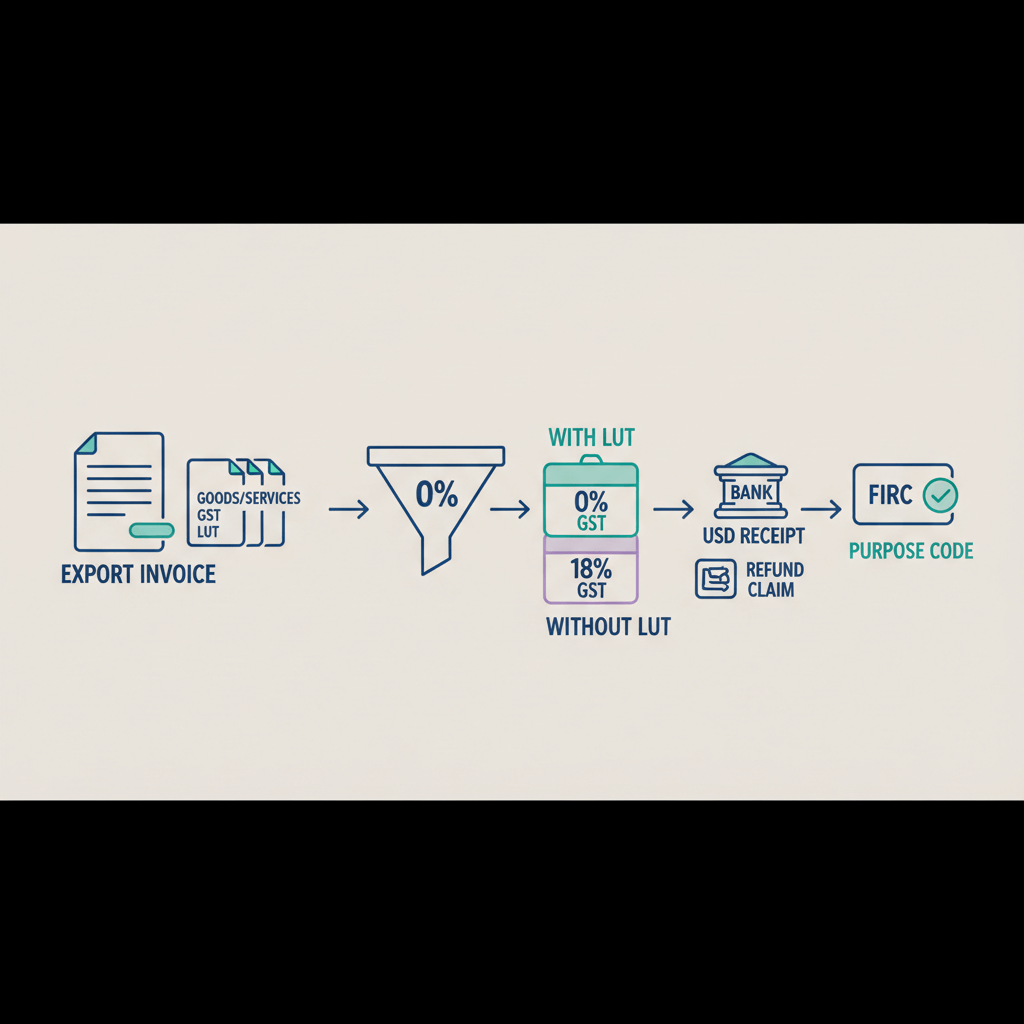


Key takeaways
- Export of services is zero rated under GST only when all five conditions are met, your business in India, recipient outside India, place of supply outside India, payment in convertible forex or permitted INR, and not the same establishment.
- Pick your GST route upfront, LUT for no IGST charge with annual renewal, or IGST refund route where you charge tax and claim it back, document the choice clearly on every invoice.
- Follow a strict export invoice format, include exporter and recipient details, SAC code, service description, invoice number and date, foreign currency amount plus INR equivalent, exchange rate source, export declaration, place of supply, and LUT number if applicable.
- Always show USD or other foreign currency amount alongside INR equivalent using the RBI reference rate on the invoice date, keep proof for filings.
- Use the correct SAC code for each service line, be consistent across invoices, and avoid generic or mismatched codes.
- Request e-FIRA or FIRC immediately after payment, track FEMA realisation deadlines, and maintain a complete documentation trail for audits and refunds.
- For faster cross-border receipts and automated compliance, consider platforms built for Indian freelancers, such as Karbon Business.
What counts as export of services under GST
Export of services stays zero rated only when five conditions are satisfied together, your business is in India, the recipient is outside India, the place of supply is outside India, payment is received in convertible forex or permitted INR, and you and the recipient are not merely establishments of the same person. Miss one condition, and the zero rated treatment collapses.
Think of these as a compliance checklist, if you bill a foreign branch of your own company or take cash instead of bank transfer, your export claim fails.
If your turnover is below the threshold, you can operate without GST registration, but to claim zero rated treatment or refunds you need registration and a valid LUT. Register early, file LUT, and you will invoice smoothly from day one, see the create compliant invoices for export in India guide for a deeper walkthrough.
GST on export services, LUT vs IGST refund
Under LUT, Letter of Undertaking
No IGST is charged on the invoice, you file a fresh LUT each financial year on the GST portal, and ensure payment is realised within the FEMA period, typically one year. Filing LUT is quick on the portal, submit Form GST RFD-11, set an April reminder to renew before your first invoice of the year, the LUT vs IGST route guide explains the steps and trade offs.
On payment of IGST, refund route
You charge IGST at the applicable service rate, then claim a refund after the client pays and you file returns. This protects compliance when payment may be delayed, but ties up cash until refund, often sixty days or more. Most freelancers prefer LUT for cleaner cash flow, just document your chosen route on every invoice and avoid mixing routes within a contract.
Export invoice format, mandatory fields
Use a consistent template so nothing gets missed. Include the following items every time.
- Exporter details: Legal business name, full address, GSTIN, match exactly with PAN and GST records.
- Invoice identification: Unique sequential number and invoice date in DD/MM/YYYY, for example FE2026-001, never reuse or leave gaps.
- Recipient details: Client’s full legal name, complete foreign billing address, and destination country.
- Service description and classification: Specific deliverables or hours, plus SAC code per service line.
- Value and currency: Amount in foreign currency, for example USD 2,000, plus INR equivalent using RBI reference rate on the invoice date, show both clearly.
- GST declarations: “Supply meant for export under LUT without payment of IGST,” or “Supply meant for export on payment of IGST,” include place of supply outside India and LUT number where relevant.
- Additional fields: Contract or SOW reference, payment terms and bank or payment link instructions, digital signature.
- Post payment addition: e-FIRA or FIRC reference after realisation, file it with the invoice and contract for audit readiness.
Understanding SAC codes for services
SAC classifies exported services for GST, it is mandatory on service invoices. Common examples include 9981 management consulting, 9982 accounting and audit, 9983 IT and software development, 9984 legal and accounting advisory, 9985 training and professional development, 9986 market research and advertising. If you provide multiple service types, list each with its own SAC and line item for clarity.
Using an incorrect or generic SAC is a common error, it triggers audits and refund delays, be consistent and keep a reference of the code you use.
Step by step, how to raise export invoices
Step 1, confirm GST route and collect recipient info
Decide LUT or IGST refund, gather client legal name, foreign address, country, tax ID if available, and email. Confirm your LUT is active on the GST portal if you plan the zero IGST route.
Step 2, identify the correct SAC code
Match the SAC code to your service description, for example 9983 for software development, store the reference link or screenshot for future invoices.
Step 3, decide invoice currency and lock exchange rate
Choose USD, EUR, or GBP as agreed with your client, record the RBI reference rate on the invoice date, keep proof, your GST return relies on this rate even if the bank settlement differs.
Step 4, populate the export invoice format
Fill all mandatory fields, include the export declaration and place of supply outside India, maintain separate series for domestic and export invoices for clean reporting.
Step 5, review tax lines
Under LUT, tax shows as 0 percent, under IGST refund route, compute the correct IGST rate for your service, include both foreign currency and INR values with the stated rate.
Step 6, send invoice and track payment
Email the invoice with clear instructions, log dispatch date, and request e-FIRA or FIRC from your bank or platform once payment arrives.
Step 7, record INR value for GST returns
Report exports in GSTR-1 Table 6A using the INR equivalent at the RBI rate on the invoice date, reconcile against bank statements and FIRA.
Step 8, maintain full documentation
Store the contract or SOW, invoice, LUT certificate, e-FIRA or FIRC, bank advice, and key emails in a single folder by invoice number, it saves days if queried later.
Can you invoice in USD, handling currency and rates
Yes, invoicing in USD or any convertible forex is valid for service exports. Show the foreign amount, the INR equivalent, and the exchange rate source, usually RBI on the invoice date. Keep proof for filings, if you receive partial payments or chargebacks, adjust with credit notes and update INR values proportionally.
Realisation, e-FIRA, and your compliance trail
e-FIRA proves foreign payment realisation in India, it supports LUT compliance, helps refunds, and closes audit loops. Many fintech platforms generate e-FIRA automatically, reducing back and forth with banks, see the e-FIRA and FIRC documents guide for the essentials.
Remember FEMA timelines, typically one year from invoice date, if payment is delayed beyond this and you used LUT, IGST may become payable retroactively, monitor aging and send polite reminders at nine, ten, and eleven months.
Practical example of an export invoice
An Indian freelancer bills a UK client USD 2,000 on 15/01/2026 under LUT, SAC 9986 for design services, RBI rate recorded at 1 USD equals ₹83.50, INR equivalent ₹1,67,000. Declaration reads “Supply meant for export under LUT without payment of IGST,” place of supply outside India, United Kingdom. Client pays via SEPA on 25/01/2026, e-FIRA arrives the same day, the export is reported in GSTR-1 Table 6A with the INR amount and LUT number, all documents are filed together.
Common mistakes to avoid
Charging IGST under LUT
LUT invoices must show zero tax, charging IGST under LUT creates mismatches and refund confusion.
Missing or incorrect SAC code
Always include the precise SAC, auditors flag generic codes or descriptions that do not match.
No export declaration wording
Use the exact phrasing for export under LUT or on payment of IGST, it signals correct treatment immediately.
Not recording INR equivalent
GST returns require rupee reporting, show INR on the invoice face and in GSTR-1, skipping it invites notices.
Using ad hoc exchange rates
Use RBI reference or CBIC notified rates and keep proof, avoid random internet rates that you cannot substantiate.
Skipping e-FIRA or FIRC
Bank credit alerts are not enough, get formal e-FIRA or FIRC with sender, currency, amount, and purpose code.
Tools and platforms for receiving international payments
- Karbon Business, virtual USD, EUR, GBP, and CAD accounts, local transfers, INR settlement within one to two days, automatic e-FIRA in twenty four hours for compliance, flat one percent platform fee with zero FX markup, and short term currency holding to hedge forex risk, built for Indian freelancers.
- Wise Business, multi currency accounts with transparent fees, ACH, SEPA, and SWIFT support.
- Payoneer, global receiving accounts that work with marketplaces and direct clients.
- PayPal, fast payment links and invoicing, though higher fees and occasional holds for India.
- RazorpayX International, Indian fintech option with virtual accounts and FX services.
Why documentation and compliance matter
Each export invoice touches GST filings, bank remittance records, FEMA reporting, and RBI data. A missing FIRA or incorrect SAC can cascade into mismatches and stalled refunds. Treat the invoice as a legal document, get the format right, lock the RBI rate, add declarations, and archive evidence properly.
Practical tips for long term success
- Build a master template: Save a clean export invoice layout and reuse it for consistency.
- Maintain a rate archive: Log invoice date, currency, RBI rate, and the proof link or screenshot.
- Automate reminders: Schedule LUT renewal, payment nudges, and GSTR-1 deadlines.
- Keep a compliance folder: Store contract or SOW, invoice PDF, LUT certificate, e-FIRA or FIRC, and bank advice by invoice number.
- Review annually with a practitioner: A yearly check with a CA or GST expert catches silent errors early.
Moving forward with confidence
Master the three pillars, choose LUT or IGST refund confidently, apply the correct SAC codes, and show foreign currency plus INR with RBI rate proof. With a step by step process, solid documentation, and the right tools, you will invoice overseas clients smoothly, realise payments on time, and file accurate GST returns without drama.
FAQ
Do I need GST registration for exporting services as a freelancer, or can I invoice without GSTIN if my turnover is below the threshold?
You can operate without GSTIN if your turnover is below the threshold, however, zero rated benefits and refunds typically require GST registration and a valid LUT. Many freelancers register early to avoid scrambling when a big overseas project lands.
What is LUT in GST for exports, and how do I apply online from India?
LUT is a Letter of Undertaking that lets you export services without charging IGST. Apply on the GST portal each financial year by submitting Form GST RFD-11, acceptance is usually instant. The LUT vs IGST route guide shows the steps and documents.
Which is better for freelancers, LUT with zero IGST or IGST refund route when my client pays late?
If you expect timely payment, LUT keeps cash flow clean. If payment could exceed the FEMA window, the IGST refund route is safer because it preserves compliance even with delays, but it ties up cash until refund. Pick the route per invoice and document it clearly.
How do I show USD and INR amounts on my export invoice, and which exchange rate should I use?
Show the foreign currency amount and the INR equivalent on the invoice face, use the RBI reference rate on the invoice date, and keep proof such as the RBI rate page or a screenshot. Your GSTR-1 relies on this INR value.
What SAC code should I use for IT services, design, or consulting work on my export invoice?
Use SAC 9983 for IT and software services, 9986 for advertising and design, 9981 for management consulting, and so on. Match the code to each line item, do not lump different services under one generic code.
How do I prove payment realisation to stay compliant under LUT, what is e-FIRA or FIRC?
e-FIRA or FIRC is the bank’s document confirming foreign inward remittance, it shows sender details, currency, amount, and purpose code. Request it immediately after payment, platforms like Karbon Business generate e-FIRA automatically within twenty four hours, which speeds up compliance.
If my US or UK client delays payment beyond one year, will I lose zero rated status under LUT?
Under LUT, payment must be realised within the FEMA permissible period, typically one year. If it crosses that window, IGST may be payable retroactively, you might need to amend returns and pay interest. Consider the IGST refund route if you expect long delays.
How do I report export invoices in GSTR-1, and where do I put the INR amount from my USD invoice?
Report the export in GSTR-1 Table 6A using the INR equivalent calculated at the RBI rate on the invoice date. Keep your invoice register, RBI rate proof, and e-FIRA aligned for clean reconciliation.
Can I use PayPal, Wise, or Karbon Business to receive overseas payments, and will I still get e-FIRA for GST compliance?
Yes. Payment platforms vary in features and fees, but you should ensure you get formal e-FIRA or FIRC. Karbon Business provides automated e-FIRA and local currency settlement, which is helpful for quick GST filings.
What invoice number format works best for exports, and why sequential numbering matters for audits?
Use a clear sequence such as FE2026-001, with no gaps or reuse. Auditors check numbering continuity to detect undisclosed income, a consistent series makes your records defensible.
How do I handle partial payments or chargebacks in USD, do I need to issue a credit note in INR?
Yes. Adjust proportionally with a credit note that reflects the foreign currency change and the updated INR equivalent, keep exchange rate evidence for the original invoice and the adjustment.
Is there a ready checklist to create compliant export invoices in India so I do not miss fields?
Follow a checklist of exporter and recipient details, SAC codes, foreign and INR values with RBI rate, export declaration, place of supply, LUT number, and post payment e-FIRA reference. See the create compliant invoices for export in India resource for a detailed blueprint.
