



Key takeaways
- LUT is generally better for most service exporters because it preserves working capital, you do not pay IGST upfront and you avoid monthly refund cycles.
- The IGST refund route can make sense for one off exports, when LUT is not available, or when you want to utilize large Input Tax Credit balances.
- Zero rated exports still require strong documentation, invoice accuracy, and timely foreign exchange realization, otherwise you risk interest or refund delays.
- Apply LUT online in minutes, renew annually, and add your LUT ARN on every export invoice to keep compliance smooth.
- Use platforms that auto generate e FIRA quickly, for example Karbon Business, to speed up refunds if you choose the IGST route and to keep LUT compliance airtight.
GST basics for export services
Exports of services from India are treated as zero rated supplies, which means no net GST burden if you meet a few conditions: your business is in India, your client is outside India, the place of supply is outside India, and payment is received in convertible foreign exchange, or INR if RBI permits.
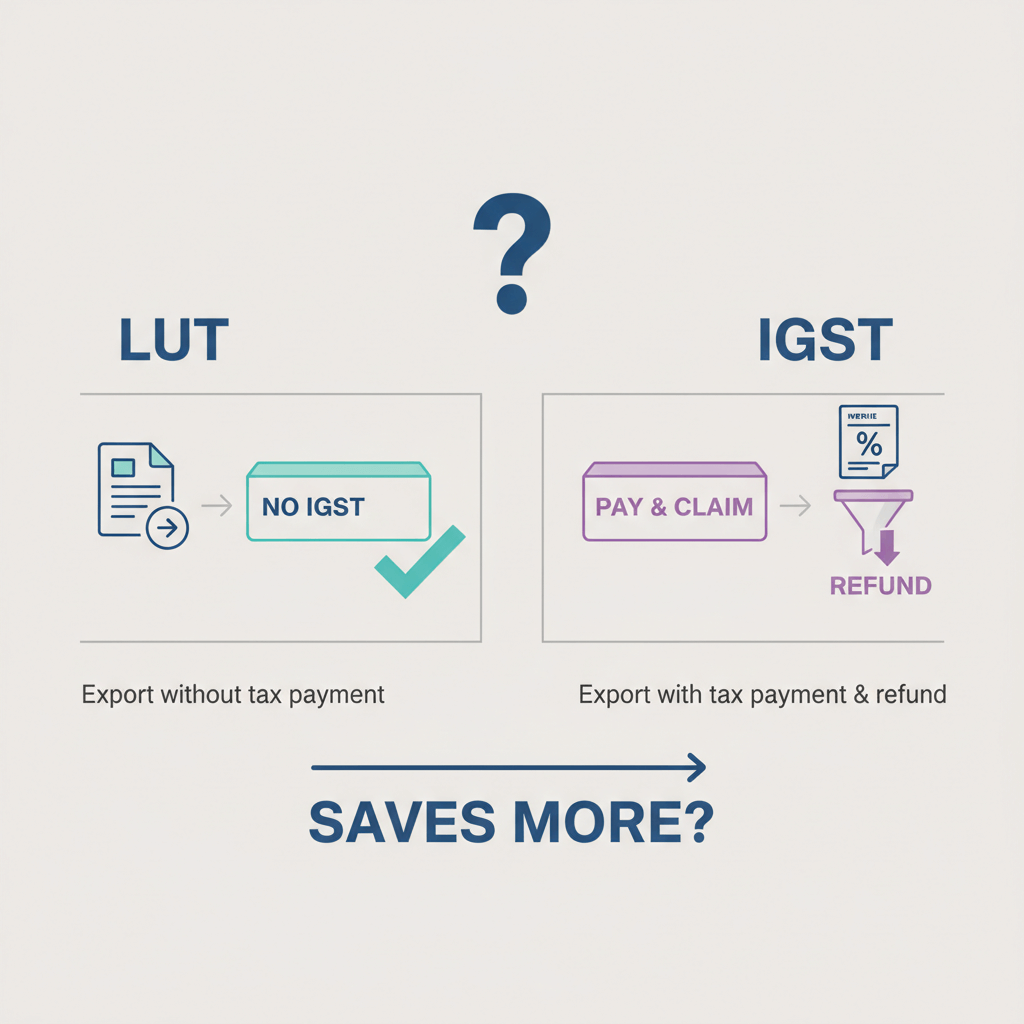
You have two routes to claim zero rating: file a LUT and export without paying IGST, or pay IGST first then claim a refund later. The practical difference is cashflow. LUT keeps your cash untouched, the IGST refund route locks up funds until refunds land, often 15 to 90 days in the real world. For a deeper explainer, see how foreign subsidiaries in India can leverage a LUT and this LUT vs IGST comparison.
Route 1: LUT, Letter of Undertaking, explained
LUT, under Rule 96A, is your promise to comply with export conditions, including bringing foreign exchange back on time. Most service exporters qualify, even brand new businesses, unless there is a serious prosecution history. For an overview, see this guide to GST on exports and this detailed comparison.
Who can apply for LUT?
Almost everyone exporting services, except those prosecuted for tax evasion exceeding ₹250 lakh in the last five years. There is no minimum turnover. New freelancers and agencies can apply from day one, as clarified in this explainer.
How to apply for LUT
- Log in to the GST portal.
- Go to Services, User Services, Furnish LUT/Bond.
- Complete Form GST RFD 11, sign with DSC or EVC, and submit.
- Your LUT is valid for one financial year, renew every year before March ends. Quick references: export GST overview, and annual renewal notes.
How to invoice under LUT
Add a clear note on your invoice, for example: “Export of services under LUT Reference No. [ARN]. IGST: Nil, Zero rated supply under GST.” Include the right SAC, for example 9983 for IT services. For step by step formatting, see how to create compliant export invoices. Do not charge IGST. For more LUT context, see this LUT primer.
Pros of the LUT route
- No upfront tax outflow, your working capital stays intact.
- Simpler compliance, report exports as zero rated in GSTR 1 and 3B, no monthly refund claims.
- Perfect for recurring exports, retainers or frequent projects. See this export GST overview for workflow tips.
Cons and pitfalls of LUT
- Realization deadline, foreign exchange must be realized within one year, else IGST plus 18 percent interest is payable. See this Rule 96A guide.
- Documentation gaps, you need e FIRA or BRC to prove forex receipt. Here is an e FIRA and FIRC guide.
- Expired LUT, invoicing under an expired LUT can trigger IGST liability, as noted in this comparison.
Route 2: Pay IGST then claim refund explained
This route means you invoice with 18 percent IGST, pay it, then file a refund application. It can be useful when LUT is not available, when you have large ITC to use, or for one off exports. For a contrast, review this comparison and this in depth guide.
How to invoice and claim refund
- Raise the invoice with 18 percent IGST and mark it zero rated.
- File GSTR 1 and GSTR 3B, showing IGST paid.
- Gather documents, export invoice, contract, e FIRA or BRC, bank statement, and returns.
- File Form RFD 01 on the portal, track via ARN. See this refund walkthrough.
- Respond quickly to department queries to avoid delays.
Pros of the IGST refund route
- Clear audit trail with tax paid and refunded.
- Sometimes smoother when you have ITC to utilize.
- Convenient for one off export jobs, as noted in this comparison.
Cons and pitfalls of the IGST route
- Upfront cash blockage until refund, see practical notes in this LUT article.
- Refund delays or rejections due to mismatches, as covered in this refund guide.
- Recurring admin effort, every export needs a fresh claim.
Side by side comparison, LUT vs IGST
- Working capital: LUT has minimal blockage, IGST refund blocks funds for 15 to 90 days.
- Refund timelines: LUT has none, IGST refunds have statutory 60 days but typically 30 to 60 days.
- Admin burden: LUT is annual plus routine GSTRs, IGST is recurring RFD 01 filings and follow ups.
- Risk profile: LUT risks interest if forex is not realized in one year, IGST risks rejection or delays due to documentation mismatches.
- Best for: LUT for regular exporters, IGST for one offs, big ITC users, or when LUT is unavailable. See this comprehensive comparison.
Real world examples
Freelance developer with a $2,000 monthly retainer: Under LUT, you receive the full amount with zero IGST outflow. Under IGST, about ₹29,700 is blocked monthly until refunds clear, as highlighted in this LUT explainer.
New agency on first EU project: If you have not filed LUT, you can either file LUT now and invoice with zero IGST, or pay IGST and claim a refund, which may take 30 to 60 days. See this step by step guide.
Designer with sporadic gigs: Even with 3 to 4 projects a year, LUT prevents cash blockage and simplifies compliance, per this overview.
Decision framework: which is better?
Choose LUT if you are eligible, export regularly, want to protect working capital, and can maintain basic documentation like e FIRA and zero rated reporting. Choose the IGST route if you are ineligible for LUT, do rare one off exports, want to utilize big ITC balances, prefer a refund based audit trail, and can afford cash blockage for 30 to 90 days. Practical pointers are summarized in this GST on exports guide.
Other factors to consider
- Client payment terms: Advances flow cleaner with LUT, otherwise you pay IGST on advances and wait for refunds.
- Forex strategy: Ability to hold currency and convert at mid market rates helps under LUT. Refunds tie cash up in INR.
- Milestone delays: LUT avoids compounding delays, IGST adds refund wait on top of client payment wait. Practical notes here: LUT strategies.
Step by step: how to apply for LUT
Step 1: Check eligibility
No prosecutions for tax evasion over ₹250 lakh in the last five years. Most freelancers and small agencies will qualify, as this guide explains.
Step 2: Log in to the portal
Go to the GST portal and sign in.
Step 3: Navigate to LUT section
Services, User Services, Furnish LUT/Bond.
Step 4: Fill Form GST RFD 11
Enter GSTIN, financial year, declarations, and authorized signatory details.
Step 5: Upload and submit
Use DSC or EVC. Save your ARN. You will mention it on export invoices.
Step 6: Validity and renewal
Valid for the financial year, renew before March end. Reference: GST on exports overview.
Sample invoice wording
“Export of services under LUT Reference No. [ARN]. IGST: Nil, Zero rated supply under GST. HSN or SAC: 9983 for IT services.” For formatting tips, see this LUT invoice note example.
Step by step: how to pay IGST and claim refund
Step 1: Invoice with IGST
Raise the export invoice with 18 percent IGST, mark it as zero rated.
Step 2: File GSTR 1 and 3B
Report outward supplies in GSTR 1, show IGST paid in GSTR 3B. A walkthrough is in this refund guide.
Step 3: Gather refund documents
- Export invoice, contract or PO.
- e FIRA or BRC proving forex receipt, platforms that auto generate e FIRA in 24 to 48 hours save time.
- Bank statement, GSTR 1 and 3B copies.
Step 4: File Form RFD 01
Apply under “Export of services with payment of tax,” upload documents, double check names, dates, and amounts match. Details in this step by step.
Step 5: Track and respond
Reply to deficiency memos quickly to avoid extended timelines.
Step 6: Reconcile your ledger
Match sanctioned refund with your electronic cash ledger and books.
Refund timelines and the cashflow reality
Statutorily 60 days, practically 15 to 90 days depending on documentation quality and officer queries. Plan buffers accordingly, as discussed here, refund timelines overview.
Planning buffers and cashflow tips
- Invoice after receipt when possible, reduce the IGST to refund gap.
- Negotiate advances, for example 50 percent upfront.
- Hold forex up to 60 days where allowed, convert at mid market rates, guidance in this overview.
- Bake in a 45 to 60 day refund lag in your cash plan.
Tips to speed up refunds
- Exact name matching across invoice, contract, bank, and e FIRA.
- Logical date and amount alignment across documents.
- Use platforms that auto generate e FIRA within 24 to 48 hours, as noted in this guide.
- Respond to queries within 24 hours.
Documentation and compliance checklist
Documents for LUT route
- LUT acknowledgment, ARN, and Form RFD 11 copy.
- Export invoices marked under LUT, zero IGST.
- e FIRA, FIRC, or BRC.
- Bank statement showing credit.
- Contract or PO and place of supply proof.
- GSTR 1 and GSTR 3B showing zero rated supplies.
Additional documents for IGST refund route
- Proof of IGST payment in GSTR 3B and ledger.
- RFD 01 acknowledgment and refund ARN.
Common mistakes to avoid
- Name mismatches across GST registration, invoice, and bank.
- Currency conversion inconsistencies, document the rate and date.
- Missing GSTR reporting for any export invoice.
- Weak place of supply evidence, see this documentation primer.
Tools and platforms that help Indian freelancers
Use solutions that handle cross border receivables, virtual foreign currency accounts, and automatic compliance documents like e FIRA. Karbon Business offers local USD, EUR, GBP, and CAD account details for ACH and SEPA, 24 to 48 hour INR settlement, auto generated e FIRA within 24 hours, a flat one percent fee with zero FX markup using mid market rates, and the ability to hold currency for up to 60 days, see Karbon Business. Faster e FIRA means faster refunds if you pay IGST, and cleaner LUT records. Additional comparisons are discussed in this refund guide and this export GST overview.
Tip: Traditional banks may take 7 to 15 days to issue FIRC or e FIRA, which can delay your refund application. Platforms that automate this within 24 to 48 hours can materially improve cashflow.
Takeaway: LUT wins for most exporters of services
For most Indian freelancers and small agencies, LUT wins on working capital, simplicity, and speed. The IGST refund route has its place for special cases, but it adds cash blockage and admin overhead.
Before you decide, ask: am I eligible for LUT, do I export regularly, can I afford cash blocked for 30 to 90 days, and do I have a system for e FIRA, invoices, and reconciliations. If you want a streamlined setup, consider Karbon Business for faster inward payments, mid market FX, and instant e FIRA that supports both LUT and refund workflows.
FAQ
Which is better for freelancers, LUT or paying IGST and claiming refund?
For most freelancers, LUT is better because it avoids upfront tax outflow, preserves working capital, and eliminates monthly refund filings. The IGST refund route is useful for one off exports, or when you want to utilize big ITC balances, but it blocks cash for weeks.
How do I apply for LUT if I just got my GST number yesterday?
Log in to the GST portal, go to Services, User Services, Furnish LUT or Bond, fill Form GST RFD 11, and submit with DSC or EVC. There is no minimum turnover requirement, so a brand new GST registrant can file LUT immediately.
What if my export client pays me via PayPal or Upwork, can I still use LUT?
Yes, as long as the final payout to you is in convertible foreign exchange or INR permitted by RBI, and you can produce e FIRA or BRC for the inward remittance. Many freelancers prefer platforms that auto create e FIRA quickly, for example Karbon Business, to keep LUT compliance airtight.
How fast can I get e FIRA for my export payment?
Traditional banks may take 7 to 15 days, which can slow refunds. Modern platforms like Karbon Business typically auto generate e FIRA within 24 hours of settlement, which speeds up both LUT documentation and IGST refunds.
My turnover is below ₹20 lakh, do I still need LUT for exporting services?
If you are not registered under GST because you are below the threshold and not required to register, LUT does not apply. If you choose to register voluntarily, then file LUT to export without paying IGST. Many freelancers register to work with enterprise clients and to claim ITC where relevant.
How should I write the LUT note on my export invoice?
Add a line such as “Export of services under LUT Ref No. [ARN]. IGST: Nil, Zero rated supply under GST. SAC: [code].” Ensure the client’s address and place of supply are clearly outside India, and keep the e FIRA or BRC attached in your records.
How long do IGST refunds on export services usually take in practice?
Although the law says 60 days, real world refunds often take 30 to 60 days if documents match perfectly. Delays beyond 60 days are possible when there are queries or mismatches. Using platforms that generate e FIRA quickly, such as Karbon Business, reduces typical bottlenecks.
Can I switch from IGST route to LUT in the middle of the financial year?
Yes, you can file LUT at any time. Future export invoices can be issued under LUT, while past invoices where IGST was paid will still require refunds via RFD 01.
Will advances from foreign clients cause issues under LUT?
You can receive advances and later issue the final tax invoice under LUT with zero IGST when the service is supplied. Ensure the e FIRA references the transaction and your final invoice matches amounts to avoid reconciliation issues.
What happens if my export proceeds come after one year under LUT?
If foreign exchange is not realized within one year from the invoice date, Rule 96A requires you to pay IGST plus applicable interest. If you anticipate delays, consult your CA early and consider whether the IGST route fits better for that transaction.
Is Karbon Business suitable for Indian freelancers receiving USD or EUR and managing GST compliance?
Yes, Karbon Business provides local USD ACH and EUR SEPA details for clients, fast INR settlement, mid market FX, and auto generated e FIRA within 24 hours, which simplifies LUT documentation and accelerates IGST refund claims for service exporters.
If my client is in the UK and pays via Wise, do I need to charge IGST on the invoice?
If conditions for export of services are met, you can invoice under LUT with zero IGST. Ensure the place of supply is outside India, the client is outside India, and payment is in convertible foreign exchange, then keep e FIRA or BRC for records.
Can I hold my USD or EUR for a few weeks before converting and still stay compliant?
Yes, subject to RBI conditions, many platforms allow holding currency for a limited period, often up to 60 days. This can help you time conversions at better rates. Your GST treatment, LUT or IGST, is unaffected as long as you realize forex within the permissible window and maintain e FIRA.
What are the most common reasons IGST refunds get delayed for freelancers?
Name mismatches between invoice, bank, and e FIRA, amount or date mismatches, missing contracts or place of supply evidence, and slow issuance of e FIRA. Using a platform that automates e FIRA generation, for example Karbon Business, and double checking document consistency helps avoid these delays.
