

Key takeaways
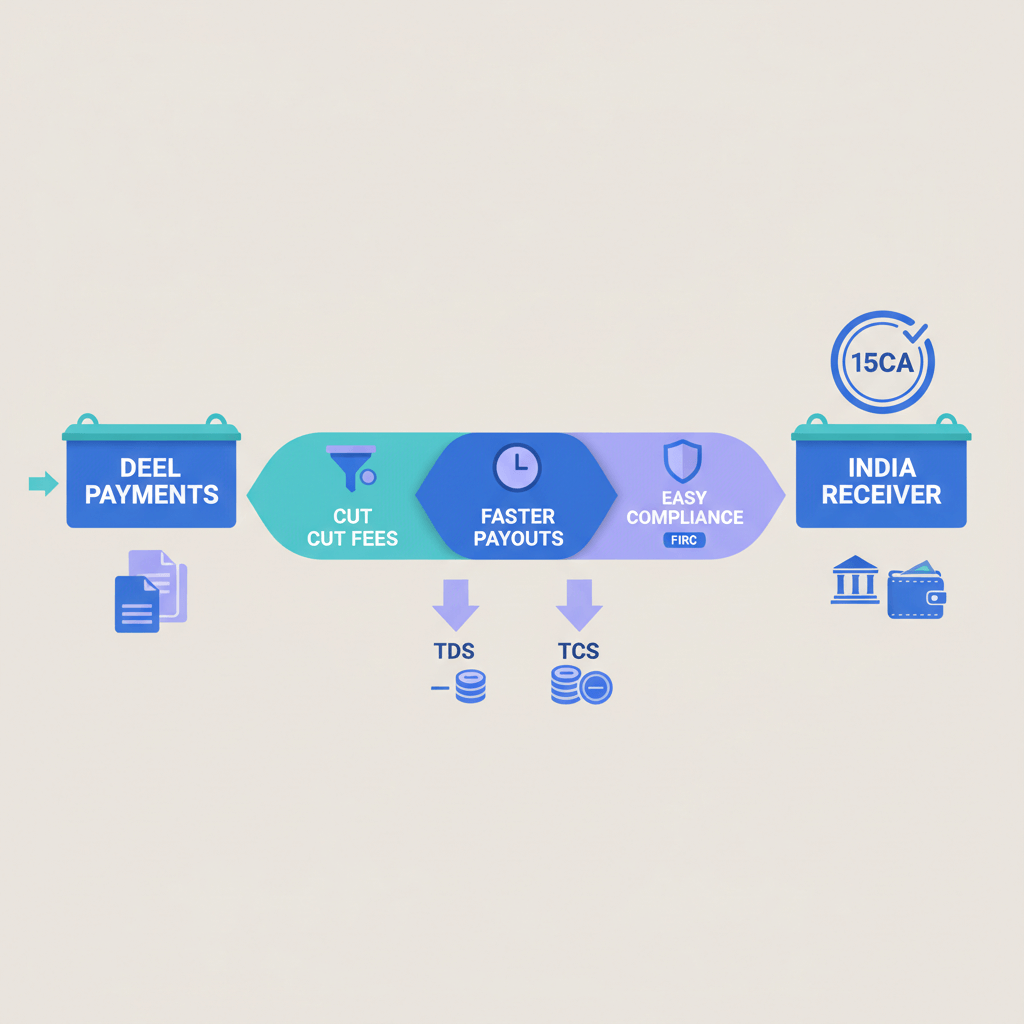
- Deel payouts to India typically cost 0.5% to 1% for local INR transfers, and 1% to 2% plus possible intermediary charges for SWIFT USD transfers, with additional FX markups quietly affecting your take home amount.
- Most withdrawals land in 2 to 5 business days, but RBI checks, bank cut offs, and holidays can push timelines further, so plan your cash flow with a buffer.
- Compliance is non negotiable: secure e-FIRA or e-FIRC for every inward remittance, match them to invoices, and keep bank credits, Form 26AS/AIS, and Deel confirmations neatly organized.
- Invoices should include your PAN, Indian address, detailed service description, currency, payment terms, and a purpose code hint for smooth bank processing.
- Batch withdrawals, verify purpose codes, and consider routing to a USD account first to control FX—many freelancers cut costs by moving final INR conversion to a low markup platform.
- If fees exceed ~1.5% to 2% all in, evaluate dedicated remittance options like Karbon Business for flat fees, mid market FX, faster INR settlement, and automatic e-FIRA.
- Avoid name mismatches across Deel, PAN, and bank, which commonly trigger holds; keep trade desk contacts handy for quick e-FIRA issuance.
How Deel pays Indian contractors: the basics
As a freelancer, your client funds Deel, the money appears in your contractor balance, and you withdraw to India via local INR transfer or SWIFT USD. Deel also partners with third parties in some cases, so always check your dashboard for the latest methods. Complete KYC thoroughly and ensure your name matches exactly across Deel, PAN, and bank—tiny differences can freeze money for days.
Want a quick pricing overview before you dive deeper? See how much does Deel cost and compare notes with independent testers in these hands-on test results.
Understanding Deel withdrawal fees to India
There are three cost buckets to watch: platform fees, withdrawal charges, and FX markup.
- Platform fees: Many contractors pay $49 per month base platform fee, plus up to $5 per inactive contract.
- Withdrawal fees: Local INR transfers are often 0.5% to 1%. SWIFT USD can be 1% to 2% plus $10 to $30 intermediary cuts.
- FX markup: Converting USD to INR usually includes a markup over the mid market rate, often another 0.5% to 2% depending on timing and amount.
Hidden friction adds up: reprocessing on returned payments, intermediary bank deductions on SWIFT, and bank side conversion spreads all reduce your net.
Optimization ideas you can apply immediately:
- For sub $1,000 payouts, local INR often beats SWIFT due to fewer fixed charges.
- Batch withdrawals rather than pulling small amounts frequently.
- Withdraw to a USD receiving account first, then convert to INR yourself when rates are favorable.
- Compare all in cost per route (platform fee + withdrawal + FX + bank charges), not just the headline fee.
For deeper comparisons and fee context, check this breakdown on how much does Deel cost and a practical field review with hands-on test results.
Real cost examples: what you’ll actually pay
Small invoice, local INR: $500 content project, 0.5% to 1% estimated fees including FX, roughly $5 to $10 cost; you receive about ₹41,000 to ₹41,200 at ~₹83/USD.
Medium invoice, SWIFT USD: $5,000 design retainer, 1% to 2% plus intermediary charges, roughly $100+ total costs; you might receive ~$4,900 in USD, then convert in India.
Optimized via USD holding: $5,000 to a virtual USD account with a flat ~1% and zero FX markup on conversion can save ₹4,000 to ₹5,000 per transfer compared to default routes.
For more pricing scenarios, see how much does Deel cost.
Payment timelines: when will you actually get paid?
After your client pays, Deel credits your balance in about 24 hours to a few days. Then:
- Local INR: 1 to 3 business days via NEFT/RTGS after withdrawal.
- SWIFT USD: 2 to 5 business days, sometimes longer due to correspondent hops and trade desk checks.
India specific variables include purpose code verification, NEFT/RTGS cut offs, non aligned holidays, and name mismatches. Realistically, plan for 2 to 5 business days, more during holidays or your first payment cycle.
See a practical test timeline in these hands-on test results.
Compliance essentials: what RBI requires
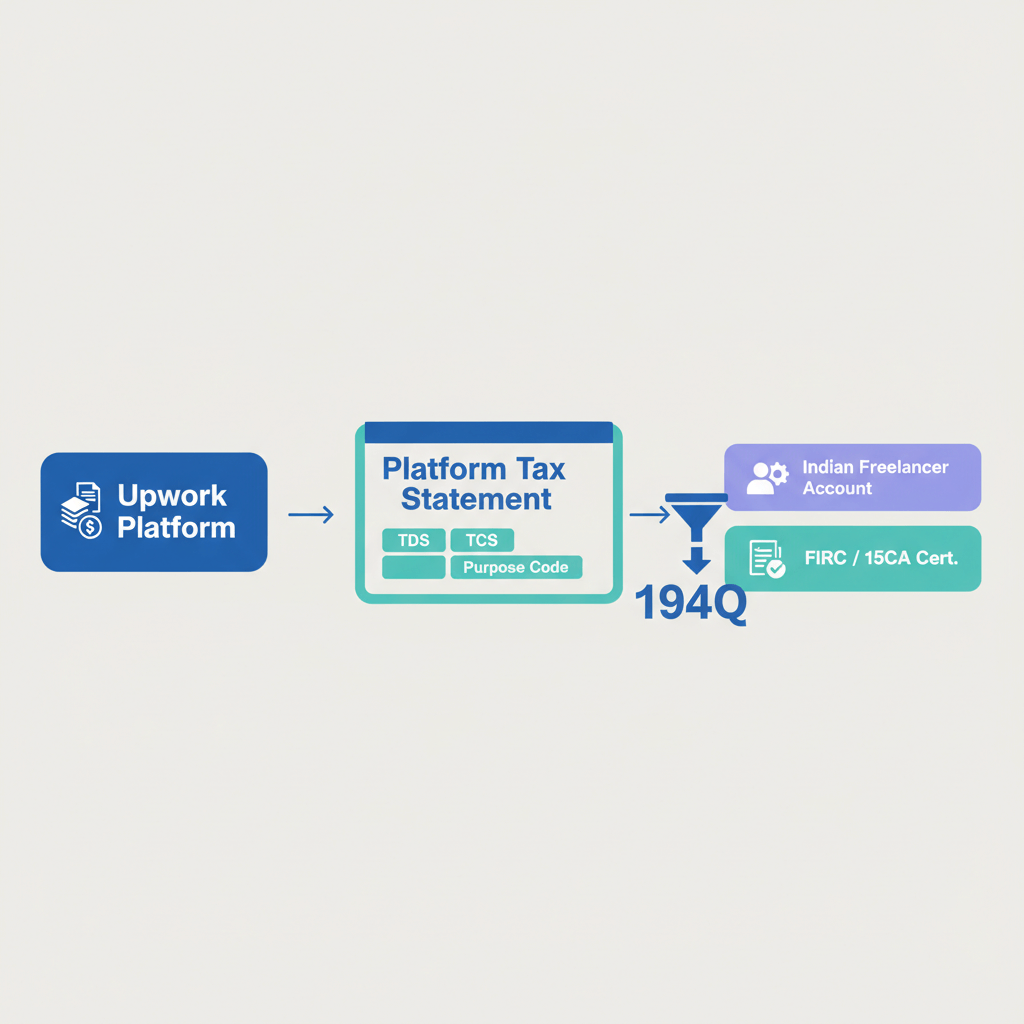
Freelance income from abroad is export of services. Each remittance needs a purpose code (e.g., P0802 for computer/software services). Keep proper remittance proof for tax and GST audits—preferably e-FIRA/e-FIRC from your bank. Learn the paperwork in this e-FIRA/FIRC documents guide. Deel confirmations support your records but don’t replace bank issued proof.
Keep invoices, e-FIRA/e-FIRC, bank statements, and Form 26AS/AIS aligned. For background on employment and India specifics, skim Deel’s India information.
Getting your remittance proof: step by step
- Once funds credit your account, check net banking trade services for auto generated e-FIRA/e-FIRC within 24 to 72 hours.
- If not present, email or visit the trade desk with bank statement credit proof, your invoice, and the Deel confirmation, and request e-FIRA/e-FIRC issuance.
- For SWIFT USD, your bank usually issues e-FIRC; for local INR, e-FIRA is common.
- Private banks often deliver faster; public banks may take longer.
- Some platforms auto issue e-FIRA within 24 hours, reducing back and forth.
Store digital backups, share with your CA, and reconcile quarterly.
Creating the perfect invoice for Deel payments
Include your legal name as per PAN, PAN number, Indian address, client details, precise service description, currency and amount, payment terms, and GST notes. Adding a line like “Export of services, RBI Purpose Code P0802” helps banks classify the credit quickly.
For more pricing references and invoice context, see this guide on Deel pricing.
Tax documents every freelancer must keep
- Income tax: e-FIRA/e-FIRC for every payment, bank statements, Deel confirmations, issued invoices, and Form 26AS/AIS.
- GST (if registered): Export invoices with LUT, LUT copy, e-FIRA/e-FIRC matched to invoices.
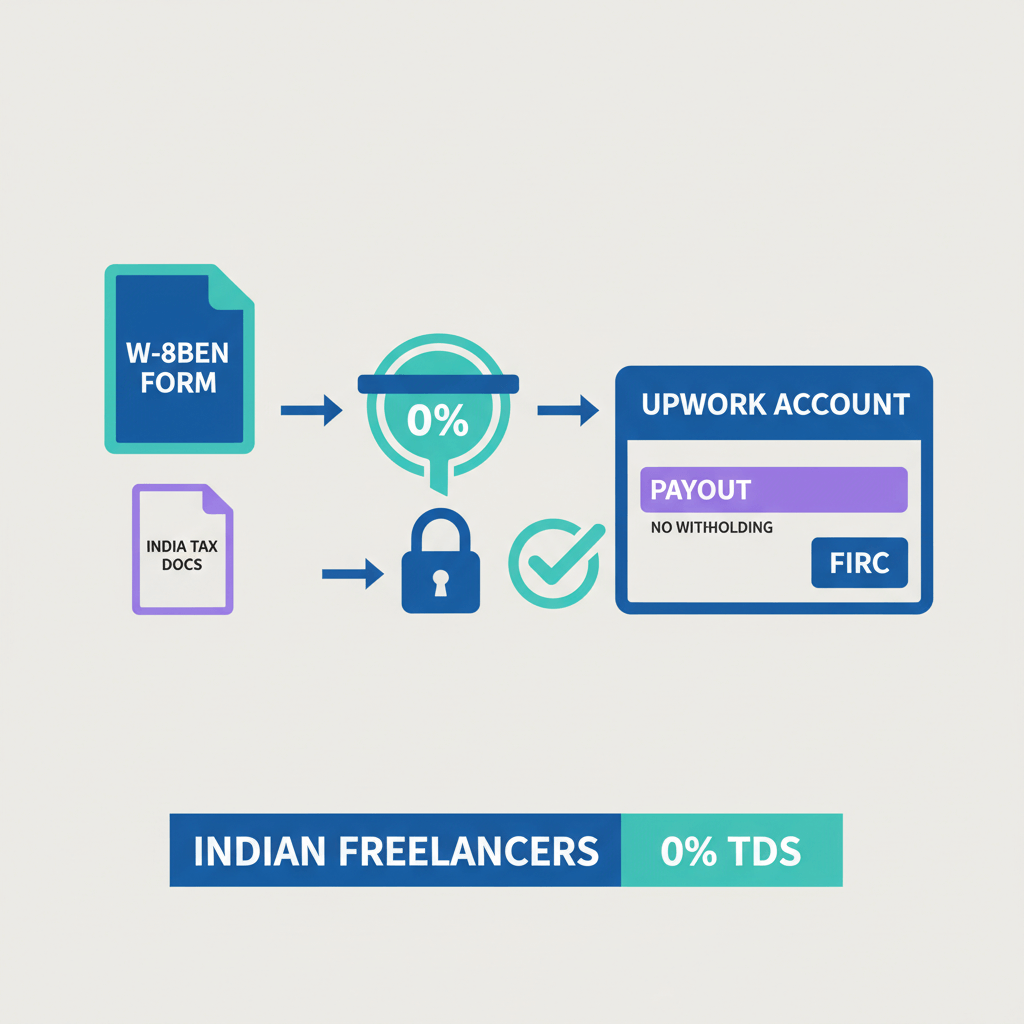
- Client compliance: Keep W-8BEN if requested by US clients.
Organize by Indian financial year. For India specifics, also review Deel’s India page.
Troubleshooting common issues with Deel payments to India
Payment delayed? Contact your bank’s trade desk, confirm the purpose code, and provide your invoice plus Deel confirmation. If a mismatch exists, fix name/address across all records and notify both sides.
Bank requesting wrong documents? Clarify you export services, not goods. Share invoice, SoW/contract, and payment confirmation.
No e-FIRA/e-FIRC? Raise a ticket with the trade desk after a week with all proofs. If delays repeat, consider an account that auto issues e-FIRA.
Unexpected FX/deductions? Ask for a credit advice showing rate and charges, then compare with mid market. Use alternate routes for better FX next time.
Purpose code confusion is common—this explainer on purpose code mismatches can help.
Deel vs dedicated remittance platforms: when to switch
Deel is convenient when clients insist on it, bundling contracts, invoices, and payouts. But all in costs and FX markups can bite. Dedicated India focused remittance accounts often provide mid market FX, flat fees, faster INR settlement, and automatic e-FIRA. If you still need Deel for a client, you can withdraw to a USD account first, then convert on your terms.
For more price comparisons, revisit how much does Deel cost.
Alternative platforms for receiving international payments to India
- Karbon Business: Multi currency receiving (USD, GBP, EUR, CAD), flat ~1% with zero FX markup on conversion, INR settlement in 24 to 48 hours, automatic e-FIRA within 24 hours, currency holding flexibility.
- Wise Business: Multi currency account with transparent fees and mid market rates; India support timelines can vary.
- Payoneer: Marketplace friendly, but watch FX and fee tiers.
- PayPal: Ubiquitous acceptance, higher fees and conversion costs for India users.
- RazorpayX International: Worth exploring if you already use Razorpay domestically.
Step by step checklist for Deel payments to India
Before first payment
- Match names across Deel, PAN, and bank.
- Pick your withdrawal route after running a small test.
- Set an invoice template with purpose code hint and GST note.
- Confirm your bank can accept foreign credits smoothly.
After each payment
- Save Deel confirmation and dashboard screenshot.
- Track bank credit date and amount, then request e-FIRA/e-FIRC within a week.
- Reconcile invoice vs credit and compute effective cost.
- Update your books with e-FIRA number and net receipts.
Quarterly
- File GST (if applicable) with export invoices and e-FIRA.
- Share organized docs with your CA and check Form 26AS/AIS.
Optimize
- Compute effective cost; if above ~1.5% to 2%, trial a different route.
- Test USD first, then convert on a platform with mid market FX.
Real freelancer story: cutting costs by half
When Ananya noticed her monthly fees creeping near 2.7%, she shifted one client’s payout to a USD receiving account, then claimed INR on a flat fee, zero markup route. With mid market FX and automatic e-FIRA, her effective costs dropped and she saved hours of admin each month. The takeaway is simple: keep using Deel where it makes relationship sense, but route money movement where it’s cheapest and most compliant.
Essential resources for managing Deel payments
- Pricing and reviews: how much does Deel cost, hands-on test results, and Deel pricing overview.
- Compliance explainers: e-FIRA/FIRC documents guide and a quick primer on purpose code mismatches.
- Official info: Deel’s India information.
Quick cost calculator: should you optimize?
List your last three invoice USD amounts, the INR you actually received, and the mid market rate on the credit date. Compute expected INR (USD × mid market), compare to actual INR, and note the difference. Divide the difference by invoice USD to get your effective percentage cost. If you’re above ~1.5%, you have meaningful savings on the table.
Example: $2,000 × ₹83.00 = ₹1,66,000 expected vs ₹1,61,500 actual → ₹4,500 total cost (~2.7%).
When to book a demo or try a different platform
- You manage multiple international clients and only some require Deel.
- Your monthly invoices exceed ~$3,000 to $5,000 where FX markups compound.
- You’re tired of chasing e-FIRA/e-FIRC and want automation.
- You want control over when to convert currency.
- You’re scaling into an agency and need multi currency rails.
Most India focused platforms complete onboarding in 2 to 4 working days. Typical KYC: PAN, masked Aadhaar, recent bank statements, and an online profile link. First settlements usually follow within 24 to 48 hours after payment claim.
Final thoughts: take control of your international payments
Deel can be smooth and reliable once you understand fees, timelines, and compliance. But your goal is maximizing net receipts with clean, audit ready documentation. Keep meticulous records, verify purpose codes, and compare all in costs regularly. If the numbers point that way, route funds through an India optimized remittance account for mid market FX, lower fees, faster INR, and automatic e-FIRA. You’ve worked hard to earn foreign income—make sure more of it stays with you.
FAQ
Deel se India me withdrawal ka total charge kitna padta hai?
Typically, local INR transfers cost around 0.5% to 1% including FX markup, while SWIFT USD can be 1% to 2% plus $10 to $30 intermediary charges. Your effective cost is withdrawal fees + FX spread + any bank deductions. Many freelancers benchmark this using a USD-to-INR mid market rate and aim to keep the gap below ~1.5% by optimizing routes, for example settling via a USD account first and converting with a platform like Karbon Business on a flat fee.
Deel payment ko Indian bank me aane me kitne din lagte hain?
Local INR withdrawals typically arrive in 1 to 3 business days, and SWIFT USD takes 2 to 5 business days. RBI purpose code checks, cut off times, and holidays can extend timelines. First time payments also face extra scrutiny. If it’s urgent, consider requesting a same day RTGS window with your bank’s trade desk and ensure your purpose code and invoice details are crystal clear.
e-FIRA ya e-FIRC kaise milega, aur kab tak mil jana chahiye?
After the credit hits your account, many banks auto issue e-FIRA/e-FIRC within 24 to 72 hours inside net banking under trade services. If not, email the trade desk with your bank credit proof, invoice, and Deel confirmation and request issuance. Some platforms, like Karbon Business, auto generate e-FIRA within 24 hours, which saves time during tax filing.
Freelance services ke liye correct RBI purpose code kya hota hai?
Most software and IT work uses P0802 (computer services/software development). Design, consulting, and other professional services have nearby codes. If the wrong code is used, banks may hold the payment or ask for documents. Keep your invoice description specific and include a purpose code hint to speed up verification.
FX markup ko kaise control karun, kyunki rate hamesha low milta hai?
Two approaches work well: withdraw to a USD receiving account first, then convert to INR when rates are favorable, and use a platform that applies mid market rates with a flat fee. Many freelancers route Deel payouts to USD, then settle INR via Karbon Business to avoid hidden spreads.
Deel invoice me kya kya details dalni chahiye taaki bank query na kare?
Include your legal name as per PAN, PAN number, Indian address, client details, precise service description, currency and amount, payment terms, and a note like “Export of services, Purpose Code P0802.” If you operate with LUT for GST, add “GST @ 0% under LUT” and the LUT reference. Clear descriptions reduce trade desk back and forth.
Bank ne e-FIRC issue nahi kiya, main kya karun?
Wait 2 to 3 business days, then raise a ticket with the trade/forex desk. Share the bank credit statement, invoice, and payment confirmation and request e-FIRC/e-FIRA explicitly. If delays persist month after month, consider using a platform that auto issues e-FIRA like Karbon Business; it substantially reduces compliance overhead.
Deel vs Karbon Business: kis se overall cost kam aata hai?
It depends on your flow. Deel is great for client management and compliance on the client’s side, but you may pay more in FX spread and withdrawal fees. Routing funds to a USD account, then converting via Karbon Business at mid market FX with a flat fee often reduces effective cost below ~1.5%, especially on invoices above $1,500.
Indian savings account me directly USD aa sakta hai kya?
Most personal savings accounts receive INR after bank side conversion, not hold USD balances. If you want to hold USD, use a regulated USD receiving account solution and then convert to INR. This gives you control over timing and rate. After conversion, settlement to your Indian bank usually takes 24 to 48 hours with specialized platforms.
Purpose code mismatch aagaya, payment hold ho gaya—ab kya steps hai?
Contact the bank’s trade desk, provide your invoice, Deel payment confirmation, and a one line description clarifying export of services with the right purpose code (e.g., P0802). Ask them to rectify the code on the remittance. Going forward, include the purpose code hint on invoices to avoid repeats.
GST registration zaroori hai kya agar main sirf foreign clients handle karta hoon?
If your aggregate turnover crosses the GST threshold, registration is required, even for exports. Exports are zero rated under LUT, so you charge 0% but must maintain documents: export invoices, LUT, and e-FIRA/e-FIRC. Your CA can advise based on your turnover and state; keep a clean document trail to sail through audits.
Chargebacks ya client disputes Deel par aajaye to kya karein?
Respond immediately within platform timelines. Share your invoice, delivery proofs, approvals, and communication history. Maintain organized folders so you can attach documents quickly. In parallel, keep a diversified payout setup—if one client disputes, others still settle normally, especially when you use a USD receiving account plus a reliable INR settlement layer like Karbon Business.