

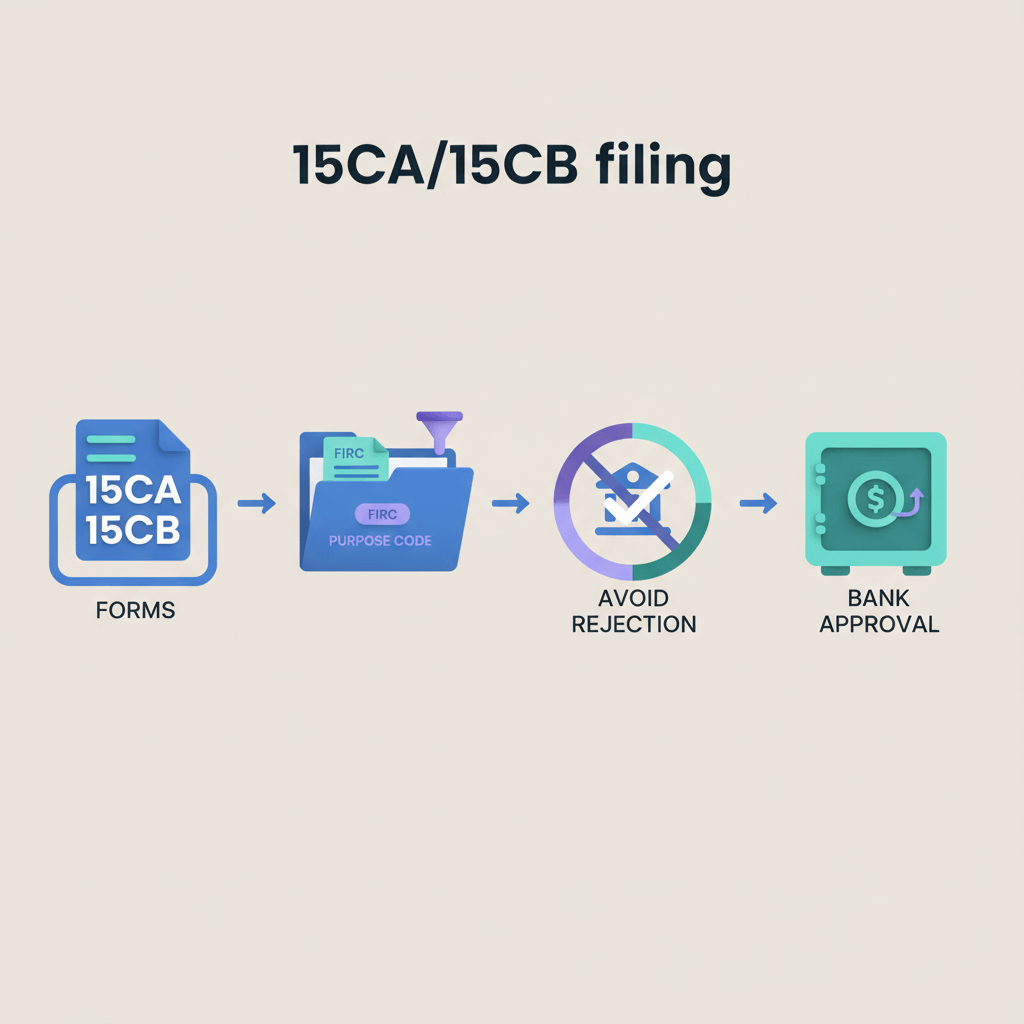


Key takeaways
- Form 15CA is your declaration to the bank before any outward remittance to a non-resident, it confirms if the payment is taxable and whether TDS is handled.
- 15CA parts, pick correctly: Part A taxable ≤ ₹5 lakh, Part B taxable > ₹5 lakh with AO order, Part C taxable > ₹5 lakh with CA’s 15CB, Part D not chargeable to tax.
- You always file 15CA, you need 15CB only for Part C, see the difference between 15CA and 15CB for clarity.
- Common freelancer cases: overseas contractor or SaaS usually Part D when genuinely non-taxable, large consulting fees that are taxable often Part C.
- Before filing, collect TRC, Form 10F, PE declaration, invoices, AO order or CA 15CB where applicable, then file 15CA on incometax.gov.in and share the acknowledgement with your bank.
- Most bank rejections come from the wrong 15CA part, DTAA article missing, purpose code mismatch with A2, or invalid 15CB linkage.
- Inbound payments never need 15CA, for receiving money use platforms like Karbon Business with automatic e-FIRA and fast INR settlement.
- Keep an audit trail, contract, invoices, DTAA notes, 15CA ack, 15CB, and bank advice, this protects you during queries.
Why banks ask for Form 15CA before outward remittances
Form 15CA is a remitter’s declaration that Indian banks rely on to ensure tax compliance before money leaves India. The form confirms whether the payment to a non-resident is chargeable to tax in India, and if yes, whether you have deducted the correct TDS. If you are receiving international payments, you do not need 15CA, that is an inward flow, banks issue e-FIRA for that. For a primer, see all about Form 15CA and Form 15CB.
Think of 15CA as you telling the bank and the income tax department, “I am sending money abroad, here is the tax story behind it.”
Form 15CA vs Form 15CB, what you need to know
To save time and avoid confusion, master the difference between 15CA and 15CB. In short, 15CA is filed by you for all outward remittances to non-residents, 15CB is a CA’s certificate needed only when you file Part C of 15CA for taxable remittances above ₹5 lakh without an AO order. External overview: filing Form 15CA and 15CB.
- 15CA contains remitter and remittee details, the nature of payment, taxability analysis, and DTAA references when relevant.
- 15CB confirms your TDS computation, the remittee’s tax residency, DTAA eligibility, and validates the position your 15CA relies on.
Understanding 15CA parts A, B, C, and D
Choose the correct part using this quick map, and see this 15CA/15CB filing guide for deeper context.
Part A, remittances up to ₹5 lakh that are taxable
Use when total taxable remittances in the financial year do not exceed ₹5 lakh. No CA certificate required. Example, paying a foreign freelancer ₹3 lakh for project work that is taxable in India.
Part B, taxable remittances above ₹5 lakh with AO order
Use when you hold an order or certificate under Section 195(2)/(3)/197 from the Assessing Officer. Rare for freelancers, common in large contracts.
Part C, taxable remittances above ₹5 lakh with CA certificate
Use when taxable and above ₹5 lakh, without an AO order, but you have your CA’s 15CB. This validates TDS and DTAA, if applicable.
Part D, remittances not chargeable to tax
Use when the payment is not taxable under the Income Tax Act, or is exempt under a DTAA. Document your DTAA position and the remittee’s tax residency. Reference explainer, filing Form 15CA and 15CB.
Decision tree for freelancers
- Is your payment taxable under domestic law or DTAA?
- No, choose Part D.
- Yes, go to step 2.
- Is the total taxable payment in the FY above ₹5 lakh?
- No, choose Part A.
- Yes, go to step 3.
- Do you have an AO order under Section 195/197?
- Yes, choose Part B.
- No, choose Part C and obtain Form 15CB.
Common freelancer scenarios and which part to use
Scenario 1, paying an overseas contractor for work done outside India
Likely Part D if the contractor is tax resident abroad and has no PE in India. Action, file Part D, document your DTAA position with TRC, Form 10F, and a no-PE declaration.
Scenario 2, foreign software or SaaS subscription
Likely Part D if the provider has no PE in India and services are performed abroad. Caution, equalization levy and GST on import of services may apply separately. Action, file Part D and handle EL or GST separately if applicable.
Scenario 3, large consulting fee to a non-resident, ₹8 lakh
Part C if services are partly or fully rendered in India or otherwise taxable. Obtain 15CB from your CA, link the acknowledgement or UDIN in your 15CA.
Scenario 4, payment covered by an AO order
Part B when you have an AO order specifying the TDS rate or exemption. Reference the order number and date in the form.
Prerequisites and documents checklist
Collect the right documents before you start, it saves days. A practical step-by-step guide is helpful for first timers.
- Your details: PAN with e-filing login, address, phone, email, bank account and AD code if bank asks.
- Remittee details: full legal name, entity type, address, country of tax residence, TIN if available, principal place of business.
- Payment details: nature of payment and RBI purpose code, amount and currency, proposed remittance date, outward remittance bank details.
- Supporting documents: invoice or contract, TRC, Form 10F, no-PE declaration, 15CB acknowledgement and UDIN for Part C, AO order for Part B, DTAA article reference if claiming non-taxability or lower rate.
Step by step 15CA filing process on the e-filing portal
Step 1, log in to the income tax e-filing portal
Visit www.incometax.gov.in, log in with PAN and password, ensure email and mobile are verified. For help, see the official user manual.
Step 2, navigate to Form 15CA
Click e-File, Income Tax Forms, File Income Tax Forms, search for Form 15CA, open the Instructions page and click Let’s Get Started. Reference, user manual.
Step 3, select the applicable part
Choose Part A, B, C, or D based on the decision tree above, then proceed. Portal help, user manual.
Step 4, fill remitter details
Confirm name, status, addresses, PAN, and contact details, then proceed.
Step 5, fill remittee details
Enter name, entity type, full address, country of residence, principal place of business, and contact details if available.
Step 6, enter remittance details
Nature of payment, amount and currency, proposed date, bank details, and RBI purpose code that matches your bank’s A2 form.
Step 7, complete the taxability section, critical
Declare whether the payment is taxable. If taxable, cite the relevant section, and the TDS rate. If claiming non-taxability or a lower treaty rate, add the DTAA article, confirm treaty residency, and state the no-PE position where applicable. Reference explainer, filing Form 15CA and 15CB.
Step 8, attach required documents
Part A minimal attachments, Part B upload AO order details, Part C is mandatory to link your CA’s 15CB acknowledgement or UDIN and attach the PDF if the portal allows, ensure your CA has filed 15CB under their login. For background, see this comprehensive guide.
Step 9, verify and submit
Preview, then e-Verify via EVC OTP or sign using DSC. A clear full walkthrough can help if you are stuck.
Step 10, download acknowledgement
Note the Transaction ID and Acknowledgement Number, download the PDF, and keep the portal email for your records, see this reference.
Step 11, share with your bank
Send the 15CA acknowledgement PDF to your bank with the A2 form, invoice or contract, DTAA reference if used, and 15CB for Part C. Banks typically process in 2–5 business days after complete documentation.
After filing, edits, withdrawals, and bank processing
- View or download filed 15CA: Worklist, For Your Information, locate by ID or date, download the PDF.
- Withdraw or revise: Withdraw before the bank processes it if you filed the wrong part, then file fresh with correct details and inform your bank.
- Bank package: 15CA ack, 15CB if Part C, invoice or PO, A2 with correct purpose code, TRC and Form 10F when applicable, PAN and KYC if first remittance, DTAA reference letter if claiming treaty benefit.
Common errors and fixes
Error 1, wrong 15CA part
Recheck taxability and the ₹5 lakh threshold, withdraw the wrong filing, submit the correct part, and share the new acknowledgement with your bank.
Error 2, name or PAN mismatch with bank
Ensure your income tax portal profile matches your bank KYC, update if needed, then refile 15CA.
Error 3, residential status incorrect
Update residential status in your income tax profile, then refile 15CA.
Error 4, missing DTAA article for 0% or reduced TDS
Add the specific DTAA article, confirm treaty residency, no-PE position, and attach a short DTAA note if possible, then refile.
Error 5, 15CB not linked or UDIN invalid
Verify the 15CB acknowledgement number or UDIN with your CA, regenerate if expired or incorrect, ensure 15CB is filed by your CA on the portal, then refile Part C.
Error 6, EVC or DSC verification fails
For EVC, confirm registered mobile, retry after a few minutes. For DSC, check validity, token drivers, browser cache, and try during off-peak hours.
Error 7, purpose code mismatch with A2
Align your 15CA purpose code with the bank’s A2, if needed file a revised 15CA.
Error 8, duplicate filings
Withdraw the duplicate, share the correct acknowledgement only, keep a simple email trail to avoid confusion.
Error 9, portal errors or timeout
Clear cache, try another browser, wait 10–15 minutes, or file during off-peak. Take screenshots and contact ITD help desk if it persists.
Compliance reminders and risk tips
- File 15CA only when needed, confirm taxability with your CA or bank before submitting.
- Document your analysis, DTAA article, TRC, Form 10F, no-PE declaration, service location, and emails.
- Equalization Levy and GST on import of services are separate layers, do not conflate them with 15CA.
- Maintain an audit trail, contracts, invoices, bank advice, 15CA ack, 15CB, and any AO order.
- Update your residential status if it changes, then align pending filings.
Micro-examples with numbers
Example 1, ₹1.2 lakh SaaS subscription to a US vendor
Part D likely, service rendered outside India and no PE in India, cite DTAA article if relevant, attach TRC and Form 10F, no 15CB needed. Bank processes without TDS.
Example 2, USD 20,000 consulting fee, part delivered in India
Part C, taxable and above ₹5 lakh, obtain 15CB, file 15CA Part C, then bank deducts TDS per CA certificate and remits balance.
Example 3, ₹8 lakh to a UK contractor with AO order
Part B, reference order number and terms, attach AO order, no 15CB required, bank remits as per order.
When you are receiving instead of sending
If you are an Indian freelancer receiving international payments, Form 15CA is not required. Focus on inward compliance, e-FIRA, and fast settlement. Karbon Business offers USD, GBP, EUR, and CAD receiving with local rails like ACH, SEPA, and FPS, settles INR in 24–48 hours, auto-generates e-FIRA within 24 hours, and charges a flat 1% platform fee with zero FX markup, mid-market Xe.com rates, with currency holding up to 60 days to hedge FX risk.
Other options include Wise Business, Payoneer, PayPal, RazorpayX International, Tazapay, OFX, WorldFirst, and Revolut Business subject to India availability, compare fees, currencies, and timelines before choosing.
Compliance disclaimer
This guide reflects current Income Tax Act provisions and portal procedures as of January 2026. Thresholds, TDS rates, DTAA terms, and portal flows can change. Verify on the Income Tax Department website or consult a qualified CA before filing. Every scenario is unique, get professional advice when in doubt, especially if you are relying on DTAA benefits or have mixed onshore and offshore service delivery.
FAQ
Do I always need Form 15CB for Part C?
Yes, Form 15CB from a Chartered Accountant is mandatory for Part C, it confirms taxability, the correct TDS rate, and any DTAA claim. Without 15CB, Part C will not go through on the portal. See this primer on filing Form 15CA and 15CB for context.
Can I file 15CA without TAN if I am a freelancer?
Yes, you can file using your PAN login. TAN is needed only if your entity has TAN based TDS obligations. Individuals and many sole proprietors file 15CA using PAN credentials.
Which 15CA part should I choose for paying a USD 300 monthly SaaS bill?
If the vendor has no PE in India and services are performed abroad, this is typically not chargeable to tax, so use Part D. Keep the vendor’s TRC, Form 10F, and no-PE declaration handy to support the DTAA position.
I am paying a designer in the Philippines ₹4 lakh for work done fully abroad, which part should I use?
When the payment is not chargeable to tax in India under domestic law or DTAA, use Part D. Document the treaty article, the no-PE in India declaration, and the remittee’s TRC to avoid bank queries.
My consulting payment is ₹9 lakh, taxable, and I do not have an AO order, what do I file?
Obtain Form 15CB from your CA, then file Form 15CA Part C and link the 15CB acknowledgement or UDIN. Share the 15CA ack, 15CB, invoice, and A2 with your bank for processing.
What if the remittee’s country does not have a DTAA with India?
Then rely on domestic tax law. If chargeable, compute TDS under the applicable section, pick Part A or Part C based on the ₹5 lakh rule and whether you have 15CB, or Part B if you have an AO order. Do not cite a DTAA article when one does not exist.
Bank is rejecting my 15CA because the purpose code in A2 does not match, how do I fix it?
Ask the bank for their accepted RBI purpose code list, align your 15CA entry to that code, withdraw the wrong filing, and submit a fresh 15CA with the correct purpose code. Share the new acknowledgement with the bank.
EVC is failing on the portal, can I switch to DSC to submit 15CA?
Yes, if you have a valid DSC mapped to your PAN, you can sign the form with DSC. Otherwise, fix EVC by updating your registered mobile and email, retrying OTP, clearing cache, or trying off-peak hours. If nothing works, raise a ticket with the portal help desk.
How many days before the remittance should I file 15CA to avoid delays?
File 1–2 days before you plan to submit the bank’s A2 and documents. This buffer covers portal hiccups and corrections. Most banks will not start processing without the 15CA acknowledgement.
As a freelancer, do I need 15CA when I receive payments from US clients?
No, 15CA applies to outward remittances only. For inbound, focus on fast settlement, purpose codes, and e-FIRA. Platforms like Karbon Business give you local USD details to collect via ACH, settle INR in 24–48 hours, and auto-generate e-FIRA for tax records.
Is Part D safe for all subscriptions and tools I pay abroad?
No, only if the payment is genuinely not chargeable to tax in India, and DTAA conditions like no PE in India are satisfied. If the service is customized, implemented, or partly delivered in India, it could be taxable, in which case you may need 15CB and Part C. When unsure, get a CA opinion.
How does Karbon Business help freelancers with international payments and compliance?
Karbon Business provides local receiving accounts in USD, GBP, EUR, and CAD, lets clients pay via ACH, SEPA, or FPS, charges a flat 1% with zero FX markup at mid-market rates, settles INR in 24–48 hours, and auto-generates e-FIRA within 24 hours. This reduces fees, speeds settlement, and simplifies your tax filing audit trail.
My CA filed 15CB but the portal says the UDIN is invalid when I try Part C, what now?
Confirm the 15CB acknowledgement or UDIN from your CA and ensure the CA filed 15CB under their e-filing account. If the UDIN expired or was entered with typos, ask the CA to regenerate and refile 15CB, then reattempt Part C with the correct number.
Can I split a big invoice into smaller payments to avoid Part C?
Banks and the tax department consider the aggregate during the financial year. Artificially splitting taxable payments above ₹5 lakh to avoid 15CB is risky and can trigger scrutiny. File correctly, get 15CB for Part C, and keep a clean trail.
What documents should I send to the bank along with 15CA to speed up processing?
Share the 15CA acknowledgement, AO order or 15CB as applicable, invoice or contract, A2 with the correct purpose code, remittee’s TRC and Form 10F if relying on DTAA, and your KYC if it is your first outward remittance with that bank. This completeness helps banks process within 2–5 business days.
