Business

Crack the UAE corridor: Get AED Faster, Pay Less

Content
share on
Contents
Share On

Key takeaways

  • For most freelancers, invoicing in USD and receiving via a virtual USD account, then converting to INR, gives faster settlement and better rates than direct AED to INR SWIFT.
  • Platforms with mid-market rates and transparent fees, for example Karbon Business, usually beat bank markups by 2 to 4 percent.
  • Always compare against the mid-market on Xe.com, any gap is hidden FX markup you are paying.
  • Request automatic e-FIRA for each inward remittance, platforms like Karbon Business generate it within 24 hours, which simplifies RBI and FEMA compliance.
  • Holding USD for up to 60 days can help you time the market, modest rate moves often add thousands of rupees to your net payout.
  • Avoid unpredictable intermediary bank fees by using virtual USD accounts, ACH, and local rails, which Virtual USD accounts and ACH transfers avoid most intermediary fees.
  • Set clear invoices, payment instructions, and purpose codes, this reduces delays, improves transparency, and accelerates settlement.

Why UAE clients matter for Indian freelancers

The UAE is a major market for Indian designers, developers, and consultants, with strong demand and repeat work. Payments usually arrive in AED or USD, so every transfer crosses borders, passes compliance checks, and converts currency. Getting this flow right saves money, speeds cash flow, and keeps you error free.

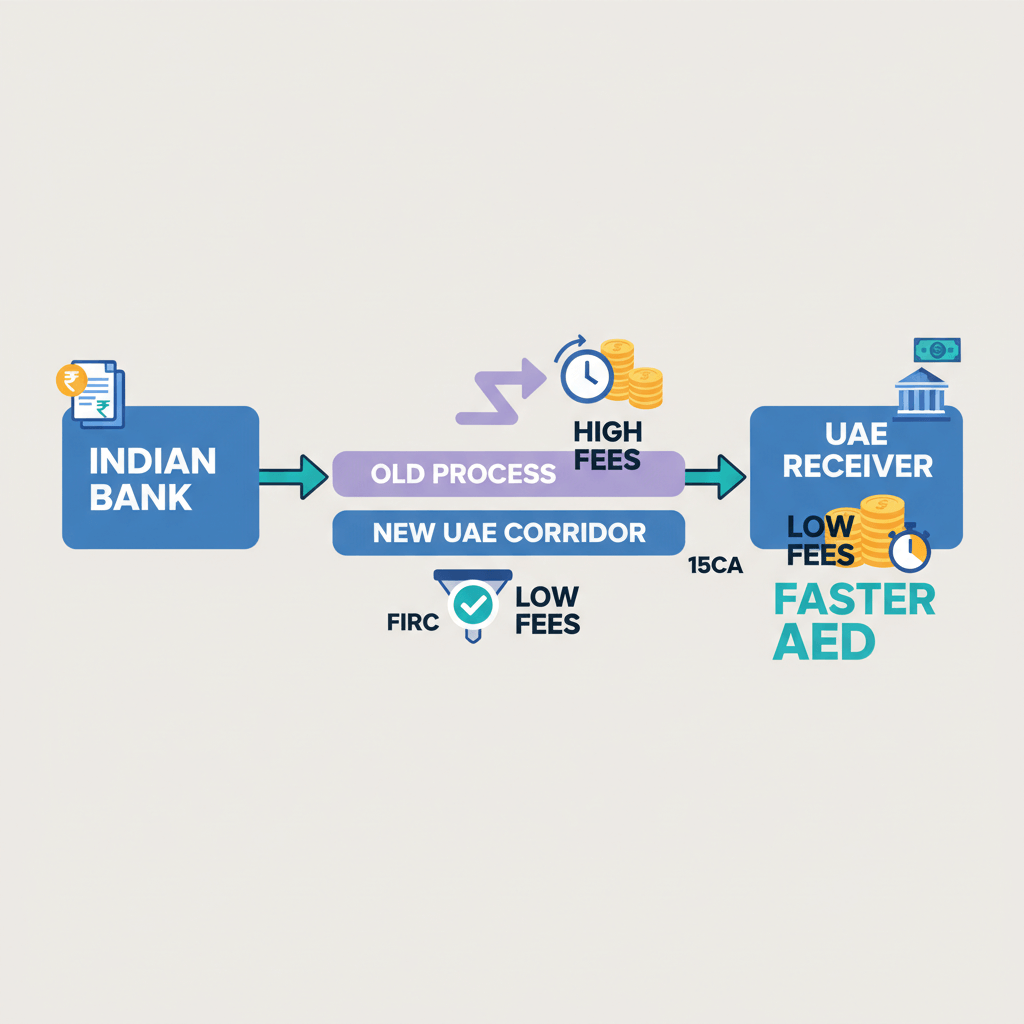
Understanding the AED to INR payment journey

Money does not teleport from Dubai to your Indian account, it moves across networks, converts currency, and clears compliance.

  1. Invoice: Send a professional invoice, include payment instructions.
  2. Client payment: Your UAE client pays in AED or USD through their bank or platform.
  3. Payment network: Funds travel via SWIFT, ACH, or a specialized platform.
  4. Currency conversion: AED converts to INR, sometimes via USD first.
  5. Compliance: e-FIRA or FIRC is generated and logged.
  6. Settlement: INR lands in your Indian bank account.

Each hop can add time, cost, and uncertainty, choosing the right rail minimizes friction.

Three main ways to receive AED payments from UAE to India

1. Direct SWIFT transfer, AED to INR

Your UAE client wires AED to your Indian bank via SWIFT, the bank converts and settles.

  • Pros: Works with any bank, no extra platform.
  • Cons: High fees, weak exchange rates, limited transparency, slower settlement.
  • Best for: One off, larger invoices when convenience matters more than cost.

2. Invoice in USD and use a virtual USD account

Ask the client to convert AED to USD locally, then send USD to your virtual account, you decide when to convert to INR.

  • Pros: Better control on FX, faster settlement, flat and transparent fees, automatic compliance documents.
  • Cons: Client adds one small step, AED to USD conversion on their side.
  • Best for: Repeat clients, medium to large invoices, freelancers who want rate timing.

Use a payment link that accepts cards or local transfers, the platform converts and settles INR to you.

  • Pros: Easy for clients, quick to share, good for small amounts.
  • Cons: Higher fees, limited FX control, not ideal for large invoices.
  • Best for: Small gigs, retainers, clients who prefer cards.

Recommended platforms to receive AED payments from UAE to India

Karbon Business: Virtual USD, GBP, EUR, CAD accounts with local rails, settle INR in 24 to 48 hours, flat 1 percent platform fee, zero FX markup at mid-market rates, automatic e-FIRA within 24 hours, hold foreign currency up to 60 days, and mobile friendly tracking.

Wise Business: Multi currency account with transparent fees and mid market rates, good for USD intermediary or AED via partners, settles in 1 to 3 business days.

Payoneer: USD and EUR receiving accounts, charges around 1 to 2 percent for withdrawals to Indian banks, common for marketplace freelancers.

PayPal: Ubiquitous, but higher all in cost, around 3 to 4 percent, slower settlement.

RazorpayX International: Indian solution with SWIFT and payment link support, suitable when scaling invoicing and compliance.

For regular UAE invoices, Karbon Business stands out with transparent pricing, quick INR settlement, and compliance automation.

Breaking down fees when you receive AED payments from UAE to India

Platform or bank fee

Traditional banks charge inbound SWIFT fees, often ₹500 to ₹1,500, modern platforms charge a small percentage or flat fee.

Foreign exchange markup

Banks often quote rates 2 to 4 percent worse than the mid-market you see on Xe.com, platforms like Karbon Business and Wise use mid-market rates with no hidden markups.

Intermediary charges

SWIFT transfers may pass through correspondent banks which take unpredictable cuts, virtual USD accounts and ACH avoid those, see Virtual USD accounts and ACH transfers avoid most intermediary fees.

GST on fee

GST applies to the platform fee, 18 percent on the fee portion only, not on the total transfer amount.

Worked example, receiving AED 10,000

Option A, Bank SWIFT

AED 10,000 at a bank rate poorer than mid-market lands less INR, plus SWIFT and intermediary fees, net to you is lower, and settlement often takes 5 days.

Option B, Karbon Business

Client converts AED to USD locally, sends USD to your virtual account, you convert at the mid-market rate, pay a flat 1 percent fee plus GST on the fee, net to you is higher, and settlement often completes in 24 to 48 hours.

Result: You typically save five figures in rupees on a 10,000 AED invoice and get paid faster.

AED to INR exchange rates, what to expect and how to track

Check the mid-market rate

Always benchmark your offered rate against Xe.com or Google Finance, any gap is FX markup.

Timing your conversion

When your platform lets you hold foreign currency, for example Karbon Business up to 60 days, you can wait for a better USD to INR rate before converting, small moves add meaningful INR on larger invoices.

AED volatility is lower than you think

AED is pegged to USD, so AED to INR essentially tracks USD to INR, major swings are rare, but watch RBI actions and global shocks.

How to invoice UAE clients for smooth payment

Choose your invoicing currency

USD is widely accepted, easy for both parties, and works well with virtual accounts, if invoicing in AED, confirm your client can convert to USD or your platform can handle AED.

Include complete payment details

  • Beneficiary name.
  • Account number and IFSC for SWIFT, or virtual account routing, account, and SWIFT.
  • Invoice number, date, and due date.
  • Service description and amount.
  • GSTIN if registered.

Add a payment instruction note

"Please transfer USD [amount] to the US account details below, once payment is sent, share the transaction reference so I can track settlement, funds reach my Indian bank in 24 to 48 hours."

Use invoice templates or software

Tools on platforms like Karbon Business pre-fill your virtual account details, this reduces errors and speeds payment.

RBI, FEMA, and compliance, receiving AED payments from UAE to India legally

What is e-FIRA or FIRC?

It is the proof of foreign inward remittance, issued by your bank or platform, the electronic version is called e-FIRA, you need it for tax filings, export records, and future audits.

Automatic e-FIRA with modern platforms

Traditional banks often require manual requests, platforms like Karbon Business generate e-FIRA automatically within 24 hours after settlement.

Purpose code for inward remittance

Choose the correct purpose code, for example S0103 for software services, S0301 for consultancy, S0402 for design, your provider will prompt you to declare it.

GST on export of services

Exports of services are generally zero rated, you do not charge GST to the UAE client, you do pay GST on platform fees, consult a CA for LUT or related filings if you are GST registered.

Tax implications

Declare foreign income in your ITR, maintain invoices, contracts, and e-FIRA, DTAA relief on the UAE side is uncommon for freelancers, but keep records clean.

Step by step, how to receive AED payments from UAE to India using Karbon Business

Step 1, Sign up and complete KYC

Visit Karbon Business, submit PAN, masked Aadhaar, recent bank statements, and your online profile, approval typically takes 2 to 4 working days, virtual USD, GBP, EUR, CAD accounts activate upon approval.

Step 2, Generate or upload your invoice

Create the invoice from the dashboard, select USD, the system pre-fills your receiving account details, download and email it to your client.

Step 3, Your client pays

The client converts AED to USD locally, then sends USD to your virtual account via ACH or wire, local rails reduce cost and delays.

Step 4, Claim the payment

Mark the invoice paid, choose to convert immediately at mid-market, or hold USD up to 60 days to time your conversion.

Step 5, INR settlement

Funds settle to your Indian bank in 24 to 48 hours, you receive notifications, and e-FIRA is generated within 24 hours.

Step 6, Track everything on mobile

Use the WhatsApp bot and dashboard for status, rates, and support, response times are typically under 20 minutes.

Common mistakes to avoid

Invoicing in AED without a conversion plan

Align invoice currency with your receiving method, otherwise payments bounce or cost more.

Accepting payments to a personal savings account

Use a current account or a compliant platform, regular export proceeds in savings accounts can trigger compliance issues.

Ignoring exchange rate timing

For larger invoices, waiting for a modest rate improvement can materially boost your payout.

Not keeping invoice and e-FIRA records

Back up documents in a cloud folder and download e-FIRA for every settlement.

Choosing the cheapest option without checking settlement time

Slow settlement strains cash flow, a slightly higher fee with faster INR credits often wins in practice.

Practical tips to maximize your net payout

  • Negotiate USD terms: Ask UAE clients to pay USD to your virtual account, explain that it is faster and clearer.
  • Batch small payments: Invoice monthly for retainers, fewer transfers mean fewer fees.
  • Monitor rates: Set alerts on Xe.com, convert when USD to INR improves.
  • Use referrals: Platforms like Karbon Business often provide credits which offset fees.
  • Keep KYC fresh: Expired documents delay payouts, review quarterly.

How Karbon Business simplifies receiving AED payments from UAE to India

India first compliance, automatic e-FIRA in 24 hours, export friendly operations. Transparent pricing, a flat 1 percent platform fee with zero FX markup at the mid-market rate. Fast settlement, INR credits in 24 to 48 hours after claim. Forex hedging, hold USD, GBP, EUR, CAD up to 60 days. Multi currency support, local rails in major currencies, so UAE clients can send USD via ACH or wire. Mobile friendly tracking, WhatsApp and dashboard. Dedicated support, quick responses and account managers for higher volumes.

Wrapping up, your action plan

  1. Choose your method, for most, USD invoicing with a virtual account is best.
  2. Complete KYC and set up accounts, 2 to 4 days on Karbon Business.
  3. Generate clear invoices with accurate receiving details.
  4. Confirm currency and rails with your client before they pay.
  5. Claim and convert at mid-market, settle INR within 24 to 48 hours.
  6. Download e-FIRA and store records.
  7. Monitor rates, hold USD when needed, convert when favorable.
  8. Review fees and timings quarterly, refine or switch if you find better outcomes.

Run the numbers on your last invoice, compare bank SWIFT against a virtual USD route with mid-market conversion, and decide whether to switch now, each saved percentage point compounds across your projects.

For help, email support@karboncard.com or call 1800-309-8470, the team can walk you through the best setup for your workflow.

FAQ

How can I receive AED from Dubai to India fast without losing on exchange rates?

Ask your client to pay in USD to a virtual USD account, then convert at mid-market to INR, platforms like Karbon Business settle INR in 24 to 48 hours with zero FX markup, which is usually faster and cheaper than direct AED to INR via SWIFT.

Is Karbon Business RBI and FEMA compliant for freelancers receiving international payments?

Yes, Karbon Business is built for Indian freelancers and small businesses, it generates e-FIRA automatically within 24 hours of settlement, prompts for the correct purpose code, and aligns with RBI and FEMA norms for export of services.

Do I need IEC or GST to receive money from UAE clients as a freelancer?

Most freelancers do not need an IEC for services, GST registration depends on your turnover and business setup, your export of services is typically zero rated, but you should keep invoices and e-FIRA, and consult a CA for LUT or any specific filings.

What is the best way to avoid intermediary bank fees on international transfers?

Avoid SWIFT corridors with multiple correspondent banks, ask clients to send USD to your virtual USD account via ACH or wire, platforms like Karbon Business use local rails, which cut unpredictable intermediary fees and speed up settlement.

Which currency should I invoice UAE clients in, AED or USD?

USD is usually the best, clients in the UAE can convert AED to USD locally at competitive rates, send USD to your virtual account, and you convert at the mid-market to INR, this path gives better transparency and control.

How do I get e-FIRA for each inward remittance, and why does it matter?

Use a platform that auto generates e-FIRA within 24 hours, for example Karbon Business, e-FIRA proves the money came from overseas legally, you need it for tax filings, export records, and future audits.

What fees should I expect when receiving AED payments to India as a freelancer?

Expect platform or bank fees, FX markup if the provider does not use mid-market, and possible intermediary charges on SWIFT, on platforms like Karbon Business you pay a flat 1 percent fee, GST on the fee portion, and zero FX markup, which is simpler and cheaper in practice.

Can I hold USD for a few weeks and convert when INR rates are better?

Yes, platforms like Karbon Business let you hold USD up to 60 days, small rate improvements on USD to INR can add thousands of rupees on larger invoices, set alerts and convert when favorable.

My client prefers card payments, is a payment link okay for small invoices?

Payment links are fine for smaller amounts, but fees are higher, often 2 to 3 percent, for retainers or small gigs they are convenient, for larger invoices prefer a virtual USD account to minimize fees and control FX.

What purpose code should I use for software, design, or consulting services?

Common examples include S0103 for software services, S0402 for design, and S0301 for consultancy, your provider will prompt you to choose, select the one that matches your service on each inward remittance.

Is it safe to receive international payments into my personal savings account?

For regular export proceeds, it is better to use a current account or a compliant platform, using a personal savings account for high volumes can trigger compliance flags, Karbon Business links to your bank and handles e-FIRA automatically.

How quickly does Karbon Business settle INR once I claim my USD payment?

Typically within 24 to 48 hours, you get email and WhatsApp notifications, and e-FIRA is available for download within 24 hours of settlement, which helps you keep clean records for taxes.

Key takeaways

  • For most freelancers, invoicing in USD and receiving via a virtual USD account, then converting to INR, gives faster settlement and better rates than direct AED to INR SWIFT.
  • Platforms with mid-market rates and transparent fees, for example Karbon Business, usually beat bank markups by 2 to 4 percent.
  • Always compare against the mid-market on Xe.com, any gap is hidden FX markup you are paying.
  • Request automatic e-FIRA for each inward remittance, platforms like Karbon Business generate it within 24 hours, which simplifies RBI and FEMA compliance.
  • Holding USD for up to 60 days can help you time the market, modest rate moves often add thousands of rupees to your net payout.
  • Avoid unpredictable intermediary bank fees by using virtual USD accounts, ACH, and local rails, which Virtual USD accounts and ACH transfers avoid most intermediary fees.
  • Set clear invoices, payment instructions, and purpose codes, this reduces delays, improves transparency, and accelerates settlement.

Why UAE clients matter for Indian freelancers

The UAE is a major market for Indian designers, developers, and consultants, with strong demand and repeat work. Payments usually arrive in AED or USD, so every transfer crosses borders, passes compliance checks, and converts currency. Getting this flow right saves money, speeds cash flow, and keeps you error free.

Understanding the AED to INR payment journey

Money does not teleport from Dubai to your Indian account, it moves across networks, converts currency, and clears compliance.

  1. Invoice: Send a professional invoice, include payment instructions.
  2. Client payment: Your UAE client pays in AED or USD through their bank or platform.
  3. Payment network: Funds travel via SWIFT, ACH, or a specialized platform.
  4. Currency conversion: AED converts to INR, sometimes via USD first.
  5. Compliance: e-FIRA or FIRC is generated and logged.
  6. Settlement: INR lands in your Indian bank account.

Each hop can add time, cost, and uncertainty, choosing the right rail minimizes friction.

Three main ways to receive AED payments from UAE to India

1. Direct SWIFT transfer, AED to INR

Your UAE client wires AED to your Indian bank via SWIFT, the bank converts and settles.

  • Pros: Works with any bank, no extra platform.
  • Cons: High fees, weak exchange rates, limited transparency, slower settlement.
  • Best for: One off, larger invoices when convenience matters more than cost.

2. Invoice in USD and use a virtual USD account

Ask the client to convert AED to USD locally, then send USD to your virtual account, you decide when to convert to INR.

  • Pros: Better control on FX, faster settlement, flat and transparent fees, automatic compliance documents.
  • Cons: Client adds one small step, AED to USD conversion on their side.
  • Best for: Repeat clients, medium to large invoices, freelancers who want rate timing.

Use a payment link that accepts cards or local transfers, the platform converts and settles INR to you.

  • Pros: Easy for clients, quick to share, good for small amounts.
  • Cons: Higher fees, limited FX control, not ideal for large invoices.
  • Best for: Small gigs, retainers, clients who prefer cards.

Recommended platforms to receive AED payments from UAE to India

Karbon Business: Virtual USD, GBP, EUR, CAD accounts with local rails, settle INR in 24 to 48 hours, flat 1 percent platform fee, zero FX markup at mid-market rates, automatic e-FIRA within 24 hours, hold foreign currency up to 60 days, and mobile friendly tracking.

Wise Business: Multi currency account with transparent fees and mid market rates, good for USD intermediary or AED via partners, settles in 1 to 3 business days.

Payoneer: USD and EUR receiving accounts, charges around 1 to 2 percent for withdrawals to Indian banks, common for marketplace freelancers.

PayPal: Ubiquitous, but higher all in cost, around 3 to 4 percent, slower settlement.

RazorpayX International: Indian solution with SWIFT and payment link support, suitable when scaling invoicing and compliance.

For regular UAE invoices, Karbon Business stands out with transparent pricing, quick INR settlement, and compliance automation.

Breaking down fees when you receive AED payments from UAE to India

Platform or bank fee

Traditional banks charge inbound SWIFT fees, often ₹500 to ₹1,500, modern platforms charge a small percentage or flat fee.

Foreign exchange markup

Banks often quote rates 2 to 4 percent worse than the mid-market you see on Xe.com, platforms like Karbon Business and Wise use mid-market rates with no hidden markups.

Intermediary charges

SWIFT transfers may pass through correspondent banks which take unpredictable cuts, virtual USD accounts and ACH avoid those, see Virtual USD accounts and ACH transfers avoid most intermediary fees.

GST on fee

GST applies to the platform fee, 18 percent on the fee portion only, not on the total transfer amount.

Worked example, receiving AED 10,000

Option A, Bank SWIFT

AED 10,000 at a bank rate poorer than mid-market lands less INR, plus SWIFT and intermediary fees, net to you is lower, and settlement often takes 5 days.

Option B, Karbon Business

Client converts AED to USD locally, sends USD to your virtual account, you convert at the mid-market rate, pay a flat 1 percent fee plus GST on the fee, net to you is higher, and settlement often completes in 24 to 48 hours.

Result: You typically save five figures in rupees on a 10,000 AED invoice and get paid faster.

AED to INR exchange rates, what to expect and how to track

Check the mid-market rate

Always benchmark your offered rate against Xe.com or Google Finance, any gap is FX markup.

Timing your conversion

When your platform lets you hold foreign currency, for example Karbon Business up to 60 days, you can wait for a better USD to INR rate before converting, small moves add meaningful INR on larger invoices.

AED volatility is lower than you think

AED is pegged to USD, so AED to INR essentially tracks USD to INR, major swings are rare, but watch RBI actions and global shocks.

How to invoice UAE clients for smooth payment

Choose your invoicing currency

USD is widely accepted, easy for both parties, and works well with virtual accounts, if invoicing in AED, confirm your client can convert to USD or your platform can handle AED.

Include complete payment details

  • Beneficiary name.
  • Account number and IFSC for SWIFT, or virtual account routing, account, and SWIFT.
  • Invoice number, date, and due date.
  • Service description and amount.
  • GSTIN if registered.

Add a payment instruction note

"Please transfer USD [amount] to the US account details below, once payment is sent, share the transaction reference so I can track settlement, funds reach my Indian bank in 24 to 48 hours."

Use invoice templates or software

Tools on platforms like Karbon Business pre-fill your virtual account details, this reduces errors and speeds payment.

RBI, FEMA, and compliance, receiving AED payments from UAE to India legally

What is e-FIRA or FIRC?

It is the proof of foreign inward remittance, issued by your bank or platform, the electronic version is called e-FIRA, you need it for tax filings, export records, and future audits.

Automatic e-FIRA with modern platforms

Traditional banks often require manual requests, platforms like Karbon Business generate e-FIRA automatically within 24 hours after settlement.

Purpose code for inward remittance

Choose the correct purpose code, for example S0103 for software services, S0301 for consultancy, S0402 for design, your provider will prompt you to declare it.

GST on export of services

Exports of services are generally zero rated, you do not charge GST to the UAE client, you do pay GST on platform fees, consult a CA for LUT or related filings if you are GST registered.

Tax implications

Declare foreign income in your ITR, maintain invoices, contracts, and e-FIRA, DTAA relief on the UAE side is uncommon for freelancers, but keep records clean.

Step by step, how to receive AED payments from UAE to India using Karbon Business

Step 1, Sign up and complete KYC

Visit Karbon Business, submit PAN, masked Aadhaar, recent bank statements, and your online profile, approval typically takes 2 to 4 working days, virtual USD, GBP, EUR, CAD accounts activate upon approval.

Step 2, Generate or upload your invoice

Create the invoice from the dashboard, select USD, the system pre-fills your receiving account details, download and email it to your client.

Step 3, Your client pays

The client converts AED to USD locally, then sends USD to your virtual account via ACH or wire, local rails reduce cost and delays.

Step 4, Claim the payment

Mark the invoice paid, choose to convert immediately at mid-market, or hold USD up to 60 days to time your conversion.

Step 5, INR settlement

Funds settle to your Indian bank in 24 to 48 hours, you receive notifications, and e-FIRA is generated within 24 hours.

Step 6, Track everything on mobile

Use the WhatsApp bot and dashboard for status, rates, and support, response times are typically under 20 minutes.

Common mistakes to avoid

Invoicing in AED without a conversion plan

Align invoice currency with your receiving method, otherwise payments bounce or cost more.

Accepting payments to a personal savings account

Use a current account or a compliant platform, regular export proceeds in savings accounts can trigger compliance issues.

Ignoring exchange rate timing

For larger invoices, waiting for a modest rate improvement can materially boost your payout.

Not keeping invoice and e-FIRA records

Back up documents in a cloud folder and download e-FIRA for every settlement.

Choosing the cheapest option without checking settlement time

Slow settlement strains cash flow, a slightly higher fee with faster INR credits often wins in practice.

Practical tips to maximize your net payout

  • Negotiate USD terms: Ask UAE clients to pay USD to your virtual account, explain that it is faster and clearer.
  • Batch small payments: Invoice monthly for retainers, fewer transfers mean fewer fees.
  • Monitor rates: Set alerts on Xe.com, convert when USD to INR improves.
  • Use referrals: Platforms like Karbon Business often provide credits which offset fees.
  • Keep KYC fresh: Expired documents delay payouts, review quarterly.

How Karbon Business simplifies receiving AED payments from UAE to India

India first compliance, automatic e-FIRA in 24 hours, export friendly operations. Transparent pricing, a flat 1 percent platform fee with zero FX markup at the mid-market rate. Fast settlement, INR credits in 24 to 48 hours after claim. Forex hedging, hold USD, GBP, EUR, CAD up to 60 days. Multi currency support, local rails in major currencies, so UAE clients can send USD via ACH or wire. Mobile friendly tracking, WhatsApp and dashboard. Dedicated support, quick responses and account managers for higher volumes.

Wrapping up, your action plan

  1. Choose your method, for most, USD invoicing with a virtual account is best.
  2. Complete KYC and set up accounts, 2 to 4 days on Karbon Business.
  3. Generate clear invoices with accurate receiving details.
  4. Confirm currency and rails with your client before they pay.
  5. Claim and convert at mid-market, settle INR within 24 to 48 hours.
  6. Download e-FIRA and store records.
  7. Monitor rates, hold USD when needed, convert when favorable.
  8. Review fees and timings quarterly, refine or switch if you find better outcomes.

Run the numbers on your last invoice, compare bank SWIFT against a virtual USD route with mid-market conversion, and decide whether to switch now, each saved percentage point compounds across your projects.

For help, email support@karboncard.com or call 1800-309-8470, the team can walk you through the best setup for your workflow.

FAQ

How can I receive AED from Dubai to India fast without losing on exchange rates?

Ask your client to pay in USD to a virtual USD account, then convert at mid-market to INR, platforms like Karbon Business settle INR in 24 to 48 hours with zero FX markup, which is usually faster and cheaper than direct AED to INR via SWIFT.

Is Karbon Business RBI and FEMA compliant for freelancers receiving international payments?

Yes, Karbon Business is built for Indian freelancers and small businesses, it generates e-FIRA automatically within 24 hours of settlement, prompts for the correct purpose code, and aligns with RBI and FEMA norms for export of services.

Do I need IEC or GST to receive money from UAE clients as a freelancer?

Most freelancers do not need an IEC for services, GST registration depends on your turnover and business setup, your export of services is typically zero rated, but you should keep invoices and e-FIRA, and consult a CA for LUT or any specific filings.

What is the best way to avoid intermediary bank fees on international transfers?

Avoid SWIFT corridors with multiple correspondent banks, ask clients to send USD to your virtual USD account via ACH or wire, platforms like Karbon Business use local rails, which cut unpredictable intermediary fees and speed up settlement.

Which currency should I invoice UAE clients in, AED or USD?

USD is usually the best, clients in the UAE can convert AED to USD locally at competitive rates, send USD to your virtual account, and you convert at the mid-market to INR, this path gives better transparency and control.

How do I get e-FIRA for each inward remittance, and why does it matter?

Use a platform that auto generates e-FIRA within 24 hours, for example Karbon Business, e-FIRA proves the money came from overseas legally, you need it for tax filings, export records, and future audits.

What fees should I expect when receiving AED payments to India as a freelancer?

Expect platform or bank fees, FX markup if the provider does not use mid-market, and possible intermediary charges on SWIFT, on platforms like Karbon Business you pay a flat 1 percent fee, GST on the fee portion, and zero FX markup, which is simpler and cheaper in practice.

Can I hold USD for a few weeks and convert when INR rates are better?

Yes, platforms like Karbon Business let you hold USD up to 60 days, small rate improvements on USD to INR can add thousands of rupees on larger invoices, set alerts and convert when favorable.

My client prefers card payments, is a payment link okay for small invoices?

Payment links are fine for smaller amounts, but fees are higher, often 2 to 3 percent, for retainers or small gigs they are convenient, for larger invoices prefer a virtual USD account to minimize fees and control FX.

What purpose code should I use for software, design, or consulting services?

Common examples include S0103 for software services, S0402 for design, and S0301 for consultancy, your provider will prompt you to choose, select the one that matches your service on each inward remittance.

Is it safe to receive international payments into my personal savings account?

For regular export proceeds, it is better to use a current account or a compliant platform, using a personal savings account for high volumes can trigger compliance flags, Karbon Business links to your bank and handles e-FIRA automatically.

How quickly does Karbon Business settle INR once I claim my USD payment?

Typically within 24 to 48 hours, you get email and WhatsApp notifications, and e-FIRA is available for download within 24 hours of settlement, which helps you keep clean records for taxes.

The views expressed in the blogs on this page are solely the opinions of the authors and do not constitute expert advice. While we strive to provide accurate and up-to-date information, we make no representations or warranties of any kind, express or implied, about the completeness, accuracy, reliability, suitability or availability with respect to the website or the information, products, services, or related graphics contained on the website for any purpose. Any reliance you place on such information is therefore strictly at your own risk. We disclaim any liability for any loss or damage including without limitation, indirect or consequential loss or damage, or any loss or damage whatsoever arising from loss of data or profits arising out of, or in connection with, the use of this website.

Find out how we can help you today!

Speak to our foreign payment specialist
Whatsapp-color Created with Sketch.
Whatsapp:
+91 74117 02726
Email:
sales@karboncard.com
Address:
Ground Floor, Karbon Business, 1st Stage Rd, Binnamangala, Hoysala Nagar, Indiranagar, Bengaluru, Karnataka 560038

Find out how we can help you today!

Speak to our foreign payment specialist
Whatsapp-color Created with Sketch.
Whatsapp:
+91 74117 02726
Email:
sales@karboncard.com
Address:
Ground Floor, Karbon Business, 1st Stage Rd, Binnamangala, Hoysala Nagar, Indiranagar, Bengaluru, Karnataka 560038

Latest from our blogs

Latest from our blogs

View All
× Save 50% - Start Now