Business

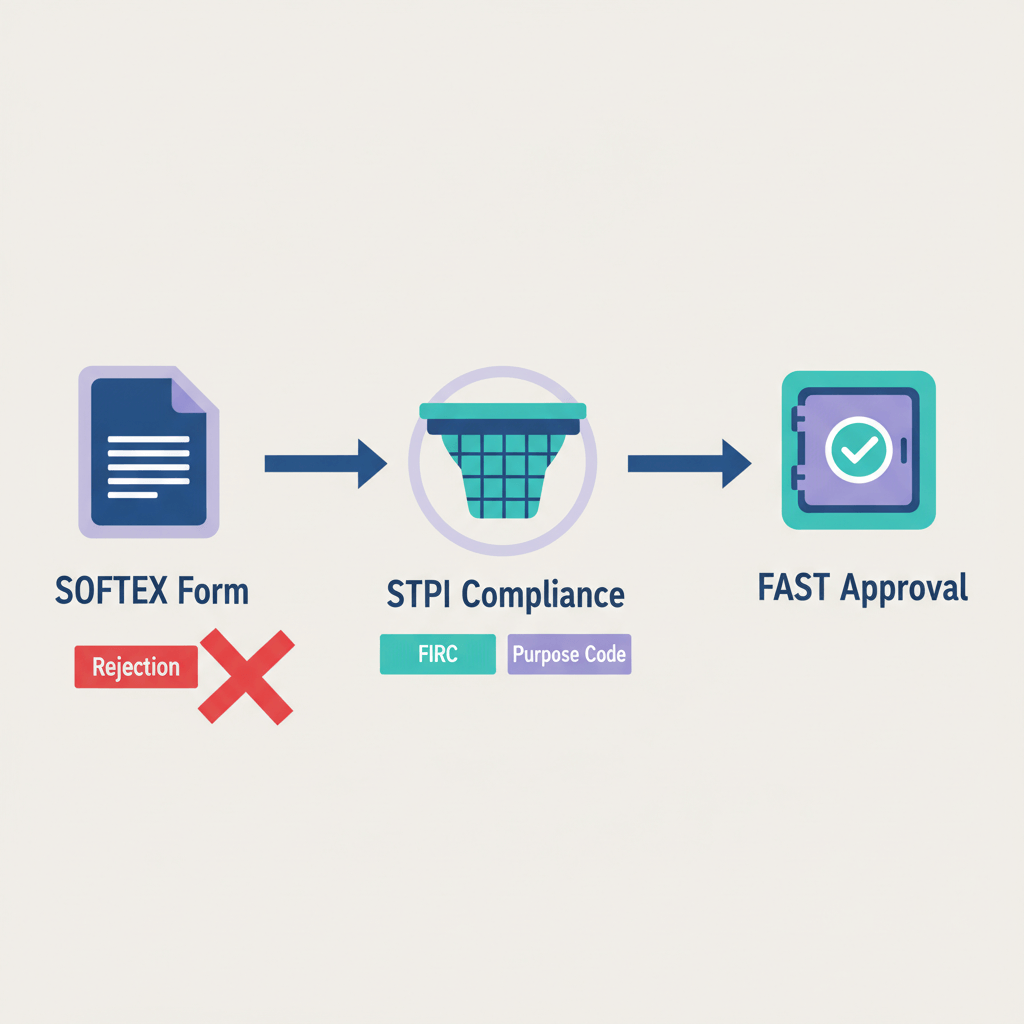
Avoid SOFTEX Rejections: STPI Secrets to Fast Approvals

Content
share on
Contents
Share On

Key takeaways

  • SOFTEX is mandatory proof of export for software and services, banks often insist on it even for non-STPI freelancers, see SOFTEX for freelancers in India.
  • Top rejection causes include document mismatches, wrong purpose codes like not selecting P0802 purpose code, value or currency discrepancies, and late filings beyond 30 days.
  • Fixes are straightforward, correct the invoice and details, attach realization advice, justify purpose code, and provide solid contracts or SOWs, a concise cover note speeds approvals.
  • File within 30 days of invoice or realization, delays need condonation and can trigger FEMA penalties, refer the SOFTEX filing compliance guide.
  • Karbon Business accelerates compliance readiness with clean invoices, instant e-FIRA, mid-market FX, and organized records, you still file SOFTEX yourself.

What is SOFTEX and who needs it?

SOFTEX is an RBI mandated declaration for software and services exports, certified by STPI or SEZ authorities, it substitutes a shipping bill for digital work. If you export code, designs, consulting, or IT services, your bank may ask for SOFTEX even if you are non-STPI, especially for higher value or recurring invoices, see SOFTEX for freelancers in India.

Banks rely on SOFTEX to validate that foreign remittances are from legitimate exports, not generic service categories that raise compliance flags. Think of SOFTEX as your narrative plus evidence, tying your invoice to a verified export.

SOFTEX vs e-FIRA and e-FIRC

SOFTEX certifies export details for RBI. e-FIRA and e-FIRC confirm the bank received the payment. Many banks issue FIRC after SOFTEX is certified, creating a clear audit trail from invoice to realization. Bottom line, SOFTEX explains what you exported, FIRA and FIRC confirm what you got paid.

Real freelancer scenarios

Priya, a UI/UX designer on Upwork, gets monthly USD retainers. Her bank pauses FIRC until prior months’ SOFTEX are submitted. Rajesh, a software consultant billing milestones in GBP, files SOFTEX upfront to keep GST refunds and banking smooth. In both stories, SOFTEX is the bridge between invoices and a penalty free banking relationship, practical filing tips here, SOFTEX filing.

Filing workflow overview

Before filing, collect IEC, STPI or SEZ registration if applicable, AD code, PAN, GST, contract or PO or SOW, invoices, and complete buyer details. Missing any one of these can trigger instant rejection.

The four step process

  1. Create your invoice. Keep number, date, currency, line items aligned with the contract.
  2. File on the STPI portal. Pick export classification, enter buyer info, purpose code, and invoice details.
  3. Attach documents. Contract or PO or SOW, invoice, bank details, client proof, then respond to clarifications swiftly.
  4. Submit certified SOFTEX to your AD bank. Bank issues e-FIRC to complete the compliance loop.

Critical timelines you cannot ignore

File SOFTEX within 30 days of the last invoice date or the realization date, whichever is earlier. Miss the window, you must seek condonation, penalties under FEMA can be significant. Read the SOFTEX filing compliance guide for timing nuances. Treat it like a tax deadline.

If delayed, refer the STPI condonation of delay compliance guide for the exact process.

SOFTEX common rejection reasons

Document mismatch

Why it happens: Invoice number or date in the portal differs from the uploaded PDF. Even tiny inconsistencies get flagged. Example: INV-2024-03 vs INV/03/2024.

Value or currency mismatch

Why it happens: Invoice shows $5,000, bank realizes $4,850 after a discount or credit note. Filing on invoice value without reconciling realized amount prompts queries. INR conversion gaps also trigger issues.

Purpose code errors

Why it happens: Selecting a royalty or licensing code instead of export of services. For IT services, use P0802 purpose code. A broader international reference is the BNP Paribas cash management overview.

Missing or insufficient supporting documents

Why it happens: No formal contract or PO, vague emails, or thin scope proof. STPI needs clear evidence of client, scope, and timeline.

AD code or bank details incorrect

Why it happens: You changed bank or branch and did not update your STPI profile, AD code mismatches are common.

IEC, GST, or PAN errors

Why it happens: Typos or an inactive IEC. Validate status before filing.

Client identity issues

Why it happens: Minimal identity info for the foreign client, no registration, address, or tax ID.

Duplicate invoices

Why it happens: Split milestones without proper tagging, system flags duplicates.

Partial or advance payments

Why it happens: Advances and later balances filed as one amount, remittance does not map to a single SOFTEX.

Wrong category selection

Why it happens: Choosing product instead of service for custom work.

Late submissions

Why it happens: Missing the 30 day window. Condonation is required. Official guidance, STPI condonation of delay compliance guide.

Generic or vague service description

Why it happens: Writing “Services rendered” without deliverables, tools, or dates, which leaves STPI unable to verify the nature of export.

What happens if you do not file or keep getting rejected?

Non-filing or repeated rejections can block GST refunds, freeze future remittances, and lead to FEMA penalties. A thorough explainer is here, RBI & FEMA compliance guide.

How to fix SOFTEX errors

Document mismatch fix

Action: Refile with corrected invoice number or date, and a remark explaining the change. Documents: Revised invoice plus the original contract or email confirmation.

Value or currency mismatch fix

Action: Attach bank realization advice, add a reconciliation note for discounts or credits, explain the conversion rate basis. Documents: Bank advice, credit note or email, reconciliation sheet.

Purpose code fix

Action: Select the correct code, typically P0802 purpose code, add a short justification. Documents: Contract or SOW highlighting service scope.

Supporting documents fix

Action: Upload complete contracts, POs, or signed SOWs, include approvals and timesheets if needed. Documents: Contract bundle, milestone sign offs.

AD code or bank details fix

Action: Update your STPI profile with a bank letter confirming your current AD code, then amend your filing. Documents: Bank letter, profile screenshot.

IEC, GST, or PAN fix

Action: Reactivate or correct registrations, then update your STPI profile. Documents: IEC or GST certificate, PAN copy.

Client identity fix

Action: Enter complete client details, attach company registration or tax ID, and onboarding proofs. Documents: Registration or tax ID, emails, website snapshots.

Duplicate invoices fix

Action: Withdraw duplicates, consolidate where appropriate, and add a clarifying remark. Documents: Combined invoice, explanation note.

Partial or advance payments fix

Action: Tag each SOFTEX with the portion covered, map each remittance to the corresponding filing. Documents: Bank advice for each tranche, reconciliation note, payment terms.

Wrong category fix

Action: Switch to service classification if applicable, justify with SOW excerpts. Documents: SOW, sample deliverables.

Late submission fix

Action: Prepare a condonation letter, explain the delay with proof, submit via portal or as instructed by STPI. Documents: Condonation letter, timeline proof, IEC, PAN, invoice, contract. Helpful reference, FAQ for non-STPI.

Generic description fix

Action: Rewrite the description with specific deliverables, tools, dates, and outcomes, link it to your SOW sections. Documents: Detailed SOW, deliverable list.

Special case, cancellations

If the client did not pay or the contract ended before export, you must seek RBI approval to cancel a SOFTEX. File a cancellation request with STPI, attach non-realization proof, and await clearance. Do not cancel without RBI approval.

STPI clarifications, what to expect and how to respond

Common clarification requests

  • Scope proof and deliverables.
  • Client identity evidence.
  • Currency rate basis and reconciliation.
  • Contract or PO validation.
  • Purpose code justification, often for P0802 purpose code.
  • Unit and AD code mapping.

How to respond effectively

Reference your filing ID and invoice number, attach precisely what is asked, and use a brief cover note that ties each attachment to the query. Clarity beats volume, keep it tight and complete.

Example cover note, “Filing ID 12345, Invoice INV-01, realized amount $4,850 vs $5,000 due to client-approved reduction, attached bank advice, credit note, and reconciliation sheet.”

Turnaround and escalation

Typical processing is about 10 business days. If there is no response in two weeks, follow up with your STPI coordinator citing the filing ID and a one line status request.

Preventive checklist, avoid rejections before you file

Pre-filing verification

  • Invoice number, date, currency, and amount match your PDF and accounting records.
  • Correct RBI purpose code, commonly P0802 purpose code for IT services.
  • IEC active on DGFT, AD code aligned with the bank letter.
  • Complete client details, legal name, address, country, tax ID, website.

Documents bundle ready

  • Signed contract or PO or SOW.
  • All invoices for the period.
  • Bank realization advice or SWIFT copy.
  • Client identity proof or registration extract.
  • Email approvals for scope and deliverables.

Service description specifics

Bad: “Web development services.”

Good: “Developed responsive e-commerce site using React and Node.js, integrated Stripe, delivered staging on January 15 and production on January 30, includes 10 product pages, cart, admin dashboard.”

Currency and rate reconciliation

If invoice is in USD but bank credited INR, note the conversion rate source, and reconcile bank charges or client deductions. One line remarks help, “Converted at mid-market 83.50 per USD on settlement date.”

Timeline discipline

Set a recurring task to file within 7 days of invoice, keep a buffer before the 30 day deadline, and track STPI’s typical 10 day processing window.

Indian freelancer best practices and real examples

Upwork and platform payments

Ravi downloads his monthly Upwork invoice, tags P0802 purpose code, files within a week, and notes weekly tranches in remarks. He attaches the Upwork contract snapshot plus bank statement excerpts. Result, approval in 8 days, FIRC issued within 48 hours post certification. Background reading, RBI & FEMA compliance guide.

Direct B2B contracts

Sneha invoices EUR retainers under an annual MSA, files on the 3rd of each month with the MSA and invoice attached, keeps her STPI profile updated after switching AD bank codes, and avoids duplicate flags by batching under the MSA reference. Result, clean record over 18 months.

High frequency, multiple clients

Arjun consolidates a monthly SOFTEX covering all invoices, lists each client and invoice inside the description, and attaches a spreadsheet mapping realizations to invoices. Filing time drops dramatically, with zero penalties. Broader context, RBI regulations for software exporters.

Where Karbon Business helps

Compliance is your responsibility, but payment infrastructure can make it far smoother. Karbon Business offers virtual USD, GBP, EUR, and CAD accounts, clean invoice generation, and e-FIRA within 24 hours, so your realization proof is ready when you file SOFTEX. With mid-market FX rates and the option to hold foreign currency for up to 60 days, you can time conversions intelligently, then cite exact rates and dates in reconciliation notes.

When STPI asks for clarifications, Karbon’s WhatsApp and email support help you retrieve transaction logs, realization dates, and client payment evidence quickly. Important: Karbon does not file SOFTEX for you, but it minimizes the data mismatches that cause rejections.

When comparing platforms, prioritize RBI and FEMA compliant virtual accounts, automated e-FIRA, and transparent FX handling. Karbon Business is built for Indian freelancers, Wise Business, Payoneer, RazorpayX International, and Tazapay serve varied needs, evaluate based on your client mix and how hands-on you want to be with documentation.

FAQ

Do I really need SOFTEX for Upwork or Fiverr payments if my bank already credits the money?

Often yes, your AD bank may require SOFTEX for software and IT services exports, even when platforms remit directly. The bank uses a certified SOFTEX to issue e-FIRC, create a clean audit trail, and support GST refunds. Many freelancers file as non-STPI exporters through the nearest STPI office. Using Karbon Business for receipts can simplify the documentation with ready e-FIRA and precise payment logs.

Which RBI purpose code should I use for web development, app design, or cloud consulting, is P0802 correct?

For most IT and computer services, P0802 applies. If you truly sold packaged software rather than services, your code could differ. Map your scope to services and justify with the SOW. Karbon Business invoices and scope summaries make purpose code justification easy because tools, deliverables, and dates are clearly documented.

How do I handle SOFTEX when a client pays in multiple tranches or sends an advance and the balance later?

File SOFTEX with clear tagging, one for the advance portion and one for the balance, or a consolidated filing that explains the split inside remarks. Attach bank advice for each tranche, and a reconciliation sheet mapping remittances to the invoice. Karbon Business shows remittance dates and amounts cleanly, which makes the mapping straightforward.

My realized amount is lower than the invoice due to discounts or platform fees, will this cause rejection?

It can trigger clarifications. Resolve it by attaching bank realization advice, the discount email or credit note, and a short reconciliation. If platform fees are involved, include the platform statement. Karbon Business provides settlement advisories you can cite directly for rate and amount clarity.

I am a freelancer without STPI registration, can I still file SOFTEX and how?

Yes, many AD banks ask non-STPI freelancers to file SOFTEX through the nearest STPI office’s process for non-unit exporters. Check your bank’s policy and the local STPI workflow. Keep IEC active, contracts and SOWs ready, and bank realization proof. For broader compliance context, review the SOFTEX filing compliance guide.

What documents should I keep ready to fix the most common SOFTEX rejections fast?

Keep a standard folder per client, signed contract or PO or SOW, consistent invoices, bank realization advice or SWIFT copy, client registration or tax ID proof, and email approvals for scope and milestones. Karbon Business helps by generating e-FIRA within 24 hours and maintaining transaction logs you can download and attach.

How do I choose the correct category, service versus software product, for custom development work?

If you deliver custom code, implementation, or consulting, it is a service. Choose service classification, justify with SOW excerpts and deliverable lists. Selecting product without selling a packaged license invites rejection. Karbon Business invoices can include scope descriptors that reinforce the service nature.

My bank asked for SOFTEX months after realization, will I face penalties and what is the condonation process?

If the 30 day limit passed, you may need condonation. Prepare a letter explaining the delay, attach proof like platform migration notes or travel records, plus IEC, PAN, contract, and invoice. Submit via the STPI portal or as instructed. Keep filing discipline going forward to avoid repeating delays.

Can Karbon Business help me get e-FIRC faster or only e-FIRA, what is the difference for freelancers?

e-FIRA is the bank’s inward remittance advice confirming the credit, which Karbon Business generates quickly. e-FIRC is a certificate many banks issue after SOFTEX, policies vary by bank. Use Karbon’s e-FIRA as realization proof for your SOFTEX filing, then request e-FIRC from your AD bank as per their process.

What should I write in the service description to avoid vague or generic clarifications?

Be specific, list tools, platforms, deliverables, dates, and outcomes. For example, “UI/UX design and prototyping using Figma, deliverables include wireframes, high fidelity mockups, interactive prototype, delivered Jan 1 to Jan 15.” Pair the description with the SOW section. Karbon Business lets you include concise scope lines per invoice to keep this consistent.

Will currency conversion differences, bank charges, or mid-market rate references cause SOFTEX queries?

They can, so add remarks explaining the rate basis and attach the bank advice. If conversion used a mid-market rate, cite the rate and date, and reconcile any bank charges visibly. Karbon Business records FX rates and settlement advice, which you can reference directly in your filing.

Do I need client registration or tax ID proof for individuals or sole proprietors abroad?

Provide what is available, full legal name, address, website or portfolio, and any tax ID such as EIN in the US or VAT in the EU. If the client is an individual, include onboarding emails, payment confirmations, and identity evidence like a LinkedIn profile or website. The stronger the identity proof, the smoother the approval.

Disclaimer: Requirements vary by STPI office, AD bank, and exporter profile. Always confirm with your bank, your STPI coordinator, or a qualified CA for case specific guidance.

Key takeaways

  • SOFTEX is mandatory proof of export for software and services, banks often insist on it even for non-STPI freelancers, see SOFTEX for freelancers in India.
  • Top rejection causes include document mismatches, wrong purpose codes like not selecting P0802 purpose code, value or currency discrepancies, and late filings beyond 30 days.
  • Fixes are straightforward, correct the invoice and details, attach realization advice, justify purpose code, and provide solid contracts or SOWs, a concise cover note speeds approvals.
  • File within 30 days of invoice or realization, delays need condonation and can trigger FEMA penalties, refer the SOFTEX filing compliance guide.
  • Karbon Business accelerates compliance readiness with clean invoices, instant e-FIRA, mid-market FX, and organized records, you still file SOFTEX yourself.

What is SOFTEX and who needs it?

SOFTEX is an RBI mandated declaration for software and services exports, certified by STPI or SEZ authorities, it substitutes a shipping bill for digital work. If you export code, designs, consulting, or IT services, your bank may ask for SOFTEX even if you are non-STPI, especially for higher value or recurring invoices, see SOFTEX for freelancers in India.

Banks rely on SOFTEX to validate that foreign remittances are from legitimate exports, not generic service categories that raise compliance flags. Think of SOFTEX as your narrative plus evidence, tying your invoice to a verified export.

SOFTEX vs e-FIRA and e-FIRC

SOFTEX certifies export details for RBI. e-FIRA and e-FIRC confirm the bank received the payment. Many banks issue FIRC after SOFTEX is certified, creating a clear audit trail from invoice to realization. Bottom line, SOFTEX explains what you exported, FIRA and FIRC confirm what you got paid.

Real freelancer scenarios

Priya, a UI/UX designer on Upwork, gets monthly USD retainers. Her bank pauses FIRC until prior months’ SOFTEX are submitted. Rajesh, a software consultant billing milestones in GBP, files SOFTEX upfront to keep GST refunds and banking smooth. In both stories, SOFTEX is the bridge between invoices and a penalty free banking relationship, practical filing tips here, SOFTEX filing.

Filing workflow overview

Before filing, collect IEC, STPI or SEZ registration if applicable, AD code, PAN, GST, contract or PO or SOW, invoices, and complete buyer details. Missing any one of these can trigger instant rejection.

The four step process

  1. Create your invoice. Keep number, date, currency, line items aligned with the contract.
  2. File on the STPI portal. Pick export classification, enter buyer info, purpose code, and invoice details.
  3. Attach documents. Contract or PO or SOW, invoice, bank details, client proof, then respond to clarifications swiftly.
  4. Submit certified SOFTEX to your AD bank. Bank issues e-FIRC to complete the compliance loop.

Critical timelines you cannot ignore

File SOFTEX within 30 days of the last invoice date or the realization date, whichever is earlier. Miss the window, you must seek condonation, penalties under FEMA can be significant. Read the SOFTEX filing compliance guide for timing nuances. Treat it like a tax deadline.

If delayed, refer the STPI condonation of delay compliance guide for the exact process.

SOFTEX common rejection reasons

Document mismatch

Why it happens: Invoice number or date in the portal differs from the uploaded PDF. Even tiny inconsistencies get flagged. Example: INV-2024-03 vs INV/03/2024.

Value or currency mismatch

Why it happens: Invoice shows $5,000, bank realizes $4,850 after a discount or credit note. Filing on invoice value without reconciling realized amount prompts queries. INR conversion gaps also trigger issues.

Purpose code errors

Why it happens: Selecting a royalty or licensing code instead of export of services. For IT services, use P0802 purpose code. A broader international reference is the BNP Paribas cash management overview.

Missing or insufficient supporting documents

Why it happens: No formal contract or PO, vague emails, or thin scope proof. STPI needs clear evidence of client, scope, and timeline.

AD code or bank details incorrect

Why it happens: You changed bank or branch and did not update your STPI profile, AD code mismatches are common.

IEC, GST, or PAN errors

Why it happens: Typos or an inactive IEC. Validate status before filing.

Client identity issues

Why it happens: Minimal identity info for the foreign client, no registration, address, or tax ID.

Duplicate invoices

Why it happens: Split milestones without proper tagging, system flags duplicates.

Partial or advance payments

Why it happens: Advances and later balances filed as one amount, remittance does not map to a single SOFTEX.

Wrong category selection

Why it happens: Choosing product instead of service for custom work.

Late submissions

Why it happens: Missing the 30 day window. Condonation is required. Official guidance, STPI condonation of delay compliance guide.

Generic or vague service description

Why it happens: Writing “Services rendered” without deliverables, tools, or dates, which leaves STPI unable to verify the nature of export.

What happens if you do not file or keep getting rejected?

Non-filing or repeated rejections can block GST refunds, freeze future remittances, and lead to FEMA penalties. A thorough explainer is here, RBI & FEMA compliance guide.

How to fix SOFTEX errors

Document mismatch fix

Action: Refile with corrected invoice number or date, and a remark explaining the change. Documents: Revised invoice plus the original contract or email confirmation.

Value or currency mismatch fix

Action: Attach bank realization advice, add a reconciliation note for discounts or credits, explain the conversion rate basis. Documents: Bank advice, credit note or email, reconciliation sheet.

Purpose code fix

Action: Select the correct code, typically P0802 purpose code, add a short justification. Documents: Contract or SOW highlighting service scope.

Supporting documents fix

Action: Upload complete contracts, POs, or signed SOWs, include approvals and timesheets if needed. Documents: Contract bundle, milestone sign offs.

AD code or bank details fix

Action: Update your STPI profile with a bank letter confirming your current AD code, then amend your filing. Documents: Bank letter, profile screenshot.

IEC, GST, or PAN fix

Action: Reactivate or correct registrations, then update your STPI profile. Documents: IEC or GST certificate, PAN copy.

Client identity fix

Action: Enter complete client details, attach company registration or tax ID, and onboarding proofs. Documents: Registration or tax ID, emails, website snapshots.

Duplicate invoices fix

Action: Withdraw duplicates, consolidate where appropriate, and add a clarifying remark. Documents: Combined invoice, explanation note.

Partial or advance payments fix

Action: Tag each SOFTEX with the portion covered, map each remittance to the corresponding filing. Documents: Bank advice for each tranche, reconciliation note, payment terms.

Wrong category fix

Action: Switch to service classification if applicable, justify with SOW excerpts. Documents: SOW, sample deliverables.

Late submission fix

Action: Prepare a condonation letter, explain the delay with proof, submit via portal or as instructed by STPI. Documents: Condonation letter, timeline proof, IEC, PAN, invoice, contract. Helpful reference, FAQ for non-STPI.

Generic description fix

Action: Rewrite the description with specific deliverables, tools, dates, and outcomes, link it to your SOW sections. Documents: Detailed SOW, deliverable list.

Special case, cancellations

If the client did not pay or the contract ended before export, you must seek RBI approval to cancel a SOFTEX. File a cancellation request with STPI, attach non-realization proof, and await clearance. Do not cancel without RBI approval.

STPI clarifications, what to expect and how to respond

Common clarification requests

  • Scope proof and deliverables.
  • Client identity evidence.
  • Currency rate basis and reconciliation.
  • Contract or PO validation.
  • Purpose code justification, often for P0802 purpose code.
  • Unit and AD code mapping.

How to respond effectively

Reference your filing ID and invoice number, attach precisely what is asked, and use a brief cover note that ties each attachment to the query. Clarity beats volume, keep it tight and complete.

Example cover note, “Filing ID 12345, Invoice INV-01, realized amount $4,850 vs $5,000 due to client-approved reduction, attached bank advice, credit note, and reconciliation sheet.”

Turnaround and escalation

Typical processing is about 10 business days. If there is no response in two weeks, follow up with your STPI coordinator citing the filing ID and a one line status request.

Preventive checklist, avoid rejections before you file

Pre-filing verification

  • Invoice number, date, currency, and amount match your PDF and accounting records.
  • Correct RBI purpose code, commonly P0802 purpose code for IT services.
  • IEC active on DGFT, AD code aligned with the bank letter.
  • Complete client details, legal name, address, country, tax ID, website.

Documents bundle ready

  • Signed contract or PO or SOW.
  • All invoices for the period.
  • Bank realization advice or SWIFT copy.
  • Client identity proof or registration extract.
  • Email approvals for scope and deliverables.

Service description specifics

Bad: “Web development services.”

Good: “Developed responsive e-commerce site using React and Node.js, integrated Stripe, delivered staging on January 15 and production on January 30, includes 10 product pages, cart, admin dashboard.”

Currency and rate reconciliation

If invoice is in USD but bank credited INR, note the conversion rate source, and reconcile bank charges or client deductions. One line remarks help, “Converted at mid-market 83.50 per USD on settlement date.”

Timeline discipline

Set a recurring task to file within 7 days of invoice, keep a buffer before the 30 day deadline, and track STPI’s typical 10 day processing window.

Indian freelancer best practices and real examples

Upwork and platform payments

Ravi downloads his monthly Upwork invoice, tags P0802 purpose code, files within a week, and notes weekly tranches in remarks. He attaches the Upwork contract snapshot plus bank statement excerpts. Result, approval in 8 days, FIRC issued within 48 hours post certification. Background reading, RBI & FEMA compliance guide.

Direct B2B contracts

Sneha invoices EUR retainers under an annual MSA, files on the 3rd of each month with the MSA and invoice attached, keeps her STPI profile updated after switching AD bank codes, and avoids duplicate flags by batching under the MSA reference. Result, clean record over 18 months.

High frequency, multiple clients

Arjun consolidates a monthly SOFTEX covering all invoices, lists each client and invoice inside the description, and attaches a spreadsheet mapping realizations to invoices. Filing time drops dramatically, with zero penalties. Broader context, RBI regulations for software exporters.

Where Karbon Business helps

Compliance is your responsibility, but payment infrastructure can make it far smoother. Karbon Business offers virtual USD, GBP, EUR, and CAD accounts, clean invoice generation, and e-FIRA within 24 hours, so your realization proof is ready when you file SOFTEX. With mid-market FX rates and the option to hold foreign currency for up to 60 days, you can time conversions intelligently, then cite exact rates and dates in reconciliation notes.

When STPI asks for clarifications, Karbon’s WhatsApp and email support help you retrieve transaction logs, realization dates, and client payment evidence quickly. Important: Karbon does not file SOFTEX for you, but it minimizes the data mismatches that cause rejections.

When comparing platforms, prioritize RBI and FEMA compliant virtual accounts, automated e-FIRA, and transparent FX handling. Karbon Business is built for Indian freelancers, Wise Business, Payoneer, RazorpayX International, and Tazapay serve varied needs, evaluate based on your client mix and how hands-on you want to be with documentation.

FAQ

Do I really need SOFTEX for Upwork or Fiverr payments if my bank already credits the money?

Often yes, your AD bank may require SOFTEX for software and IT services exports, even when platforms remit directly. The bank uses a certified SOFTEX to issue e-FIRC, create a clean audit trail, and support GST refunds. Many freelancers file as non-STPI exporters through the nearest STPI office. Using Karbon Business for receipts can simplify the documentation with ready e-FIRA and precise payment logs.

Which RBI purpose code should I use for web development, app design, or cloud consulting, is P0802 correct?

For most IT and computer services, P0802 applies. If you truly sold packaged software rather than services, your code could differ. Map your scope to services and justify with the SOW. Karbon Business invoices and scope summaries make purpose code justification easy because tools, deliverables, and dates are clearly documented.

How do I handle SOFTEX when a client pays in multiple tranches or sends an advance and the balance later?

File SOFTEX with clear tagging, one for the advance portion and one for the balance, or a consolidated filing that explains the split inside remarks. Attach bank advice for each tranche, and a reconciliation sheet mapping remittances to the invoice. Karbon Business shows remittance dates and amounts cleanly, which makes the mapping straightforward.

My realized amount is lower than the invoice due to discounts or platform fees, will this cause rejection?

It can trigger clarifications. Resolve it by attaching bank realization advice, the discount email or credit note, and a short reconciliation. If platform fees are involved, include the platform statement. Karbon Business provides settlement advisories you can cite directly for rate and amount clarity.

I am a freelancer without STPI registration, can I still file SOFTEX and how?

Yes, many AD banks ask non-STPI freelancers to file SOFTEX through the nearest STPI office’s process for non-unit exporters. Check your bank’s policy and the local STPI workflow. Keep IEC active, contracts and SOWs ready, and bank realization proof. For broader compliance context, review the SOFTEX filing compliance guide.

What documents should I keep ready to fix the most common SOFTEX rejections fast?

Keep a standard folder per client, signed contract or PO or SOW, consistent invoices, bank realization advice or SWIFT copy, client registration or tax ID proof, and email approvals for scope and milestones. Karbon Business helps by generating e-FIRA within 24 hours and maintaining transaction logs you can download and attach.

How do I choose the correct category, service versus software product, for custom development work?

If you deliver custom code, implementation, or consulting, it is a service. Choose service classification, justify with SOW excerpts and deliverable lists. Selecting product without selling a packaged license invites rejection. Karbon Business invoices can include scope descriptors that reinforce the service nature.

My bank asked for SOFTEX months after realization, will I face penalties and what is the condonation process?

If the 30 day limit passed, you may need condonation. Prepare a letter explaining the delay, attach proof like platform migration notes or travel records, plus IEC, PAN, contract, and invoice. Submit via the STPI portal or as instructed. Keep filing discipline going forward to avoid repeating delays.

Can Karbon Business help me get e-FIRC faster or only e-FIRA, what is the difference for freelancers?

e-FIRA is the bank’s inward remittance advice confirming the credit, which Karbon Business generates quickly. e-FIRC is a certificate many banks issue after SOFTEX, policies vary by bank. Use Karbon’s e-FIRA as realization proof for your SOFTEX filing, then request e-FIRC from your AD bank as per their process.

What should I write in the service description to avoid vague or generic clarifications?

Be specific, list tools, platforms, deliverables, dates, and outcomes. For example, “UI/UX design and prototyping using Figma, deliverables include wireframes, high fidelity mockups, interactive prototype, delivered Jan 1 to Jan 15.” Pair the description with the SOW section. Karbon Business lets you include concise scope lines per invoice to keep this consistent.

Will currency conversion differences, bank charges, or mid-market rate references cause SOFTEX queries?

They can, so add remarks explaining the rate basis and attach the bank advice. If conversion used a mid-market rate, cite the rate and date, and reconcile any bank charges visibly. Karbon Business records FX rates and settlement advice, which you can reference directly in your filing.

Do I need client registration or tax ID proof for individuals or sole proprietors abroad?

Provide what is available, full legal name, address, website or portfolio, and any tax ID such as EIN in the US or VAT in the EU. If the client is an individual, include onboarding emails, payment confirmations, and identity evidence like a LinkedIn profile or website. The stronger the identity proof, the smoother the approval.

Disclaimer: Requirements vary by STPI office, AD bank, and exporter profile. Always confirm with your bank, your STPI coordinator, or a qualified CA for case specific guidance.

The views expressed in the blogs on this page are solely the opinions of the authors and do not constitute expert advice. While we strive to provide accurate and up-to-date information, we make no representations or warranties of any kind, express or implied, about the completeness, accuracy, reliability, suitability or availability with respect to the website or the information, products, services, or related graphics contained on the website for any purpose. Any reliance you place on such information is therefore strictly at your own risk. We disclaim any liability for any loss or damage including without limitation, indirect or consequential loss or damage, or any loss or damage whatsoever arising from loss of data or profits arising out of, or in connection with, the use of this website.

Find out how we can help you today!

Speak to our foreign payment specialist
Whatsapp-color Created with Sketch.
Whatsapp:
+91 74117 02726
Email:
sales@karboncard.com
Address:
Ground Floor, Karbon Business, 1st Stage Rd, Binnamangala, Hoysala Nagar, Indiranagar, Bengaluru, Karnataka 560038

Find out how we can help you today!

Speak to our foreign payment specialist
Whatsapp-color Created with Sketch.
Whatsapp:
+91 74117 02726
Email:
sales@karboncard.com
Address:
Ground Floor, Karbon Business, 1st Stage Rd, Binnamangala, Hoysala Nagar, Indiranagar, Bengaluru, Karnataka 560038

Latest from our blogs

Latest from our blogs

View All
× Save 50% - Start Now