Business

Shipping docs decoded: Packing list vs invoice explained

Content
share on
Contents
Share On

Key takeaways

  • The invoice records commercial value for payment, taxes, and duties, the packing list describes physical contents for logistics and customs.
  • Banks, forwarders, and customs often ask for both together to validate valuation and verify cartons, weights, and dimensions.
  • India permits a Commercial Invoice cum Packing List, but the two documents still serve distinct roles.
  • Do not show prices on the packing list, keep it strictly non commercial, and make sure HS codes, quantities, and descriptions match the invoice.
  • For services exports, you typically do not need a packing list, but you do need clean invoicing and timely e-FIRA.
  • Accurate weights, dimensions, and carton marks can shave days off clearance time and avoid reweigh or inspection delays.
  • Keep digital copies of everything for eBRC, audits, and incentives, and reconcile invoice, packing list, and Shipping Bill before you close the file.

Quick answer

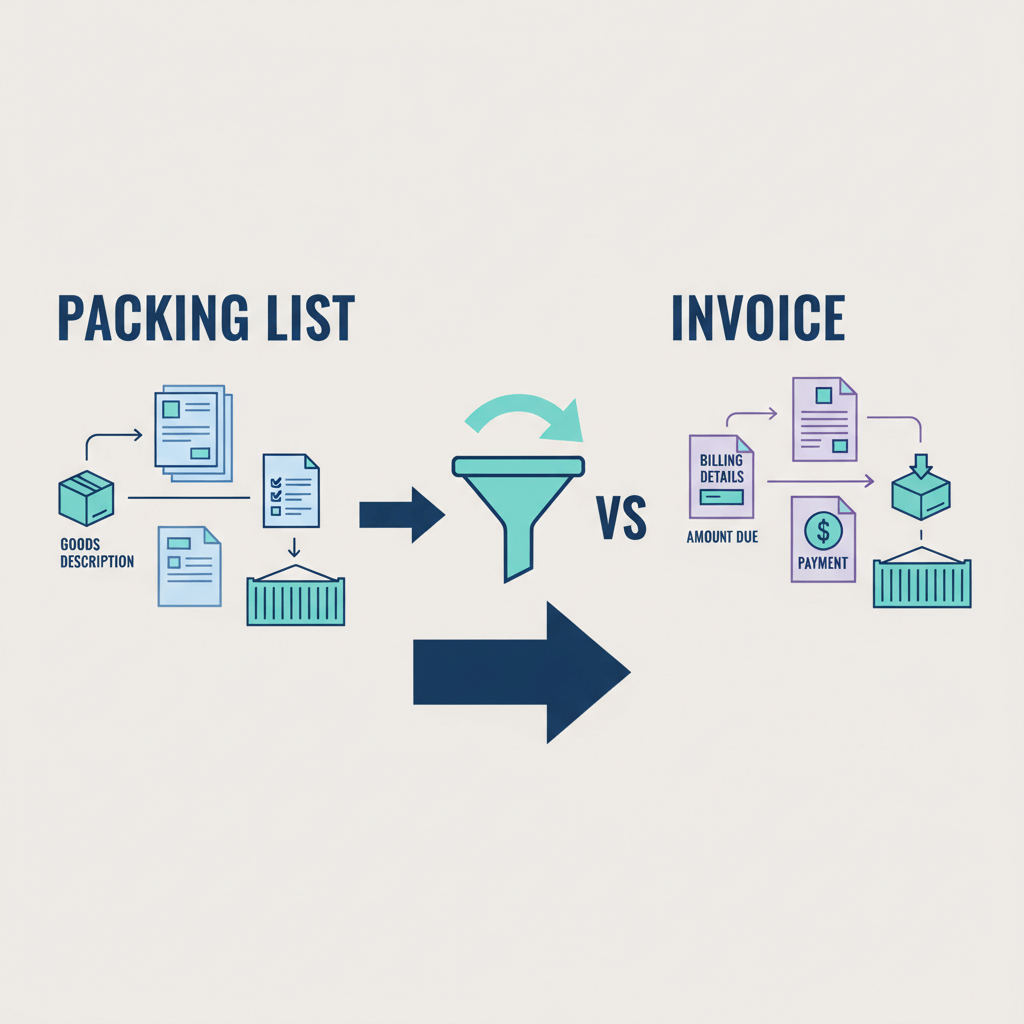
Packing list vs invoice, exports: the invoice moves money, the packing list moves boxes. The invoice captures the commercial value for payment and duties. The packing list details what is physically inside each package, including counts, weights, and dimensions, so logistics teams and customs can inspect and verify.

Indian policy allows a Commercial Invoice cum Packing List, yet both functions remain distinct, and forwarders and customs frequently insist on the pair for smooth clearance.

If you export services, you typically won’t need a packing list, but you must issue a clear invoice and obtain your e-FIRA once payment lands.


Packing list meaning

A packing list is a detailed shipping manifest, listing items, quantities, weights, dimensions, packaging type, and marks on cartons. Everyone who touches the shipment uses it, from the shipper and forwarder, to export and import customs, to the consignee’s receiving team.

Indian specifics: your Shipping Bill on ICEGATE must align with the packing list, and the list should mirror your commercial invoice and HS codes. It is mandatory under the Foreign Trade Policy, either as a standalone document or combined. For a practical how to, see this packing list for export guide.


Packing list vs invoice, what each must contain

Purpose

  • Packing list: logistics and compliance, describes the physical shipment for handling, inspection, and verification.
  • Invoice: commercial and payment, records transaction value for payment, taxes, and duties.

Audience

  • Packing list: customs and operations teams, forwarders, and the consignee.
  • Invoice: buyer and accounts, your bank, and customs for valuation.

What goes on a packing list

  • Clear item descriptions with SKU or HS code references.
  • Number of packages, for example 12 cartons.
  • Gross and net weight in kilograms.
  • Dimensions per package or pallet, in centimeters.
  • Marks and numbers on each carton, for example 1 of 12.
  • Packaging type, such as carton, crate, pallet.
  • Shipment references, exporter and consignee details, PO number, vessel or flight when available.

What goes on an invoice

  • Seller and buyer legal details, invoice number and date.
  • HS code and line item descriptions.
  • Quantity, unit price, total value, and currency.
  • Incoterms, for example FOB or CIF, plus tax notes like GST zero rated for exports.
  • Bank and payment instructions, including account and SWIFT.

Common confusions to avoid

  • Never put prices on the packing list, it is a non commercial document.
  • Missing weights or dimensions can trigger reweigh fees or inspection delays.
  • Mismatched HS codes or quantities between documents will hold up your shipment.

For a practical primer, browse this export packing list guide.


When each document is required

  • Ocean or air freight, FCL/LCL: packing list is almost always required, invoice is always required, both ride with the bill of lading or airway bill.
  • Courier or express, DHL, FedEx, UPS: very small, low value shipments may move with an invoice only, but multiple SKUs or cartons benefit from a packing list for speedier inspections.
  • E commerce exports, postal or EMS: check postal rules, a packing list helps if customs opens the parcel.
  • Destination country specifics: some ports mandate detailed packing lists. Confirm with your forwarder or buyer.
  • Special cases: partial shipments, consolidations, and returns practically require a packing list to reconcile what shipped when.

In India, the Foreign Trade Policy requires either separate invoice and packing list, or a combined version. Skipping them is not an option. For more context, see this export packing list explainer.


Step by step, create each document correctly

Packing list template walkthrough

Header: exporter details, address, IEC, date, invoice and PO reference, shipment reference like BL or AWB when available.

Core table: SKU, HS reference, description, quantity per package, total packages, net and gross weight in kilograms, dimensions in centimeters, marks and numbers, packaging type.

Footer: total packages and total gross weight, sign and date.

Best practices: keep SKU and HS naming consistent across all documents, measure with a scale and tape, attach one packing list on the outer carton and another inside the first carton, and match quantities line by line with your invoice. For a broader context on export docs, review common export documents.

Invoice template walkthrough

Header: seller and buyer details, IEC and GST where applicable, invoice number and date, HS codes.

Core table: descriptions, quantities, unit prices, totals, and currency.

Footer: Incoterms like FOB Mumbai or CIF Hamburg, payment terms like Net 30 or advance, GST note for zero rated exports, and complete bank details with SWIFT.

Double check that descriptions and quantities mirror the packing list exactly. You can also explore a combined commercial invoice and packing list approach when acceptable to your buyer and forwarder.


India specific compliance and process

Pre shipment: confirm IEC and GST are active, classify HS codes correctly, prepare any required certificates, and label cartons with marks and numbers that match your packing list.

Customs: file your Shipping Bill on ICEGATE, attach invoice, packing list, and transport documents, and ensure weights and quantities align with the Shipping Bill declarations.

Post shipment: your bank may need documents for export finance or for issuing an eBRC, the bank realisation certificate. Retain digital copies for audits and incentives. For more on invoicing, see this commercial invoice for export overview.


Exporters checklist

Pre shipment checklist

  • Confirm IEC and GST are active.
  • Verify HS codes for each product.
  • Prepare certificates like Certificate of Origin or test reports if needed.
  • Create your packing list with accurate weights, dimensions, and carton marks.
  • Issue your commercial invoice for exports with correct Incoterms and currency.
  • Book your forwarder and arrange insurance when required.

Shipment checklist

  • File the Shipping Bill on ICEGATE.
  • Collect your bill of lading or airway bill.
  • Share the invoice, packing list, and transport documents with your buyer and forwarder.

Post shipment and payment checklist

  • Submit documents to your bank, especially for LC or finance.
  • Track inward remittance and confirm payment arrival.
  • Obtain your e-FIRA for services or eBRC for goods, and reconcile values across all documents.
  • Keep a master digital folder of everything, useful for returns, audits, and incentives.


Examples and mini case studies

Small craft exporter with mixed SKUs: A Jaipur studio ships 50 ceramic bowls and 30 wooden trays in five cartons. A clear packing list with carton marks like Carton 1 of 5: 10 bowls, 6 trays helps destination customs and speeds clearance to two days.

Design studio shipping prototypes: A Bangalore studio logs precise weights and dimensions on the packing list. During a random inspection, those accurate figures prevent penalties and delays.

Service exporter, software: A Pune freelancer invoices a UK client, no packing list needed. Payment arrives via an international platform, and the bank issues e-FIRA within 24 hours, ensuring RBI compliance. For a refresher, see this export packing list guide even if you are cross checking goods requirements.


Common mistakes and how to avoid them

  • Mismatched quantities or descriptions: any mismatch between invoice and packing list will stall clearance, cross check line by line.
  • Wrong or missing HS codes: use the correct HS classification or consult a customs broker.
  • No marks or numbers on cartons: label each carton clearly, for example 1 of 5, 2 of 5.
  • Prices on the packing list: keep the packing list non commercial.
  • Estimated weights or dimensions: measuring accurately avoids reweigh fees and disputes.


Tools, templates, and pro tips

  • Templates: set up Excel or Google Sheets templates for packing list and invoice, with formulas to reduce manual errors.
  • File naming: use clear conventions, for example PL_INV12345_2025-04-15 and version tags.
  • Digital signatures: most transactions accept digitally signed PDFs, check LC terms if originals are needed.
  • Master references: maintain a SKU to HS mapping and a library of standard weights and dimensions.

For more context on logistics documentation, see this export packing list resource.


Payment and compliance for exporters

For product exporters: align invoice and shipping docs so your bank can issue eBRC, and keep the packing list and invoice together in your bank submission folder. The eBRC proves realisation and helps you claim incentives.

For service exporters: you do not need a packing list. Issue a clear invoice with milestones and currency, and ensure your bank or platform issues e-FIRA promptly after payment lands.

If you receive international payments regularly, consider a platform tailored for Indian SMBs and freelancers. Karbon Business offers virtual accounts in USD, GBP, EUR, and CAD, quick INR settlement in 24 to 48 hours, and automatic e-FIRA generation. You can also compare Wise Business, Payoneer, PayPal, and RazorpayX International, and pick based on fees, speed, and supported currencies.

The bottom line: accurate invoicing plus the right compliance documents reduce penalties, speed up cash flow, and unlock incentives.


Wrapping up

Once you see the split, it is simple. The invoice handles money and duties, the packing list handles logistics and verification. Use the checklists and templates above, match HS codes and quantities across documents, label cartons clearly, and file your Shipping Bill on time. If you export services, focus on clean invoicing and quick e-FIRA tracking. With these basics, your next international shipment will be smoother, faster, and far less stressful.

FAQ

Is a packing list mandatory for all exports from India?

Yes, for goods exports you must provide a packing list as a separate document or combined with the invoice under India’s Foreign Trade Policy. Services exports do not require a packing list, only a clean invoice and e-FIRA.

Can I send a courier shipment abroad with only the invoice, no packing list?

Very small, low value courier parcels sometimes move with just an invoice, but it is safer to include a packing list, especially if you have multiple SKUs or cartons. Couriers and customs use it to check contents quickly.

What happens if quantities differ between my invoice and packing list at customs?

Customs will likely hold the shipment for clarification, which can mean storage charges and missed cut offs. Always cross check quantities and descriptions line by line before filing your Shipping Bill.

Do I need to print prices on the packing list for the buyer’s warehouse?

No, keep the packing list non commercial. Prices belong only on the invoice. The warehouse needs counts, weights, dimensions, and carton marks, not values.

Which Incoterms should I show on the invoice for a first time export?

Pick terms that match your logistics capability and buyer expectations. New exporters often start with FOB or FCA. State the term clearly on the invoice, for example FOB Mumbai, and ensure your buyer agrees in writing.

How do I handle partial shipments when one order goes out in phases?

Issue one commercial invoice, then a separate packing list for each partial shipment. Reference the master invoice on each packing list so everyone can reconcile what shipped when.

Are digital copies of invoice and packing list acceptable to Indian banks for eBRC?

Yes, banks and customs accept digital submissions in most cases. Keep high quality PDFs. Your bank will use these to issue the eBRC after proceeds are realised.

As a freelancer exporting services, what proof do I need after I get paid?

You need e-FIRA from your bank or payment platform as proof of foreign inward remittance. Platforms like Karbon Business auto generate e-FIRA within about 24 hours of receipt, which keeps you compliant with RBI rules.

What is the easiest way to receive USD or EUR payments as an Indian freelancer?

Use an international collection account that gives you local currency coordinates in the client’s market, for example a USD account. Karbon Business offers virtual USD, GBP, EUR, and CAD accounts, with settlements to INR in 24 to 48 hours and automatic e-FIRA.

How do I minimise fees when clients pay me from abroad?

Quote in the currency your client prefers, then compare platforms on FX markup, transfer fees, and settlement speed. For instance, Karbon Business shows transparent FX and fees, which helps you price projects accurately.

Will my bank ask for the packing list when I submit documents for export finance?

Often yes, especially for goods exports. Banks cross check your invoice, packing list, and Shipping Bill to validate quantities and values before financing or issuing the eBRC.

If my buyer wants a combined document, is the Commercial Invoice cum Packing List valid in India?

Yes, it is permitted, as long as it contains all mandatory fields. Still, keep the roles distinct within the combined document, and ensure there are no prices inside the packing section.

How quickly can I get paid and receive e-FIRA after sending a services invoice?

Settlement speed depends on the platform and the buyer’s payment method. With Karbon Business, typical settlement to INR is 24 to 48 hours after funds arrive, and e-FIRA is generated automatically, which you can download for your records.

What should I do if customs reweighs my shipment and finds a difference?

Provide your measurement logs and updated packing list if needed, and coordinate with your forwarder to amend the Shipping Bill when required. Accurate pre shipment measurements reduce this risk significantly.

Key takeaways

  • The invoice records commercial value for payment, taxes, and duties, the packing list describes physical contents for logistics and customs.
  • Banks, forwarders, and customs often ask for both together to validate valuation and verify cartons, weights, and dimensions.
  • India permits a Commercial Invoice cum Packing List, but the two documents still serve distinct roles.
  • Do not show prices on the packing list, keep it strictly non commercial, and make sure HS codes, quantities, and descriptions match the invoice.
  • For services exports, you typically do not need a packing list, but you do need clean invoicing and timely e-FIRA.
  • Accurate weights, dimensions, and carton marks can shave days off clearance time and avoid reweigh or inspection delays.
  • Keep digital copies of everything for eBRC, audits, and incentives, and reconcile invoice, packing list, and Shipping Bill before you close the file.

Quick answer

Packing list vs invoice, exports: the invoice moves money, the packing list moves boxes. The invoice captures the commercial value for payment and duties. The packing list details what is physically inside each package, including counts, weights, and dimensions, so logistics teams and customs can inspect and verify.

Indian policy allows a Commercial Invoice cum Packing List, yet both functions remain distinct, and forwarders and customs frequently insist on the pair for smooth clearance.

If you export services, you typically won’t need a packing list, but you must issue a clear invoice and obtain your e-FIRA once payment lands.


Packing list meaning

A packing list is a detailed shipping manifest, listing items, quantities, weights, dimensions, packaging type, and marks on cartons. Everyone who touches the shipment uses it, from the shipper and forwarder, to export and import customs, to the consignee’s receiving team.

Indian specifics: your Shipping Bill on ICEGATE must align with the packing list, and the list should mirror your commercial invoice and HS codes. It is mandatory under the Foreign Trade Policy, either as a standalone document or combined. For a practical how to, see this packing list for export guide.


Packing list vs invoice, what each must contain

Purpose

  • Packing list: logistics and compliance, describes the physical shipment for handling, inspection, and verification.
  • Invoice: commercial and payment, records transaction value for payment, taxes, and duties.

Audience

  • Packing list: customs and operations teams, forwarders, and the consignee.
  • Invoice: buyer and accounts, your bank, and customs for valuation.

What goes on a packing list

  • Clear item descriptions with SKU or HS code references.
  • Number of packages, for example 12 cartons.
  • Gross and net weight in kilograms.
  • Dimensions per package or pallet, in centimeters.
  • Marks and numbers on each carton, for example 1 of 12.
  • Packaging type, such as carton, crate, pallet.
  • Shipment references, exporter and consignee details, PO number, vessel or flight when available.

What goes on an invoice

  • Seller and buyer legal details, invoice number and date.
  • HS code and line item descriptions.
  • Quantity, unit price, total value, and currency.
  • Incoterms, for example FOB or CIF, plus tax notes like GST zero rated for exports.
  • Bank and payment instructions, including account and SWIFT.

Common confusions to avoid

  • Never put prices on the packing list, it is a non commercial document.
  • Missing weights or dimensions can trigger reweigh fees or inspection delays.
  • Mismatched HS codes or quantities between documents will hold up your shipment.

For a practical primer, browse this export packing list guide.


When each document is required

  • Ocean or air freight, FCL/LCL: packing list is almost always required, invoice is always required, both ride with the bill of lading or airway bill.
  • Courier or express, DHL, FedEx, UPS: very small, low value shipments may move with an invoice only, but multiple SKUs or cartons benefit from a packing list for speedier inspections.
  • E commerce exports, postal or EMS: check postal rules, a packing list helps if customs opens the parcel.
  • Destination country specifics: some ports mandate detailed packing lists. Confirm with your forwarder or buyer.
  • Special cases: partial shipments, consolidations, and returns practically require a packing list to reconcile what shipped when.

In India, the Foreign Trade Policy requires either separate invoice and packing list, or a combined version. Skipping them is not an option. For more context, see this export packing list explainer.


Step by step, create each document correctly

Packing list template walkthrough

Header: exporter details, address, IEC, date, invoice and PO reference, shipment reference like BL or AWB when available.

Core table: SKU, HS reference, description, quantity per package, total packages, net and gross weight in kilograms, dimensions in centimeters, marks and numbers, packaging type.

Footer: total packages and total gross weight, sign and date.

Best practices: keep SKU and HS naming consistent across all documents, measure with a scale and tape, attach one packing list on the outer carton and another inside the first carton, and match quantities line by line with your invoice. For a broader context on export docs, review common export documents.

Invoice template walkthrough

Header: seller and buyer details, IEC and GST where applicable, invoice number and date, HS codes.

Core table: descriptions, quantities, unit prices, totals, and currency.

Footer: Incoterms like FOB Mumbai or CIF Hamburg, payment terms like Net 30 or advance, GST note for zero rated exports, and complete bank details with SWIFT.

Double check that descriptions and quantities mirror the packing list exactly. You can also explore a combined commercial invoice and packing list approach when acceptable to your buyer and forwarder.


India specific compliance and process

Pre shipment: confirm IEC and GST are active, classify HS codes correctly, prepare any required certificates, and label cartons with marks and numbers that match your packing list.

Customs: file your Shipping Bill on ICEGATE, attach invoice, packing list, and transport documents, and ensure weights and quantities align with the Shipping Bill declarations.

Post shipment: your bank may need documents for export finance or for issuing an eBRC, the bank realisation certificate. Retain digital copies for audits and incentives. For more on invoicing, see this commercial invoice for export overview.


Exporters checklist

Pre shipment checklist

  • Confirm IEC and GST are active.
  • Verify HS codes for each product.
  • Prepare certificates like Certificate of Origin or test reports if needed.
  • Create your packing list with accurate weights, dimensions, and carton marks.
  • Issue your commercial invoice for exports with correct Incoterms and currency.
  • Book your forwarder and arrange insurance when required.

Shipment checklist

  • File the Shipping Bill on ICEGATE.
  • Collect your bill of lading or airway bill.
  • Share the invoice, packing list, and transport documents with your buyer and forwarder.

Post shipment and payment checklist

  • Submit documents to your bank, especially for LC or finance.
  • Track inward remittance and confirm payment arrival.
  • Obtain your e-FIRA for services or eBRC for goods, and reconcile values across all documents.
  • Keep a master digital folder of everything, useful for returns, audits, and incentives.


Examples and mini case studies

Small craft exporter with mixed SKUs: A Jaipur studio ships 50 ceramic bowls and 30 wooden trays in five cartons. A clear packing list with carton marks like Carton 1 of 5: 10 bowls, 6 trays helps destination customs and speeds clearance to two days.

Design studio shipping prototypes: A Bangalore studio logs precise weights and dimensions on the packing list. During a random inspection, those accurate figures prevent penalties and delays.

Service exporter, software: A Pune freelancer invoices a UK client, no packing list needed. Payment arrives via an international platform, and the bank issues e-FIRA within 24 hours, ensuring RBI compliance. For a refresher, see this export packing list guide even if you are cross checking goods requirements.


Common mistakes and how to avoid them

  • Mismatched quantities or descriptions: any mismatch between invoice and packing list will stall clearance, cross check line by line.
  • Wrong or missing HS codes: use the correct HS classification or consult a customs broker.
  • No marks or numbers on cartons: label each carton clearly, for example 1 of 5, 2 of 5.
  • Prices on the packing list: keep the packing list non commercial.
  • Estimated weights or dimensions: measuring accurately avoids reweigh fees and disputes.


Tools, templates, and pro tips

  • Templates: set up Excel or Google Sheets templates for packing list and invoice, with formulas to reduce manual errors.
  • File naming: use clear conventions, for example PL_INV12345_2025-04-15 and version tags.
  • Digital signatures: most transactions accept digitally signed PDFs, check LC terms if originals are needed.
  • Master references: maintain a SKU to HS mapping and a library of standard weights and dimensions.

For more context on logistics documentation, see this export packing list resource.


Payment and compliance for exporters

For product exporters: align invoice and shipping docs so your bank can issue eBRC, and keep the packing list and invoice together in your bank submission folder. The eBRC proves realisation and helps you claim incentives.

For service exporters: you do not need a packing list. Issue a clear invoice with milestones and currency, and ensure your bank or platform issues e-FIRA promptly after payment lands.

If you receive international payments regularly, consider a platform tailored for Indian SMBs and freelancers. Karbon Business offers virtual accounts in USD, GBP, EUR, and CAD, quick INR settlement in 24 to 48 hours, and automatic e-FIRA generation. You can also compare Wise Business, Payoneer, PayPal, and RazorpayX International, and pick based on fees, speed, and supported currencies.

The bottom line: accurate invoicing plus the right compliance documents reduce penalties, speed up cash flow, and unlock incentives.


Wrapping up

Once you see the split, it is simple. The invoice handles money and duties, the packing list handles logistics and verification. Use the checklists and templates above, match HS codes and quantities across documents, label cartons clearly, and file your Shipping Bill on time. If you export services, focus on clean invoicing and quick e-FIRA tracking. With these basics, your next international shipment will be smoother, faster, and far less stressful.

FAQ

Is a packing list mandatory for all exports from India?

Yes, for goods exports you must provide a packing list as a separate document or combined with the invoice under India’s Foreign Trade Policy. Services exports do not require a packing list, only a clean invoice and e-FIRA.

Can I send a courier shipment abroad with only the invoice, no packing list?

Very small, low value courier parcels sometimes move with just an invoice, but it is safer to include a packing list, especially if you have multiple SKUs or cartons. Couriers and customs use it to check contents quickly.

What happens if quantities differ between my invoice and packing list at customs?

Customs will likely hold the shipment for clarification, which can mean storage charges and missed cut offs. Always cross check quantities and descriptions line by line before filing your Shipping Bill.

Do I need to print prices on the packing list for the buyer’s warehouse?

No, keep the packing list non commercial. Prices belong only on the invoice. The warehouse needs counts, weights, dimensions, and carton marks, not values.

Which Incoterms should I show on the invoice for a first time export?

Pick terms that match your logistics capability and buyer expectations. New exporters often start with FOB or FCA. State the term clearly on the invoice, for example FOB Mumbai, and ensure your buyer agrees in writing.

How do I handle partial shipments when one order goes out in phases?

Issue one commercial invoice, then a separate packing list for each partial shipment. Reference the master invoice on each packing list so everyone can reconcile what shipped when.

Are digital copies of invoice and packing list acceptable to Indian banks for eBRC?

Yes, banks and customs accept digital submissions in most cases. Keep high quality PDFs. Your bank will use these to issue the eBRC after proceeds are realised.

As a freelancer exporting services, what proof do I need after I get paid?

You need e-FIRA from your bank or payment platform as proof of foreign inward remittance. Platforms like Karbon Business auto generate e-FIRA within about 24 hours of receipt, which keeps you compliant with RBI rules.

What is the easiest way to receive USD or EUR payments as an Indian freelancer?

Use an international collection account that gives you local currency coordinates in the client’s market, for example a USD account. Karbon Business offers virtual USD, GBP, EUR, and CAD accounts, with settlements to INR in 24 to 48 hours and automatic e-FIRA.

How do I minimise fees when clients pay me from abroad?

Quote in the currency your client prefers, then compare platforms on FX markup, transfer fees, and settlement speed. For instance, Karbon Business shows transparent FX and fees, which helps you price projects accurately.

Will my bank ask for the packing list when I submit documents for export finance?

Often yes, especially for goods exports. Banks cross check your invoice, packing list, and Shipping Bill to validate quantities and values before financing or issuing the eBRC.

If my buyer wants a combined document, is the Commercial Invoice cum Packing List valid in India?

Yes, it is permitted, as long as it contains all mandatory fields. Still, keep the roles distinct within the combined document, and ensure there are no prices inside the packing section.

How quickly can I get paid and receive e-FIRA after sending a services invoice?

Settlement speed depends on the platform and the buyer’s payment method. With Karbon Business, typical settlement to INR is 24 to 48 hours after funds arrive, and e-FIRA is generated automatically, which you can download for your records.

What should I do if customs reweighs my shipment and finds a difference?

Provide your measurement logs and updated packing list if needed, and coordinate with your forwarder to amend the Shipping Bill when required. Accurate pre shipment measurements reduce this risk significantly.

The views expressed in the blogs on this page are solely the opinions of the authors and do not constitute expert advice. While we strive to provide accurate and up-to-date information, we make no representations or warranties of any kind, express or implied, about the completeness, accuracy, reliability, suitability or availability with respect to the website or the information, products, services, or related graphics contained on the website for any purpose. Any reliance you place on such information is therefore strictly at your own risk. We disclaim any liability for any loss or damage including without limitation, indirect or consequential loss or damage, or any loss or damage whatsoever arising from loss of data or profits arising out of, or in connection with, the use of this website.

Find out how we can help you today!

Speak to our foreign payment specialist
Whatsapp-color Created with Sketch.
Whatsapp:
+91 74117 02726
Email:
sales@karboncard.com
Address:
Ground Floor, Karbon Business, 1st Stage Rd, Binnamangala, Hoysala Nagar, Indiranagar, Bengaluru, Karnataka 560038

Find out how we can help you today!

Speak to our foreign payment specialist
Whatsapp-color Created with Sketch.
Whatsapp:
+91 74117 02726
Email:
sales@karboncard.com
Address:
Ground Floor, Karbon Business, 1st Stage Rd, Binnamangala, Hoysala Nagar, Indiranagar, Bengaluru, Karnataka 560038

Latest from our blogs

Latest from our blogs

View All
× Save 50% - Start Now