

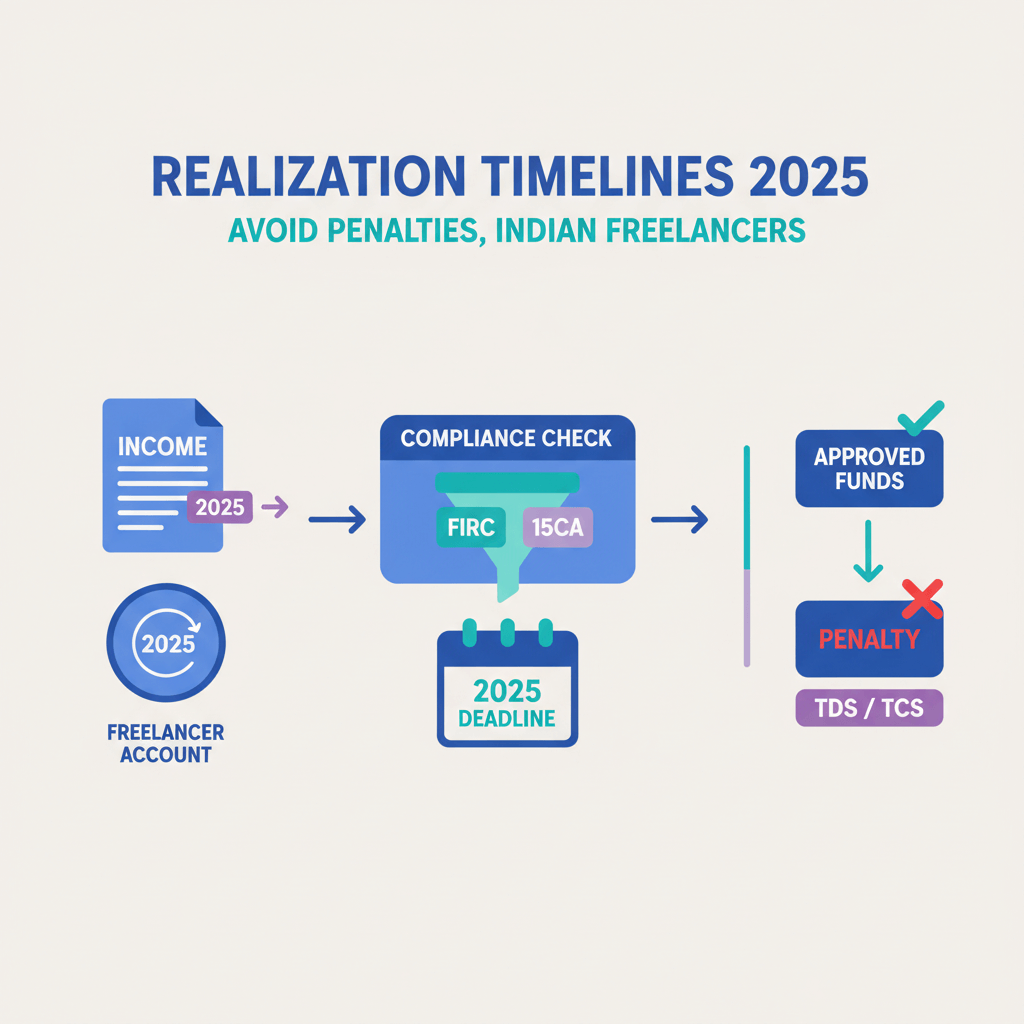


Key takeaways
- Indian freelancers must realize export proceeds within RBI’s window, 15 months for foreign currency invoices, 18 months for INR invoices, measured from invoice or service completion date.
- Advance receipts against future exports now carry a 3 year utilization or refund window, a major flexibility upgrade for long projects.
- If payment will be late, proactively apply for an extension through your Authorized Dealer bank with solid documentation, do not wait for the deadline to pass.
- When recovery is impossible, you can formally write off unrealized proceeds under FEMA, but only with comprehensive evidence and bank or RBI approval.
- Penalties under FEMA can be steep, however genuine freelancers who stay transparent, document diligently, and respond promptly usually avoid worst case outcomes.
- Keep airtight records, contracts, delivery proof, client emails, and FIRA or FIRC documents, platforms like Karbon Business automate much of this.
- Track deadlines, match payments to invoices, and treat platform earnings the same as direct client payments for compliance.
What is the Export Proceeds Realization Period Under RBI Rules
The export proceeds realization period is the maximum time RBI allows you to bring home payments for services exported from India. Under FEMA, every dollar, pound, or rupee earned from a foreign client must be realized, meaning credited into India through proper banking channels. Think of it as a legal deadline, when you invoice a client abroad, the clock starts.
Your Authorized Dealer bank tracks these exports, matches payments to invoices, and flags delays. Whether you code for a US startup, design for a European agency, or write for UK publishers, once you raise an invoice for a foreign client, you are bound by these timelines.
Compliance is not a mere banking formality, it is a hard requirement enforced via your AD bank, backed by RBI.
Current RBI Export Realization Timeline for Freelancers and Service Exporters
As of October 2025, RBI has relaxed and consolidated timelines for service exporters. For invoices denominated in foreign currency, you have 15 months to realize proceeds. For invoices denominated in INR, you have 18 months. These changes flow from RBI’s Foreign Exchange Management (Export and Import of Goods and Services) Regulations, 2026, replacing the 2015 rules.
The date of export for services is usually the invoice date or completion date, as your contract specifies. For retainers, each invoice carries its own timeline.
One crucial change, advance receipts against future exports now have a 3 year window to be utilized or refunded, providing far more flexibility for upfront payments linked to long projects, see RBI notification on the FEMA Regulations, 2026.
How Export Realization Rules Apply to Freelance Service Income
Freelancers are service exporters under FEMA when invoicing foreign clients for work performed as Indian residents. The platform you use, Upwork, Fiverr, Toptal, does not change your obligation. Your bank expects documentation, invoice details, and timely realization. The rules apply to individuals and registered businesses alike.
Understanding the 15 Month and 18 Month Realization Windows
15 months applies when your invoice is in USD, EUR, GBP, CAD, or any foreign currency. If you use a solution like Karbon Business with virtual foreign currency accounts, the payment can land in the foreign currency first, then be converted to INR, the 15 month window still governs.
18 months applies when the invoice is in INR and the client pays in INR. This is less common, but RBI recognizes it may take foreign entities more time to convert and remit rupees.
- The clock starts from invoice date or service completion date, as per contract.
- Partial payments are allowed, each must arrive within the applicable window.
- Reissuing or revising invoices does not reset the original export date.
What Happens When Your Client Doesn’t Pay Within the Realization Period
If the deadline passes, your AD bank flags the unrealized export, then asks for an explanation and documentation. You should provide contracts, delivery proof, and collection efforts, for example reminder emails and payment commitments.
Legitimate delays, client cash flow problems, disputes, or insolvency, can be considered, but only with evidence. Ignoring notices risks frozen remittances and escalation to RBI enforcement. Stay ahead of the deadline, if payment looks late, engage your bank early.
Getting an Extension Beyond the Standard Realization Period
When your client confirms they will pay but needs more time, request an extension through your AD bank. Submit a letter explaining the reason, attach the invoice, delivery proof, and the client’s written payment commitment. Banks can grant limited extensions on their own, longer ones often go to RBI for approval. There is no automatic right to unlimited extensions, each case is evaluated.
Extensions buy time, they do not eliminate consequences if payment never arrives.
How to Write Off Unrealized Export Proceeds Under FEMA
If recovery is impossible, apply to write off the receivable. Provide the invoice, export declaration, delivery evidence, collection efforts, and proof of client insolvency or closure if available. For smaller sums, banks may decide, larger amounts often go to RBI. Expect weeks or months for review, keep documentation airtight.
After approval, the unrealized amount is removed from your export obligations. If the client pays later, you must report and repatriate those funds.
Penalties for Non Compliance with Export Proceeds Realization Rules
Penalties under FEMA can be up to three times the amount involved, or two lakh rupees per contravention, with additional daily penalties for continuing violations. Triggers include failure to realize without extension or write off, non response to bank inquiries, false documentation, and repeated lapses.
RBI enforcement begins with a show cause notice, you can respond with documentation. Severity depends on intent, amount, cooperation, and history. RBI also offers compounding for many first time, less serious contraventions, allowing settlement via a fee rather than full penalty proceedings.
Transparent communication, timely applications, and thorough records are your best defense against penalties.
Best Practices for Managing Export Realization as a Freelancer
- Before invoicing, vet clients, use clear contracts, and invoice at fair market rates.
- When invoicing, state currency, terms, and due dates, and log each invoice with its realization deadline.
- Track deadlines, set reminders at 30 and 15 days prior, and match incoming payments to specific invoices.
- When payment arrives, secure bank confirmations and FIRA or FIRC, and update your ledger.
- If payment will be late, contact your bank at least 60 days before the deadline, file for extension with evidence.
- Maintain a compliance file, contracts, delivery proof, client approvals, and all collection attempts.
- Use proper channels, avoid informal routes, and prefer platforms that automate documentation.
Tools and Platforms That Simplify Export Realization Compliance
Dedicated cross border payment platforms simplify receiving funds, generating e FIRA or FIRC, and matching payments to invoices.
- Karbon Business offers virtual USD, GBP, EUR, and CAD accounts with local rails, automatic e FIRA within 24 hours, and INR settlement typically in 24 to 48 hours, with flat fees and transparent FX.
- Wise Business provides multi currency accounts, availability for Indian residents varies under RBI norms.
- Payoneer enables multi currency receiving accounts, fees may be higher.
- PayPal is widely accepted, but often costlier.
- RazorpayX International caters to Indian businesses with embedded compliance tooling.
Key features to prioritize, automatic FIRA or FIRC generation, invoice tagging, multi currency holding with clear FX, dashboard tracking, and integrated invoicing.
For records, cloud accounting like Zoho Books or QuickBooks Online, plus organized Drive or Notion folders by client and project, make audits and bank queries easier.
Common Mistakes Freelancers Make with Export Proceeds Realization
- Not tracking deadlines, learn only when a bank notice arrives.
- Assuming platform payments are exempt, they are not.
- Mixing personal and business remittances, invites compliance confusion.
- Ignoring small amounts, rules apply regardless of size.
- Parking funds abroad indefinitely, the obligation is to repatriate within the window.
- Weak delivery documentation, makes genuine exports look suspicious.
- Waiting until last minute, banks respond better to proactive requests.
- Poor evidence for extensions or write offs, gather as you go.
- Assuming disputes pause the clock, they do not, apply for an extension.
- Accepting verbal promises, get payment commitments in writing.
How Export Proceeds Realization Interacts with Income Tax and GST
Tax recognition usually follows accrual, you may owe tax even before payment arrives. If you write off later, you may claim bad debt depending on your accounting method and proof. For GST, exports are zero rated when conditions are met, payment in convertible foreign exchange, recipient outside India, and place of supply outside India. Keep FIRA or FIRC as proof, see the e FIRA and FIRC documents guide.
FEMA and tax rules intersect but differ, a FEMA write off does not automatically satisfy tax treatment, retain separate evidence for the Income Tax Act and GST.
Getting Help, When to Consult a FEMA Compliance Expert
Consult experts when significant unrealized exports approach deadlines, when you face show cause notices, when banks reject extensions or write offs, or in multi jurisdiction transactions. Specialists help structure applications, respond to RBI queries, and advise on compounding and documentation. Prepare full files, invoices, delivery proof, timelines, and be candid about facts.
Future Changes to Export Realization Rules, What to Watch For
Recent liberalization, 15 month window for foreign currency and 18 months for INR, plus 3 year advance receipt flexibility, shows RBI’s exporter friendly direction. Expect more delegation to AD banks, faster digital documentation, and broader automation. Stay informed via RBI circulars, bank updates, and credible fintech sources, then adapt your processes accordingly.
Conclusion, Staying Compliant Without Stress
Make realization timelines part of your routine, track 15 or 18 month windows from the day you invoice, and keep documentation impeccable. Apply early for extensions if needed, write off only as a last resort with complete evidence, and use platforms that generate e FIRA automatically. The 2025 reforms give meaningful breathing room, manage deadlines actively, and compliance will feel simple rather than stressful.
Professional freelancers deliver great work, and they also run tight operations, export realization compliance is integral to that professionalism.
FAQ
How many months do I actually get to receive international client payments into India if my invoice is in USD?
You get 15 months from the invoice or service completion date, whichever your contract specifies, to realize the proceeds into India. If you receive funds in a USD account first, for example through Karbon Business, you still need to repatriate within the same 15 month window.
If I invoice in INR to a foreign company, does my realization timeline change?
Yes, INR denominated invoices carry an 18 month realization window instead of 15. This longer period accounts for the extra steps foreign entities take to convert and remit rupees.
What counts as the date of export for a freelancer, invoice date or project completion?
For services, RBI generally treats the invoice date or the completion date as the export date, depending on your contract terms. For retainers, each invoice creates its own timeline. Always log the exact date you want your bank to treat as the export event.
I was paid via a platform, Upwork or Fiverr, do FEMA realization rules still apply to me?
Yes, platform payments are not exempt. You must ensure funds are brought to India within the applicable window, and you must keep documentation of the underlying services and invoices. Platforms like Karbon Business help by generating e FIRA quickly, which simplifies banking and tax records.
My client is delayed, can I get an extension beyond 15 or 18 months?
You can request an extension through your Authorized Dealer bank with written evidence that the client acknowledges the debt and provides a realistic payment schedule. Banks may approve limited extensions, longer ones often go to RBI. Apply at least 60 days before your deadline.
What documents should I keep ready to avoid trouble with unrealized exports?
Maintain contracts or statements of work, delivery proof like files, commits, or published links, client acceptance emails, invoice details, payment reminders, and any written payment commitments. If you use Karbon Business, keep the e FIRA or FIRC your dashboard generates for each payment.
How do penalties under FEMA practically affect a freelancer if payment never comes?
If you do nothing, your bank may flag you and RBI can issue a show cause notice. Penalties can be significant, but genuine freelancers who respond promptly, document efforts, and apply for extension or write off usually resolve issues via compounding or bank approved write offs rather than severe penalties.
Can I park dollars abroad and convert later, will that be okay for RBI?
Holding funds briefly in foreign currency accounts is fine, but realization requires repatriation within 15 or 18 months. For example, Karbon Business lets you hold and convert with transparent FX, however you must still meet RBI deadlines by getting those funds into India in time.
If I write off an unpaid invoice under FEMA, do I still need to worry about tax?
Yes, FEMA write off and tax treatment are separate. On accrual basis, you likely recognized income when invoiced, then claim a bad debt in the year of write off with proper evidence. On cash basis, unpaid invoices were never recognized as income. Keep your e FIRA or FIRC and bank records for tax filing clarity.
Do small invoices, say 50 or 100 dollars, really need the same compliance?
Absolutely, RBI rules apply regardless of amount. Build one consistent workflow for every foreign invoice, track the deadline, store documentation, and secure FIRA or FIRC for each payment, platforms such as Karbon Business make this easy even for small amounts.
What if my client disputes scope and refuses to pay, does that pause the realization clock?
No, disputes do not automatically pause timelines. You should gather evidence of the dispute and your delivery, then apply for an extension before the deadline. If payment remains impossible, prepare a thorough write off application with all correspondence and delivery proof.
Will my bank help me or block me if I have an unrealized export approaching the deadline?
Your AD bank is obligated to ensure compliance, but they do guide you procedurally. Engage them early, provide documentation, and request extensions or write offs as needed. If you present clear records, banks are far more supportive, especially when your history shows you use compliant channels like Karbon Business.
How do I prove to the bank that my payment mapped to the right invoice?
Use invoice numbers in payment references, tag incoming funds to invoices in your payment platform, and keep the bank’s credit advice alongside the relevant invoice. Many platforms provide built in invoice matching, which the bank and your accountant appreciate during reviews.
Is e FIRA or FIRC really necessary for freelancers, or can I skip it?
It is crucial. FIRA or FIRC proves inward remittance and FX conversion, needed for bank compliance, GST zero rating eligibility, and tax scrutiny. Choose tools that generate e FIRA automatically after each payment, that way your documents stay complete without manual requests.
Can I receive payments to my friend’s foreign account and bring money later to India?
No, avoid informal routes. RBI expects you to receive and realize via legitimate channels into India. Use compliant platforms or your AD bank directly, and ensure payments are traceable to your invoices and repatriated within the window.
