Business

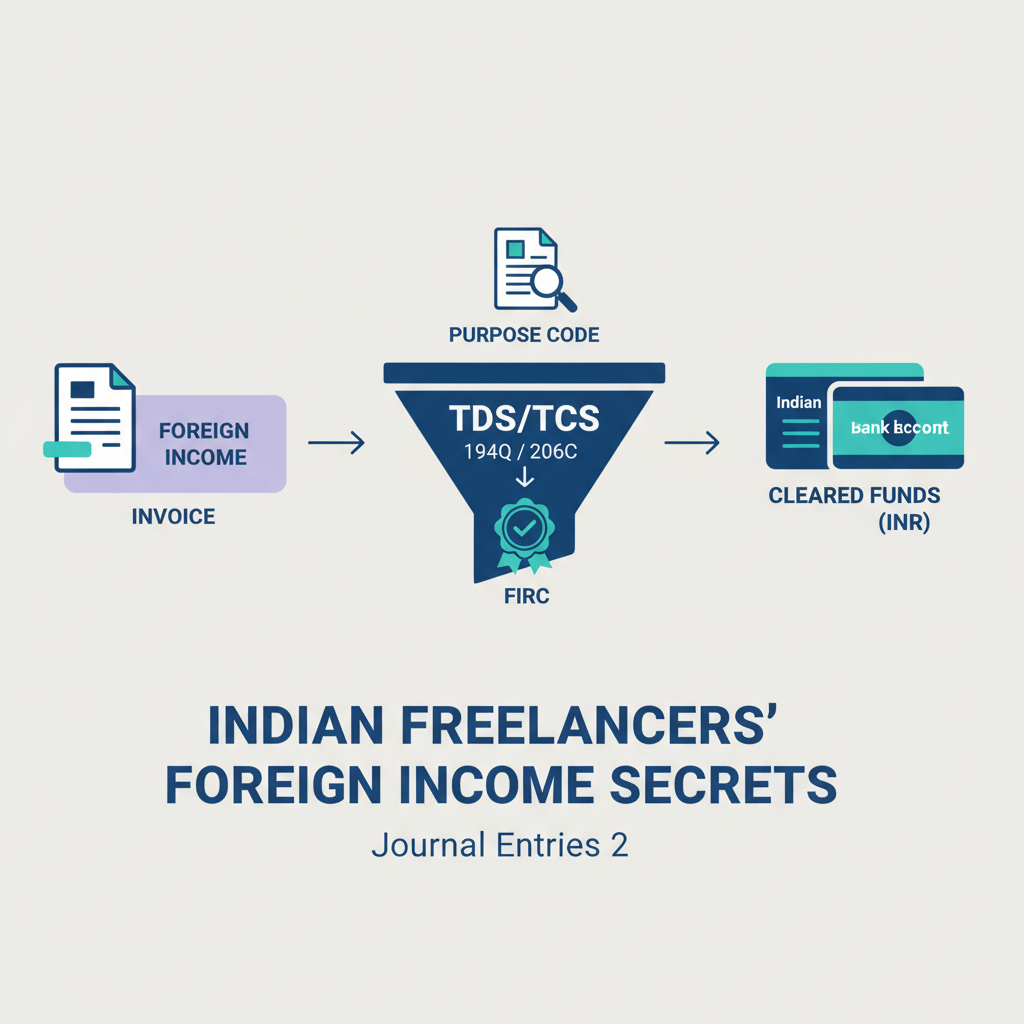
Journal entries 2: Indian Freelancers' Foreign Income Secrets

Content
share on
Contents
Share On

Key takeaways

  • Record export sales at the invoice date exchange rate, not the receipt date rate; this is the crux of proper foreign currency accounting under AS 11 and Ind AS 21.
  • When money lands in INR, book the foreign exchange difference as a realized gain or loss, separate from revenue, and expense bank or platform fees distinctly.
  • If an invoice is unpaid at period end, revalue the receivable at the closing rate and recognize an unrealized FX gain or loss.
  • Retain a clean audit trail: invoice, remittance advice, bank statement, and e-FIRA or e-FIRC; see the e-FIRA/FIRC documents guide.
  • Use a consistent rate source and maintain a simple FX log to make your month-end close, tax filing, and reconciliations effortless.
  • Copy the ready-to-use journal entry templates below, adapted from this journal entry for foreign currency transactions explainer.
  • Payment platforms matter: clear FX, fees, and fast e-FIRA simplify entries; Indian freelancers often choose Karbon Business for this.

Why accurate journal entries for export income in foreign currency matter

Accurate entries deliver three wins for freelancers: RBI/FEMA compliance, correct tax reporting, and predictable cash flow. Every inward remittance should flow through approved channels, backed by e-FIRA or e-FIRC. For step-by-step documents, see the e-FIRA/FIRC documents guide.

What you record must match what you can prove. Your invoices, the bank’s remittance advice, and your e-FIRA should reconcile line by line.

Clean FX accounting also prevents surprises. Invoice today in USD, get paid weeks later, and the rupee moves, sometimes a lot. Knowing what changed and why, lets you plan spends, price smart, and avoid audit headaches.

What counts as export income for freelancers

Service export income is billing a foreign client in a foreign currency, and receiving that money through an authorized Indian banking channel. Keep three documents for every transaction:

  • Invoice/Statement of Work with currency, scope, and offshore client details.
  • e-FIRA/e-FIRC as legal proof of inward remittance through an authorized dealer.
  • Bank/platform advice showing applied exchange rate, fees, and INR credit.

Only post entries when the paperwork ties out. If the e-FIRA amount or rate differs from your bank line, investigate before you journal.

Accounting basis: cash vs accrual and why it matters

This guide illustrates accrual accounting, where you recognize revenue on the invoice date. Many Indian freelancers file taxes on cash basis or presumptive schemes, yet still maintain accrual books for clarity. For pros and cons by method, skim this accrual vs cash basis article.

Either way, the mechanics of FX differences remain the same. Only the timing of revenue recognition changes.

Exchange rate fundamentals: invoice date vs receipt date

The golden rule: use the invoice date rate to book the sale. When INR is credited later, the gap between receipt-date value and invoice-date value is your realized FX gain or loss. If unpaid at year end, revalue the receivable at the closing rate to book an unrealized FX gain or loss. For a deeper primer, see this journal entry for foreign currency transactions overview.


Step-by-step example: journal entry for export income in foreign currency

Scenario setup

  • Invoice: USD 1,000 on 15 Jan 2026 at INR 83/USD.
  • Receipt: 10 Feb 2026 at INR 84/USD.
  • Bank/platform fee: 1% on INR proceeds.
  • Year end: 31 Mar 2026.

Entry 1: Invoice date – export sales entry

INR equivalent = 1,000 × 83 = 83,000.

Accounts Receivable (Foreign Client) Dr  83,000
    To Export Sales / Service Income        83,000
(Being export services invoiced at INR 83/USD on 15 Jan 2026)

Why: Revenue and receivable both at the invoice-date rate, period.

Entry 2: Receipt date – payment received, FX gain, and fees

  • Receipt-date value = 1,000 × 84 = 84,000.
  • Fee 1% = 840. Net bank credit = 83,160.
  • Realized FX gain = 84,000 − 83,000 = 1,000.
Bank (INR)                              Dr  83,160
Foreign Exchange Gain                   Dr   1,000
    To Accounts Receivable                   83,000
    To Bank Charges/Remittance Fee               840
(Being USD 1,000 received at INR 84/USD; 1% fee deducted)

Keep revenue clean. FX goes to Other Income/Expense, fees to Bank Charges.

Entry 3: Period-end revaluation – if unpaid at year end

If still outstanding on 31 Mar 2026 and closing rate is INR 85/USD:

  • Revalued AR = 1,000 × 85 = 85,000.
  • Unrealized FX gain = 85,000 − 83,000 = 2,000.
Accounts Receivable (Foreign Client) Dr   2,000
    To Unrealized FX Gain (Other Income)      2,000
(Being revaluation of USD 1,000 AR at INR 85/USD on 31 Mar 2026)

Reverse this at the start of the next period, then book the actual realized FX when money arrives.

FX differences: how to record, at a glance

ScenarioJournal entryP&L impact
Receipt-rate < invoice-rate (loss)Dr FX Loss; Cr Accounts ReceivableOther Expense
Receipt-rate > invoice-rate (gain)Dr Bank + Dr FX Gain; Cr Accounts ReceivableOther Income
Outstanding AR at period end, rate improvesDr AR; Cr Unrealized FX GainOther Income (unrealized)
Outstanding AR at period end, rate weakensDr Unrealized FX Loss; Cr AROther Expense (unrealized)

Edge cases: partial payments, advances, chargebacks

Partial payments

Client pays USD 600 on 10 Feb 2026 at INR 84/USD.

  • Receipt value = 600 × 84 = 50,400; 1% fee = 504; bank credit = 49,896.
  • Original AR for this portion = 600 × 83 = 49,800.
  • Realized FX gain = 600.
Bank (INR)                              Dr  49,896
Foreign Exchange Gain                   Dr     600
    To Accounts Receivable                   49,800
    To Bank Charges/Remittance Fee               504
(Being partial receipt of USD 600; fee deducted)

Outstanding AR remains for USD 400 at the original invoice-rate INR 83/USD.

Advance receipts

Bank (INR)                              Dr  83,000
    To Advance from Client (Liability)       83,000
(Being advance received at INR 83/USD; invoice pending)
Advance from Client (Liability)         Dr  83,000
    To Export Sales / Service Income         83,000
(Being revenue recognition against advance on invoicing)

Chargebacks and refunds

Refund agreed for USD 100 from a USD 1,000 invoice at 83/USD.

Credit Note / Sales Return              Dr   8,300
    To Accounts Receivable                    8,300
(Being credit note for USD 100 at invoice-rate)

If INR outflow on refund date is 8,400 at 84/USD, the 100 difference is an FX loss recorded on settlement.

Documentation and reconciliation checklist

  • Match every transaction across invoice, bank line, and e-FIRA/e-FIRC; see e-FIRA/FIRC documents guide.
  • Maintain an FX log with invoice date/rate, receipt date/rate, fees, realized FX.
  • Run an AR schedule monthly, revalue unpaid foreign invoices at period end.
  • Reconcile bank monthly, differences usually mean missing FX entries or unrecorded fees.

Sample FX log:

Invoice DateUSDInv. RateReceipt DateRcpt. RateFee (INR)Realized FX
15 Jan 20261,0008310 Feb 202684840+1,000
20 Jan 202650083.525 Feb 202682410−750

GST and export compliance note

Service exports are typically zero-rated. Don’t charge IGST if you’ve filed a valid LUT; here’s a fast primer on the LUT for zero-rated services. Your revenue entry excludes GST on the outbound invoice. Keep input tax credit and refunds separate in your GST workings.

Under FEMA/RBI, e-FIRA is mandatory for each inward remittance; align the receipt-date entry in your books to it.

Common mistakes to avoid

  • Booking sales at receipt-date rate. Always use the invoice-date rate.
  • Ignoring FX differences. Record realized and unrealized FX separately from revenue.
  • Netting fees against revenue. Expense fees as Bank Charges or Remittance Fees.
  • Skipping year-end revaluation. Revalue unpaid foreign AR at the closing rate.
  • Weak documentation. No e-FIRA, no proof; store all documents per transaction.
  • Mixing rates in one entry. Keep invoice, receipt, and revaluation entries distinct.

Practical templates: copy and use

Template 1: invoice-date export sales entry

Date: [Invoice Date]
Invoice Amount: [FX Amount]
Invoice Rate: INR [Rate]/[FX]
INR Equivalent: [FX Amount] × [Rate] = [INR Amount]

Accounts Receivable (Client: [Name]) Dr [INR Amount]
    To Export Sales / Service Income      [INR Amount]
(Being export services invoiced at INR [Rate]/[FX] on [Invoice Date])

Template 2: receipt-date entry with FX and fees

Date: [Receipt Date]
Receipt Rate: INR [Rate]/[FX]
Invoice Rate: INR [Invoice Rate]/[FX]
FX Difference: ([Rate] − [Invoice Rate]) × [FX Amount] = [Gain/Loss INR]
Fee: [Fee %] × ([Rate] × [FX Amount]) = [Fee INR]
Net Bank: ([Rate] × [FX Amount]) − [Fee INR]

Bank (INR)                              Dr [Net INR]
Foreign Exchange Gain/Loss              Dr [FX +/-]
    To Accounts Receivable                [Original INR AR]
    To Bank Charges/Remittance Fee        [Fee INR]
(Being [FX Amount] received at INR [Rate]/[FX]; fee deducted)

Template 3: period-end AR revaluation

Date: [Balance Sheet Date]
Outstanding AR: [FX Amount] at INR [Invoice Rate]/[FX]
Closing Rate: INR [Closing Rate]/[FX]
Unrealized FX = ([Closing Rate] − [Invoice Rate]) × [FX Amount]

[If gain]
Accounts Receivable (Client)            Dr [Unrealized Gain]
    To Unrealized FX Gain                  [Unrealized Gain]

[If loss]
Unrealized FX Loss                      Dr [Unrealized Loss]
    To Accounts Receivable                 [Unrealized Loss]
(Being revaluation at closing rate on [Balance Sheet Date])

Tools and workflow tips

  • Consistency in rate sources. Pick one source, document it, and stick to it for the period.
  • Bank advice is source of truth. Use the rate on the remittance advice/e-FIRA for receipt entries.
  • Monthly close rhythm. Reconcile bank, update FX log, revalue outstanding AR for internal reporting.
  • Foreign currency balances. If a platform lets you hold currency, track unrealized FX until conversion.
  • Simple sheet, big impact. A spreadsheet that ties date, rate, fees, and gains will save you hours.

Choosing payment solutions that simplify your entries

Pick providers that show clear FX rates, itemized fees, quick INR settlement, and generate e-FIRA automatically. For example, Karbon Business provides virtual accounts in major currencies, mid-market FX, INR settlement in 24–48 hours, and automated e-FIRA to keep your books neat.

Compare options by effective rate on landed INR, documentation, and support. Transparent platforms make your journal entries almost plug-and-play.

Conclusion and next steps

Mastering the journal entry for export income in foreign currency boils down to three moves: book revenue at the invoice date rate, record realized/unrealized FX separately, and keep a bulletproof document trail with e-FIRA and bank advice. Adopt the templates, run a monthly FX log, and revalue open AR at close. Your books will reconcile faster, your tax filings will be cleaner, and your cash flow will make more sense.

Action step: pull the last quarter’s foreign invoices, match them to bank lines and e-FIRAs, and post any missing FX or fee entries today. Your future self, and your CA, will thank you.

FAQ

Invoice date vs payment date: which exchange rate should I use to book export sales in India?

Use the invoice date exchange rate to record the sale and receivable, always. When INR arrives later, compute the difference between receipt-date value and invoice-date value as a realized FX gain or loss, posted to Other Income/Expense, separate from revenue.

Client paid after a month and INR moved a lot, how do I pass the journal entry?

Keep the original revenue untouched at invoice-date INR. On receipt, debit Bank for the net credit, debit FX Gain (or Loss) for the difference, credit Accounts Receivable for the original INR AR, and credit Bank Charges for platform fees. This mirrors the worked example above.

I file taxes under 44ADA or cash basis; do I still need to book FX gains and losses?

For clean reconciliations, yes, track realized FX on each receipt. Many freelancers still maintain accrual books for clarity, then adjust for cash basis at tax time. Unrealized FX at year end applies only if you keep accrual financials; your CA can align this with your tax method.

Wise/Payoneer/PayPal deducted fees before credit; should I reduce revenue or book a separate expense?

Book a separate expense. Credit Bank Charges/Remittance Fee for the deducted amount. Do not net fees against revenue or AR; it obscures your true income and complicates analysis. Platforms like Karbon Business show itemized fees and mid-market FX, which makes the entry straightforward.

Do I need e-FIRA or FIRC for every payment, and how do I map it in my books?

Yes, keep e-FIRA/e-FIRC for each inward remittance. Attach it to the receipt entry as support. Ensure the INR credited, date, and rate match your bank line; if not, adjust for fees or minor rate differences. For a checklist, use the e-FIRA/FIRC documents guide.

What is the period-end revaluation entry for unpaid USD invoices in India?

Revalue the foreign AR at the closing rate on the balance sheet date. If the rate improved, debit Accounts Receivable and credit Unrealized FX Gain; if it worsened, debit Unrealized FX Loss and credit Accounts Receivable. Reverse it at the start of the next period and book the real FX on receipt.

Which RBI purpose code should I use for freelance services so my payment isn’t delayed?

Use the correct service export purpose code (often in the P08xx family for IT/consulting). Banks scrutinize this for compliance and e-FIRA issuance. If you are unsure, refer to a plain-English list like the RBI purpose codes overview and check with your AD bank before the client pays.

How do I handle partial payments against a single USD invoice in my ledger?

Settle only the proportional INR receivable at the invoice-rate for the paid portion. Compute realized FX on that portion using the receipt-date rate. Book fees on the partial amount. Leave the balance AR at the original invoice-rate and revalue at period end if still unpaid.

PayPal shows lower INR than expected; how do I reflect hidden FX markup and fees?

Replicate what actually happened: use the PayPal receipt-date INR value, expense the explicit fees, and the remaining shortfall versus invoice-date INR becomes an FX loss. To improve take-home, many Indian freelancers move clients to ACH/SEPA rails on platforms like Karbon Business, which use mid-market FX and issue e-FIRA automatically.

Do I need a LUT under GST for export of services, and does it affect journal entries?

A valid LUT lets you zero-rate exports, so your client invoice carries no IGST. Journal entries for revenue are unaffected, as you book only the service value. Keep LUT and e-FIRA on file for compliance and refunds. For a quick walkthrough, see LUT for zero-rated services.

Can I hold USD for a better rate and convert later, and how do I account for it?

If your provider lets you lawfully hold USD for a short window, track it as a foreign currency balance. No realized FX hits P&L until conversion; revalue at period end if you maintain accrual reports. When you convert to INR, book the realized FX versus the invoice-date rate. Karbon Business supports currency holding with clear audit trails.

Which platform pays Indian freelancers the most in INR after all fees and FX—any practical tip?

Compare the “effective rate” on landed INR: the applied FX rate, explicit fees, hidden spreads, and e-FIRA availability. Platforms with mid-market FX, flat transparent fees, and fast INR settlement usually win. Many freelancers report higher takes with Karbon Business due to mid-market FX, 1% platform fee, and automated e-FIRA that keeps books clean.

Key takeaways

  • Record export sales at the invoice date exchange rate, not the receipt date rate; this is the crux of proper foreign currency accounting under AS 11 and Ind AS 21.
  • When money lands in INR, book the foreign exchange difference as a realized gain or loss, separate from revenue, and expense bank or platform fees distinctly.
  • If an invoice is unpaid at period end, revalue the receivable at the closing rate and recognize an unrealized FX gain or loss.
  • Retain a clean audit trail: invoice, remittance advice, bank statement, and e-FIRA or e-FIRC; see the e-FIRA/FIRC documents guide.
  • Use a consistent rate source and maintain a simple FX log to make your month-end close, tax filing, and reconciliations effortless.
  • Copy the ready-to-use journal entry templates below, adapted from this journal entry for foreign currency transactions explainer.
  • Payment platforms matter: clear FX, fees, and fast e-FIRA simplify entries; Indian freelancers often choose Karbon Business for this.

Why accurate journal entries for export income in foreign currency matter

Accurate entries deliver three wins for freelancers: RBI/FEMA compliance, correct tax reporting, and predictable cash flow. Every inward remittance should flow through approved channels, backed by e-FIRA or e-FIRC. For step-by-step documents, see the e-FIRA/FIRC documents guide.

What you record must match what you can prove. Your invoices, the bank’s remittance advice, and your e-FIRA should reconcile line by line.

Clean FX accounting also prevents surprises. Invoice today in USD, get paid weeks later, and the rupee moves, sometimes a lot. Knowing what changed and why, lets you plan spends, price smart, and avoid audit headaches.

What counts as export income for freelancers

Service export income is billing a foreign client in a foreign currency, and receiving that money through an authorized Indian banking channel. Keep three documents for every transaction:

  • Invoice/Statement of Work with currency, scope, and offshore client details.
  • e-FIRA/e-FIRC as legal proof of inward remittance through an authorized dealer.
  • Bank/platform advice showing applied exchange rate, fees, and INR credit.

Only post entries when the paperwork ties out. If the e-FIRA amount or rate differs from your bank line, investigate before you journal.

Accounting basis: cash vs accrual and why it matters

This guide illustrates accrual accounting, where you recognize revenue on the invoice date. Many Indian freelancers file taxes on cash basis or presumptive schemes, yet still maintain accrual books for clarity. For pros and cons by method, skim this accrual vs cash basis article.

Either way, the mechanics of FX differences remain the same. Only the timing of revenue recognition changes.

Exchange rate fundamentals: invoice date vs receipt date

The golden rule: use the invoice date rate to book the sale. When INR is credited later, the gap between receipt-date value and invoice-date value is your realized FX gain or loss. If unpaid at year end, revalue the receivable at the closing rate to book an unrealized FX gain or loss. For a deeper primer, see this journal entry for foreign currency transactions overview.


Step-by-step example: journal entry for export income in foreign currency

Scenario setup

  • Invoice: USD 1,000 on 15 Jan 2026 at INR 83/USD.
  • Receipt: 10 Feb 2026 at INR 84/USD.
  • Bank/platform fee: 1% on INR proceeds.
  • Year end: 31 Mar 2026.

Entry 1: Invoice date – export sales entry

INR equivalent = 1,000 × 83 = 83,000.

Accounts Receivable (Foreign Client) Dr  83,000
    To Export Sales / Service Income        83,000
(Being export services invoiced at INR 83/USD on 15 Jan 2026)

Why: Revenue and receivable both at the invoice-date rate, period.

Entry 2: Receipt date – payment received, FX gain, and fees

  • Receipt-date value = 1,000 × 84 = 84,000.
  • Fee 1% = 840. Net bank credit = 83,160.
  • Realized FX gain = 84,000 − 83,000 = 1,000.
Bank (INR)                              Dr  83,160
Foreign Exchange Gain                   Dr   1,000
    To Accounts Receivable                   83,000
    To Bank Charges/Remittance Fee               840
(Being USD 1,000 received at INR 84/USD; 1% fee deducted)

Keep revenue clean. FX goes to Other Income/Expense, fees to Bank Charges.

Entry 3: Period-end revaluation – if unpaid at year end

If still outstanding on 31 Mar 2026 and closing rate is INR 85/USD:

  • Revalued AR = 1,000 × 85 = 85,000.
  • Unrealized FX gain = 85,000 − 83,000 = 2,000.
Accounts Receivable (Foreign Client) Dr   2,000
    To Unrealized FX Gain (Other Income)      2,000
(Being revaluation of USD 1,000 AR at INR 85/USD on 31 Mar 2026)

Reverse this at the start of the next period, then book the actual realized FX when money arrives.

FX differences: how to record, at a glance

ScenarioJournal entryP&L impact
Receipt-rate < invoice-rate (loss)Dr FX Loss; Cr Accounts ReceivableOther Expense
Receipt-rate > invoice-rate (gain)Dr Bank + Dr FX Gain; Cr Accounts ReceivableOther Income
Outstanding AR at period end, rate improvesDr AR; Cr Unrealized FX GainOther Income (unrealized)
Outstanding AR at period end, rate weakensDr Unrealized FX Loss; Cr AROther Expense (unrealized)

Edge cases: partial payments, advances, chargebacks

Partial payments

Client pays USD 600 on 10 Feb 2026 at INR 84/USD.

  • Receipt value = 600 × 84 = 50,400; 1% fee = 504; bank credit = 49,896.
  • Original AR for this portion = 600 × 83 = 49,800.
  • Realized FX gain = 600.
Bank (INR)                              Dr  49,896
Foreign Exchange Gain                   Dr     600
    To Accounts Receivable                   49,800
    To Bank Charges/Remittance Fee               504
(Being partial receipt of USD 600; fee deducted)

Outstanding AR remains for USD 400 at the original invoice-rate INR 83/USD.

Advance receipts

Bank (INR)                              Dr  83,000
    To Advance from Client (Liability)       83,000
(Being advance received at INR 83/USD; invoice pending)
Advance from Client (Liability)         Dr  83,000
    To Export Sales / Service Income         83,000
(Being revenue recognition against advance on invoicing)

Chargebacks and refunds

Refund agreed for USD 100 from a USD 1,000 invoice at 83/USD.

Credit Note / Sales Return              Dr   8,300
    To Accounts Receivable                    8,300
(Being credit note for USD 100 at invoice-rate)

If INR outflow on refund date is 8,400 at 84/USD, the 100 difference is an FX loss recorded on settlement.

Documentation and reconciliation checklist

  • Match every transaction across invoice, bank line, and e-FIRA/e-FIRC; see e-FIRA/FIRC documents guide.
  • Maintain an FX log with invoice date/rate, receipt date/rate, fees, realized FX.
  • Run an AR schedule monthly, revalue unpaid foreign invoices at period end.
  • Reconcile bank monthly, differences usually mean missing FX entries or unrecorded fees.

Sample FX log:

Invoice DateUSDInv. RateReceipt DateRcpt. RateFee (INR)Realized FX
15 Jan 20261,0008310 Feb 202684840+1,000
20 Jan 202650083.525 Feb 202682410−750

GST and export compliance note

Service exports are typically zero-rated. Don’t charge IGST if you’ve filed a valid LUT; here’s a fast primer on the LUT for zero-rated services. Your revenue entry excludes GST on the outbound invoice. Keep input tax credit and refunds separate in your GST workings.

Under FEMA/RBI, e-FIRA is mandatory for each inward remittance; align the receipt-date entry in your books to it.

Common mistakes to avoid

  • Booking sales at receipt-date rate. Always use the invoice-date rate.
  • Ignoring FX differences. Record realized and unrealized FX separately from revenue.
  • Netting fees against revenue. Expense fees as Bank Charges or Remittance Fees.
  • Skipping year-end revaluation. Revalue unpaid foreign AR at the closing rate.
  • Weak documentation. No e-FIRA, no proof; store all documents per transaction.
  • Mixing rates in one entry. Keep invoice, receipt, and revaluation entries distinct.

Practical templates: copy and use

Template 1: invoice-date export sales entry

Date: [Invoice Date]
Invoice Amount: [FX Amount]
Invoice Rate: INR [Rate]/[FX]
INR Equivalent: [FX Amount] × [Rate] = [INR Amount]

Accounts Receivable (Client: [Name]) Dr [INR Amount]
    To Export Sales / Service Income      [INR Amount]
(Being export services invoiced at INR [Rate]/[FX] on [Invoice Date])

Template 2: receipt-date entry with FX and fees

Date: [Receipt Date]
Receipt Rate: INR [Rate]/[FX]
Invoice Rate: INR [Invoice Rate]/[FX]
FX Difference: ([Rate] − [Invoice Rate]) × [FX Amount] = [Gain/Loss INR]
Fee: [Fee %] × ([Rate] × [FX Amount]) = [Fee INR]
Net Bank: ([Rate] × [FX Amount]) − [Fee INR]

Bank (INR)                              Dr [Net INR]
Foreign Exchange Gain/Loss              Dr [FX +/-]
    To Accounts Receivable                [Original INR AR]
    To Bank Charges/Remittance Fee        [Fee INR]
(Being [FX Amount] received at INR [Rate]/[FX]; fee deducted)

Template 3: period-end AR revaluation

Date: [Balance Sheet Date]
Outstanding AR: [FX Amount] at INR [Invoice Rate]/[FX]
Closing Rate: INR [Closing Rate]/[FX]
Unrealized FX = ([Closing Rate] − [Invoice Rate]) × [FX Amount]

[If gain]
Accounts Receivable (Client)            Dr [Unrealized Gain]
    To Unrealized FX Gain                  [Unrealized Gain]

[If loss]
Unrealized FX Loss                      Dr [Unrealized Loss]
    To Accounts Receivable                 [Unrealized Loss]
(Being revaluation at closing rate on [Balance Sheet Date])

Tools and workflow tips

  • Consistency in rate sources. Pick one source, document it, and stick to it for the period.
  • Bank advice is source of truth. Use the rate on the remittance advice/e-FIRA for receipt entries.
  • Monthly close rhythm. Reconcile bank, update FX log, revalue outstanding AR for internal reporting.
  • Foreign currency balances. If a platform lets you hold currency, track unrealized FX until conversion.
  • Simple sheet, big impact. A spreadsheet that ties date, rate, fees, and gains will save you hours.

Choosing payment solutions that simplify your entries

Pick providers that show clear FX rates, itemized fees, quick INR settlement, and generate e-FIRA automatically. For example, Karbon Business provides virtual accounts in major currencies, mid-market FX, INR settlement in 24–48 hours, and automated e-FIRA to keep your books neat.

Compare options by effective rate on landed INR, documentation, and support. Transparent platforms make your journal entries almost plug-and-play.

Conclusion and next steps

Mastering the journal entry for export income in foreign currency boils down to three moves: book revenue at the invoice date rate, record realized/unrealized FX separately, and keep a bulletproof document trail with e-FIRA and bank advice. Adopt the templates, run a monthly FX log, and revalue open AR at close. Your books will reconcile faster, your tax filings will be cleaner, and your cash flow will make more sense.

Action step: pull the last quarter’s foreign invoices, match them to bank lines and e-FIRAs, and post any missing FX or fee entries today. Your future self, and your CA, will thank you.

FAQ

Invoice date vs payment date: which exchange rate should I use to book export sales in India?

Use the invoice date exchange rate to record the sale and receivable, always. When INR arrives later, compute the difference between receipt-date value and invoice-date value as a realized FX gain or loss, posted to Other Income/Expense, separate from revenue.

Client paid after a month and INR moved a lot, how do I pass the journal entry?

Keep the original revenue untouched at invoice-date INR. On receipt, debit Bank for the net credit, debit FX Gain (or Loss) for the difference, credit Accounts Receivable for the original INR AR, and credit Bank Charges for platform fees. This mirrors the worked example above.

I file taxes under 44ADA or cash basis; do I still need to book FX gains and losses?

For clean reconciliations, yes, track realized FX on each receipt. Many freelancers still maintain accrual books for clarity, then adjust for cash basis at tax time. Unrealized FX at year end applies only if you keep accrual financials; your CA can align this with your tax method.

Wise/Payoneer/PayPal deducted fees before credit; should I reduce revenue or book a separate expense?

Book a separate expense. Credit Bank Charges/Remittance Fee for the deducted amount. Do not net fees against revenue or AR; it obscures your true income and complicates analysis. Platforms like Karbon Business show itemized fees and mid-market FX, which makes the entry straightforward.

Do I need e-FIRA or FIRC for every payment, and how do I map it in my books?

Yes, keep e-FIRA/e-FIRC for each inward remittance. Attach it to the receipt entry as support. Ensure the INR credited, date, and rate match your bank line; if not, adjust for fees or minor rate differences. For a checklist, use the e-FIRA/FIRC documents guide.

What is the period-end revaluation entry for unpaid USD invoices in India?

Revalue the foreign AR at the closing rate on the balance sheet date. If the rate improved, debit Accounts Receivable and credit Unrealized FX Gain; if it worsened, debit Unrealized FX Loss and credit Accounts Receivable. Reverse it at the start of the next period and book the real FX on receipt.

Which RBI purpose code should I use for freelance services so my payment isn’t delayed?

Use the correct service export purpose code (often in the P08xx family for IT/consulting). Banks scrutinize this for compliance and e-FIRA issuance. If you are unsure, refer to a plain-English list like the RBI purpose codes overview and check with your AD bank before the client pays.

How do I handle partial payments against a single USD invoice in my ledger?

Settle only the proportional INR receivable at the invoice-rate for the paid portion. Compute realized FX on that portion using the receipt-date rate. Book fees on the partial amount. Leave the balance AR at the original invoice-rate and revalue at period end if still unpaid.

PayPal shows lower INR than expected; how do I reflect hidden FX markup and fees?

Replicate what actually happened: use the PayPal receipt-date INR value, expense the explicit fees, and the remaining shortfall versus invoice-date INR becomes an FX loss. To improve take-home, many Indian freelancers move clients to ACH/SEPA rails on platforms like Karbon Business, which use mid-market FX and issue e-FIRA automatically.

Do I need a LUT under GST for export of services, and does it affect journal entries?

A valid LUT lets you zero-rate exports, so your client invoice carries no IGST. Journal entries for revenue are unaffected, as you book only the service value. Keep LUT and e-FIRA on file for compliance and refunds. For a quick walkthrough, see LUT for zero-rated services.

Can I hold USD for a better rate and convert later, and how do I account for it?

If your provider lets you lawfully hold USD for a short window, track it as a foreign currency balance. No realized FX hits P&L until conversion; revalue at period end if you maintain accrual reports. When you convert to INR, book the realized FX versus the invoice-date rate. Karbon Business supports currency holding with clear audit trails.

Which platform pays Indian freelancers the most in INR after all fees and FX—any practical tip?

Compare the “effective rate” on landed INR: the applied FX rate, explicit fees, hidden spreads, and e-FIRA availability. Platforms with mid-market FX, flat transparent fees, and fast INR settlement usually win. Many freelancers report higher takes with Karbon Business due to mid-market FX, 1% platform fee, and automated e-FIRA that keeps books clean.

The views expressed in the blogs on this page are solely the opinions of the authors and do not constitute expert advice. While we strive to provide accurate and up-to-date information, we make no representations or warranties of any kind, express or implied, about the completeness, accuracy, reliability, suitability or availability with respect to the website or the information, products, services, or related graphics contained on the website for any purpose. Any reliance you place on such information is therefore strictly at your own risk. We disclaim any liability for any loss or damage including without limitation, indirect or consequential loss or damage, or any loss or damage whatsoever arising from loss of data or profits arising out of, or in connection with, the use of this website.

Find out how we can help you today!

Speak to our foreign payment specialist
Whatsapp-color Created with Sketch.
Whatsapp:
+91 74117 02726
Email:
sales@karboncard.com
Address:
Ground Floor, Karbon Business, 1st Stage Rd, Binnamangala, Hoysala Nagar, Indiranagar, Bengaluru, Karnataka 560038

Find out how we can help you today!

Speak to our foreign payment specialist
Whatsapp-color Created with Sketch.
Whatsapp:
+91 74117 02726
Email:
sales@karboncard.com
Address:
Ground Floor, Karbon Business, 1st Stage Rd, Binnamangala, Hoysala Nagar, Indiranagar, Bengaluru, Karnataka 560038

Latest from our blogs

Latest from our blogs

View All
× Save 50% - Start Now