



Key takeaways
- Foreign Inward Remittance Certificate, or FIRC, is the official proof from your bank or authorized dealer that overseas funds hit your Indian account, it is essential for tax filing, audits, and FEMA compliance.
- Banks now issue digital e-FIRA, which works like a paper FIRC but arrives faster, see the e-FIRA guide for a complete walkthrough.
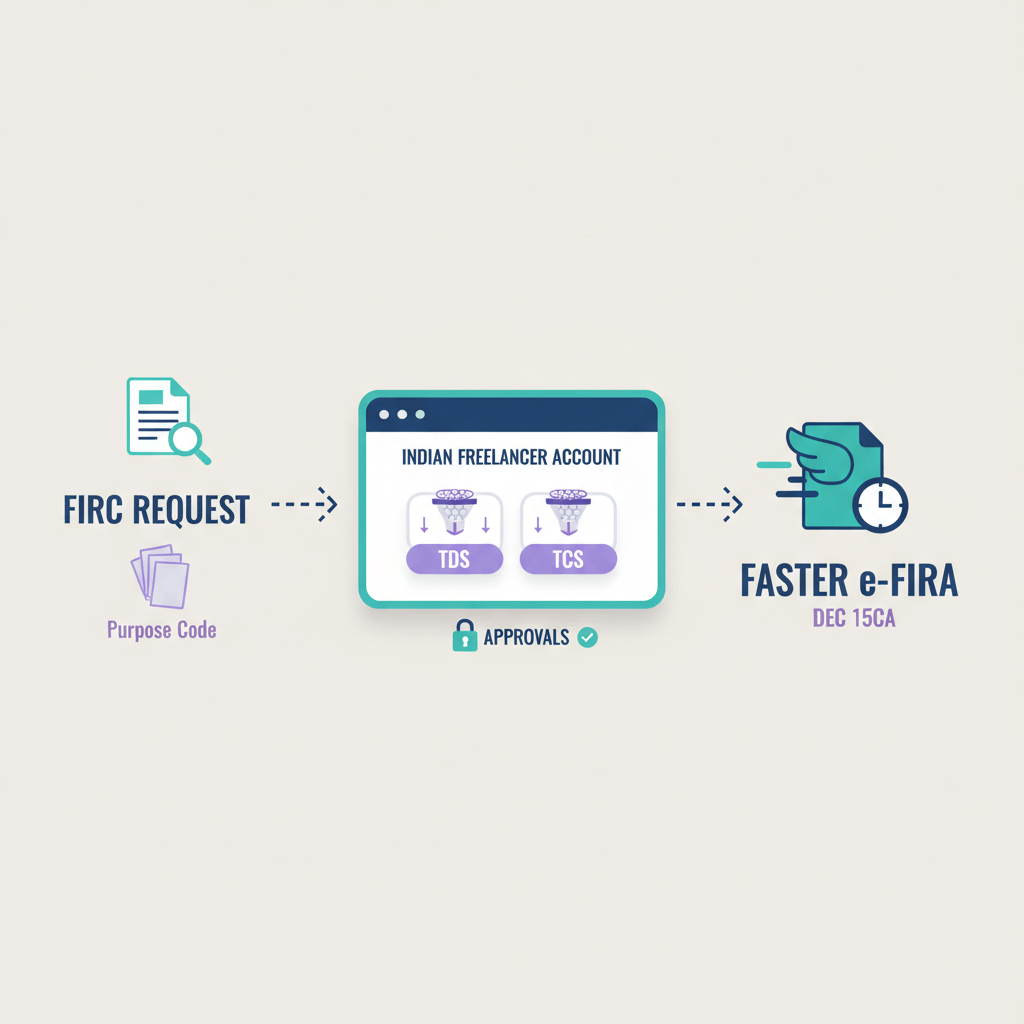
- Requesting FIRC is a simple email process to your bank’s forex team, keep your UTR, date, purpose code, and invoice handy, or choose platforms that auto-generate it.
- Payment gateways often issue FIRC themselves, not your bank, platforms like Karbon Business auto-generate e-FIRA within 24 hours, saving time.
- Organize certificates by financial year, pair each FIRC with its invoice, and maintain a tracking sheet to simplify your CA’s work during tax season.
What is a Foreign Inward Remittance Certificate?
A Foreign Inward Remittance Certificate, or FIRC, is an official document issued by your bank or authorized dealer confirming that you received money from outside India into your Indian bank account. Think of it as a receipt for international payments, it proves the money came from legitimate sources and helps you stay compliant with Indian tax and foreign exchange regulations.
The certificate typically lists the remitter’s name and country, the amount in foreign currency and INR, the applied exchange rate, the transaction date, and your account details. It is signed or digitally authenticated by the bank, making it valid for official use.
For freelancers, FIRC supports three big needs, income tax filing, chartered accountant audits, and FEMA or RBI compliance. Most banks now issue digital versions called e-FIRA, which behave exactly like physical certificates but arrive faster and are easier to store, explore the e-FIRA guide to understand formats and usage. For basics, see this overview on FIRC full form.
“If you received $100 or $10,000, you are entitled to a FIRC. Treat it as your shield during audits and assessments.”
Why Indian freelancers need FIRC
Income Tax Filing and TDS
When you file your income tax return, foreign income must be declared. Your CA will ask for proof, especially for significant amounts, and FIRC is that proof. Without it, questions about the source of funds can arise, and in scrutiny, the FIRC becomes your primary evidence that the money came from legitimate overseas business activity.
Chartered Accountant audits
If your turnover crosses audit thresholds, your CA will request FIRCs for all foreign transactions. Even below limits, organized FIRCs keep your books clean and your assessments smoother.
GST and export benefits
Export of services can be zero rated under GST, and FIRC proves receipt in convertible foreign exchange. It also helps with audit trails for export turnover, learn more with a primer on understanding FIRC.
Bank reconciliation and record keeping
Over time, many international credits look similar. FIRC captures sender details and purpose codes, making reconciliation and dispute resolution easier.
What information does a FIRC contain?
Beneficiary details, your name as per bank records, your account number, and branch details.
Remitter information, the payer’s name, address, and country. If you are paid via an aggregator like PayPal, the remitter may appear as their Indian banking partner, which is normal.
Amount and currency details, the original foreign currency amount, the INR conversion, and the exact exchange rate applied on conversion date.
Transaction date and reference number, the UTR or transaction ID helps trace and match ledger entries.
Purpose code, RBI mandated code that categorizes the service, for many freelancers, P0805 fits business and management consultancy, others like P1010 for audiovisual services or P0906 for advertising may apply. Getting the code right matters.
Bank or authorized dealer stamp or digital authentication, confirms the certificate’s validity.
For a quick refresher on terminology and scope, skim this summary on FIRC full form.
How to request FIRC from your bank, step by step
Step 1, gather transaction details
Collect the UTR, credit date, amount in foreign currency and INR, sender’s name and country, plus your invoice or contract. Keep your RBI purpose code ready.
Step 2, draft your request
Most banks accept requests over email to their forex or remittance team. Use a clear subject line, include your full name, account number, transaction date, UTR, amounts, remitter details, and purpose code. Attach the statement page showing the credit and the invoice.
Sample opener
“I request you to issue the Foreign Inward Remittance Certificate for the below transaction.”
Then list your details cleanly, and ask for e-FIRA issuance at the earliest.
Step 3, send to the correct department
Do not mail your home branch, look up the bank’s forex or remittance email. Private banks often centralize this, public banks may prefer in-branch applications.
Step 4, follow up
Typical issuance takes 7 to 15 days. If delayed, send a polite reminder referencing the original request. Escalate to the branch manager or grievance cell if needed.
Step 5, verify the certificate
Check name, amount, date, remitter, and purpose code. Ask for a corrected version promptly if any field is wrong. For an online walkthrough, see how to get FIRC certificate online.
Getting FIRC when using payment gateways and fintechs
Understand the payment flow
Gateways settle via their Indian banking partners. Your bank may show Citibank or another intermediary as remitter, not your client, therefore the gateway or fintech must issue the FIRC, not your bank.
Requesting FIRC from platforms
Payoneer provides free e-FIRA on request. PayPal can issue FIRC, though the process may take longer via India support. Wise provides transaction documentation, and can assist with compliance letters.
Karbon Business for freelancers
Karbon Business auto-generates e-FIRA within 24 hours for every international payment, offers virtual USD, GBP, EUR, and CAD accounts with local details, settles to INR in 24 to 48 hours, charges a flat 1% platform fee with zero FX markup, and is built for RBI and FEMA compliance.
For deeper context on platform comparisons and common pitfalls, see a practical FIRC advice in India roundup.
Common issues and how to fix them
Name mismatch between client and remitter, keep client emails that confirm use of a third party processor, attach those when sharing documents with your CA.
Missing or incorrect UTR, always pick the UTR from your Indian bank statement, not the gateway’s internal ID.
Wrong purpose code, ask the bank to reissue with the correct code, share your invoice or contract to prove the service type, more on this in purpose code mismatches.
Bank refuses or delays issuance, reference RBI requirements, escalate to the manager or grievance cell, switch to a bank or platform that handles remittances regularly if issues persist.
Certificate has errors, request corrections immediately, do not file taxes with a wrong document.
Complex multi intermediary flows, document each hop and keep a simple narrative with amounts and confirmations, your CA can use this with the FIRC as a complete trail.
For a troubleshooting checklist, review this practical guide to receive Foreign Inward Remittance Certificate in India.
How long does FIRC take?
Traditional banks, expect 7 to 15 working days for e-FIRA after a complete request, private banks are usually faster, public banks may take longer, especially at small branches.
Payment platforms, Payoneer often turns around in 7 to 15 days, PayPal varies based on support volume, Wise responds in 5 to 10 business days for documentation.
Fintechs built for India, Karbon Business generates e-FIRA automatically within 24 hours post claim, eliminating manual requests.
For broader timelines and process notes, browse this overview of the FIRC certificate.
Organizing and storing your FIRC documents
Create a system early, dedicate folders by financial year, with subfolders for FIRCs, invoices, and statements.
Name files clearly, use searchable names like “FIRC_2024_March_Client_USD500.pdf”.
Match FIRCs to invoices, keep pairs together so reconciliation is painless.
Maintain a tracking spreadsheet, columns for date, client, invoice, amounts, UTR, FIRC status, filename, and purpose code make tax season effortless.
Backup, keep local and cloud copies, scan any physical certificates.
Retention, maintain records for at least six years from the end of the relevant assessment year, longer for complex cases or large amounts.
FIRC and tax filing, what your CA needs
Income tax return disclosure, FIRC proves the foreign income and supports categorization and computation.
Foreign Tax Credit, if tax was withheld abroad, FIRC helps establish gross receipts, combine it with foreign tax proof to claim FTC.
GST compliance, export of services can be zero rated, FIRC proves receipt in foreign exchange.
Audit requirements, auditors match FIRCs to reported foreign income and check FEMA compliance.
What to provide your CA, all FIRCs for the year, matching invoices, bank statements, foreign tax details, and a summary spreadsheet. Proactive, organized handover saves time and fees.
Choosing the right payment setup for easier FIRC management
Evaluate your current flow, if you spend hours chasing certificates, consider alternatives.
Look for, automatic documentation, speed, accuracy, dashboard access, strong support, fair fees, and strict RBI or FEMA compliance.
Direct bank transfers, simple, but often slower and costlier, with manual FIRC requests.
Traditional platforms, client friendly, but fees and FIRC wait times can be higher.
India focused fintech, Karbon Business stands out for automatic e-FIRA in 24 hours, virtual USD, GBP, EUR, and CAD accounts, INR settlements in 24 to 48 hours, flat 1% fee with zero FX markup, and compliance by design.
Using multiple platforms, fine for flexibility, just keep a clean tracking sheet so no certificate is missed.
Make the switch carefully, inform clients, test with a small payment, update invoices and contracts, keep old accounts accessible for one tax cycle to retrieve historical FIRCs.
FAQ
How long does it take to get FIRC from a bank in India?
Most banks issue e-FIRA in 7 to 15 working days once your request is complete with UTR, date, amount, remitter, and purpose code. Private banks are generally faster than public sector banks, incomplete requests cause delays.
Is FIRC mandatory for every foreign payment freelancers receive?
Yes for commercial remittances, RBI requires authorized dealers to issue FIRC for all business related inward remittances, regardless of amount. Personal gifts or family transfers follow different documentation, but for freelancing income, get FIRC.
Can I request FIRC for old transactions, say last financial year?
Yes, you can request FIRC for past transactions, older cases may take more time as banks retrieve archived records. It is best to request immediately after each payment to avoid long back and forth during tax season.
My branch says small amounts do not need FIRC, is that true?
No, there is no minimum threshold under RBI for commercial remittances. If the funds are business income, you are entitled to FIRC. Escalate to the branch manager or grievance cell if you face refusal.
I got paid via PayPal, how do I get FIRC for that?
Request FIRC from PayPal India support with transaction ID, date, amount, and your registered details. Your Indian bank will show PayPal’s banking partner as remitter, so the platform, not your bank, must issue the certificate. Many freelancers prefer Karbon Business because it auto generates e-FIRA within 24 hours, removing manual requests.
Do I need one FIRC per payment or can I combine multiple credits?
Each foreign inward remittance gets a separate FIRC. If you receive three payments from the same client in a month, you will have three FIRCs, combining is not supported by banks or platforms.
What is the RBI purpose code for freelancers, and why is it important?
Purpose codes categorize the reason for foreign exchange, many freelancers use P0805 for business and management consultancy, others like P1010 for audiovisual or codes for software services may fit. The correct code ensures FEMA compliance and avoids processing issues.
Can I use bank statements in place of FIRC for taxes and audits?
Bank statements prove the credit, but they do not replace FIRC as a compliance document. Your CA may accept statements as supplementary evidence, however for scrutiny and audits, FIRC is the primary proof of legitimate foreign earnings.
What should I do if my FIRC has errors in amount or remitter name?
Ask the issuing bank or platform to reissue a corrected certificate. Share the incorrect FIRC, highlight the errors, and attach supporting documents like the bank statement and invoice. Do not file taxes with a wrong certificate.
How can I speed up FIRC issuance, any practical hacks?
Send a complete request with UTR, date, exact amounts, remitter details, and purpose code. Email the bank’s forex team, reference your earlier request when following up, and build a relationship with the bank’s remittance desk. Many freelancers switch to Karbon Business because e-FIRA is auto generated within 24 hours of claiming payment.
Which platform is best for easy FIRC, Payoneer, Wise, or Karbon Business?
Payoneer issues free e-FIRA on request, Wise provides documentation for tax purposes, but formal FIRC may require support, Karbon Business is tailored for Indian freelancers and auto generates e-FIRA within 24 hours, offers local receiving accounts in USD, GBP, EUR, and CAD, settles INR in 24 to 48 hours, and charges a flat 1% fee with zero FX markup.
Will FIRC help with GST export of services and audit preparation?
Yes, FIRC is key proof of receipt in convertible foreign exchange, it supports zero rated export treatment under GST and gives auditors a reliable compliance trail. Pair FIRC with matching invoices and an organized ledger for smooth audits.
If my payment shows the processor’s name instead of the client on FIRC, is that a problem?
It is common when clients pay via gateways or payroll processors. Keep client email confirmation and platform receipts that link the processor to your client’s payment. Your CA can reconcile the trail, platforms like Karbon Business simplify this by auto documenting flows with e-FIRA.
