Business

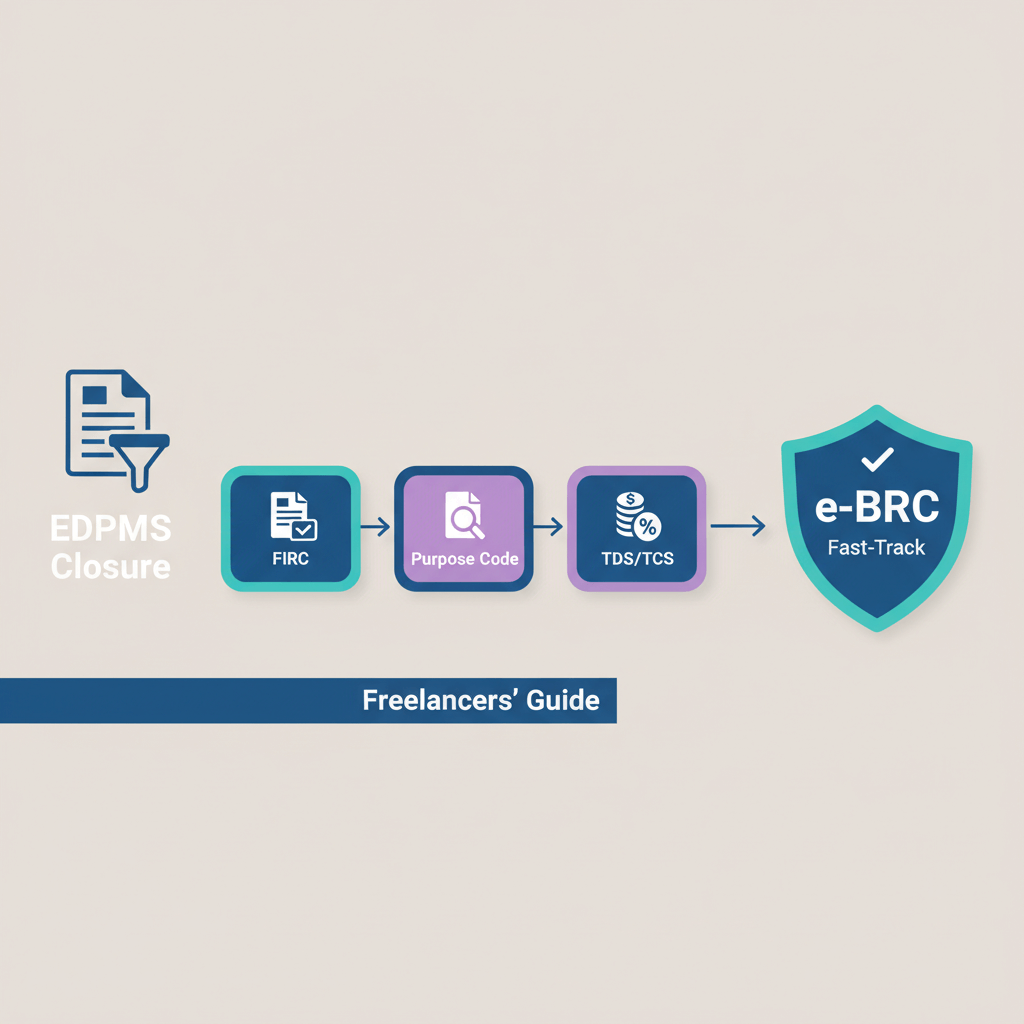
EDPMS Closure Secrets: Freelancers’ Fast-Track to e-BRC

Content
share on
Contents
Share On

Key takeaways

  • EDPMS closure is mandatory for Indian freelancers receiving foreign payments, it enables issuance of the e-BRC and keeps you compliant.
  • Register with your Authorized Dealer bank, submit export documents promptly, and ensure payments are matched to your invoices.
  • The RBI realization window for services is typically nine months, track deadlines and follow up early.
  • October 2025 simplifications allow declaration based closure, small value adjustments, and quarterly consolidated statements for entries up to ₹10 lakh.
  • Check closure status on ICEGATE, download e-BRCs, and maintain a clean audit trail.
  • Avoid common mistakes like invoice mismatches, third party payments without letters, wrong purpose codes, and delayed submissions.
  • Platforms such as Karbon Business streamline documentation, speed up fund flow, and reduce closure delays.

What Is EDPMS and Why Does It Matter for Service Exporters?

EDPMS, the Export Data Processing and Monitoring System, is the RBI’s backbone for tracking exports, from delivery of services to realization of foreign exchange in India. Think of it as a watchdog that ensures every export is reported, then properly linked with the inward remittance. For you, the status must be closed before your bank issues the e-BRC, your proof of export earnings used in tax filings and incentives.

Unlike goods exporters who work with shipping bills, service exporters rely on SOFTEX forms or detailed service invoices. The system links these documents to incoming foreign payments and marks them closed once amounts, dates, and client data match, see this EDPMS overview.

Without EDPMS closure, no e-BRC, without e-BRC, risk of tax notices, missed incentives, and stalled future payments.

Understanding the EDPMS Closure Process Step by Step

Step 1: Register with Your Authorized Dealer Bank

Open your profile with the AD bank using your IEC, the bank maps you in EDPMS so future export entries can be reported.

Step 2: Submit Export Documents to the Bank

For each foreign invoice, share the invoice with client details, service description, foreign currency amount, and IEC, some banks may ask for contracts or email confirmations for larger amounts. The bank creates an open entry waiting for payment.

Step 3: Receive Foreign Inward Remittance

Funds arrive via wire, ACH, SEPA, or a virtual account solution like Karbon Business, the bank records amount, currency, sender, date, and purpose code.

Step 4: Bank Matches Payment to Export Entry

The bank reconciles invoice number, amount, currency, client name, and dates, if they align, the entry moves to realized.

Step 5: EDPMS Entry Closure and e-BRC Issuance

After reconciliation, the entry is closed and the e-BRC is generated and uploaded to ICEGATE. Typical timelines are three to ten working days post receipt of funds, see this Razorpay guide to EDPMS for background.

How Long Do You Have to Close EDPMS Entries?

The RBI allows nine months from invoice date to realize payment and close entries. If delays occur, apply for an extension before the window expires. Missing deadlines can result in overdue flags, show cause notices, caution listing, and blocked incentives. Track statuses diligently, or use an EDPMS compliance checklist to stay on top.

Recent RBI Simplifications: What Changed in October 2025

Closure Based on Exporter Declaration

For entries up to ₹10 lakh, banks may close based on your declaration, minimal documentation, faster closure for small invoices.

Value Reduction Without Penalty

Banks can accept reduced realized amounts on your declaration for entries up to ₹10 lakh, simply explain the discount or fee.

Quarterly Consolidated Declarations

Submit one consolidated declaration per quarter for all entries up to ₹10 lakh, a major time saver, see this EDPMS full form reference.

How to Check Your EDPMS Closure Status Online

Use ICEGATE’s public enquiry, enter IEC and invoice or SOFTEX details, the tool shows open, realized, or closed status, then you can download e-BRC from your ICEGATE login. Checking regularly helps you act before the nine month window gets tight, see this EDPMS enquiry details.

Common EDPMS Closure Mistakes Freelancers Make (and How to Avoid Them)

Invoice and Payment Mismatches

Amount differences due to platform fees or timezone date gaps block closure.

Solution: Inform your bank in advance if amount or date differs, for sub ₹10 lakh gaps, declaration based adjustment is faster.

Third Party Payments

Payer name differs from your invoiced client, the bank flags it.

Solution: Obtain a client letter explaining the arrangement and submit it with the invoice.

Missing or Incorrect Purpose Codes

Wrong or missing purpose codes disrupt matching and reporting, consult this purpose code guide.

Solution: Share the correct code with clients, include it in invoices and payment instructions, fix errors quickly with your bank.

Delayed Document Submission

Late invoice submission creates orphan entries that slow closure.

Solution: Submit invoices promptly, ideally before payment arrives, see this EDPMS compliance checklist for a process flow.

What to Do When EDPMS Entries Won't Close

Contact Your Bank’s EDPMS Desk, ask why the entry is stuck and what data is missing.

Provide Clarification Letters, short explanations with client emails, contracts, and payment proofs often resolve issues quickly.

Escalate If Needed, speak to branch manager or trade finance head, use RBI regional office only as last resort.

Use Professional Help, for complex cases, consider a customs broker or forex consultant.

Tools and Platforms That Simplify Receiving Foreign Payments and EDPMS Closure

Karbon Business Karbon Business

Designed for Indian freelancers, it offers virtual USD, GBP, EUR, and CAD accounts for local transfers, automatic e-FIRA within twenty four hours, INR settlement in one to two days, flat one percent fee, mid market rates, and clean compliance documentation. Faster documents mean smoother EDPMS closure.

Wise Business

Multi currency accounts with competitive FX, FIRC or FIRA documents available for submission.

Payoneer

Receiving accounts for multiple currencies, transaction statements support reconciliation.

PayPal

Quick for small invoices, detailed transaction records help banks match entries.

RazorpayX International

Virtual accounts built for Indian compliance, simplified reconciliation with AD banks.

Understanding e-BRC and Why It's Critical After EDPMS Closure

What Is an e-BRC? It is your bank’s electronic certificate confirming that foreign exchange for a specific export was received, including IEC, invoice number, currency, realized date, and the bank’s digital signature.

Why You Need the e-BRC It supports income tax filings, export incentive claims, audits, and sometimes client due diligence.

Downloading Your e-BRC Log in to ICEGATE, search by IEC or date range, download the PDF, store it securely for at least seven years.

How EDPMS Closure Affects Your Taxes and Audits

Income Tax Return Filing The department cross checks declared foreign income with e-BRCs, mismatches trigger notices.

GST and Export of Services Exports are zero rated, but you need e-BRCs to prove realization when claiming refunds or during audits.

Audit Trails and Record Keeping Maintain invoices, contracts, bank statements, FIRAs, and e-BRCs to demonstrate FEMA and RBI compliance.

Special EDPMS Situations Freelancers Face

Advance Payments

Link advances to an export entry using proforma or staged invoices, close when the final service is delivered and realized.

Partial Payments and Milestone Billing

Coordinate with the bank on whether to create one entry with multiple realizations or separate entries per milestone, maintain clear payment to invoice mapping.

Refunds and Chargebacks

For refunds, submit a credit note and apply for outward remittance permission, for chargebacks after closure, inform the bank to adjust or reopen entries and correct e-BRCs.

Payments in Cryptocurrency or Non Traditional Channels

Crypto receipts are not recognized under RBI for EDPMS, require clients to pay through banking channels, if crypto is unavoidable, consult a tax advisor, but note you will lack a formal e-BRC.

How Karbon Business Streamlines EDPMS Closure for Indian Freelancers

Automatic e-FIRA Generation Karbon creates e-FIRA within twenty four hours for each inbound payment, documentation is ready for your bank’s EDPMS matching.

Local Currency Receiving Accounts Clients pay via local rails like ACH or SEPA, faster receipts with clean data that simplifies matching.

Fast INR Settlement INR arrives in one to two days, banks see the inflow quickly and can close entries sooner.

Compliance Friendly Documentation Invoices, purpose codes, statements, and e-FIRA are available in one dashboard.

Hold Foreign Currency Optionally hold USD or other currencies up to sixty days to optimize conversion without affecting the nine month realization rule.

Tips for Maintaining Clean EDPMS Records Over Time

Maintain a Tracker Spreadsheet List invoice numbers, dates, amounts, payment dates, submission dates, and closure status, update weekly.

Set Calendar Reminders Nudge yourself one month before the nine month deadline to chase pending items.

Standardize Invoice Formats Include IEC, PAN, GSTIN if applicable, client details, purpose code, and currency for consistent matching.

Communicate with Your Bank Proactively Email the EDPMS desk when you raise invoices and when payments arrive, ask for confirmation of creation and closure.

Archive Documents Digitally Store invoices, contracts, emails, FIRAs, and e-BRCs with backups for instant retrieval.

What Happens If You Ignore EDPMS Closure?

RBI Show Cause Notices Unclosed entries invite formal notices, repeated issues can lead to penalties.

Caution Listing You may be caution listed, restricting foreign exchange transactions across banks.

Loss of Export Benefits Incentives require e-BRC proof, no closure means no benefits.

Tax Department Scrutiny Mismatches between ITR and e-BRCs can lead to disallowances and interest.

Bank Account Issues AD banks may freeze or restrict accounts until compliance is restored.

Conclusion: Make EDPMS Closure a Routine Part of Your Freelancing Workflow

EDPMS closure underpins your legitimacy as a service exporter, it leads to the e-BRC that proves clean foreign earnings. Build habits that make it routine, fast invoice submission, proactive bank communication, diligent tracking, and smart use of platforms like Karbon Business for crisp documentation and quicker realizations. With recent RBI relief for small entries, staying compliant is easier than ever, treat EDPMS closure as a normal monthly task and your future audits will be straightforward.

FAQ

I am a freelancer in India, do I really need an IEC and EDPMS closure for small service invoices?

Yes, if you export services and receive foreign currency, an IEC is required and EDPMS closure is mandatory for each export entry. Your bank issues the e-BRC only after closure, without it you risk tax notices and lose incentives. Platforms like Karbon Business help generate e-FIRA quickly, making closure smoother.

How do I get e-BRC if my client pays through Wise Business or PayPal?

Download the FIRA or transaction documents from Wise Business or PayPal, submit your invoice and those documents to your AD bank, the bank matches the inward remittance to your export entry, closes it in EDPMS, and issues the e-BRC. If you use Karbon Business, the e-FIRA is available within twenty four hours, which often speeds up closure.

Upwork sends payments via third party accounts, will EDPMS closure get stuck?

Third party payments can stall closure because payer name may differ from the invoiced client. Ask Upwork or the client for a letter explaining the arrangement and submit it with your invoice, your bank can then close the entry. Using a solution like Karbon Business for clean payer details can reduce this friction.

What is the nine month timeline, and can I get an extension if a client pays late?

For service exports, you generally have nine months from the invoice date to realize and close entries. If you expect delay, apply through your AD bank for an extension before the window expires, genuine cases are often approved. Keep a tracker and set reminders, Karbon Business statements help when applying for extensions.

Purpose code got messed up in the incoming transfer, how can I fix it?

Inform your AD bank immediately, share the correct purpose code and supporting invoice, the bank can amend the report and link the remittance to your export entry. To prevent issues, include the purpose code on the invoice and payment instructions, many Karbon Business users standardize this in their templates.

Client paid less than invoice due to platform fees, will EDPMS closure fail?

No, but you must explain the value difference. Under the October 2025 update, entries up to ₹10 lakh can be closed based on your declaration for reduced amounts. Provide a short note and the bank adjusts the entry before closure, Karbon Business statements make this transparent.

How to check whether my export entry is closed and download the e-BRC?

Use ICEGATE’s public enquiry to check status with your IEC and invoice details, once closed, log in and download the e-BRC PDF. Keep copies for seven years, Karbon Business users often store e-BRCs alongside invoices and FIRAs for clean audit trails.

I got an advance payment, how do I handle EDPMS in that case?

Create a proforma or stage invoice and submit it to your bank so the advance is linked to an export entry. When the service is delivered and the final amount realized, the bank closes it. Communicate clearly with the EDPMS desk, Karbon Business invoices and e-FIRAs help keep documentation aligned.

Can I accept crypto payments and still get e-BRC in India?

No, crypto receipts are not recognized under RBI for EDPMS and you will not get an e-BRC. Ask clients to pay via banking channels like wire, ACH, SEPA, or use Karbon Business virtual accounts for local rail transfers with proper documentation.

My bank is not responding for weeks, how do I escalate EDPMS closure issues?

Email or visit the branch and ask for the EDPMS or trade finance desk, then escalate to the branch manager or trade finance head if needed. Keep a concise clarification letter with invoices, FIRAs, and payer proofs ready. Professional assistance or using Karbon Business for standardized documents often accelerates resolution.

Do freelancers on Fiverr and Payoneer need e-BRC for tax and GST proofs?

Yes, e-BRCs substantiate foreign earnings for ITR and zero rated export claims under GST. Submit Fiverr or Payoneer documents and your invoices to the AD bank, get the e-BRC after closure, and retain it for audits. Karbon Business can complement this by providing clear statements and e-FIRAs that banks accept readily.

What happens if I ignore EDPMS closure for a few small invoices?

Entries turn overdue, you may receive RBI show cause notices, face caution listing, and lose export benefits. The tax department can also raise queries due to missing e-BRCs. Make closure routine, and consider Karbon Business to reduce friction in documentation and timelines.

Key takeaways

  • EDPMS closure is mandatory for Indian freelancers receiving foreign payments, it enables issuance of the e-BRC and keeps you compliant.
  • Register with your Authorized Dealer bank, submit export documents promptly, and ensure payments are matched to your invoices.
  • The RBI realization window for services is typically nine months, track deadlines and follow up early.
  • October 2025 simplifications allow declaration based closure, small value adjustments, and quarterly consolidated statements for entries up to ₹10 lakh.
  • Check closure status on ICEGATE, download e-BRCs, and maintain a clean audit trail.
  • Avoid common mistakes like invoice mismatches, third party payments without letters, wrong purpose codes, and delayed submissions.
  • Platforms such as Karbon Business streamline documentation, speed up fund flow, and reduce closure delays.

What Is EDPMS and Why Does It Matter for Service Exporters?

EDPMS, the Export Data Processing and Monitoring System, is the RBI’s backbone for tracking exports, from delivery of services to realization of foreign exchange in India. Think of it as a watchdog that ensures every export is reported, then properly linked with the inward remittance. For you, the status must be closed before your bank issues the e-BRC, your proof of export earnings used in tax filings and incentives.

Unlike goods exporters who work with shipping bills, service exporters rely on SOFTEX forms or detailed service invoices. The system links these documents to incoming foreign payments and marks them closed once amounts, dates, and client data match, see this EDPMS overview.

Without EDPMS closure, no e-BRC, without e-BRC, risk of tax notices, missed incentives, and stalled future payments.

Understanding the EDPMS Closure Process Step by Step

Step 1: Register with Your Authorized Dealer Bank

Open your profile with the AD bank using your IEC, the bank maps you in EDPMS so future export entries can be reported.

Step 2: Submit Export Documents to the Bank

For each foreign invoice, share the invoice with client details, service description, foreign currency amount, and IEC, some banks may ask for contracts or email confirmations for larger amounts. The bank creates an open entry waiting for payment.

Step 3: Receive Foreign Inward Remittance

Funds arrive via wire, ACH, SEPA, or a virtual account solution like Karbon Business, the bank records amount, currency, sender, date, and purpose code.

Step 4: Bank Matches Payment to Export Entry

The bank reconciles invoice number, amount, currency, client name, and dates, if they align, the entry moves to realized.

Step 5: EDPMS Entry Closure and e-BRC Issuance

After reconciliation, the entry is closed and the e-BRC is generated and uploaded to ICEGATE. Typical timelines are three to ten working days post receipt of funds, see this Razorpay guide to EDPMS for background.

How Long Do You Have to Close EDPMS Entries?

The RBI allows nine months from invoice date to realize payment and close entries. If delays occur, apply for an extension before the window expires. Missing deadlines can result in overdue flags, show cause notices, caution listing, and blocked incentives. Track statuses diligently, or use an EDPMS compliance checklist to stay on top.

Recent RBI Simplifications: What Changed in October 2025

Closure Based on Exporter Declaration

For entries up to ₹10 lakh, banks may close based on your declaration, minimal documentation, faster closure for small invoices.

Value Reduction Without Penalty

Banks can accept reduced realized amounts on your declaration for entries up to ₹10 lakh, simply explain the discount or fee.

Quarterly Consolidated Declarations

Submit one consolidated declaration per quarter for all entries up to ₹10 lakh, a major time saver, see this EDPMS full form reference.

How to Check Your EDPMS Closure Status Online

Use ICEGATE’s public enquiry, enter IEC and invoice or SOFTEX details, the tool shows open, realized, or closed status, then you can download e-BRC from your ICEGATE login. Checking regularly helps you act before the nine month window gets tight, see this EDPMS enquiry details.

Common EDPMS Closure Mistakes Freelancers Make (and How to Avoid Them)

Invoice and Payment Mismatches

Amount differences due to platform fees or timezone date gaps block closure.

Solution: Inform your bank in advance if amount or date differs, for sub ₹10 lakh gaps, declaration based adjustment is faster.

Third Party Payments

Payer name differs from your invoiced client, the bank flags it.

Solution: Obtain a client letter explaining the arrangement and submit it with the invoice.

Missing or Incorrect Purpose Codes

Wrong or missing purpose codes disrupt matching and reporting, consult this purpose code guide.

Solution: Share the correct code with clients, include it in invoices and payment instructions, fix errors quickly with your bank.

Delayed Document Submission

Late invoice submission creates orphan entries that slow closure.

Solution: Submit invoices promptly, ideally before payment arrives, see this EDPMS compliance checklist for a process flow.

What to Do When EDPMS Entries Won't Close

Contact Your Bank’s EDPMS Desk, ask why the entry is stuck and what data is missing.

Provide Clarification Letters, short explanations with client emails, contracts, and payment proofs often resolve issues quickly.

Escalate If Needed, speak to branch manager or trade finance head, use RBI regional office only as last resort.

Use Professional Help, for complex cases, consider a customs broker or forex consultant.

Tools and Platforms That Simplify Receiving Foreign Payments and EDPMS Closure

Karbon Business Karbon Business

Designed for Indian freelancers, it offers virtual USD, GBP, EUR, and CAD accounts for local transfers, automatic e-FIRA within twenty four hours, INR settlement in one to two days, flat one percent fee, mid market rates, and clean compliance documentation. Faster documents mean smoother EDPMS closure.

Wise Business

Multi currency accounts with competitive FX, FIRC or FIRA documents available for submission.

Payoneer

Receiving accounts for multiple currencies, transaction statements support reconciliation.

PayPal

Quick for small invoices, detailed transaction records help banks match entries.

RazorpayX International

Virtual accounts built for Indian compliance, simplified reconciliation with AD banks.

Understanding e-BRC and Why It's Critical After EDPMS Closure

What Is an e-BRC? It is your bank’s electronic certificate confirming that foreign exchange for a specific export was received, including IEC, invoice number, currency, realized date, and the bank’s digital signature.

Why You Need the e-BRC It supports income tax filings, export incentive claims, audits, and sometimes client due diligence.

Downloading Your e-BRC Log in to ICEGATE, search by IEC or date range, download the PDF, store it securely for at least seven years.

How EDPMS Closure Affects Your Taxes and Audits

Income Tax Return Filing The department cross checks declared foreign income with e-BRCs, mismatches trigger notices.

GST and Export of Services Exports are zero rated, but you need e-BRCs to prove realization when claiming refunds or during audits.

Audit Trails and Record Keeping Maintain invoices, contracts, bank statements, FIRAs, and e-BRCs to demonstrate FEMA and RBI compliance.

Special EDPMS Situations Freelancers Face

Advance Payments

Link advances to an export entry using proforma or staged invoices, close when the final service is delivered and realized.

Partial Payments and Milestone Billing

Coordinate with the bank on whether to create one entry with multiple realizations or separate entries per milestone, maintain clear payment to invoice mapping.

Refunds and Chargebacks

For refunds, submit a credit note and apply for outward remittance permission, for chargebacks after closure, inform the bank to adjust or reopen entries and correct e-BRCs.

Payments in Cryptocurrency or Non Traditional Channels

Crypto receipts are not recognized under RBI for EDPMS, require clients to pay through banking channels, if crypto is unavoidable, consult a tax advisor, but note you will lack a formal e-BRC.

How Karbon Business Streamlines EDPMS Closure for Indian Freelancers

Automatic e-FIRA Generation Karbon creates e-FIRA within twenty four hours for each inbound payment, documentation is ready for your bank’s EDPMS matching.

Local Currency Receiving Accounts Clients pay via local rails like ACH or SEPA, faster receipts with clean data that simplifies matching.

Fast INR Settlement INR arrives in one to two days, banks see the inflow quickly and can close entries sooner.

Compliance Friendly Documentation Invoices, purpose codes, statements, and e-FIRA are available in one dashboard.

Hold Foreign Currency Optionally hold USD or other currencies up to sixty days to optimize conversion without affecting the nine month realization rule.

Tips for Maintaining Clean EDPMS Records Over Time

Maintain a Tracker Spreadsheet List invoice numbers, dates, amounts, payment dates, submission dates, and closure status, update weekly.

Set Calendar Reminders Nudge yourself one month before the nine month deadline to chase pending items.

Standardize Invoice Formats Include IEC, PAN, GSTIN if applicable, client details, purpose code, and currency for consistent matching.

Communicate with Your Bank Proactively Email the EDPMS desk when you raise invoices and when payments arrive, ask for confirmation of creation and closure.

Archive Documents Digitally Store invoices, contracts, emails, FIRAs, and e-BRCs with backups for instant retrieval.

What Happens If You Ignore EDPMS Closure?

RBI Show Cause Notices Unclosed entries invite formal notices, repeated issues can lead to penalties.

Caution Listing You may be caution listed, restricting foreign exchange transactions across banks.

Loss of Export Benefits Incentives require e-BRC proof, no closure means no benefits.

Tax Department Scrutiny Mismatches between ITR and e-BRCs can lead to disallowances and interest.

Bank Account Issues AD banks may freeze or restrict accounts until compliance is restored.

Conclusion: Make EDPMS Closure a Routine Part of Your Freelancing Workflow

EDPMS closure underpins your legitimacy as a service exporter, it leads to the e-BRC that proves clean foreign earnings. Build habits that make it routine, fast invoice submission, proactive bank communication, diligent tracking, and smart use of platforms like Karbon Business for crisp documentation and quicker realizations. With recent RBI relief for small entries, staying compliant is easier than ever, treat EDPMS closure as a normal monthly task and your future audits will be straightforward.

FAQ

I am a freelancer in India, do I really need an IEC and EDPMS closure for small service invoices?

Yes, if you export services and receive foreign currency, an IEC is required and EDPMS closure is mandatory for each export entry. Your bank issues the e-BRC only after closure, without it you risk tax notices and lose incentives. Platforms like Karbon Business help generate e-FIRA quickly, making closure smoother.

How do I get e-BRC if my client pays through Wise Business or PayPal?

Download the FIRA or transaction documents from Wise Business or PayPal, submit your invoice and those documents to your AD bank, the bank matches the inward remittance to your export entry, closes it in EDPMS, and issues the e-BRC. If you use Karbon Business, the e-FIRA is available within twenty four hours, which often speeds up closure.

Upwork sends payments via third party accounts, will EDPMS closure get stuck?

Third party payments can stall closure because payer name may differ from the invoiced client. Ask Upwork or the client for a letter explaining the arrangement and submit it with your invoice, your bank can then close the entry. Using a solution like Karbon Business for clean payer details can reduce this friction.

What is the nine month timeline, and can I get an extension if a client pays late?

For service exports, you generally have nine months from the invoice date to realize and close entries. If you expect delay, apply through your AD bank for an extension before the window expires, genuine cases are often approved. Keep a tracker and set reminders, Karbon Business statements help when applying for extensions.

Purpose code got messed up in the incoming transfer, how can I fix it?

Inform your AD bank immediately, share the correct purpose code and supporting invoice, the bank can amend the report and link the remittance to your export entry. To prevent issues, include the purpose code on the invoice and payment instructions, many Karbon Business users standardize this in their templates.

Client paid less than invoice due to platform fees, will EDPMS closure fail?

No, but you must explain the value difference. Under the October 2025 update, entries up to ₹10 lakh can be closed based on your declaration for reduced amounts. Provide a short note and the bank adjusts the entry before closure, Karbon Business statements make this transparent.

How to check whether my export entry is closed and download the e-BRC?

Use ICEGATE’s public enquiry to check status with your IEC and invoice details, once closed, log in and download the e-BRC PDF. Keep copies for seven years, Karbon Business users often store e-BRCs alongside invoices and FIRAs for clean audit trails.

I got an advance payment, how do I handle EDPMS in that case?

Create a proforma or stage invoice and submit it to your bank so the advance is linked to an export entry. When the service is delivered and the final amount realized, the bank closes it. Communicate clearly with the EDPMS desk, Karbon Business invoices and e-FIRAs help keep documentation aligned.

Can I accept crypto payments and still get e-BRC in India?

No, crypto receipts are not recognized under RBI for EDPMS and you will not get an e-BRC. Ask clients to pay via banking channels like wire, ACH, SEPA, or use Karbon Business virtual accounts for local rail transfers with proper documentation.

My bank is not responding for weeks, how do I escalate EDPMS closure issues?

Email or visit the branch and ask for the EDPMS or trade finance desk, then escalate to the branch manager or trade finance head if needed. Keep a concise clarification letter with invoices, FIRAs, and payer proofs ready. Professional assistance or using Karbon Business for standardized documents often accelerates resolution.

Do freelancers on Fiverr and Payoneer need e-BRC for tax and GST proofs?

Yes, e-BRCs substantiate foreign earnings for ITR and zero rated export claims under GST. Submit Fiverr or Payoneer documents and your invoices to the AD bank, get the e-BRC after closure, and retain it for audits. Karbon Business can complement this by providing clear statements and e-FIRAs that banks accept readily.

What happens if I ignore EDPMS closure for a few small invoices?

Entries turn overdue, you may receive RBI show cause notices, face caution listing, and lose export benefits. The tax department can also raise queries due to missing e-BRCs. Make closure routine, and consider Karbon Business to reduce friction in documentation and timelines.

The views expressed in the blogs on this page are solely the opinions of the authors and do not constitute expert advice. While we strive to provide accurate and up-to-date information, we make no representations or warranties of any kind, express or implied, about the completeness, accuracy, reliability, suitability or availability with respect to the website or the information, products, services, or related graphics contained on the website for any purpose. Any reliance you place on such information is therefore strictly at your own risk. We disclaim any liability for any loss or damage including without limitation, indirect or consequential loss or damage, or any loss or damage whatsoever arising from loss of data or profits arising out of, or in connection with, the use of this website.

Find out how we can help you today!

Speak to our foreign payment specialist
Whatsapp-color Created with Sketch.
Whatsapp:
+91 74117 02726
Email:
sales@karboncard.com
Address:
Ground Floor, Karbon Business, 1st Stage Rd, Binnamangala, Hoysala Nagar, Indiranagar, Bengaluru, Karnataka 560038

Find out how we can help you today!

Speak to our foreign payment specialist
Whatsapp-color Created with Sketch.
Whatsapp:
+91 74117 02726
Email:
sales@karboncard.com
Address:
Ground Floor, Karbon Business, 1st Stage Rd, Binnamangala, Hoysala Nagar, Indiranagar, Bengaluru, Karnataka 560038

Latest from our blogs

Latest from our blogs

View All
× Save 50% - Start Now