Business

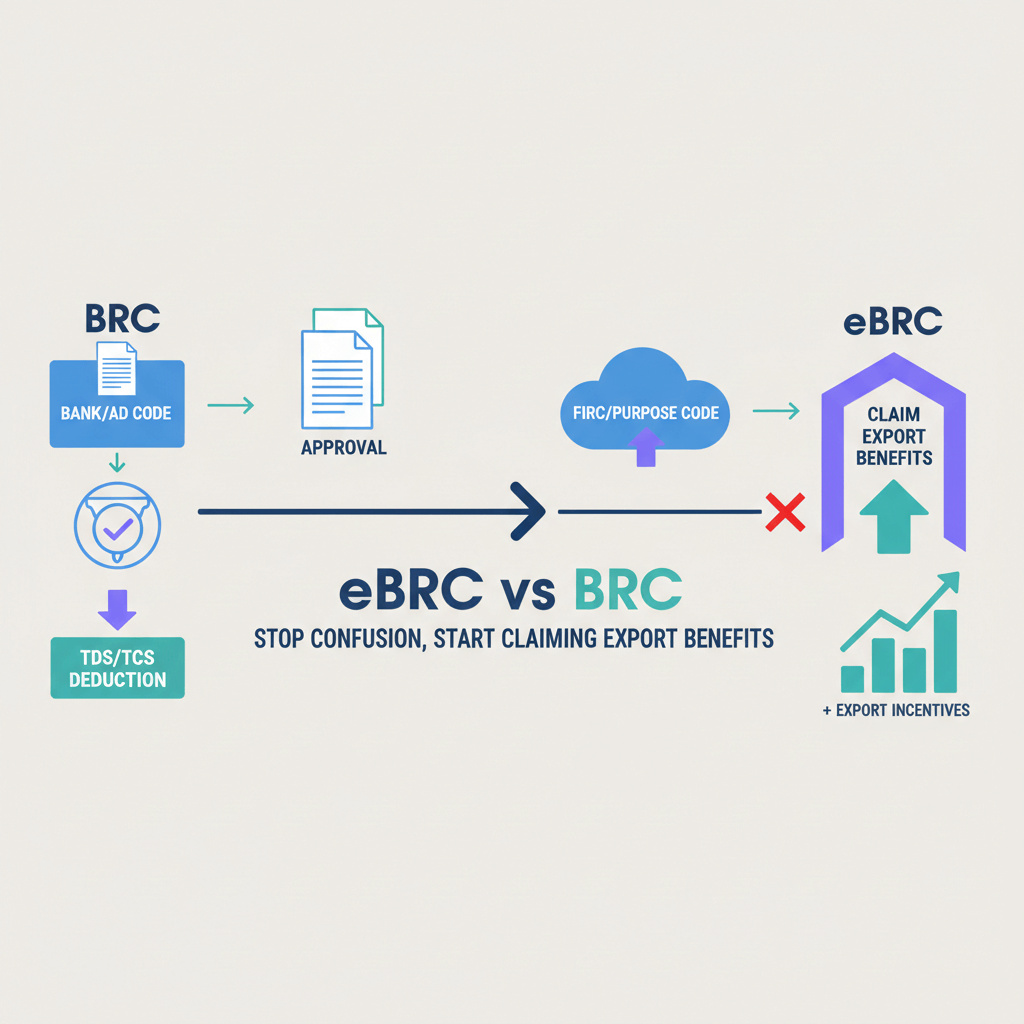
eBRC vs BRC: Stop Confusion, Start Claiming Export Benefits

Content
share on
Contents
Share On

Key takeaways

  • Match document to export type: Goods need eBRC, services and freelance work use FIRA/FIRC. This single decision eliminates 90% of confusion.
  • BRC is legacy, eBRC is current: Paper BRC has been replaced by eBRC for goods, and FIRC for exports has largely evolved into FIRA after RBI guideline changes in 2016.
  • eBRC links to a shipping bill or SOFTEX: If there’s no shipping bill, don’t chase eBRC; rely on FIRA plus your invoice.
  • FIRA is issued by your bank or platform: Many fintechs auto-generate compliant e-FIRA within 24 hours; for example, Karbon Business offers automatic e-FIRA for every collection.
  • Purpose code accuracy matters: A wrong FEMA purpose code can delay GST refunds or trigger RBI queries, so share the correct code with clients upfront.
  • Keep a monthly paper trail: Reconcile invoices to FIRAs/eBRCs, download documents, and maintain a simple tracker for audit-ready compliance.

What Are eBRC, FIRC, BRC, and FIRA? Quick Definitions to Set the Foundation

Think of these documents as different types of receipts that prove foreign currency reached India for your exports, but each one serves a different regulator or workflow.

FIRC (Foreign Inward Remittance Certificate) is a bank-issued document proving an inward foreign remittance. Historically used for all inward remittances, many banks stopped issuing FIRC for export payments after RBI guideline changes in 2016, shifting to FIRA.

FIRA (Foreign Inward Remittance Advice) is the modern replacement for FIRC for export collections; banks or fintech partners issue it, often electronically, to confirm the export payment and its details. For a deep dive into how FIRA compares to FIRC, see this FIRA vs FIRC explainer.

BRC (Bank Realisation Certificate) was the traditional paper certificate that confirmed export proceeds realization for goods, tied to shipping documents. For a plain-English comparison, check the differences between FIRC and BRC.

eBRC (electronic Bank Realisation Certificate) is the digital successor to BRC. Banks upload realization data to DGFT’s EDPMS against a shipping bill or SOFTEX; you download the PDF from DGFT. For more, see this guide to BRC vs eBRC and bank realisation certificate basics.

Bottom line: FIRA/FIRC prove an inward remittance. eBRC proves payment realization against a specific export shipment or SOFTEX.

eBRC vs FIRC vs BRC: The Quick Answer for Your Export Type

If you export goods (handicrafts, garments, electronics), you need eBRC, because your shipping bill links your payment to customs records. Paper BRC is legacy; eBRC has replaced it in practice.

If you export services or freelance work (web development, design, content, consulting), your primary proof is FIRA/FIRC, as there’s no shipping bill. Many banks and compliant platforms issue e-FIRA quickly; here’s a clear comparison of FIRA vs eBRC.

Software exporters fall in between. Packaged software with SOFTEX can lead to eBRC, but SaaS or remote development is treated as services, so FIRA/FIRC applies.

Golden rule: Goods → eBRC. Services → FIRA/FIRC.

eBRC vs FIRC: What Makes Them Different?

AspecteBRCFIRC/FIRA
Who issues it?Bank uploads to DGFT EDPMS; you download from DGFT.Your bank or compliant fintech issues it directly to you.
What it’s linked toShipping bill, bill of lading, or SOFTEX; ties payment to shipment.The remittance transaction itself (UTR, remitter, amount, purpose code).
Primary useDGFT claims, duty drawback, export obligation discharge for goods/software with SOFTEX.GST refunds under LUT, audit trails, KYC, FEMA/RBI compliance for services.
How you get itAfter bank upload, log into DGFT with IEC and download the PDF.Request via bank trade desk or receive auto-generated e-FIRA from platforms.
Typical usersManufacturers, merchant exporters, software product firms.Freelancers, agencies, consultants, SaaS providers.

Authorities accept each in its lane. If you’re claiming GST refunds on services, officers look for invoices, LUT, and FIRA, not eBRC. DGFT, in contrast, validates goods exports with eBRC; see a practical overview of eBRC for exporters.

BRC vs FIRC: Clearing Up the Confusion

BRC was designed exclusively for export proceeds of goods, tied to shipping documents. FIRC covered any foreign inward remittance, from services to investments. For a simple breakdown, read the difference between BRC and FIRC.

In practice, BRC → eBRC for goods, and FIRC → FIRA for export services. If a bank says they no longer issue FIRC for exports, request FIRA/e-FIRA instead.

The Export Proof Documents Ecosystem: What Exists and When to Use Each

For goods exporters you’ll commonly use:

  • Shipping bill (with AD code)
  • Bill of lading or airway bill
  • Commercial invoice
  • eBRC from DGFT
  • GST invoices and returns

For service exporters and freelancers your essentials are:

  • Commercial invoice or contract
  • FIRA/FIRC (proof of payment)
  • SOFTEX (only for packaged software/product exports)
  • LUT for zero-rated supplies
  • GST returns and reconciliation

A helpful primer on where each fits is this difference between BRC and FIRC.

Use the right proof for the right task:

  • GST refunds on services under LUT: FIRA/FIRC + invoice + returns
  • DGFT claims on goods: eBRC + shipping bill + invoice
  • Audits: Contract + FIRA/eBRC + bank statements + invoices
  • KYC checks: FIRA/FIRC + invoice + PAN
  • RBI/FEMA: FIRA with correct purpose code

Decision Flow: Which Document Do You Actually Need?

Step 1: What did you export?

  • Goods? → Go to Step 2a.
  • Services? → Go to Step 2b.

Step 2a: Goods exports

  • Have a shipping bill with AD code? → Bank uploads realization → Download eBRC from DGFT.
  • Claiming GST refund? → Add eBRC to invoice and return set.

Step 2b: Service exports

  • No shipping bill/SOFTEX? → Use FIRA/FIRC as primary proof.
  • Using a fintech? → Download e-FIRA from your dashboard.
  • Ensure correct purpose code (e.g., P1017 for IT services, P0802 for consultancy).
  • Claiming GST refund under LUT? → File with FIRA + invoices + returns.

Step 3: Mixed/special cases

  • Both goods and services? → Keep documents separate: goods → eBRC, services → FIRA.
  • Advance/milestone receipts? → One FIRA per remittance; reconcile to invoices.
  • Using a platform like Karbon Business? → Ensure they provide compliant e-FIRA with purpose code and remitter details.

How to Obtain Each Document Quickly and Correctly

Getting FIRC or FIRA from Your Bank

Collect details first: UTR/ARN, remitter name and country, currency and INR amount, invoice reference, and the correct purpose code. Request via the right channel: Use your bank’s trade/forex desk or online export services section. Don’t be surprised by naming: many institutions issue FIRA instead of FIRC for exports. Auto e-FIRA: Platforms built for freelancers auto-generate compliant e-FIRA; for example, Karbon Business issues an e-FIRA for every inward collection, typically within 24 hours, which saves repeated bank follow-ups. Match FIRA to invoice: Verify remitter details, amount, and purpose code; fix discrepancies early. Timelines: Banks may take 3–7 working days; fintechs often deliver in 24–48 hours.

Accessing Your eBRC from the DGFT Portal

Bank uploads first: Your bank must upload realization data to EDPMS against your shipping bill/SOFTEX. Log in to DGFT: Use IEC credentials and navigate to eBRC/Realisation. Download and verify: Cross-check shipping bill number, invoice value, realized amount, and bank reference.

Fix common issues:

  • Name/IEC mismatch → Ask bank to correct upload or amend shipping bill via CHA.
  • Missing AD code on shipping bill → Get CHA to file an amendment, then ask bank to re-upload.
  • Partial payments → Expect multiple eBRC entries; keep all and reconcile.
  • Delayed uploads → Proactively follow up if older than 10 days.

No shipping bill → No eBRC. Service exporters should use FIRA instead.

What About Legacy Paper BRC?

Paper BRC is effectively discontinued; eBRC is the standard for goods, while FIRA covers service exports. If a form still says “BRC,” provide the eBRC.

Common Pitfalls and How to Fix Them

Bank stopped issuing FIRC

The fix: Request FIRA/e-FIRA. If anyone insists on “FIRC,” show the equivalence post-2016 and proceed with FIRA for exports.

Wrong or missing purpose code

The fix: Share the correct code in your invoice instructions before payment. If a mistake occurs, immediately ask your bank for an amendment and retain a clear documentary trail.

Pooled marketplace payouts

The fix: Obtain a payout breakdown from the platform and attach it to your FIRA. Some providers let you tag invoices to pooled funds for cleaner reconciliation.

Multiple invoices in one remittance

The fix: Prepare a reconciliation note mapping the single FIRA to multiple invoices and file it with your returns.

No AD code on shipping bill

The fix: Amend the shipping bill via your CHA to include the AD code, then ask your bank to re-upload to EDPMS for eBRC generation.

Chargebacks or reversals

The fix: Secure a bank reversal note, pair it with the original FIRA, adjust GST claims if needed, and keep a full audit trail. If funds are re-sent, you’ll receive a fresh FIRA.

Compliance and Tax: Where Each Document Fits

GST refunds on zero-rated supplies (LUT)

Officers validate your invoices, LUT, GSTR-1 and GSTR-3B, and FIRA/FIRC as proof of foreign exchange receipt. Timing and values should align to avoid delays. File promptly each quarter and maintain a tracker mapping invoice to FIRA reference.

DGFT schemes and export obligations (goods)

DGFT checks eBRC tied to your shipping bill for duty drawback, Advance Authorisation, EPCG, and similar programs. FIRA alone is insufficient for goods exports.

Audits, scrutiny, and KYC

Auditors and platforms want the full story: contracts/POs, invoices, bank statements, and FIRA/eBRC as applicable. RBI/FEMA queries are eased by accurate purpose codes and clean remittance documentation.

A Real-World Example: Service Freelancer Receiving USD via ACH

Priya, a UI/UX designer in Pune, invoices $2,000 to a US client. The client pays via ACH to a virtual USD account from Karbon Business. Priya claims the payment in her dashboard; within 24 hours she gets an e-FIRA detailing remitter, amount, purpose code P1017, and her invoice reference. She converts to INR, receives settlement in 24–48 hours, and files the e-FIRA with her accounts. For her quarterly GST refund under LUT, she submits the invoice, e-FIRA, and GSTR-3B—no eBRC involved, because there’s no shipping bill. Simple, fast, compliant.

Quick Monthly Checklist: Staying Organized

  1. Tag each sale as goods or services, so you know whether to fetch eBRC or FIRA.
  2. Share the correct FEMA purpose code with clients before they pay.
  3. Reconcile every remittance to the right invoice(s) on the day it lands.
  4. Download/store all FIRAs and check DGFT for eBRCs by the 5th of each month.
  5. Maintain a tracker: Date, Client, Invoice No, FC/INR Amount, Payment Date, FIRA/eBRC Ref, Purpose Code, GST Period.
  6. Scan for errors and fix within days, not months.

Choosing the Right Tools to Simplify Compliance

As volumes grow, automate collections, proofs, and reconciliation where possible.

Payment collection platforms:

  • Karbon Business – Virtual USD/GBP/EUR/CAD accounts with local receiving, automatic e-FIRA within 24 hours, flat 1% fee with zero FX markup, INR settlement in 24–48 hours.
  • Wise Business – Multi-currency accounts and remittance certificates on request; India-specific workflows vary.
  • Payoneer – Popular for marketplaces; confirm India-compliant remittance advice and settlement timelines.
  • PayPal – Familiar but higher fees; best for occasional, smaller amounts.
  • RazorpayX International – Forex collections and payouts with Indian stack integrations.

Back-office enablers: Accounting software (Zoho Books, Tally, QuickBooks), cloud storage for documents, a reconciliation spreadsheet, and calendar reminders for downloads and filings. The quiet compound effect of good ops beats last-minute scramble.

Final Takeaways: Simplify Your Export Proof Process

eBRC anchors goods exports to shipping bills in DGFT. FIRA/FIRC anchors service exports to actual foreign currency received. BRC is history, and FIRC for exports largely means FIRA today. Use the goods-versus-services decision, verify purpose codes, keep monthly documentation tight, and lean on platforms that auto-generate compliant e-FIRA so your cash flow and compliance keep pace with your growth.

FAQ

Bank FIRC nahi de raha, what should I ask for instead?

Ask for FIRA or e-FIRA. After the 2016 shift in banking practice, most banks issue FIRA for export receipts. It serves the same compliance purpose, and platforms like Karbon Business auto-generate e-FIRA for each inward payment.

How do I claim GST refund on export services if I only have FIRA and no eBRC?

That’s correct for services. File your refund with zero-rated invoices, LUT, GSTR-1 and GSTR-3B, and FIRA as proof of foreign exchange receipt. eBRC is not required when there’s no shipping bill, which is the case for most service exports.

Which FEMA purpose code should I use for IT freelancing and how do I ensure it’s applied?

Commonly, P1017 for software/IT services and P0802 for business/consultancy services. Share the code in your invoice payment instructions and confirm with your client’s finance team. If the wrong code was used, contact your bank immediately to seek an amendment and keep all supporting documents.

Can I get eBRC for Upwork or Fiverr payouts since I’m exporting services?

Usually no. eBRC requires a shipping bill or SOFTEX link. Marketplace payouts for services are covered by FIRA. Use the platform’s payout report along with your FIRA for reconciliation and GST refunds.

Is a fintech-generated e-FIRA accepted by GST officers and auditors in India?

Yes, provided the fintech works with RBI-licensed banks and includes mandatory details (remitter, currency, amount, purpose code, date, your identifiers). Karbon Business, for example, issues compliant e-FIRA for every collection, which auditors and GST officers accept.

How do I reconcile one FIRA that covers multiple invoices for my GST filing?

Prepare a breakup statement mapping the single remittance to all covered invoices with amounts and dates. Attach it to your FIRA and book the receipt against the invoices in your accounting software. Auditors rely on this reconciliation trail.

My client paid in two milestones; will I get two FIRAs or one combined?

You’ll typically receive one FIRA per remittance, so two FIRAs for two credits. Map each to the relevant milestone or invoice. If your system allows, tag both FIRAs to a single master invoice with part-payments.

Will DGFT accept FIRA for my goods export incentive claim?

No. DGFT validates goods exports via eBRC linked to your shipping bill in EDPMS. Make sure your bank uploads realization correctly and then download the eBRC from the DGFT portal for your claim.

What’s the fastest way for freelancers in India to get export proof without chasing the bank?

Use a platform that auto-generates e-FIRA for every inward payment. Karbon Business is a popular choice among Indian freelancers because it issues e-FIRA within about 24 hours and settles INR quickly, which keeps both compliance and cash flow smooth.

How long should I keep my FIRAs and eBRCs for audits and tax notices?

Keep them for at least seven years. GST and income tax look-back windows can be up to six years, and having well-organized digital copies of FIRA, eBRC, invoices, and bank statements drastically reduces audit friction.

Can I still request a paper BRC from my bank if a government office asks for it?

Paper BRC has been replaced by eBRC. If any office references BRC, they mean eBRC in today’s system. Ask your bank to ensure the upload is done, then download the eBRC from the DGFT portal and submit that instead.

What if my client’s payment came from a different country account than their registered office; will my FIRA be valid?

Yes, as long as the FIRA accurately shows the remitting bank and country and your purpose code and invoices align. Keep an email from the client explaining the payment routing. This is common with global treasury setups and is acceptable under FEMA when documented properly.

Key takeaways

  • Match document to export type: Goods need eBRC, services and freelance work use FIRA/FIRC. This single decision eliminates 90% of confusion.
  • BRC is legacy, eBRC is current: Paper BRC has been replaced by eBRC for goods, and FIRC for exports has largely evolved into FIRA after RBI guideline changes in 2016.
  • eBRC links to a shipping bill or SOFTEX: If there’s no shipping bill, don’t chase eBRC; rely on FIRA plus your invoice.
  • FIRA is issued by your bank or platform: Many fintechs auto-generate compliant e-FIRA within 24 hours; for example, Karbon Business offers automatic e-FIRA for every collection.
  • Purpose code accuracy matters: A wrong FEMA purpose code can delay GST refunds or trigger RBI queries, so share the correct code with clients upfront.
  • Keep a monthly paper trail: Reconcile invoices to FIRAs/eBRCs, download documents, and maintain a simple tracker for audit-ready compliance.

What Are eBRC, FIRC, BRC, and FIRA? Quick Definitions to Set the Foundation

Think of these documents as different types of receipts that prove foreign currency reached India for your exports, but each one serves a different regulator or workflow.

FIRC (Foreign Inward Remittance Certificate) is a bank-issued document proving an inward foreign remittance. Historically used for all inward remittances, many banks stopped issuing FIRC for export payments after RBI guideline changes in 2016, shifting to FIRA.

FIRA (Foreign Inward Remittance Advice) is the modern replacement for FIRC for export collections; banks or fintech partners issue it, often electronically, to confirm the export payment and its details. For a deep dive into how FIRA compares to FIRC, see this FIRA vs FIRC explainer.

BRC (Bank Realisation Certificate) was the traditional paper certificate that confirmed export proceeds realization for goods, tied to shipping documents. For a plain-English comparison, check the differences between FIRC and BRC.

eBRC (electronic Bank Realisation Certificate) is the digital successor to BRC. Banks upload realization data to DGFT’s EDPMS against a shipping bill or SOFTEX; you download the PDF from DGFT. For more, see this guide to BRC vs eBRC and bank realisation certificate basics.

Bottom line: FIRA/FIRC prove an inward remittance. eBRC proves payment realization against a specific export shipment or SOFTEX.

eBRC vs FIRC vs BRC: The Quick Answer for Your Export Type

If you export goods (handicrafts, garments, electronics), you need eBRC, because your shipping bill links your payment to customs records. Paper BRC is legacy; eBRC has replaced it in practice.

If you export services or freelance work (web development, design, content, consulting), your primary proof is FIRA/FIRC, as there’s no shipping bill. Many banks and compliant platforms issue e-FIRA quickly; here’s a clear comparison of FIRA vs eBRC.

Software exporters fall in between. Packaged software with SOFTEX can lead to eBRC, but SaaS or remote development is treated as services, so FIRA/FIRC applies.

Golden rule: Goods → eBRC. Services → FIRA/FIRC.

eBRC vs FIRC: What Makes Them Different?

AspecteBRCFIRC/FIRA
Who issues it?Bank uploads to DGFT EDPMS; you download from DGFT.Your bank or compliant fintech issues it directly to you.
What it’s linked toShipping bill, bill of lading, or SOFTEX; ties payment to shipment.The remittance transaction itself (UTR, remitter, amount, purpose code).
Primary useDGFT claims, duty drawback, export obligation discharge for goods/software with SOFTEX.GST refunds under LUT, audit trails, KYC, FEMA/RBI compliance for services.
How you get itAfter bank upload, log into DGFT with IEC and download the PDF.Request via bank trade desk or receive auto-generated e-FIRA from platforms.
Typical usersManufacturers, merchant exporters, software product firms.Freelancers, agencies, consultants, SaaS providers.

Authorities accept each in its lane. If you’re claiming GST refunds on services, officers look for invoices, LUT, and FIRA, not eBRC. DGFT, in contrast, validates goods exports with eBRC; see a practical overview of eBRC for exporters.

BRC vs FIRC: Clearing Up the Confusion

BRC was designed exclusively for export proceeds of goods, tied to shipping documents. FIRC covered any foreign inward remittance, from services to investments. For a simple breakdown, read the difference between BRC and FIRC.

In practice, BRC → eBRC for goods, and FIRC → FIRA for export services. If a bank says they no longer issue FIRC for exports, request FIRA/e-FIRA instead.

The Export Proof Documents Ecosystem: What Exists and When to Use Each

For goods exporters you’ll commonly use:

  • Shipping bill (with AD code)
  • Bill of lading or airway bill
  • Commercial invoice
  • eBRC from DGFT
  • GST invoices and returns

For service exporters and freelancers your essentials are:

  • Commercial invoice or contract
  • FIRA/FIRC (proof of payment)
  • SOFTEX (only for packaged software/product exports)
  • LUT for zero-rated supplies
  • GST returns and reconciliation

A helpful primer on where each fits is this difference between BRC and FIRC.

Use the right proof for the right task:

  • GST refunds on services under LUT: FIRA/FIRC + invoice + returns
  • DGFT claims on goods: eBRC + shipping bill + invoice
  • Audits: Contract + FIRA/eBRC + bank statements + invoices
  • KYC checks: FIRA/FIRC + invoice + PAN
  • RBI/FEMA: FIRA with correct purpose code

Decision Flow: Which Document Do You Actually Need?

Step 1: What did you export?

  • Goods? → Go to Step 2a.
  • Services? → Go to Step 2b.

Step 2a: Goods exports

  • Have a shipping bill with AD code? → Bank uploads realization → Download eBRC from DGFT.
  • Claiming GST refund? → Add eBRC to invoice and return set.

Step 2b: Service exports

  • No shipping bill/SOFTEX? → Use FIRA/FIRC as primary proof.
  • Using a fintech? → Download e-FIRA from your dashboard.
  • Ensure correct purpose code (e.g., P1017 for IT services, P0802 for consultancy).
  • Claiming GST refund under LUT? → File with FIRA + invoices + returns.

Step 3: Mixed/special cases

  • Both goods and services? → Keep documents separate: goods → eBRC, services → FIRA.
  • Advance/milestone receipts? → One FIRA per remittance; reconcile to invoices.
  • Using a platform like Karbon Business? → Ensure they provide compliant e-FIRA with purpose code and remitter details.

How to Obtain Each Document Quickly and Correctly

Getting FIRC or FIRA from Your Bank

Collect details first: UTR/ARN, remitter name and country, currency and INR amount, invoice reference, and the correct purpose code. Request via the right channel: Use your bank’s trade/forex desk or online export services section. Don’t be surprised by naming: many institutions issue FIRA instead of FIRC for exports. Auto e-FIRA: Platforms built for freelancers auto-generate compliant e-FIRA; for example, Karbon Business issues an e-FIRA for every inward collection, typically within 24 hours, which saves repeated bank follow-ups. Match FIRA to invoice: Verify remitter details, amount, and purpose code; fix discrepancies early. Timelines: Banks may take 3–7 working days; fintechs often deliver in 24–48 hours.

Accessing Your eBRC from the DGFT Portal

Bank uploads first: Your bank must upload realization data to EDPMS against your shipping bill/SOFTEX. Log in to DGFT: Use IEC credentials and navigate to eBRC/Realisation. Download and verify: Cross-check shipping bill number, invoice value, realized amount, and bank reference.

Fix common issues:

  • Name/IEC mismatch → Ask bank to correct upload or amend shipping bill via CHA.
  • Missing AD code on shipping bill → Get CHA to file an amendment, then ask bank to re-upload.
  • Partial payments → Expect multiple eBRC entries; keep all and reconcile.
  • Delayed uploads → Proactively follow up if older than 10 days.

No shipping bill → No eBRC. Service exporters should use FIRA instead.

What About Legacy Paper BRC?

Paper BRC is effectively discontinued; eBRC is the standard for goods, while FIRA covers service exports. If a form still says “BRC,” provide the eBRC.

Common Pitfalls and How to Fix Them

Bank stopped issuing FIRC

The fix: Request FIRA/e-FIRA. If anyone insists on “FIRC,” show the equivalence post-2016 and proceed with FIRA for exports.

Wrong or missing purpose code

The fix: Share the correct code in your invoice instructions before payment. If a mistake occurs, immediately ask your bank for an amendment and retain a clear documentary trail.

Pooled marketplace payouts

The fix: Obtain a payout breakdown from the platform and attach it to your FIRA. Some providers let you tag invoices to pooled funds for cleaner reconciliation.

Multiple invoices in one remittance

The fix: Prepare a reconciliation note mapping the single FIRA to multiple invoices and file it with your returns.

No AD code on shipping bill

The fix: Amend the shipping bill via your CHA to include the AD code, then ask your bank to re-upload to EDPMS for eBRC generation.

Chargebacks or reversals

The fix: Secure a bank reversal note, pair it with the original FIRA, adjust GST claims if needed, and keep a full audit trail. If funds are re-sent, you’ll receive a fresh FIRA.

Compliance and Tax: Where Each Document Fits

GST refunds on zero-rated supplies (LUT)

Officers validate your invoices, LUT, GSTR-1 and GSTR-3B, and FIRA/FIRC as proof of foreign exchange receipt. Timing and values should align to avoid delays. File promptly each quarter and maintain a tracker mapping invoice to FIRA reference.

DGFT schemes and export obligations (goods)

DGFT checks eBRC tied to your shipping bill for duty drawback, Advance Authorisation, EPCG, and similar programs. FIRA alone is insufficient for goods exports.

Audits, scrutiny, and KYC

Auditors and platforms want the full story: contracts/POs, invoices, bank statements, and FIRA/eBRC as applicable. RBI/FEMA queries are eased by accurate purpose codes and clean remittance documentation.

A Real-World Example: Service Freelancer Receiving USD via ACH

Priya, a UI/UX designer in Pune, invoices $2,000 to a US client. The client pays via ACH to a virtual USD account from Karbon Business. Priya claims the payment in her dashboard; within 24 hours she gets an e-FIRA detailing remitter, amount, purpose code P1017, and her invoice reference. She converts to INR, receives settlement in 24–48 hours, and files the e-FIRA with her accounts. For her quarterly GST refund under LUT, she submits the invoice, e-FIRA, and GSTR-3B—no eBRC involved, because there’s no shipping bill. Simple, fast, compliant.

Quick Monthly Checklist: Staying Organized

  1. Tag each sale as goods or services, so you know whether to fetch eBRC or FIRA.
  2. Share the correct FEMA purpose code with clients before they pay.
  3. Reconcile every remittance to the right invoice(s) on the day it lands.
  4. Download/store all FIRAs and check DGFT for eBRCs by the 5th of each month.
  5. Maintain a tracker: Date, Client, Invoice No, FC/INR Amount, Payment Date, FIRA/eBRC Ref, Purpose Code, GST Period.
  6. Scan for errors and fix within days, not months.

Choosing the Right Tools to Simplify Compliance

As volumes grow, automate collections, proofs, and reconciliation where possible.

Payment collection platforms:

  • Karbon Business – Virtual USD/GBP/EUR/CAD accounts with local receiving, automatic e-FIRA within 24 hours, flat 1% fee with zero FX markup, INR settlement in 24–48 hours.
  • Wise Business – Multi-currency accounts and remittance certificates on request; India-specific workflows vary.
  • Payoneer – Popular for marketplaces; confirm India-compliant remittance advice and settlement timelines.
  • PayPal – Familiar but higher fees; best for occasional, smaller amounts.
  • RazorpayX International – Forex collections and payouts with Indian stack integrations.

Back-office enablers: Accounting software (Zoho Books, Tally, QuickBooks), cloud storage for documents, a reconciliation spreadsheet, and calendar reminders for downloads and filings. The quiet compound effect of good ops beats last-minute scramble.

Final Takeaways: Simplify Your Export Proof Process

eBRC anchors goods exports to shipping bills in DGFT. FIRA/FIRC anchors service exports to actual foreign currency received. BRC is history, and FIRC for exports largely means FIRA today. Use the goods-versus-services decision, verify purpose codes, keep monthly documentation tight, and lean on platforms that auto-generate compliant e-FIRA so your cash flow and compliance keep pace with your growth.

FAQ

Bank FIRC nahi de raha, what should I ask for instead?

Ask for FIRA or e-FIRA. After the 2016 shift in banking practice, most banks issue FIRA for export receipts. It serves the same compliance purpose, and platforms like Karbon Business auto-generate e-FIRA for each inward payment.

How do I claim GST refund on export services if I only have FIRA and no eBRC?

That’s correct for services. File your refund with zero-rated invoices, LUT, GSTR-1 and GSTR-3B, and FIRA as proof of foreign exchange receipt. eBRC is not required when there’s no shipping bill, which is the case for most service exports.

Which FEMA purpose code should I use for IT freelancing and how do I ensure it’s applied?

Commonly, P1017 for software/IT services and P0802 for business/consultancy services. Share the code in your invoice payment instructions and confirm with your client’s finance team. If the wrong code was used, contact your bank immediately to seek an amendment and keep all supporting documents.

Can I get eBRC for Upwork or Fiverr payouts since I’m exporting services?

Usually no. eBRC requires a shipping bill or SOFTEX link. Marketplace payouts for services are covered by FIRA. Use the platform’s payout report along with your FIRA for reconciliation and GST refunds.

Is a fintech-generated e-FIRA accepted by GST officers and auditors in India?

Yes, provided the fintech works with RBI-licensed banks and includes mandatory details (remitter, currency, amount, purpose code, date, your identifiers). Karbon Business, for example, issues compliant e-FIRA for every collection, which auditors and GST officers accept.

How do I reconcile one FIRA that covers multiple invoices for my GST filing?

Prepare a breakup statement mapping the single remittance to all covered invoices with amounts and dates. Attach it to your FIRA and book the receipt against the invoices in your accounting software. Auditors rely on this reconciliation trail.

My client paid in two milestones; will I get two FIRAs or one combined?

You’ll typically receive one FIRA per remittance, so two FIRAs for two credits. Map each to the relevant milestone or invoice. If your system allows, tag both FIRAs to a single master invoice with part-payments.

Will DGFT accept FIRA for my goods export incentive claim?

No. DGFT validates goods exports via eBRC linked to your shipping bill in EDPMS. Make sure your bank uploads realization correctly and then download the eBRC from the DGFT portal for your claim.

What’s the fastest way for freelancers in India to get export proof without chasing the bank?

Use a platform that auto-generates e-FIRA for every inward payment. Karbon Business is a popular choice among Indian freelancers because it issues e-FIRA within about 24 hours and settles INR quickly, which keeps both compliance and cash flow smooth.

How long should I keep my FIRAs and eBRCs for audits and tax notices?

Keep them for at least seven years. GST and income tax look-back windows can be up to six years, and having well-organized digital copies of FIRA, eBRC, invoices, and bank statements drastically reduces audit friction.

Can I still request a paper BRC from my bank if a government office asks for it?

Paper BRC has been replaced by eBRC. If any office references BRC, they mean eBRC in today’s system. Ask your bank to ensure the upload is done, then download the eBRC from the DGFT portal and submit that instead.

What if my client’s payment came from a different country account than their registered office; will my FIRA be valid?

Yes, as long as the FIRA accurately shows the remitting bank and country and your purpose code and invoices align. Keep an email from the client explaining the payment routing. This is common with global treasury setups and is acceptable under FEMA when documented properly.

The views expressed in the blogs on this page are solely the opinions of the authors and do not constitute expert advice. While we strive to provide accurate and up-to-date information, we make no representations or warranties of any kind, express or implied, about the completeness, accuracy, reliability, suitability or availability with respect to the website or the information, products, services, or related graphics contained on the website for any purpose. Any reliance you place on such information is therefore strictly at your own risk. We disclaim any liability for any loss or damage including without limitation, indirect or consequential loss or damage, or any loss or damage whatsoever arising from loss of data or profits arising out of, or in connection with, the use of this website.

Find out how we can help you today!

Speak to our foreign payment specialist
Whatsapp-color Created with Sketch.
Whatsapp:
+91 74117 02726
Email:
sales@karboncard.com
Address:
Ground Floor, Karbon Business, 1st Stage Rd, Binnamangala, Hoysala Nagar, Indiranagar, Bengaluru, Karnataka 560038

Find out how we can help you today!

Speak to our foreign payment specialist
Whatsapp-color Created with Sketch.
Whatsapp:
+91 74117 02726
Email:
sales@karboncard.com
Address:
Ground Floor, Karbon Business, 1st Stage Rd, Binnamangala, Hoysala Nagar, Indiranagar, Bengaluru, Karnataka 560038

Latest from our blogs

Latest from our blogs

View All
× Save 50% - Start Now