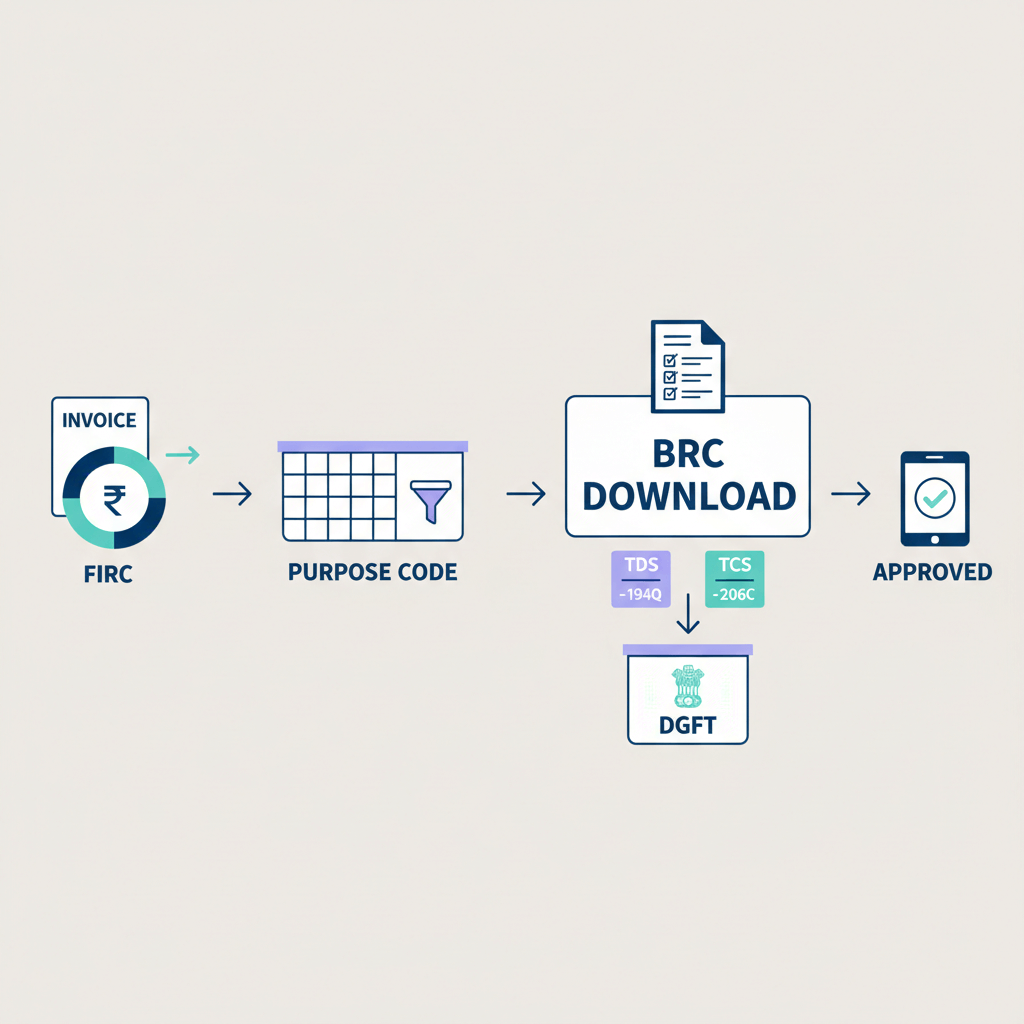
Business

BRC Download Secrets: DGFT Guide for Indian Freelancers

Content
share on
Contents
Share On

Key takeaways

  • eBRC is a bank issued, digitally signed proof that your foreign earnings were received and converted to INR, it lives on the DGFT portal and can be downloaded any time.
  • If you export services as a freelancer, you will usually use e-FIRA for tax and FEMA compliance, but knowing eBRC helps when incentives or specific documentation are required.
  • You need an active IEC, your DGFT login, and your bank must upload realisation data to ICEGATE before your eBRC shows up.
  • Search your eBRC by shipping bill, dates, or bank, then download and verify amounts, currency, exchange rate, and client details.
  • If your eBRC is missing or wrong, coordinate with your bank’s forex or trade desk to upload or correct data, then recheck DGFT in 24 to 48 hours.
  • Automated platforms like Karbon Business generate e-FIRA within 24 hours, which simplifies compliance for most freelancers.

What is a Bank Realisation Certificate and why freelancers should care

A Bank Realisation Certificate confirms foreign money landed in your Indian account and was converted to rupees. It includes the currency received, INR credited, exchange rate, and realisation date. For freelancers, it supports tax filings, satisfies FEMA rules, and, when applicable, enables export linked benefits.

Today, you mostly deal with the digital version, the eBRC. It is issued by your bank and made available via the DGFT portal. Keep it handy for ITR documentation, loan applications, and audits.

Bottom line: your skills earn the money, the certificate proves it was received through legal channels.

Pro tip: If your bank or CA asks for “FIRC” or “FIRA,” they mean the same thing in practice for services, now commonly called e-FIRA.

eBRC in plain English

The eBRC replaced paper BRCs, eliminating branch visits, stamps, and delays. Banks upload realisation data to ICEGATE, DGFT displays it, and you download a digitally signed PDF. You can retrieve historical certificates anytime, which is a lifesaver during audits.

Digital speed is great, but the system is only as fast as your bank’s upload. If the upload is late or incorrect, the DGFT record will be late or incorrect too.

Who needs to download BRC from DGFT

Goods exporters must download eBRC to close shipping bills and claim incentives. Service exporters, including most freelancers, primarily rely on e-FIRA for FEMA and tax compliance. You may still need eBRC if you hold an IEC and are claiming a specific export benefit, or if a client or partner requires it.

Using a platform that automates documentation helps. Example: Karbon Business auto generates e-FIRA within 24 hours of settlement, which covers routine freelancer needs without chasing bank branches.

Prerequisites and documents you should line up

  • Active IEC linked to your PAN.
  • DGFT portal login credentials.
  • Your bank must upload realisation data to ICEGATE.
  • A reference like shipping bill number for goods, or the bank’s reference for service exports.
  • Optional digital signature if you are filing incentive applications.

If you do not have an IEC yet, apply on the DGFT portal at dgft.gov.in. Keep PAN, Aadhaar, a cancelled cheque, and a photo ready.

Step by step: download eBRC from the DGFT portal

1) Visit the portal and sign in

Go to dgft.gov.in, choose the exporter or IEC holder login, enter your IEC as username and your password, complete the CAPTCHA, and land on your dashboard.

2) Open the eBRC section

Navigate to Services or eBRC or Export Realisation, then click the eBRC option. You will reach the search screen.

3) Search smart

  • By shipping bill number, fastest for goods exporters.
  • By SB date range or BRC date range, useful for batch downloads.
  • By bank name plus date range, handy when you do not recall the exact bill number.

4) Download and verify

Open the matching record, click View or Download to get the PDF. Verify client name, currency and amount, INR equivalent, exchange rate, realisation date, and your IEC. Save with a clear filename, for example, eBRC_ClientName_Invoice123_Mar2026.pdf.

Checklist: Match eBRC amounts with your invoice and bank statement before filing taxes or claiming any benefit.

Common issues and quick fixes

eBRC not visible even after payment

Likely cause, your bank has not uploaded to ICEGATE yet. Call your bank’s forex or trade finance desk, share the transaction reference, credit date, and your IEC, and request an expedited upload. Allow 24 to 48 hours for DGFT sync. If still missing, email bank support and DGFT helpdesk with evidence.

Wrong data on the certificate

Provide your bank with proof, invoice, SWIFT or payment advice, and bank statement. Ask for a correction upload to ICEGATE. Follow up weekly until you see the updated eBRC on DGFT.

Login problems at DGFT

Use “Forgot Password,” ensure your IEC is active, and try Chrome or Firefox if errors persist. Clear cache and cookies when the portal misbehaves.

No shipping bill for service exports

Freelancers often rely on e-FIRA instead of eBRC. If a BRC is specifically required, speak to your bank on their reporting method for service exports, they may use an invoice or internal reference in place of a shipping bill.

Where eBRC and e-FIRA fit into tax and FEMA compliance

For ITR, eBRC or e-FIRA proves the funds came from overseas and arrived via authorised channels. For FEMA, the bank’s reporting to RBI plus your certificates close the compliance loop. Maintain year wise folders and a spreadsheet that maps each payment to its certificate number to be audit ready.

If you prefer automation, platforms designed for freelancers can reduce paperwork. Example, Karbon Business auto generates e-FIRA within 24 hours, so your documentation stays in sync with payments without manual follow up.

Alternatives that streamline cross border documentation

  • Karbon Business, local USD, GBP, EUR, CAD accounts, INR settlement within 24 to 48 hours, automatic e-FIRA within 24 hours, flat 1 percent platform fee, zero FX markup.
  • Wise Business, multi currency accounts with transparent pricing.
  • Payoneer, integrated with global marketplaces, useful statements, you still need FIRA when funds hit your Indian bank.
  • PayPal, widespread acceptance for small tickets, expect higher fees and extra steps for documentation.
  • Razorpay X International, India focused tooling for inward remittances and compliance.

Choose the option that balances cost, speed, and how much manual compliance work you want to handle.

Practical habits that save time

  • Keep a master log, track each foreign payment, invoice number, currency, INR, bank reference, and certificate status.
  • Download immediately, do not wait until tax time to retrieve eBRC or e-FIRA.
  • Reconcile monthly, cross check the log with bank statements and your certificate folder.
  • Know your bank contacts, have the forex or trade email handy for quick escalations.
  • Validate platform documents, confirm your CA accepts your provider’s e-FIRA, for example from Karbon Business.
  • Ask a CA early, for high value or complex cases, get expert guidance before year end.

When your bank delays certificates, escalate clearly

  1. Branch first, share invoice, SWIFT details, credit date, IEC, and set a 3 to 5 working day deadline.
  2. Regional trade finance, email a concise case summary with attachments and CC the branch manager.
  3. RBI Ombudsman, file a complaint on RBI’s CMS portal if you see no action within a reasonable period.
  4. Manual stopgap, request a signed, stamped certificate on bank letterhead while waiting for the eBRC.
  5. Switch if needed, consider a platform with faster documentation workflows, for example Karbon Business.

Tech is shrinking the compliance grind

Automation links payments, regulatory uploads, and downloadable records in one flow. You get faster settlements, transparent fees, and certificates that are generated without back and forth. Reduced manual data entry means fewer errors and fewer mismatches in DGFT.

Freelancers who adopt these tools spend more time on billable work and less on chasing paperwork. That is a competitive advantage.

Final take

Downloading eBRC from DGFT is straightforward once your IEC is active and your bank uploads realisations. Build a system, keep records tidy, and automate wherever possible. If you mostly export services, e-FIRA will cover you for tax and FEMA, and platforms like Karbon Business can make that effortless.

Your craft brings in revenue, clean documentation keeps the business resilient.

FAQ

Do freelancers actually need a BRC or will e-FIRA be enough for ITR and FEMA compliance?

Most Indian freelancers exporting services can rely on e-FIRA issued by their bank or payment provider for ITR support and FEMA compliance. BRC is essential for goods exports and for specific incentive claims. If you do not need to close shipping bills or claim export benefits, your e-FIRA usually suffices. For example, users of Karbon Business get automatic e-FIRA within 24 hours of settlement, which most CAs accept for tax records.

How many days after receiving payment does eBRC show up on DGFT for a small exporter?

Typically three to seven working days from the credit date, assuming your bank uploads realisation data to ICEGATE promptly. Some banks finish within 24 to 48 hours, while others take longer. If nothing appears after a week, ask the bank’s forex desk to confirm the upload and recheck DGFT after 24 hours.

I am a service freelancer without a shipping bill, how do I download eBRC from DGFT?

Pure service exports usually use e-FIRA rather than eBRC. If a BRC is specifically required, ask your bank how they report service realisations, they may use an invoice number or internal reference in place of a shipping bill. Get that reference from the bank, then search the DGFT eBRC section by dates and bank, or by the provided reference.

IEC is mandatory for freelancing income from abroad or only for eBRC downloads?

You can receive foreign payments without an IEC, and your bank can issue e-FIRA for compliance. IEC becomes necessary when you want to access DGFT services such as eBRC downloads or apply for export schemes. If you plan to claim incentives or may need eBRC later, obtain an IEC early to avoid delays.

DGFT eBRC not showing even after a week, what exactly should I tell my bank?

Share the transaction reference, credit date, foreign currency amount, your IEC, and ask them to confirm, not just assume, that they have uploaded the realisation to ICEGATE against your IEC. Request an email confirmation and a timeline. If they confirm upload, wait 24 to 48 hours, then recheck DGFT. If still missing, escalate to the regional trade finance team and, if required, to the RBI Ombudsman via CMS.

Can I use statements from PayPal, Wise, or Payoneer instead of e-FIRA or eBRC for filing taxes?

Marketplace or wallet statements are useful, but Indian tax authorities and CAs typically ask for e-FIRA or bank issued FIRC to prove foreign inward remittance. When funds land in your Indian account, ensure your bank issues e-FIRA. Platforms such as Karbon Business simplify this by generating e-FIRA automatically after settlement, which keeps your tax file complete.

What if the client name or currency is wrong on my eBRC, will income tax accept it?

Incorrect details can cause issues during audits. Ask your bank to upload a corrected entry to ICEGATE with proper client name, currency code, and amounts. Keep evidence ready, invoice, SWIFT message, bank statement. After correction, download the updated eBRC and attach it to your records to avoid queries later.

Is there any fee to download eBRC from DGFT or to get e-FIRA from my bank?

DGFT does not charge for eBRC downloads. Many banks issue e-FIRA without fees, though some may levy nominal charges for manual or special requests. If costs and delays are frequent, consider a platform that bundles compliant documentation, for example Karbon Business offers automatic e-FIRA with transparent pricing.

For GST registered freelancers under LUT, do I need BRC to support zero rated supply claims?

For services, CAs generally rely on e-FIRA plus invoices and agreements to substantiate export of services under LUT. BRC is not always mandatory, but if a department or scheme requests it, coordinate with your bank for an eBRC reference. Maintain a clean audit trail of invoices, e-FIRA, and reconciliations month by month.

How do I keep track of dozens of payments and certificates across clients and currencies?

Maintain a master spreadsheet with invoice number, currency, amount, INR credited, bank reference, and eBRC or e-FIRA status. Reconcile monthly against bank statements and your certificate folder. You can reduce manual effort by using a provider like Karbon Business that auto generates e-FIRA and keeps documents downloadable on demand.

Will using a USD account from a platform delay my documentation or cause FEMA issues?

It should not, provided the platform routes funds through authorised channels and generates compliant inward remittance documents when converting to INR. Confirm that e-FIRA is available for each settlement into your Indian account. Karbon Business, for instance, settles to INR within 24 to 48 hours and issues e-FIRA within 24 hours, keeping FEMA documentation tight.

If my bank keeps delaying uploads, can a manually stamped certificate work for deadlines?

Yes, request a signed, stamped interim certificate on bank letterhead with all details, then continue pursuing the official eBRC upload. Use the manual certificate for immediate tax or audit needs, and replace it with the DGFT eBRC once the bank corrects or completes the upload.

Key takeaways

  • eBRC is a bank issued, digitally signed proof that your foreign earnings were received and converted to INR, it lives on the DGFT portal and can be downloaded any time.
  • If you export services as a freelancer, you will usually use e-FIRA for tax and FEMA compliance, but knowing eBRC helps when incentives or specific documentation are required.
  • You need an active IEC, your DGFT login, and your bank must upload realisation data to ICEGATE before your eBRC shows up.
  • Search your eBRC by shipping bill, dates, or bank, then download and verify amounts, currency, exchange rate, and client details.
  • If your eBRC is missing or wrong, coordinate with your bank’s forex or trade desk to upload or correct data, then recheck DGFT in 24 to 48 hours.
  • Automated platforms like Karbon Business generate e-FIRA within 24 hours, which simplifies compliance for most freelancers.

What is a Bank Realisation Certificate and why freelancers should care

A Bank Realisation Certificate confirms foreign money landed in your Indian account and was converted to rupees. It includes the currency received, INR credited, exchange rate, and realisation date. For freelancers, it supports tax filings, satisfies FEMA rules, and, when applicable, enables export linked benefits.

Today, you mostly deal with the digital version, the eBRC. It is issued by your bank and made available via the DGFT portal. Keep it handy for ITR documentation, loan applications, and audits.

Bottom line: your skills earn the money, the certificate proves it was received through legal channels.

Pro tip: If your bank or CA asks for “FIRC” or “FIRA,” they mean the same thing in practice for services, now commonly called e-FIRA.

eBRC in plain English

The eBRC replaced paper BRCs, eliminating branch visits, stamps, and delays. Banks upload realisation data to ICEGATE, DGFT displays it, and you download a digitally signed PDF. You can retrieve historical certificates anytime, which is a lifesaver during audits.

Digital speed is great, but the system is only as fast as your bank’s upload. If the upload is late or incorrect, the DGFT record will be late or incorrect too.

Who needs to download BRC from DGFT

Goods exporters must download eBRC to close shipping bills and claim incentives. Service exporters, including most freelancers, primarily rely on e-FIRA for FEMA and tax compliance. You may still need eBRC if you hold an IEC and are claiming a specific export benefit, or if a client or partner requires it.

Using a platform that automates documentation helps. Example: Karbon Business auto generates e-FIRA within 24 hours of settlement, which covers routine freelancer needs without chasing bank branches.

Prerequisites and documents you should line up

  • Active IEC linked to your PAN.
  • DGFT portal login credentials.
  • Your bank must upload realisation data to ICEGATE.
  • A reference like shipping bill number for goods, or the bank’s reference for service exports.
  • Optional digital signature if you are filing incentive applications.

If you do not have an IEC yet, apply on the DGFT portal at dgft.gov.in. Keep PAN, Aadhaar, a cancelled cheque, and a photo ready.

Step by step: download eBRC from the DGFT portal

1) Visit the portal and sign in

Go to dgft.gov.in, choose the exporter or IEC holder login, enter your IEC as username and your password, complete the CAPTCHA, and land on your dashboard.

2) Open the eBRC section

Navigate to Services or eBRC or Export Realisation, then click the eBRC option. You will reach the search screen.

3) Search smart

  • By shipping bill number, fastest for goods exporters.
  • By SB date range or BRC date range, useful for batch downloads.
  • By bank name plus date range, handy when you do not recall the exact bill number.

4) Download and verify

Open the matching record, click View or Download to get the PDF. Verify client name, currency and amount, INR equivalent, exchange rate, realisation date, and your IEC. Save with a clear filename, for example, eBRC_ClientName_Invoice123_Mar2026.pdf.

Checklist: Match eBRC amounts with your invoice and bank statement before filing taxes or claiming any benefit.

Common issues and quick fixes

eBRC not visible even after payment

Likely cause, your bank has not uploaded to ICEGATE yet. Call your bank’s forex or trade finance desk, share the transaction reference, credit date, and your IEC, and request an expedited upload. Allow 24 to 48 hours for DGFT sync. If still missing, email bank support and DGFT helpdesk with evidence.

Wrong data on the certificate

Provide your bank with proof, invoice, SWIFT or payment advice, and bank statement. Ask for a correction upload to ICEGATE. Follow up weekly until you see the updated eBRC on DGFT.

Login problems at DGFT

Use “Forgot Password,” ensure your IEC is active, and try Chrome or Firefox if errors persist. Clear cache and cookies when the portal misbehaves.

No shipping bill for service exports

Freelancers often rely on e-FIRA instead of eBRC. If a BRC is specifically required, speak to your bank on their reporting method for service exports, they may use an invoice or internal reference in place of a shipping bill.

Where eBRC and e-FIRA fit into tax and FEMA compliance

For ITR, eBRC or e-FIRA proves the funds came from overseas and arrived via authorised channels. For FEMA, the bank’s reporting to RBI plus your certificates close the compliance loop. Maintain year wise folders and a spreadsheet that maps each payment to its certificate number to be audit ready.

If you prefer automation, platforms designed for freelancers can reduce paperwork. Example, Karbon Business auto generates e-FIRA within 24 hours, so your documentation stays in sync with payments without manual follow up.

Alternatives that streamline cross border documentation

  • Karbon Business, local USD, GBP, EUR, CAD accounts, INR settlement within 24 to 48 hours, automatic e-FIRA within 24 hours, flat 1 percent platform fee, zero FX markup.
  • Wise Business, multi currency accounts with transparent pricing.
  • Payoneer, integrated with global marketplaces, useful statements, you still need FIRA when funds hit your Indian bank.
  • PayPal, widespread acceptance for small tickets, expect higher fees and extra steps for documentation.
  • Razorpay X International, India focused tooling for inward remittances and compliance.

Choose the option that balances cost, speed, and how much manual compliance work you want to handle.

Practical habits that save time

  • Keep a master log, track each foreign payment, invoice number, currency, INR, bank reference, and certificate status.
  • Download immediately, do not wait until tax time to retrieve eBRC or e-FIRA.
  • Reconcile monthly, cross check the log with bank statements and your certificate folder.
  • Know your bank contacts, have the forex or trade email handy for quick escalations.
  • Validate platform documents, confirm your CA accepts your provider’s e-FIRA, for example from Karbon Business.
  • Ask a CA early, for high value or complex cases, get expert guidance before year end.

When your bank delays certificates, escalate clearly

  1. Branch first, share invoice, SWIFT details, credit date, IEC, and set a 3 to 5 working day deadline.
  2. Regional trade finance, email a concise case summary with attachments and CC the branch manager.
  3. RBI Ombudsman, file a complaint on RBI’s CMS portal if you see no action within a reasonable period.
  4. Manual stopgap, request a signed, stamped certificate on bank letterhead while waiting for the eBRC.
  5. Switch if needed, consider a platform with faster documentation workflows, for example Karbon Business.

Tech is shrinking the compliance grind

Automation links payments, regulatory uploads, and downloadable records in one flow. You get faster settlements, transparent fees, and certificates that are generated without back and forth. Reduced manual data entry means fewer errors and fewer mismatches in DGFT.

Freelancers who adopt these tools spend more time on billable work and less on chasing paperwork. That is a competitive advantage.

Final take

Downloading eBRC from DGFT is straightforward once your IEC is active and your bank uploads realisations. Build a system, keep records tidy, and automate wherever possible. If you mostly export services, e-FIRA will cover you for tax and FEMA, and platforms like Karbon Business can make that effortless.

Your craft brings in revenue, clean documentation keeps the business resilient.

FAQ

Do freelancers actually need a BRC or will e-FIRA be enough for ITR and FEMA compliance?

Most Indian freelancers exporting services can rely on e-FIRA issued by their bank or payment provider for ITR support and FEMA compliance. BRC is essential for goods exports and for specific incentive claims. If you do not need to close shipping bills or claim export benefits, your e-FIRA usually suffices. For example, users of Karbon Business get automatic e-FIRA within 24 hours of settlement, which most CAs accept for tax records.

How many days after receiving payment does eBRC show up on DGFT for a small exporter?

Typically three to seven working days from the credit date, assuming your bank uploads realisation data to ICEGATE promptly. Some banks finish within 24 to 48 hours, while others take longer. If nothing appears after a week, ask the bank’s forex desk to confirm the upload and recheck DGFT after 24 hours.

I am a service freelancer without a shipping bill, how do I download eBRC from DGFT?

Pure service exports usually use e-FIRA rather than eBRC. If a BRC is specifically required, ask your bank how they report service realisations, they may use an invoice number or internal reference in place of a shipping bill. Get that reference from the bank, then search the DGFT eBRC section by dates and bank, or by the provided reference.

IEC is mandatory for freelancing income from abroad or only for eBRC downloads?

You can receive foreign payments without an IEC, and your bank can issue e-FIRA for compliance. IEC becomes necessary when you want to access DGFT services such as eBRC downloads or apply for export schemes. If you plan to claim incentives or may need eBRC later, obtain an IEC early to avoid delays.

DGFT eBRC not showing even after a week, what exactly should I tell my bank?

Share the transaction reference, credit date, foreign currency amount, your IEC, and ask them to confirm, not just assume, that they have uploaded the realisation to ICEGATE against your IEC. Request an email confirmation and a timeline. If they confirm upload, wait 24 to 48 hours, then recheck DGFT. If still missing, escalate to the regional trade finance team and, if required, to the RBI Ombudsman via CMS.

Can I use statements from PayPal, Wise, or Payoneer instead of e-FIRA or eBRC for filing taxes?

Marketplace or wallet statements are useful, but Indian tax authorities and CAs typically ask for e-FIRA or bank issued FIRC to prove foreign inward remittance. When funds land in your Indian account, ensure your bank issues e-FIRA. Platforms such as Karbon Business simplify this by generating e-FIRA automatically after settlement, which keeps your tax file complete.

What if the client name or currency is wrong on my eBRC, will income tax accept it?

Incorrect details can cause issues during audits. Ask your bank to upload a corrected entry to ICEGATE with proper client name, currency code, and amounts. Keep evidence ready, invoice, SWIFT message, bank statement. After correction, download the updated eBRC and attach it to your records to avoid queries later.

Is there any fee to download eBRC from DGFT or to get e-FIRA from my bank?

DGFT does not charge for eBRC downloads. Many banks issue e-FIRA without fees, though some may levy nominal charges for manual or special requests. If costs and delays are frequent, consider a platform that bundles compliant documentation, for example Karbon Business offers automatic e-FIRA with transparent pricing.

For GST registered freelancers under LUT, do I need BRC to support zero rated supply claims?

For services, CAs generally rely on e-FIRA plus invoices and agreements to substantiate export of services under LUT. BRC is not always mandatory, but if a department or scheme requests it, coordinate with your bank for an eBRC reference. Maintain a clean audit trail of invoices, e-FIRA, and reconciliations month by month.

How do I keep track of dozens of payments and certificates across clients and currencies?

Maintain a master spreadsheet with invoice number, currency, amount, INR credited, bank reference, and eBRC or e-FIRA status. Reconcile monthly against bank statements and your certificate folder. You can reduce manual effort by using a provider like Karbon Business that auto generates e-FIRA and keeps documents downloadable on demand.

Will using a USD account from a platform delay my documentation or cause FEMA issues?

It should not, provided the platform routes funds through authorised channels and generates compliant inward remittance documents when converting to INR. Confirm that e-FIRA is available for each settlement into your Indian account. Karbon Business, for instance, settles to INR within 24 to 48 hours and issues e-FIRA within 24 hours, keeping FEMA documentation tight.

If my bank keeps delaying uploads, can a manually stamped certificate work for deadlines?

Yes, request a signed, stamped interim certificate on bank letterhead with all details, then continue pursuing the official eBRC upload. Use the manual certificate for immediate tax or audit needs, and replace it with the DGFT eBRC once the bank corrects or completes the upload.

The views expressed in the blogs on this page are solely the opinions of the authors and do not constitute expert advice. While we strive to provide accurate and up-to-date information, we make no representations or warranties of any kind, express or implied, about the completeness, accuracy, reliability, suitability or availability with respect to the website or the information, products, services, or related graphics contained on the website for any purpose. Any reliance you place on such information is therefore strictly at your own risk. We disclaim any liability for any loss or damage including without limitation, indirect or consequential loss or damage, or any loss or damage whatsoever arising from loss of data or profits arising out of, or in connection with, the use of this website.

Find out how we can help you today!

Speak to our foreign payment specialist
Whatsapp-color Created with Sketch.
Whatsapp:
+91 74117 02726
Email:
sales@karboncard.com
Address:
Ground Floor, Karbon Business, 1st Stage Rd, Binnamangala, Hoysala Nagar, Indiranagar, Bengaluru, Karnataka 560038

Find out how we can help you today!

Speak to our foreign payment specialist
Whatsapp-color Created with Sketch.
Whatsapp:
+91 74117 02726
Email:
sales@karboncard.com
Address:
Ground Floor, Karbon Business, 1st Stage Rd, Binnamangala, Hoysala Nagar, Indiranagar, Bengaluru, Karnataka 560038

Latest from our blogs

Latest from our blogs

View All
× Save 50% - Start Now