



Key takeaways
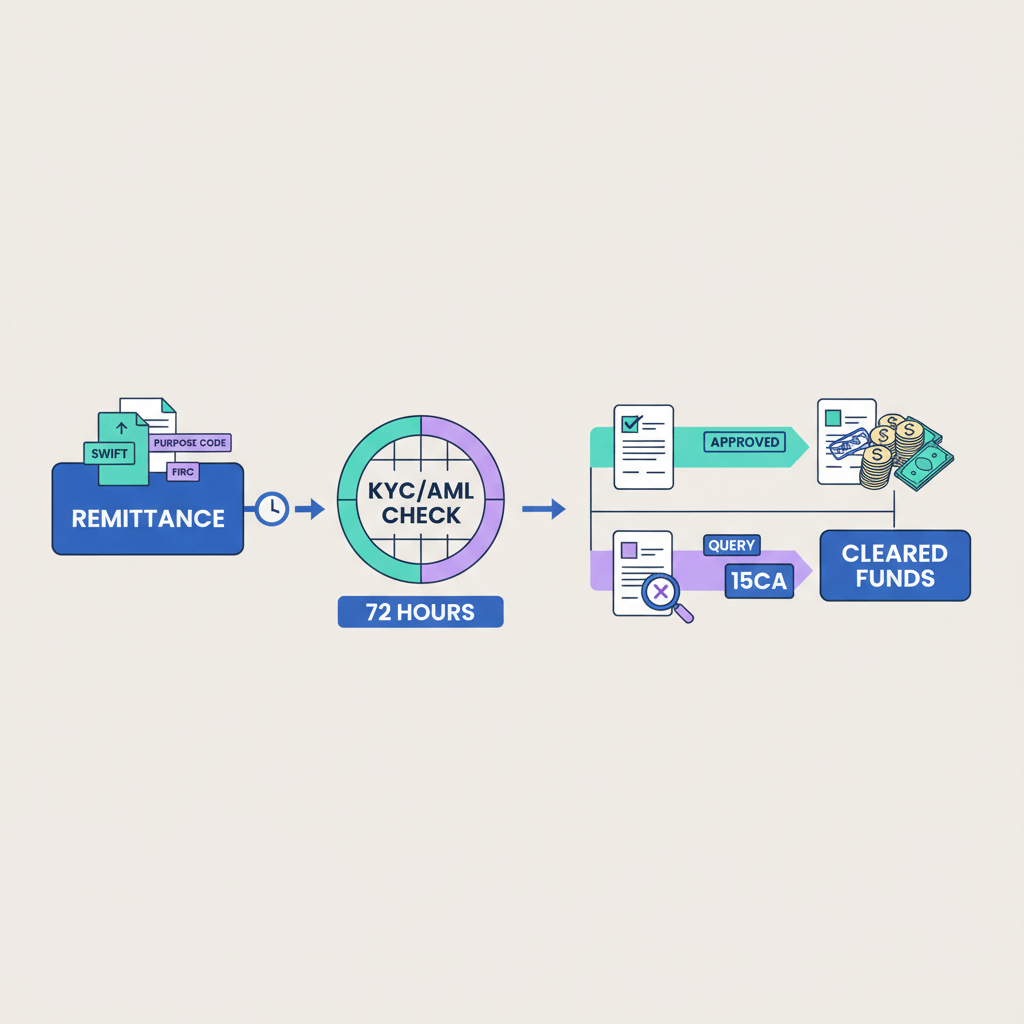
- KYC and AML checks on inward remittances are routine under RBI and FEMA, respond with organized proof to get funds cleared in 24 to 72 hours.
- Always keep a ready invoice bundle, contract or SOW, delivery proof, remittance advice, PAN and masked Aadhaar, plus links to your professional profiles.
- Answer the bank’s “source of funds” question clearly, describe the client’s business, payment route, amount breakdown, and purpose code.
- Use the provided email and WhatsApp templates to reply fast, ask for expected turnaround time, and offer client contact if needed.
- Prevent future queries by standardizing invoices with purpose codes, maintaining client folders, and requesting invoice numbers in payment memos.
- Track purpose codes like P0802 for software services, and file e-FIRAs for tax records and audits.
- Platforms like Karbon Business can streamline compliance, speed up e-FIRA, and improve FX outcomes.
KYC/AML queries on inward remittance, simplified
Your phone pings, the money is not in yet, the bank wants documents. Take a breath. These checks are standard, they protect the financial system, and with the right response your funds are usually released quickly.
Goal: prove who you are, what you delivered, who paid you, and why the amount matches your invoice, then your bank clears the remittance.
What are KYC and AML checks on inward remittance?
When foreign money enters India, banks verify identity and legitimacy. KYC confirms you and your account details, PAN, address, and business registration. For a quick primer on documentation for inward remittance, see this guide. AML checks assess whether funds are lawful and the transaction makes business sense, see the RBI’s explanation in this notification.
Under RBI and FEMA, banks that are Authorized Dealers must tag every inward remittance with a purpose code. Freelancers should know common codes, for example P0802 for software services, P0104 for design, see RBI purpose codes for freelancers, and understand the compliance rationale in FEMA guidelines for inward remittance.
Common AML questions you may receive
- Who are you and what services did you provide? Share your contract or SOW, and the invoice.
- Source of funds, the bank wants to know how your client earns money and why they are paying you, see typical AML flags in this AML guide.
- Relationship with the remitter, direct client, marketplace client, or referred by a partner.
- Why this specific amount, explain taxes, fees, milestones, or platform charges.
- Purpose code, country, and route, for example ACH, SEPA, FPS, or SWIFT, see this compliance guideline for inward remittance.
- Name mismatches, clarify when a subsidiary or individual sender differs from the invoice entity.
- Marketplace payouts, provide job details, workroom screenshots, contract terms, and official payout pages.
Documents to keep ready as invoice proof
Preparation is half the battle. FEMA expects documentation for business remittances, see this FEMA checklist. Keep these as PDFs:
- Signed contract or SOW, include scope, dates, deliverables, payment terms.
- Detailed invoice, legal names and addresses, your PAN, clear service description, dates or billing period, hourly rate or fixed fee, total in foreign currency, bank or payout details, purpose code, unique invoice number, see examples in this inward remittance guide.
- Proof of delivery, Git commits, design files, timesheets, emails, meeting notes, live links, or client confirmations.
- Payment trail, purchase order, remittance advice or client bank screenshot, or marketplace payout page.
- Your KYC, PAN, masked Aadhaar, business registration if applicable, see policy standards in this KYC policy.
- Online validation links, LinkedIn, portfolio, Upwork, or relevant social profiles.
- e-FIRA for past payments, request and file them, see a quick explainer in this compliance guide.
Step by step, how to respond when the bank asks source of funds
- Read the query carefully, list every item requested, see FEMA guidance.
- Match the payment to your docs, confirm invoice number, amount, dates, and client name, reference tips in this compliance guide.
- Bundle proof into a PDF, contract, invoice, delivery proof, remittance note, see examples in this guide.
- Draft a concise response, answer in the bank’s order, use bullets or numbers.
- Attach clearly named files, for example Invoice_123_ClientX.pdf, Contract_ClientX_Jan2025.pdf.
- Offer client contact if needed, with permission, see routing context in this bank resource.
- Ask for turnaround time, and confirm if anything else is pending, see FEMA references.
Most complete responses are cleared in 24 to 72 hours.
Copy paste reply formats you can use today
Email or portal subject
Response to KYC, AML Queries on Inward Remittance, [Your Full Name], Invoice #[123], USD [Amount]
Email body
Dear [Bank Officer Name or Compliance Team],
Thank you for your message regarding the recent inward remittance. Please find my responses and documents below.
1. Transaction summary
[Client Company Name], a [Country] based [industry], paid USD [Amount] on [Date] via [SWIFT or ACH or SEPA or FPS] for [service], purpose code P0802.
2. Source of funds
[Client Company Name] is a [jurisdiction, entity type] operating in [industry]. Funds originate from their legitimate business operations. Attached company profile and remittance advice for verification.
3. Services rendered
[Brief scope], delivered between [start] and [end]. Delivery confirmed on [date] via [Git commits, live link, acceptance email].
4. Payment details
Payment routed via [route] from [country], represents [full payment or milestone] for Invoice #[123] dated [date].
Attachments
Contract_SOW_ClientX.pdf, Invoice_#123.pdf, Delivery_Proof.pdf, Remittance_Advice.pdf, My_PAN_KYC.pdf, LinkedIn link inside body.
I can provide my client’s contact, with permission, if needed. Please advise the expected turnaround time for releasing funds.
Regards,
[Your Full Name]
[Phone]
[PAN]
Short WhatsApp format
Hi [Officer Name], responding to AML query for USD [Amount] from [Client] on [Date].
Services, [brief scope]
Source, [client business type]
Purpose code, P0802
Attached, Invoice #123, Contract, PAN.
Anything else needed, and expected TAT for clearance?
Thanks, [Your Name]
Real world scenarios, how to answer
- First payment from a new client, highlight contract or SOW, and link your profiles. Example, “We connected via LinkedIn, see attached contract and portfolio.” See pointers in this guide.
- Partial or milestone payment, state the milestone and due balance, attach contract milestones.
- Individual paying on behalf of a company, attach PO, explain authorization by finance team, and include the authorizing email.
- Marketplace payout, send job link or screenshots, contract, and payout confirmation, as shown in this compliance guide.
- Refund or chargeback, re-sent, clarify it is a re-credit, reference the original date and invoice, and confirm no net gain.
- Sudden high value payment, give context, pilot to scale up, attach prior invoices and new SOW.
Common mistakes that trigger delays
- Vague invoices, missing scope, dates, or purpose code, see the compliance checklist in this guide.
- Name mismatches, sender differs from invoice entity, proactively explain, see a primer in this article.
- Third party payments, without proof of relationship or authorization, read FEMA do’s and don’ts.
- Referencing cryptocurrency or cash, avoid, these are not acceptable for inward remittances, see cautions in this compliance note.
- Inconsistent amounts, explain fees or deductions, attach the breakdown.
- Unorganized replies, long essays or random zip files slow down compliance review, stick to numbered bullets and named PDFs, see FEMA guidance.
Prevent future KYC and AML queries
- Standardize invoices, always include purpose code and clear descriptions, see this invoice checklist.
- Maintain client folders, contract, invoices, delivery proof, remittance advice, and e-FIRAs.
- Request invoice number in payment memo, ask clients to add the invoice reference, see bank transfer tips in this resource.
- Prefer direct payments, avoid unrelated third parties unless documented, see FEMA guidelines.
- Keep a source of funds paragraph template, quickly customize for each client and query.
Mini templates for faster responses
Source of funds, company client
“[Client Company Name], a [Country] based [industry] firm, website [link], pays from revenue generated by [their operations] for my [service] as per the attached contract dated [date].”
Source of funds, individual client
“[Client Name], a [Country] based [profession], paid from professional earnings for my freelance [service]. Attached email agreement, delivery confirmation, and their LinkedIn profile for verification.”
Source of funds, marketplace
“This is an Upwork payout for Job #[ID]. Funds were held in escrow and released upon milestone completion. Attached workroom screenshots and official payout confirmation.”
Invoice line items
Software development, “Custom web app development, 40 hours at USD 50 per hour, total USD 2000, Purpose Code P0802, delivered via GitHub on [date].”
Design, “Brand identity package including logo, style guide, and marketing materials, fixed fee USD 1500, Purpose Code P0104, delivered [date].”
File naming and cover sheet
1. Invoice_#123_ClientX_Jan2025.pdf
2. Contract_SOW_ClientX_Dec2024.pdf
3. Delivery_Proof_Screenshots.pdf
4. Remittance_Advice_Transfer.pdf
5. My_PAN_Masked_Aadhaar.pdf
Compliance notes in plain English
Authorized Dealer banks must collect purpose codes and proof for each inward remittance, per RBI and FEMA. Once settled, your bank issues an e-FIRA that you should store for 5 to 8 years, see this RBI note. When sharing Aadhaar, mask it and keep only the last four digits visible, see control practices in this KYC policy.
Compliance is not a barrier, it is a framework that protects you and your clients, and it helps your bank release funds confidently.
How Karbon Business fits in
Karbon Business was built for Indian freelancers. The platform collects payments via local account details in USD, GBP, EUR, or CAD, your client pays through ACH, SEPA, or FPS, you claim the payment, and INR reaches your bank in 24 to 48 hours. e-FIRAs are generated fast, usually within 24 hours of settlement, and support helps you assemble AML friendly bundles. You also get mid market FX rates with zero markup, which means more in your pocket.
If you are tired of chasing banks for e-FIRAs or repeating the same details, platforms like Karbon Business, Wise Business, Payoneer, and RazorpayX International provide workflows aligned with how Indian freelancers work today.
Quick reference checklist
Keep this short list handy any time a query arrives:
- Invoice with purpose code, unique number, dates, scope.
- Contract or SOW, signed or accepted via email.
- Proof of delivery, files, links, emails, or acceptance note.
- PAN and masked Aadhaar, business registration if applicable.
- Remittance advice or client bank screenshot.
- Client company profile or website link.
- Your LinkedIn or portfolio link.
Wrapping up
Responding to KYC or AML queries is part of global freelancing. The fastest path to cleared funds is simple, prepare a solid invoice bundle, read the bank’s ask carefully, reply with concise bullets, attach clearly named PDFs, and ask for the turnaround time. With each successful response you reduce future friction, you build a strong compliance track record, and you keep your cash flow steady.
Disclaimer, educational only, not legal or financial advice. Policies vary by bank or platform, always follow your institution’s instructions, and consult a qualified expert for complex cases, see this FEMA explainer.
FAQ
How do I reply to a bank asking for source of funds on my freelance payment?
Use a structured email. Start with a transaction summary, add a clear source of funds paragraph describing your client’s business and what generates their revenue, explain the service you delivered, mention the purpose code, and attach contract, invoice, delivery proof, and remittance advice. If you use Karbon Business, attach the e-FIRA once available for extra clarity.
What documents should I attach when HDFC or ICICI asks for KYC or AML proof on inward remittance?
Attach your signed contract or SOW, detailed invoice with purpose code, proof of delivery like files or acceptance emails, PAN and masked Aadhaar, and the client’s remittance advice. A concise cover note improves turnaround time. Users of Karbon Business can also include the platform’s payment confirmation and e-FIRA.
What is a purpose code for freelancers, and which one should I use for software or design services?
Purpose codes classify the reason money enters India. Common freelancer codes include P0802 for software services and P0104 for design. Confirm with your bank, keep the same code on your invoice and in your email reply, and file the e-FIRA for taxes. Platforms like Karbon Business help tag the right code automatically.
How do I explain a name mismatch, like money coming from a subsidiary or a finance manager instead of the invoiced company?
Address it upfront. State that the sender is a subsidiary or an authorized individual paying on behalf of the client. Attach the purchase order or an authorization email from the client’s finance team. Add the relationship in one sentence, and include the contract showing the primary client. This is a common scenario, and banks clear it when documentation is clear.
What should I do if the received amount is less than the invoice due to fees or taxes?
Provide a short breakdown, for example platform fee, bank charges, or withholding. Attach the contract clause or payout statement showing the deduction. Reconcile the net amount to the invoice total in your email. If using Karbon Business, add the payout statement from your dashboard that shows the fee split.
How do I handle marketplace payouts like Upwork or Fiverr when the bank asks for proof?
Share workroom screenshots, the job contract or offer, payout confirmation page, and your verified profile link, then connect the payout to your invoice number. Mention that funds were held in platform escrow and released on milestone completion. This satisfies most AML queries quickly.
Is an email agreement enough if my client is an individual and we did not sign a formal contract?
Yes, an email thread is acceptable if it clearly states scope, deliverables, rates, and payment terms. Attach the entire thread, include your client’s LinkedIn or website, and add delivery evidence. Many freelancers on Karbon Business use email agreements plus a detailed invoice to pass compliance reviews.
How long do AML reviews usually take, and can I speed them up?
Most complete responses clear in 24 to 72 hours. Speed up by answering the bank’s questions in the same order they asked, using bullets, naming files clearly, and proactively explaining any mismatches. Submitting through a platform like Karbon Business can help by bundling documents neatly and generating e-FIRA fast.
What is an e-FIRA, and why do freelancers need it for international payments?
Electronic Foreign Inward Remittance Advice, the e-FIRA, is the bank’s official receipt for foreign funds. It is needed for compliance and tax filing, and you should store it for 5 to 8 years. Solutions like Karbon Business automate e-FIRA generation after settlement, which saves follow ups with banks.
How do I prevent repeated KYC or AML queries from my bank on each payment?
Standardize your invoices with purpose codes, keep client folders with contract and delivery proof, ask clients to include the invoice number in the transfer memo, and reply with a consistent template. Over time, your compliance track record improves. Many freelancers also route payments through Karbon Business to reduce friction.
My first international payment is flagged, how do I convince the bank quickly?
Send a crisp package on day one, contract or email agreement, purpose coded invoice, delivery sample or acceptance email, client website link, and remittance advice. Add a short paragraph on how you met the client and the business rationale for the project. If you are using Karbon Business, include your dashboard confirmation to show the verified payment flow.
Will mentioning crypto or cash transfers affect my inward remittance review?
Yes, avoid mentioning crypto or cash, they complicate compliance and can delay or block payments. Keep your explanation focused on legitimate business payments via banking rails like ACH, SEPA, FPS, or SWIFT, with clear invoices and contracts.
