

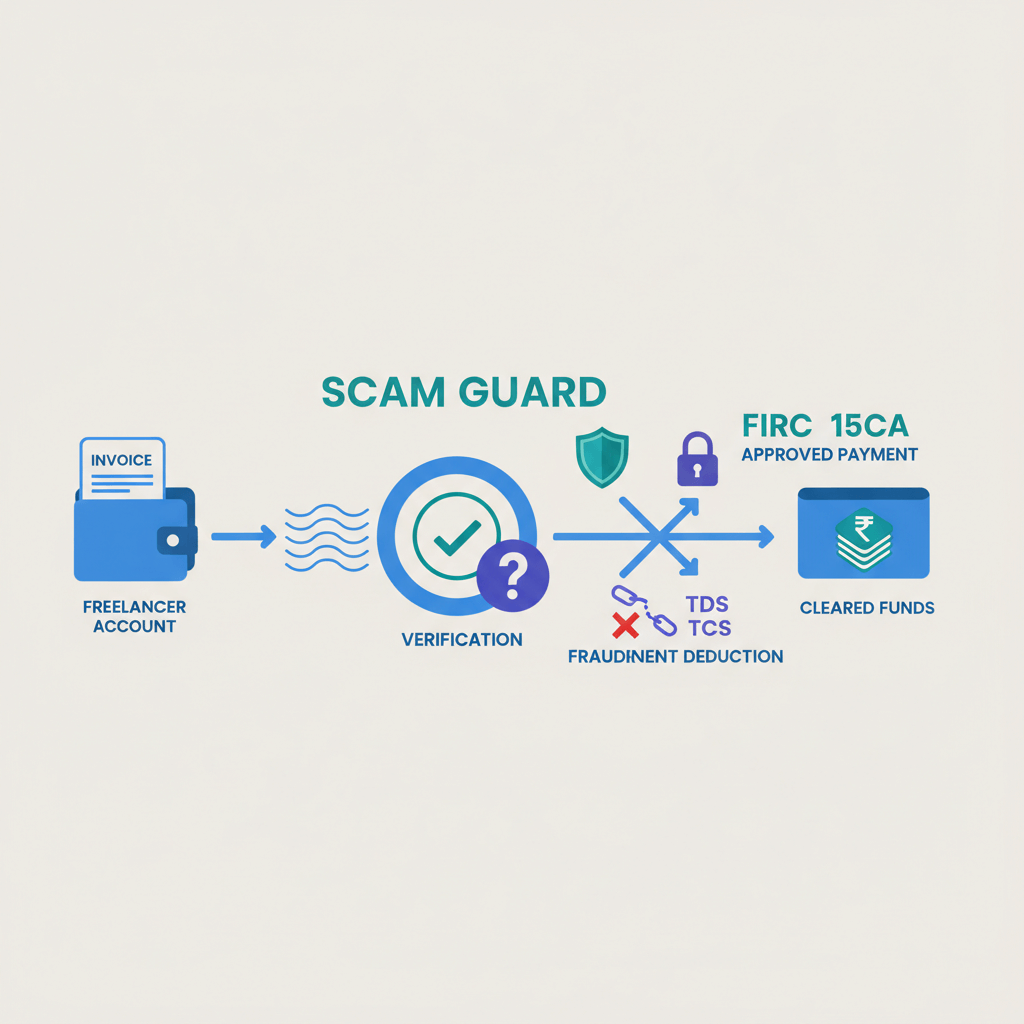


Key takeaways
- Freelancer scams targeting Indian professionals are rising, projections point to 71,500 online fraud cases in 2025, cross-border gigs face higher risk due to chargebacks, FX confusion, and compliance gaps.
- Watch for classic traps like overpayment and refund requests, off-platform card pushes, fake purchase orders and domain spoofing, phishing and KYC theft, cryptocurrency or gift card payments, compliance fee deposits, scope creep through trial work, third-party invoicing, foreign exchange manipulation, and instant hiring without verification.
- Major red flags include refusal of verifiable payment methods, no contract or milestones, urgent secrecy, mismatched email domains and LinkedIn profiles, requests for OTPs or document selfies, split payments across entities, invoicing a different company, a push to Telegram or WhatsApp, attempts to bypass invoicing or e-FIRA, and explicit card payment insistence.
- Prevent scams by verifying identity with calls and references, using escrow or milestone payments, preferring ACH, SEPA, FPS, or SWIFT, never delivering final work before cleared funds, and choosing platforms like Karbon Business for local-currency accounts and automatic compliance.
- Establish strong contracts, watermark previews, hold source files until paid, organize compliance documents, use mid-market FX references, and respond decisively when red flags appear, report scams to cybercrime.gov.in.
- Case studies from Bengaluru, Hyderabad, and Mumbai show how vigilance, verification, and correct payment methods prevented losses and identity theft.
A wake-up call for Indian freelancers
Imagine Priya, a Mumbai-based designer, landing a $2,000 project from a supposed US startup. The client sends $3,000, then urgently asks for a $1,000 refund. Priya sends the difference, the original payment reverses through a dispute, she loses both cash and confidence. Stories like this are common as India’s freelance boom accelerates, cross-border work expands, and fraudsters exploit payment reversals, FX opacity, and compliance confusion.
The good news, you can spot the patterns and shut them down before money leaves your account.
What are freelancer scams?
Freelancer scams are deliberate deceptions designed to steal your money, your data, or your work. These are not tough negotiations, they are calculated plays that end with you unpaid even after delivery.
- Chargeback: a bank reverses a card payment if the client disputes it, sometimes months later.
- Escrow: a third-party holds funds until you deliver and the client approves.
- ACH, SEPA, FPS: local bank transfer systems in the US, EU, and UK, these carry much lower dispute risk than cards.
- SWIFT: the global wire transfer network, verifiable, but slower and fee prone.
- e-FIRA: RBI-mandated proof of foreign inward remittance, essential for taxes and GST claims.
Context: India is on track for 71,500 online fraud cases in 2025, with job scams forming a sizable chunk. Scammers are adapting AI and synthetic identities to target freelancers, especially in tech-heavy hubs.
Top freelancer scams to watch for in 2025
- Overpayment and refund: a client sends more than your invoice, then requests a quick refund of the excess, the original payment reverses, you are left exposed.
- Off-platform card payment push: a client insists on card payments to avoid platform fees, then disputes the charge after delivery.
- Fake purchase orders and domain spoofing: emails mimic big brands, domains are subtly misspelled, signatures look official, the paperwork is theater.
- Phishing and KYC theft: links request PAN copies, Aadhaar OTPs, or document selfies for verification, once they have your OTP, accounts can be compromised.
- Crypto, gift cards, or PayPal Friends and Family: irreversible, untraceable, non-compliant if something goes wrong.
- Compliance fee deposits: demands for bank verification charges or tax clearance fees before payment, real clients never ask you to pay them.
- Scope creep via trial work: a small test expands into full work delivered free, then silence.
- Third-party invoicing: you are told to bill a different entity, often a tactic to dodge AML rules.
- Foreign exchange manipulation: agents offer below-market rates, pocketing the difference.
- Instant hiring without verification: no brief, no call, no details, only urgency and secrecy.
Freelancer red flags, behaviors that signal risk
- Refusal of verifiable payment methods, a push for crypto, gift cards, or Friends and Family.
- No contract or milestone structure, vague promises, payment after delivery without specifics.
- Urgent demands paired with secrecy, no real business operates like a spy thriller.
- Email domain and LinkedIn profile mismatches, thin connections, new accounts, stock photos.
- Requests for personal documents or OTPs, nobody needs your Aadhaar OTP to hire you for design or code.
- Split payments across entities or countries, multiple invoices for one project.
- Invoicing a different entity than the hiring company, compliance alarm bells.
- Instant shift to Telegram or WhatsApp, no paper trail, no accountability.
- Attempts to bypass invoicing, e-FIRA, or taxes, suggestions to skip paperwork.
- Explicit card payment insistence and talk about disputes, easier for them, devastating for you.
How to avoid freelancer scams, your prevention playbook
Due diligence before you say yes
- Verify the company site, confirm the email domain matches, search independent sources.
- Check LinkedIn, look for established profiles, real networks, consistent history.
- Mandate a video call to discuss scope, budget, timelines, scammers avoid it.
- Ask for references from previous freelancers, real clients provide them.
Payment protections that actually work
- Use escrow or milestone payments, 30 to 50 percent upfront, remainder on delivery and approval.
- Prefer ACH, SEPA, FPS, or SWIFT, avoid crypto, gift cards, and Friends and Family.
- Never deliver final work before cleared funds, invoice first, deliver after confirmation.
- Consider platforms built for Indian freelancers, for example, Karbon Business offers USD, GBP, EUR, and CAD accounts with local transfers, ACH, SEPA, and FPS, automatic compliance, and reduced chargeback risk.
Contracts and scope control
Draft a detailed Statement of Work, include milestones, revision limits, delivery dates, and IP terms. Specify that rights transfer only upon full payment. Add a fraud clause, payments must come from the named client entity, no third-party billing accepted, any chargeback voids the agreement and you retain all delivered work.
Delivery hygiene
- Watermark previews, send low-resolution mockups until payment clears.
- Release source files only after final confirmation, use private repos for code.
- Use secure, expiring links, never grant admin access until funds settle.
Compliance and documentation
- Track every e-FIRA, organize by month and year.
- Maintain GST invoices, proper records protect you during audits.
- Store contracts, emails, and payment confirmations, documentation is defense.
- Use mid-market FX references, consider checking xe.com.
Response protocol when red flags appear
Pause immediately, then insist on verified methods and written contracts. Refuse OTPs or document selfies, offer secure alternatives, and walk away if pressure continues. Document suspicious exchanges and report them to cybercrime.gov.in.
India-specific case studies
- Ankita, developer, Bengaluru: spotted an overpayment and refund pattern, insisted on canceling the card payment and using ACH to a USD business account, the scammer vanished, loss averted.
- Rahul, designer, Hyderabad: noticed a misspelled email domain, demanded a video call and proper PO, the agency disappeared, identity theft avoided.
- Priya, writer, Mumbai: was told to invoice a Dubai shell for a US client, flagged AML risk, insisted on invoicing the hiring entity with proper e-FIRA, the client complied, project completed smoothly.
Practical tools and templates
Client vetting checklist
- ☐ Website active and professional, domain matches email?
- ☐ LinkedIn looks established, solid connections, pre-2023 history?
- ☐ Verifiable references from previous freelancers?
- ☐ Video call completed, scope, budget, timelines clarified?
- ☐ Payment method is ACH, SEPA, FPS, or SWIFT only?
- ☐ Written contract with milestones agreed?
- ☐ Domain and registration details verified independently?
- ☐ Project details make business sense, realistic scope and timelines?
Anti-scam contract clauses
Example language: Payments shall be made solely from the client’s legal entity, no third-party billing accepted. All payments must be verifiable bank transfers, ACH, SEPA, FPS, or SWIFT. Milestone structure, 50 percent upon signing, 50 percent upon delivery and approval, payment due within three business days of invoice. Chargebacks or reversals void the contract, all delivered work remains your property until full payment clears. Intellectual property transfers only upon receipt of final payment.
Invoice terms template
- Payment Terms: bank transfer, ACH, within three business days of invoice date.
- Foreign Exchange: mid-market rate per xe.com on payment date.
- Late Payment: 1.5 percent per week on overdue balances.
- Compliance Note: e-FIRA required for INR settlement.
- Accepted Methods: ACH, SEPA, FPS, SWIFT, no cards, no crypto, no third-party processors.
Payment method comparison
| Payment Method | Pros | Cons | Chargeback Risk |
|---|---|---|---|
| ACH, SEPA, FPS | Fast local transfers, low fees, direct bank to bank | Client needs account in that currency | Low |
| Credit or debit card | Quick processing, widely available | High fees, long dispute windows | High |
| SWIFT wire | Global reach, traceable, works across countries | Slower, intermediary bank fees | Medium |
| PayPal Business | Familiar, some protections | Fees and poor conversion rates | Medium |
| Cryptocurrency | No intermediaries, fast transfers | Volatile, irreversible, unclear compliance | Very high |
| Gift cards | None for business | Untraceable, irreversible, zero recourse | Extreme |
Scam response scripts
Card payment push: I only accept ACH or bank transfers for milestones, this protects both parties and aligns with RBI compliance.
OTP or document requests: I do not share OTPs or identity selfies before a signed agreement, a PAN copy can be provided within the contract if required.
No contract pressure: Happy to proceed after a quick video call, then a contract, I can start once the first milestone clears.
Crypto or gift cards: My accounting requires bank transfers with proper remittance, I can share ACH or SWIFT details post agreement.
Different invoicing entity: For compliance, I invoice the contracting entity, if there is a business reason, we can discuss it on a call with legal teams.
Reducing risk with specialized payment solutions
Infrastructure matters as much as vigilance. Platforms tailored for Indian freelancers automate RBI compliance, reduce chargeback exposure, and provide transparent FX. Karbon Business offers multi-currency accounts with local transfer rails, ACH, SEPA, and FPS, INR settlement within 24 to 48 hours, and automatic e-FIRA generation. A flat, transparent fee model, mid-market rates, and AML monitoring enhance safety. Fast support via WhatsApp, email, or phone helps verify suspicious requests before you act.
Downloadable resources for immediate protection
Use a client vetting checklist, a protective invoice template, and contract clauses for milestones, IP transfer, and fraud prevention. When in doubt, ask for a second opinion, reach out to your payment platform’s support team for verification, or consult freelancer communities for pattern recognition and practical advice.
Building long-term safety habits
Start every relationship with verification, make written contracts non-negotiable, review payment processes quarterly, stay informed about new tactics, and document everything from day one. Build peer networks, share alerts, and approach your freelance practice like a professional services business, with systems, compliance, and risk management baked in.
Your financial safety matters
You work hard for every rupee, and you deserve secure, compliant, timely payment. With awareness of red flags and a reliable process, you can grow an international freelance business with confidence. Begin with one change today, adopt the checklist, update your invoice terms, join a community, and set up a compliant payment platform like Karbon Business. Small, consistent steps compound into strong protection.
FAQ
How can I avoid chargebacks when getting paid by international clients?
Prefer ACH, SEPA, FPS, or SWIFT, avoid direct card payments where disputes can reverse funds months later. Use milestone invoicing with partial upfront payments, hold final deliverables until cleared funds. Platforms like Karbon Business enable local payments from your client’s country, reducing dispute exposure while keeping compliance airtight.
What is e-FIRA, and why do Indian freelancers need it for international payments?
e-FIRA is RBI’s electronic proof of foreign inward remittance, it supports tax filing and GST claims, and shows your payment came in legally. Without e-FIRA, audits turn stressful. If you use Karbon Business, e-FIRA is generated automatically within 24 hours, which removes compliance headaches.
Is PayPal Friends and Family safe for freelance payments from abroad?
No, Friends and Family lacks business protections, payments are harder to contest if something goes wrong, and compliance papers are missing. Use business transfers, ACH, SEPA, FPS, or SWIFT. A platform like Karbon Business gives clients local transfer options with proper remittance documentation.
My client is insisting on crypto or gift cards, should I accept it?
Decline it. Crypto and gift cards are irreversible, untraceable, and create compliance gaps in India. Offer bank transfer alternatives, ACH, SEPA, FPS, or SWIFT. If they refuse, walk away. With Karbon Business, you can share local bank details in USD, GBP, EUR, or CAD, which removes the excuse for crypto.
How do I verify if an overseas client and their domain are legit before starting work?
Check the website and email domain match, search company registration databases, review LinkedIn history and network strength, and insist on a video call. Ask for references from past freelancers. If anything feels staged or rushed, pause. A secure platform like Karbon Business adds an extra layer by flagging suspicious payment patterns.
What invoice terms can protect me from scope creep and late payment?
Define milestones, 30 to 50 percent upfront, balance on delivery, revision limits, and late fee clauses. State accepted methods, ACH, SEPA, FPS, or SWIFT, no cards or crypto. Include a compliance note requiring e-FIRA. If you invoice through Karbon Business, your client pays like a domestic vendor using local rails.
What should I do if a client asks me to invoice a completely different entity?
Politely refuse and explain you only invoice the contracting entity for compliance and audit clarity. Suggest a call with both parties to understand the business reason. If they insist without transparency, exit. Using platforms like Karbon Business ensures your payment trail and remittance details match your invoice, which helps during audits.
How can I get better FX rates without falling for shady conversion offers?
Use mid-market references from xe.com, avoid agents promising below-market rates. Platforms such as Karbon Business apply transparent pricing and let you hold foreign currency briefly, so you can convert when rates are favorable, not when intermediaries dictate.
Is it okay to start work before the first milestone clears if the client is in a hurry?
Avoid it. Start after the first milestone is paid and cleared. Share watermarked previews during the process, and release final files only after the last payment confirms. With Karbon Business, local client payments clear quickly, making this policy easy to follow without harming timelines.
Where do I report suspected freelancer scams targeting Indian professionals?
Document the exchange and file a report at cybercrime.gov.in. Share anonymized details in freelancer communities to warn others. If you are receiving payments via Karbon Business, contact support for a rapid sanity check on suspicious payment requests.
Can platforms like Karbon Business really reduce chargeback risk for Indian freelancers?
Yes, by enabling local bank transfers, ACH, SEPA, and FPS, clients pay you like domestic vendors, which removes the need for card payments and their long dispute windows. You also receive automatic e-FIRA, AML monitoring, and transparent FX, which together lower risk and simplify audits.
What red flags should I watch for in first messages from a new overseas client?
Instant hiring without details, urgency plus secrecy, mismatched domains, requests for OTPs or document selfies, and pressure to move to Telegram or WhatsApp. Respond with a call request and a simple process, milestone contract, verified payment method, and a clear timeline. If they resist, step away and protect your time.
