Business

Maximize Freelance Earnings & Income in India Today

Content
share on
Contents
Share On

Key takeaways

  • Build your rates backward from an annual take home target, add business expenses, taxes, and a profit buffer, then divide by realistic billable hours to get a base hourly rate.
  • Utilization of 45 to 65 percent is realistic for solo freelancers in India, plan around 48 working weeks and 40 hours per week for total hours.
  • Switch to low fee, mid market FX platforms with fast INR settlement and automatic compliance to boost net take home without changing headline rates.
  • For export of services, file an LUT, and ensure every inward foreign remittance generates an e-FIRA.
  • Mix pricing models, hourly for uncertain scope, project for defined outcomes, retainers for ongoing work, and value pricing when you can prove business impact.
  • Quarterly reviews of rates, FX assumptions, and platform fees help maintain profitability as your skills and demand grow.

Freelancer earning potential in India, a practical playbook

If you are starting out, or already managing multiple clients, the real question is simple, what can you earn consistently, and what will actually hit your Indian bank after platform fees, FX spreads, and taxes? This guide gives you a step by step freelance income estimation framework, converts it into workable freelance rates, and shows how payment rails, foreign exchange, and compliance change your net realization.

Key definitions

  • Gross revenue: total invoiced, before expenses, fees, and taxes.
  • Net income: take home after business expenses, payment fees, FX costs, and taxes, this is the real number that pays your bills.
  • Billable versus non billable: delivery and scoped revisions are billable, marketing, admin, proposals, and downtime are not, they must be funded by billable hours.
  • Utilization rate: billable hours divided by total hours, 45 to 65 percent is realistic for solo freelancers over a year.
  • Effective hourly rate: net income divided by total hours worked, it is what you truly earn per hour.
  • Payment realization: INR after platform fees, FX markup, double conversions, and taxes, it is the difference between your invoice and what lands in your bank.

The five step income to rates framework

Step 1, set your annual take home target

Start with your life costs and savings goals, convert them into an annual net income target, for example if you need ₹80,000 per month and want to save ₹2,00,000 a year, aim for about ₹11,60,000 take home. This is your North Star.

Step 2, add business overheads

Budget software and tools, connectivity, equipment amortization, marketing, workspace, subcontractors, and professional services. A typical solo in India spends ₹1,00,000 to ₹3,00,000 annually, put a number that matches your stack and workflow.

Step 3, estimate taxes and compliance

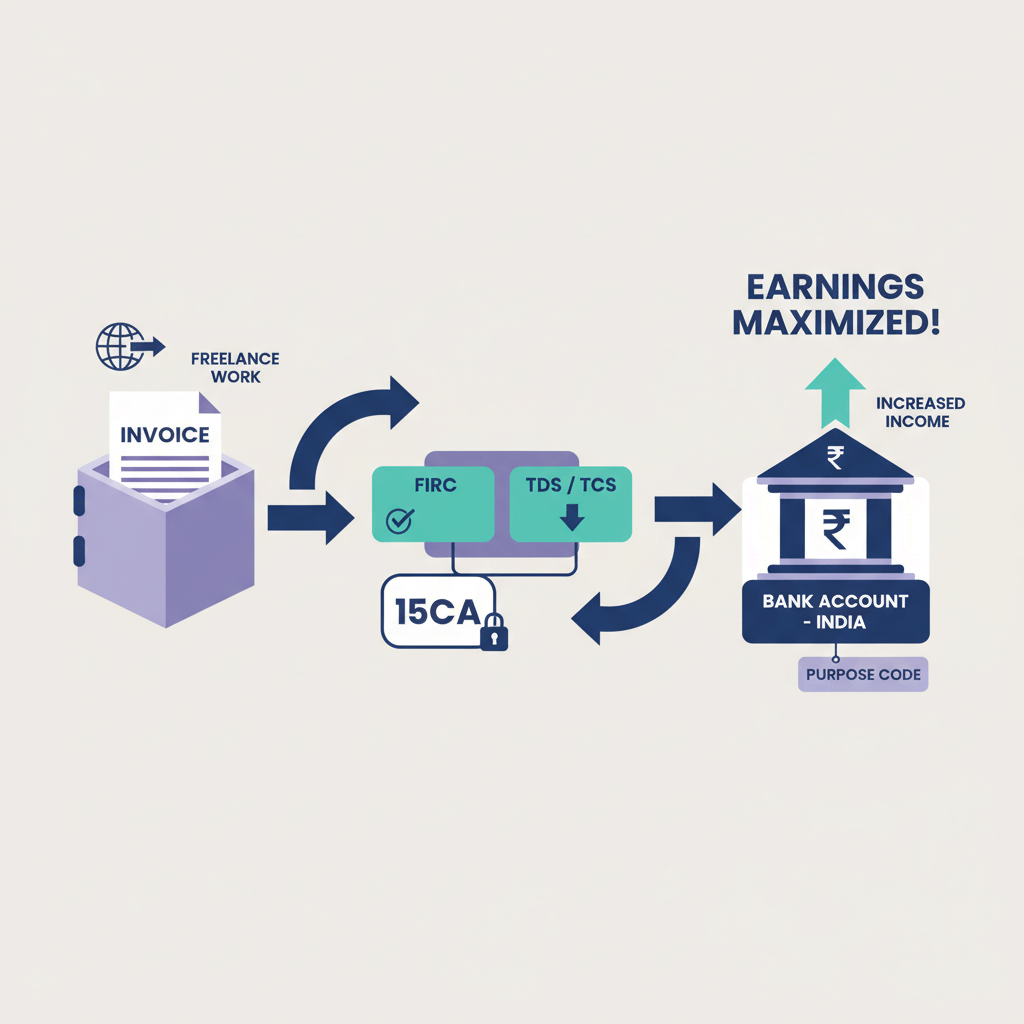
Project your income tax based on slabs, many freelancers fall between 10 and 30 percent. If you export services, file an LUT to keep GST zero rated, register when turnover crosses ₹20 lakhs and file returns. For every foreign remittance, make sure an e-FIRA is generated, platforms that auto issue this within 24 hours save you time and reduce risk.

Step 4, choose realistic utilization

Plan for 48 working weeks and 40 hours weekly, that is 1,920 total hours. At 50 percent utilization, you have 960 billable hours, at 60 percent, 1,152 billable hours. New freelancers should model 45 to 50 percent, seasoned professionals with retainers might reach 60 to 65 percent.

Step 5, convert the model into rates

Required revenue = take home target + annual business expenses + tax provision + profit and risk buffer

Add a 10 to 20 percent buffer for scope creep, bad debts, currency swings, and lean months. Then compute billable hours, and use the base hourly rate formula.

Base hourly rate = required revenue ÷ billable hours

Translate this into project pricing, day rates, or retainers, add premiums for complexity, urgency, or niche expertise, and clearly define scope and revision caps.

How fees and FX change your net realization

Your quoted rate is only half the story, the rest is realization. Platform fees range from 3 to 10 percent, FX markups are often 2 to 4 percent over mid market, double conversions add more leak, and slow payouts push you into expensive credit.

  • Case A, 3 percent platform fee plus 2 to 3 percent FX markup, 5 to 7 percent leak.
  • Case B, 1 percent inward remittance fee, mid market FX with zero markup, INR settlement in 24 to 48 hours, that is meaningful savings every month.

Holding currency balances for up to 60 days lets you time conversions, but ensure your provider is RBI compliant. Automatic e-FIRA generation within 24 hours removes painful back and forth with banks. Fast settlement keeps cash flow healthy so you do not rely on credit.

Platforms built for Indian freelancers often provide local USD, GBP, EUR, and CAD details for client ease, mid market FX at 0 percent markup with a flat inward fee around 1 percent, 24 to 48 hour INR settlement, and automatic compliance. Karbon Business is designed specifically for this use case.

Pricing models and when to use each

  • Hourly, best for uncertain scope, consulting, ad hoc support, pros include transparency, cons include income capped by time and client fixation on hours.
  • Project, best for defined outcomes, pros include value capture from efficiency and easier client budgeting, cons require tight scoping and change order discipline.
  • Retainers, best for ongoing work, pros include stabilized income and improved utilization, cons require clear deliverables and boundaries.
  • Value pricing, charge a fraction of measurable business impact, requires proof and deep understanding of the client’s metrics.
  • Tiered packages, offer Starter, Standard, Premium, anchor expectations and protect your time.

Researching market benchmarks

Browse platforms, agency rate cards, and communities to calibrate. Signals that drive higher rates include niche specialization, portfolio strength with metrics, communication quality, and reliability. With strong positioning, many Indian freelancers serving US, UK, or EU clients can charge closer to international benchmarks.

Service specific notes

  • Software development, niche stacks, DevOps, security heavy work, and ownership of architecture justify higher rates, price sprints or milestones tied to shipped features.
  • Design and creative, price by complexity, usage rights, licensing scope, and revisions, retain source files and charge separately for IP transfer.
  • Content and marketing, bill for business impact and subject expertise, prefer retainers for ongoing assets, avoid word count pricing as the sole lever.
  • Consulting, price based on access and leverage, favor strategy retainers and workshops, move away from hourly when proof accumulates.
  • Education and training, price by curriculum IP, cohort size, and outcomes, use per seat, licensing, or coaching retainers.

Worked examples

Example 1, new content writer at 50 percent utilization

Take home target ₹7,20,000, expenses ₹1,20,000, taxes about ₹84,000, buffer ₹92,000, required revenue ≈ ₹10,00,000. Billable hours 960, base hourly ≈ ₹1,040, quote ₹1,000 to ₹1,200 hourly. A 1,200 to 1,500 word post takes 3 to 4 hours, base per article ≈ ₹4,000, offer retainers like 8 posts at ₹3,500 each. Using a platform at 5 percent leak instead of 1 percent can cost ₹36,000 to ₹60,000 annually.

Example 2, mid level frontend developer selling sprints

Take home ₹21,60,000, expenses ₹2,40,000, taxes ₹4,00,000, buffer ₹4,30,000, required revenue ≈ ₹32,30,000. Billable hours 1,056, base hourly ≈ ₹3,050, quote ₹3,000 to ₹3,500. Two week sprint, 60 hours, sprint base ₹1,80,000, add 20 percent risk to ₹2,15,000. Day rate ~₹18,000. On a $2,500 sprint, shifting from 5 percent to 1 percent fees saves about ₹8,400 per sprint, see freelancer charges for additional perspective.

Example 3, solo designer with retainers plus quarterly projects

Take home ₹30,00,000, expenses ₹3,00,000, taxes ₹8,25,000, buffer ₹6,15,000, required revenue ≈ ₹47,40,000. Billable hours 1,152, base hourly ≈ ₹4,115, quote ₹4,000 to ₹4,500. Three retainers at ₹90,000 each per month plus one ₹4,00,000 to ₹6,00,000 project per quarter reaches target with buffer. On a $5,000 project, moving from 5 percent leak to 1 percent saves ₹16,800 each time.

Raising rates without losing clients

Raise when you are consistently booked, scope creep is frequent, and your results have improved. Communicate confidently, grandfather current clients for a short period, offer tiered options, and consider shifting from hourly to value focused retainers to reframe the conversation.

Risk management and compliance

Use clear contracts, define scope, revisions, payment terms, IP ownership, and late fees. Invoices for export of services should list currency, detailed description, and your foreign receiving details, mention GST treatment and GSTIN if registered. Maintain contracts, invoices, bank statements, and e-FIRA PDFs in one place. Follow RBI compliant rails, choose accurate purpose codes, and respond swiftly to document requests.

Tools and templates

  • Income estimation sheet, inputs for take home, expenses, tax, utilization, platform fees, and FX markup, outputs for required revenue, base hourly, day rate, retainer suggestions, and effective hourly after fees.
  • Rate card, hourly, day rate, typical project ranges, retainer tiers, and payment terms.
  • Scope and change order templates, inclusions, exclusions, revision caps, timelines, payment schedule, and a documented change process.
  • Invoice template, global details for USD, GBP, EUR, CAD receiving, SWIFT if needed, payment references, and notes on GST and e-FIRA.

Quarterly checklist

  • Define annual take home target and update it.
  • Review expenses and taxes, add a profit buffer.
  • Recalculate utilization and billable hours, then your base hourly.
  • Select pricing models and refresh your rate card.
  • Compare platforms for fees, FX, settlement speed, and compliance, prioritize mid market FX, flat low fees, 24 to 48 hour INR settlement, and auto e-FIRA.
  • Adjust rates for demand, skill growth, niche positioning, and currency shifts.
  • Update contracts, invoices, and documentation.

Comparing payment solutions for Indian freelancers

Karbon Business offers virtual USD, GBP, EUR, CAD receiving with local transfer details, 0 percent FX markup at live mid market rates, a 1 percent inward fee, 24 to 48 hour INR settlement, 60 day currency holding, and automatic e-FIRA. Wise Business, Payoneer, PayPal, and others vary on fees, FX spreads, and speed, model your monthly foreign currency inflow and compute net INR after total costs. Even a 1 to 2 percent improvement can save ₹24,000 to ₹48,000 annually on ₹2,00,000 monthly volume.

Final thoughts

Pricing is math, positioning, and confidence. Duplicate your spreadsheet, plug in your numbers, and let the model drive your base hourly. Compare platforms for total cost and speed, small percentage savings compound over time. Set a quarterly rate review, refine scope templates, and communicate updates clearly. With better pricing and smarter payment rails, your freelancer earning potential in India rises without adding hours.

FAQ

What is realistic freelancer earning potential in India for beginners versus experienced professionals?

Beginners in content, design, or social media often start around ₹300 to ₹800 per hour, with take home ₹30,000 to ₹60,000 monthly once they have steady clients and reasonable utilization. Experienced specialists in software, UX, analytics, or high impact marketing charge ₹2,000 to ₹4,000+ per hour, reaching ₹1,00,000 to ₹3,00,000+ per month depending on niche, client base, and pricing model, see how to become a freelancer and earn lakhs in 2025 for broader context.

How do I set my freelance rates for US or UK clients from India without underquoting?

Build your base hourly from a clear income estimation, then convert to USD or GBP using conservative FX. Cross check with platform and agency benchmarks, position niche outcomes and strong communication, and avoid racing to the bottom. Platforms with low fees and mid market FX, like Karbon Business, help you protect take home without inflating headline rates.

How do Indians doing freelance estimate income if months are up and down?

Use an annual model, assign higher buffers, say 20 to 25 percent, and mix retainers with projects. Bank excess from peak months to cover slower periods, and ensure fast INR settlement so cash flow is steady even when invoices bunch up.

Should I quote hourly or project rate for an international client who is not clear on scope?

Start hourly when scope is fuzzy, set a discovery cap, then switch to a project fee once deliverables are defined. Document revisions, add change order clauses, and consider a retainer for ongoing requests. This approach usually improves net realization compared to staying hourly forever.

How much do payment fees and FX spreads actually reduce my take home in INR?

Every percentage point matters, on ₹2,00,000 monthly foreign revenue, dropping from 5 percent to 1 percent total costs saves ₹8,000 per month, or ₹96,000 per year, see highest paying freelancing jobs in India for market context, and compare provider fee stacks before choosing.

Is LUT mandatory for zero GST on export of services, and who will handle e-FIRA?

If you are exporting services, filing an LUT keeps GST at zero rated, and every inward remittance should generate an e-FIRA. Payment platforms that auto issue e-FIRA within 24 hours reduce compliance headaches and make CA filings faster, Karbon Business is built to automate this for freelancers.

What is the best way to get paid from US clients, ACH or wire, and how fast will INR hit my bank?

Local ACH to your USD receiving details is cheaper for clients and typically faster than international wires. With mid market FX and a flat inward fee, settlement in 24 to 48 hours keeps your cash flow healthy, platforms like Karbon Business provide local USD, GBP, EUR, CAD accounts to make this seamless.

How do Indian freelancers avoid blocked payments or FEMA issues?

Use RBI compliant platforms, keep purpose codes accurate, do not mix personal remittances with business invoices, and store contracts, invoices, bank statements, and e-FIRA PDFs. Respond quickly to document requests, and keep invoice descriptions aligned with remittance purpose.

What is a good starting hourly rate for a mid level developer in India serving US startups?

After modeling take home, expenses, taxes, and utilization, many mid level frontend developers quote ₹3,000 to ₹3,500 per hour. Sprint pricing of ₹2,00,000 to ₹2,25,000 for two weeks is common, and choosing a low fee FX platform improves net INR without raising the sticker price.

Can I hold USD or EUR and convert later for better rates, is that legal for freelancers?

Some platforms allow holding balances up to 60 days within RBI rules, so you can time conversions when INR weakens. Confirm your provider’s policy, and ensure mid market FX with 0 percent markup, Karbon Business is designed to support currency holding and quick conversion with transparent rates.

How to structure retainers so Indian freelancers don’t get scope creep via WhatsApp?

Define monthly caps on hours or outputs, set response windows, and list what is excluded. Offer tiered retainers, Starter covers essentials, Standard adds speed, Premium adds priority access. Any out of scope request moves to a change order at your hourly rate.

What documents does my CA need at year end for foreign client payments?

Provide engagement contracts or emails, invoices with payment references, bank statements showing INR credits, and all e-FIRA certificates. With automatic e-FIRA, your CA spends less time chasing the bank and filings are smoother.

Key takeaways

  • Build your rates backward from an annual take home target, add business expenses, taxes, and a profit buffer, then divide by realistic billable hours to get a base hourly rate.
  • Utilization of 45 to 65 percent is realistic for solo freelancers in India, plan around 48 working weeks and 40 hours per week for total hours.
  • Switch to low fee, mid market FX platforms with fast INR settlement and automatic compliance to boost net take home without changing headline rates.
  • For export of services, file an LUT, and ensure every inward foreign remittance generates an e-FIRA.
  • Mix pricing models, hourly for uncertain scope, project for defined outcomes, retainers for ongoing work, and value pricing when you can prove business impact.
  • Quarterly reviews of rates, FX assumptions, and platform fees help maintain profitability as your skills and demand grow.

Freelancer earning potential in India, a practical playbook

If you are starting out, or already managing multiple clients, the real question is simple, what can you earn consistently, and what will actually hit your Indian bank after platform fees, FX spreads, and taxes? This guide gives you a step by step freelance income estimation framework, converts it into workable freelance rates, and shows how payment rails, foreign exchange, and compliance change your net realization.

Key definitions

  • Gross revenue: total invoiced, before expenses, fees, and taxes.
  • Net income: take home after business expenses, payment fees, FX costs, and taxes, this is the real number that pays your bills.
  • Billable versus non billable: delivery and scoped revisions are billable, marketing, admin, proposals, and downtime are not, they must be funded by billable hours.
  • Utilization rate: billable hours divided by total hours, 45 to 65 percent is realistic for solo freelancers over a year.
  • Effective hourly rate: net income divided by total hours worked, it is what you truly earn per hour.
  • Payment realization: INR after platform fees, FX markup, double conversions, and taxes, it is the difference between your invoice and what lands in your bank.

The five step income to rates framework

Step 1, set your annual take home target

Start with your life costs and savings goals, convert them into an annual net income target, for example if you need ₹80,000 per month and want to save ₹2,00,000 a year, aim for about ₹11,60,000 take home. This is your North Star.

Step 2, add business overheads

Budget software and tools, connectivity, equipment amortization, marketing, workspace, subcontractors, and professional services. A typical solo in India spends ₹1,00,000 to ₹3,00,000 annually, put a number that matches your stack and workflow.

Step 3, estimate taxes and compliance

Project your income tax based on slabs, many freelancers fall between 10 and 30 percent. If you export services, file an LUT to keep GST zero rated, register when turnover crosses ₹20 lakhs and file returns. For every foreign remittance, make sure an e-FIRA is generated, platforms that auto issue this within 24 hours save you time and reduce risk.

Step 4, choose realistic utilization

Plan for 48 working weeks and 40 hours weekly, that is 1,920 total hours. At 50 percent utilization, you have 960 billable hours, at 60 percent, 1,152 billable hours. New freelancers should model 45 to 50 percent, seasoned professionals with retainers might reach 60 to 65 percent.

Step 5, convert the model into rates

Required revenue = take home target + annual business expenses + tax provision + profit and risk buffer

Add a 10 to 20 percent buffer for scope creep, bad debts, currency swings, and lean months. Then compute billable hours, and use the base hourly rate formula.

Base hourly rate = required revenue ÷ billable hours

Translate this into project pricing, day rates, or retainers, add premiums for complexity, urgency, or niche expertise, and clearly define scope and revision caps.

How fees and FX change your net realization

Your quoted rate is only half the story, the rest is realization. Platform fees range from 3 to 10 percent, FX markups are often 2 to 4 percent over mid market, double conversions add more leak, and slow payouts push you into expensive credit.

  • Case A, 3 percent platform fee plus 2 to 3 percent FX markup, 5 to 7 percent leak.
  • Case B, 1 percent inward remittance fee, mid market FX with zero markup, INR settlement in 24 to 48 hours, that is meaningful savings every month.

Holding currency balances for up to 60 days lets you time conversions, but ensure your provider is RBI compliant. Automatic e-FIRA generation within 24 hours removes painful back and forth with banks. Fast settlement keeps cash flow healthy so you do not rely on credit.

Platforms built for Indian freelancers often provide local USD, GBP, EUR, and CAD details for client ease, mid market FX at 0 percent markup with a flat inward fee around 1 percent, 24 to 48 hour INR settlement, and automatic compliance. Karbon Business is designed specifically for this use case.

Pricing models and when to use each

  • Hourly, best for uncertain scope, consulting, ad hoc support, pros include transparency, cons include income capped by time and client fixation on hours.
  • Project, best for defined outcomes, pros include value capture from efficiency and easier client budgeting, cons require tight scoping and change order discipline.
  • Retainers, best for ongoing work, pros include stabilized income and improved utilization, cons require clear deliverables and boundaries.
  • Value pricing, charge a fraction of measurable business impact, requires proof and deep understanding of the client’s metrics.
  • Tiered packages, offer Starter, Standard, Premium, anchor expectations and protect your time.

Researching market benchmarks

Browse platforms, agency rate cards, and communities to calibrate. Signals that drive higher rates include niche specialization, portfolio strength with metrics, communication quality, and reliability. With strong positioning, many Indian freelancers serving US, UK, or EU clients can charge closer to international benchmarks.

Service specific notes

  • Software development, niche stacks, DevOps, security heavy work, and ownership of architecture justify higher rates, price sprints or milestones tied to shipped features.
  • Design and creative, price by complexity, usage rights, licensing scope, and revisions, retain source files and charge separately for IP transfer.
  • Content and marketing, bill for business impact and subject expertise, prefer retainers for ongoing assets, avoid word count pricing as the sole lever.
  • Consulting, price based on access and leverage, favor strategy retainers and workshops, move away from hourly when proof accumulates.
  • Education and training, price by curriculum IP, cohort size, and outcomes, use per seat, licensing, or coaching retainers.

Worked examples

Example 1, new content writer at 50 percent utilization

Take home target ₹7,20,000, expenses ₹1,20,000, taxes about ₹84,000, buffer ₹92,000, required revenue ≈ ₹10,00,000. Billable hours 960, base hourly ≈ ₹1,040, quote ₹1,000 to ₹1,200 hourly. A 1,200 to 1,500 word post takes 3 to 4 hours, base per article ≈ ₹4,000, offer retainers like 8 posts at ₹3,500 each. Using a platform at 5 percent leak instead of 1 percent can cost ₹36,000 to ₹60,000 annually.

Example 2, mid level frontend developer selling sprints

Take home ₹21,60,000, expenses ₹2,40,000, taxes ₹4,00,000, buffer ₹4,30,000, required revenue ≈ ₹32,30,000. Billable hours 1,056, base hourly ≈ ₹3,050, quote ₹3,000 to ₹3,500. Two week sprint, 60 hours, sprint base ₹1,80,000, add 20 percent risk to ₹2,15,000. Day rate ~₹18,000. On a $2,500 sprint, shifting from 5 percent to 1 percent fees saves about ₹8,400 per sprint, see freelancer charges for additional perspective.

Example 3, solo designer with retainers plus quarterly projects

Take home ₹30,00,000, expenses ₹3,00,000, taxes ₹8,25,000, buffer ₹6,15,000, required revenue ≈ ₹47,40,000. Billable hours 1,152, base hourly ≈ ₹4,115, quote ₹4,000 to ₹4,500. Three retainers at ₹90,000 each per month plus one ₹4,00,000 to ₹6,00,000 project per quarter reaches target with buffer. On a $5,000 project, moving from 5 percent leak to 1 percent saves ₹16,800 each time.

Raising rates without losing clients

Raise when you are consistently booked, scope creep is frequent, and your results have improved. Communicate confidently, grandfather current clients for a short period, offer tiered options, and consider shifting from hourly to value focused retainers to reframe the conversation.

Risk management and compliance

Use clear contracts, define scope, revisions, payment terms, IP ownership, and late fees. Invoices for export of services should list currency, detailed description, and your foreign receiving details, mention GST treatment and GSTIN if registered. Maintain contracts, invoices, bank statements, and e-FIRA PDFs in one place. Follow RBI compliant rails, choose accurate purpose codes, and respond swiftly to document requests.

Tools and templates

  • Income estimation sheet, inputs for take home, expenses, tax, utilization, platform fees, and FX markup, outputs for required revenue, base hourly, day rate, retainer suggestions, and effective hourly after fees.
  • Rate card, hourly, day rate, typical project ranges, retainer tiers, and payment terms.
  • Scope and change order templates, inclusions, exclusions, revision caps, timelines, payment schedule, and a documented change process.
  • Invoice template, global details for USD, GBP, EUR, CAD receiving, SWIFT if needed, payment references, and notes on GST and e-FIRA.

Quarterly checklist

  • Define annual take home target and update it.
  • Review expenses and taxes, add a profit buffer.
  • Recalculate utilization and billable hours, then your base hourly.
  • Select pricing models and refresh your rate card.
  • Compare platforms for fees, FX, settlement speed, and compliance, prioritize mid market FX, flat low fees, 24 to 48 hour INR settlement, and auto e-FIRA.
  • Adjust rates for demand, skill growth, niche positioning, and currency shifts.
  • Update contracts, invoices, and documentation.

Comparing payment solutions for Indian freelancers

Karbon Business offers virtual USD, GBP, EUR, CAD receiving with local transfer details, 0 percent FX markup at live mid market rates, a 1 percent inward fee, 24 to 48 hour INR settlement, 60 day currency holding, and automatic e-FIRA. Wise Business, Payoneer, PayPal, and others vary on fees, FX spreads, and speed, model your monthly foreign currency inflow and compute net INR after total costs. Even a 1 to 2 percent improvement can save ₹24,000 to ₹48,000 annually on ₹2,00,000 monthly volume.

Final thoughts

Pricing is math, positioning, and confidence. Duplicate your spreadsheet, plug in your numbers, and let the model drive your base hourly. Compare platforms for total cost and speed, small percentage savings compound over time. Set a quarterly rate review, refine scope templates, and communicate updates clearly. With better pricing and smarter payment rails, your freelancer earning potential in India rises without adding hours.

FAQ

What is realistic freelancer earning potential in India for beginners versus experienced professionals?

Beginners in content, design, or social media often start around ₹300 to ₹800 per hour, with take home ₹30,000 to ₹60,000 monthly once they have steady clients and reasonable utilization. Experienced specialists in software, UX, analytics, or high impact marketing charge ₹2,000 to ₹4,000+ per hour, reaching ₹1,00,000 to ₹3,00,000+ per month depending on niche, client base, and pricing model, see how to become a freelancer and earn lakhs in 2025 for broader context.

How do I set my freelance rates for US or UK clients from India without underquoting?

Build your base hourly from a clear income estimation, then convert to USD or GBP using conservative FX. Cross check with platform and agency benchmarks, position niche outcomes and strong communication, and avoid racing to the bottom. Platforms with low fees and mid market FX, like Karbon Business, help you protect take home without inflating headline rates.

How do Indians doing freelance estimate income if months are up and down?

Use an annual model, assign higher buffers, say 20 to 25 percent, and mix retainers with projects. Bank excess from peak months to cover slower periods, and ensure fast INR settlement so cash flow is steady even when invoices bunch up.

Should I quote hourly or project rate for an international client who is not clear on scope?

Start hourly when scope is fuzzy, set a discovery cap, then switch to a project fee once deliverables are defined. Document revisions, add change order clauses, and consider a retainer for ongoing requests. This approach usually improves net realization compared to staying hourly forever.

How much do payment fees and FX spreads actually reduce my take home in INR?

Every percentage point matters, on ₹2,00,000 monthly foreign revenue, dropping from 5 percent to 1 percent total costs saves ₹8,000 per month, or ₹96,000 per year, see highest paying freelancing jobs in India for market context, and compare provider fee stacks before choosing.

Is LUT mandatory for zero GST on export of services, and who will handle e-FIRA?

If you are exporting services, filing an LUT keeps GST at zero rated, and every inward remittance should generate an e-FIRA. Payment platforms that auto issue e-FIRA within 24 hours reduce compliance headaches and make CA filings faster, Karbon Business is built to automate this for freelancers.

What is the best way to get paid from US clients, ACH or wire, and how fast will INR hit my bank?

Local ACH to your USD receiving details is cheaper for clients and typically faster than international wires. With mid market FX and a flat inward fee, settlement in 24 to 48 hours keeps your cash flow healthy, platforms like Karbon Business provide local USD, GBP, EUR, CAD accounts to make this seamless.

How do Indian freelancers avoid blocked payments or FEMA issues?

Use RBI compliant platforms, keep purpose codes accurate, do not mix personal remittances with business invoices, and store contracts, invoices, bank statements, and e-FIRA PDFs. Respond quickly to document requests, and keep invoice descriptions aligned with remittance purpose.

What is a good starting hourly rate for a mid level developer in India serving US startups?

After modeling take home, expenses, taxes, and utilization, many mid level frontend developers quote ₹3,000 to ₹3,500 per hour. Sprint pricing of ₹2,00,000 to ₹2,25,000 for two weeks is common, and choosing a low fee FX platform improves net INR without raising the sticker price.

Can I hold USD or EUR and convert later for better rates, is that legal for freelancers?

Some platforms allow holding balances up to 60 days within RBI rules, so you can time conversions when INR weakens. Confirm your provider’s policy, and ensure mid market FX with 0 percent markup, Karbon Business is designed to support currency holding and quick conversion with transparent rates.

How to structure retainers so Indian freelancers don’t get scope creep via WhatsApp?

Define monthly caps on hours or outputs, set response windows, and list what is excluded. Offer tiered retainers, Starter covers essentials, Standard adds speed, Premium adds priority access. Any out of scope request moves to a change order at your hourly rate.

What documents does my CA need at year end for foreign client payments?

Provide engagement contracts or emails, invoices with payment references, bank statements showing INR credits, and all e-FIRA certificates. With automatic e-FIRA, your CA spends less time chasing the bank and filings are smoother.

The views expressed in the blogs on this page are solely the opinions of the authors and do not constitute expert advice. While we strive to provide accurate and up-to-date information, we make no representations or warranties of any kind, express or implied, about the completeness, accuracy, reliability, suitability or availability with respect to the website or the information, products, services, or related graphics contained on the website for any purpose. Any reliance you place on such information is therefore strictly at your own risk. We disclaim any liability for any loss or damage including without limitation, indirect or consequential loss or damage, or any loss or damage whatsoever arising from loss of data or profits arising out of, or in connection with, the use of this website.

Find out how we can help you today!

Speak to our foreign payment specialist
Whatsapp-color Created with Sketch.
Whatsapp:
+91 74117 02726
Email:
sales@karboncard.com
Address:
Ground Floor, Karbon Business, 1st Stage Rd, Binnamangala, Hoysala Nagar, Indiranagar, Bengaluru, Karnataka 560038

Find out how we can help you today!

Speak to our foreign payment specialist
Whatsapp-color Created with Sketch.
Whatsapp:
+91 74117 02726
Email:
sales@karboncard.com
Address:
Ground Floor, Karbon Business, 1st Stage Rd, Binnamangala, Hoysala Nagar, Indiranagar, Bengaluru, Karnataka 560038

Latest from our blogs

Latest from our blogs

View All
× Save 50% - Start Now