Business

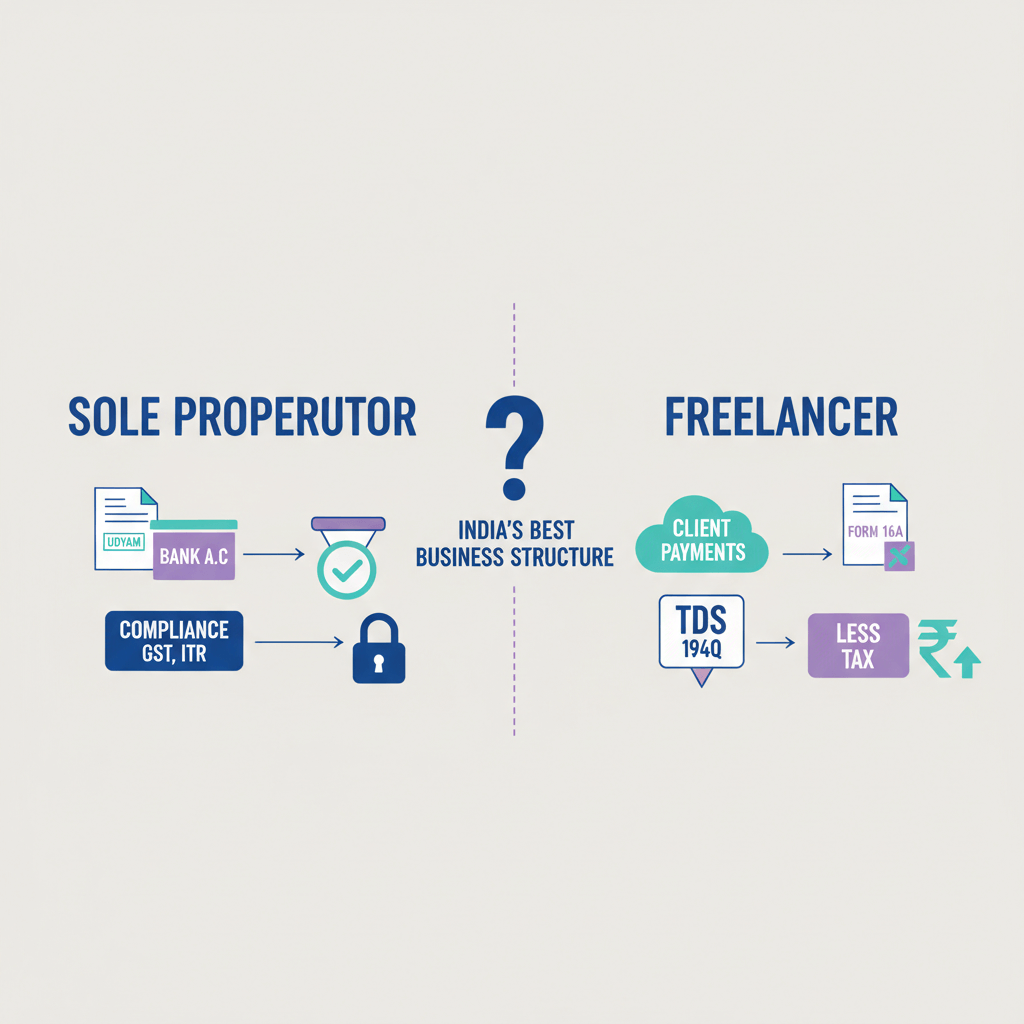
Sole Proprietor or Freelancer? India's Best Business Structure

Content
share on
Contents
Share On

Key takeaways

  • Freelancer is a work style, not a legal entity, in Indian law you are an individual with business or professional income, effectively a sole proprietor unless you form an LLP or company.
  • For overseas payments, select correct purpose codes, and collect e-FIRA for every inward remittance, this proves export proceeds for FEMA, RBI, income tax, and GST.
  • Section 44ADA can simplify taxes for many professionals, declare fifty percent of gross receipts as profit, still pay advance tax, usually by 15 March in a single instalment for 44ADA.
  • GST registration is generally required once services turnover crosses ₹20 lakh, exports are zero rated, file LUT to avoid paying IGST upfront.
  • Use a current account for business clarity, for faster and cheaper overseas receipts consider Karbon Business to accept local ACH, SEPA, FPS with automatic e-FIRA and flat fees.
  • Invoices must carry PAN, client details, currency, SAC code, payment terms, and bank or virtual account details, clean paperwork speeds payouts and refunds.
  • Stay sole proprietor while small and simple, upgrade to LLP, OPC, or Pvt Ltd when revenue, risk, hiring, or enterprise demands grow.

Sole Proprietorship vs Freelancer in India, practical answers

A quick story to set the scene

Ravi, a developer in Pune, works remotely for a US startup, he invoices in his own name and gets paid in USD. His client asked for company details and tax ID, his bank emailed about purpose codes, and his CA mentioned 44ADA, GST, and LUT. If this sounds familiar, you are in the right guide.

Disclaimer: Educational content only, not professional advice, confirm thresholds and rules with a CA before filing.

What freelancer really means

A freelancer is simply an individual providing services independently, sometimes on retainers, often on projects. There is no separate legal status for a freelancer, tax law views you as an individual earning business or professional income.

Think of freelancer as a work style, not a legal form, the Income Tax Department looks at your PAN, your receipts, and your expenses, not at a special freelancer tag.

What a sole proprietorship is

A sole proprietorship means you carry on business in your own name or a trade name, the business and you are the same legal person, profits are taxed in your personal hands. There is no liability shield, so business debts and claims can reach personal assets.

In practice, most Indian freelancers are already sole proprietors without any extra registration, unless they choose LLP or company for limited liability and scaling needs.

Quick context on other structures

  • OPC, separate company with one shareholder, useful when you need company credibility but work solo.
  • LLP, separate entity with limited liability, common for consulting teams and agencies.
  • Private Limited Company, best for startups that raise capital, offer ESOPs, and run larger operations.

Bottom line, if you invoice in your own name, you are effectively a sole proprietor freelancer, upgrade only when revenue, risk, or hiring justify higher compliance.

Identity, liability, and risk

As a freelancer or sole proprietor, your business and personal identity are one, you file taxes on your PAN, not a separate entity. Liability is unlimited, so consider professional indemnity insurance once you sign bigger contracts, or move to LLP or company for a liability shield.

Banking and remittance essentials

You can start with a savings account for small gigs, then open a current account in your trade name for cleaner records as you grow. For foreign clients, use virtual currency accounts that accept local ACH, SEPA, FPS, and ensure e-FIRA is generated for each receipt, it is your core export proof for FEMA and GST.

Pick correct purpose codes for software, IT services, design, or consulting, consistent coding plus invoices plus e-FIRA equals smooth audits and refunds.

Useful registrations, not overkill

  • Income tax, report under profits and gains of business or profession.
  • GST, mandatory above ₹20 lakh services turnover, exports are zero rated, furnish LUT to avoid IGST on invoices.
  • Udyam, optional MSME registration for credibility and vendor onboarding.
  • IEC, usually not required for pure services, check with your CA if you sell software products or digital goods.

Invoicing overseas clients, essentials

Include your name or trade name, address, PAN, client legal name and country, invoice number, date, currency, service description with SAC code, GST treatment, payment terms, and settlement details. Add virtual account details if you use a platform, and mention SWIFT or IBAN only when needed. Clean invoices reduce payout delays.

Record keeping that survives audits

Maintain a numbered invoice series, store contracts, e-FIRA, bank statements, and GST filings in cloud folders by financial year, keep six to eight years of records. Track deductible expenses monthly, software, internet, rent, equipment, travel, marketing, and subcontractors.

Freelancer taxes, the practical run through

Your income falls under profits and gains of business or profession, deduct legitimate business expenses, and consider Section 44AA thresholds for books of accounts. Clean books from day one save effort during scrutiny.

Section 44ADA suits many professionals, declare fifty percent of gross receipts as profit up to the applicable turnover limit, useful when expenses are modest. If your real margin is lower, use regular books and claim actual expenses.

Advance tax is due when your annual tax exceeds ₹10,000, regular taxpayers pay quarterly, 44ADA taxpayers can pay full estimated tax by 15 March. Missing timelines triggers interest, so set a calendar and fund it monthly.

TDS from Indian clients is common at ten percent under 194J, claim credit in ITR. Foreign clients usually pay gross, keep contracts, invoices, and e-FIRA to prove export income.

GST on exports requires conditions like recipient outside India, payment in foreign exchange, and correct place of supply. With LUT, zero tax on invoice and you may claim input refunds, or pay IGST then claim refund. LUT is popular because it preserves cash flow.

When to stay sole proprietor, when to upgrade

Stay sole proprietor if revenue is modest, risk is low, and you operate solo, it is simple and low compliance. Upgrade to LLP, OPC, or Pvt Ltd when revenue grows, you hire a team, enterprise clients demand limited liability, or you plan ESOPs and fundraising.

Snapshot, sole proprietor is low compliance and unlimited liability, LLP and company add limited liability and more filings, pick the smallest structure that safely supports your current scale.

International payments, first principles

Prefer local rails via virtual accounts for recurring invoices, ACH, SEPA, FPS are cheaper and faster than SWIFT for routine payouts. Use SWIFT when local payouts are not possible or for larger one time transfers.

Consider Karbon Business for USD, GBP, EUR, and CAD virtual accounts, local client payments, flat fees around one percent, zero FX markup, and automatic e-FIRA in about twenty four hours. Other options include Wise Business, Payoneer, PayPal, and Skydo, each with different fees and flows.

If your provider allows short holding in foreign currency, for example up to sixty days, time your conversions to INR to manage simple FX risk, this is basic hedging, helpful when income is in USD and expenses are in INR.

Documentation to stay audit ready

  • Signed contracts or statements of work.
  • Invoices with SAC codes and currency.
  • e-FIRA or FIRA per remittance, plus matching bank statements.
  • GST LUT acknowledgements, returns, and any refund filings.
  • Expense proofs, subscriptions, rent agreements, equipment bills.

Common mistakes to avoid

  • Running heavy business inflows from a personal savings account, mixing personal and business makes filing painful.
  • Ignoring advance tax timelines, interest adds up quickly.
  • Skipping purpose codes or not collecting e-FIRA, which can trigger bank holds or refund issues.
  • Invoices missing SAC code, client address, currency, conversion rate, or payment terms, sloppy invoicing delays payments.
  • Poor documentation of deliverables and contracts, you need evidence if a client or an auditor asks.

How Karbon Business fits in

For Indian freelancers and sole proprietors exporting services, Karbon Business provides virtual USD, GBP, EUR, and CAD accounts so clients pay locally, then you receive INR in twenty four to forty eight hours. Fees are flat and transparent, FX uses mid market rates, and e-FIRA is auto generated for each payment, simplifying ITR, GST returns, and refunds.

Your workflow becomes simple, raise invoice with Karbon account details, client pays via local transfer, you receive INR and e-FIRA, you archive documents and stay ready for taxes and audits.

Quick start checklists and templates

Business registration tips

PAN and Aadhaar ready, pick a trade name, open a current account, get Udyam, evaluate GST and file LUT for exports, set up invoicing with SAC codes and currency, decide a record keeping system.

Freelancer taxes checklist

Classify income under business or profession, decide 44ADA versus normal books, set an advance tax calendar, track deductible expenses monthly, store invoices, e-FIRA, and proofs for six to eight years.

Invoice template notes

Your details and PAN, client details and country, invoice number and date, currency and SAC code, GST treatment and INR equivalent if needed, payment terms, bank or virtual account details, and optional payment link.

FAQ

I am a freelancer working from India for a US startup, do I need a company or can I just invoice in my own name?

You can invoice in your own name as a sole proprietor, this is normal for Indian freelancers. Include PAN, address, bank or virtual account details, and if registered under GST then include GSTIN and state. For credibility, consider Udyam registration and a current account, and share a clean invoice and a vendor profile. If the client asks for company details and tax ID, you can state sole proprietor status with PAN and GSTIN if applicable.

My bank asked for purpose codes on an incoming SWIFT, which one should I use for software development services?

Select the code that matches your service category, software development and IT services have specific entries, check the latest RBI list and use consistent coding across invoices and receipts. For an overview and examples, refer to purpose codes, consistent codes plus e-FIRA reduce scrutiny and speed refunds.

Is Section 44ADA applicable for freelance developers and consultants, and how do I pay advance tax under 44ADA?

Many IT and consulting professionals qualify for 44ADA, confirm with your CA based on your services and turnover. Under 44ADA you may declare fifty percent of gross receipts as profit, and you can pay the entire advance tax by 15 March. Keep a monthly estimate, set aside cash, and avoid interest under sections 234B and 234C.

Do I need GST if all my clients are outside India and I only export services?

GST is driven by turnover and activity, not only client location. Once you cross ₹20 lakh services turnover, registration is generally required even if all invoices are exports. Exports are zero rated, so furnish LUT annually to avoid charging IGST, then claim input credit refunds if eligible.

What exactly is e-FIRA, and how does it help with taxes and GST for freelancers?

e-FIRA is electronic Foreign Inward Remittance Advice, proof that your money came as export proceeds in foreign exchange. It supports FEMA and RBI compliance, helps substantiate export income in ITR, and is necessary for GST export refunds. Archive e-FIRA for each payment and ensure it matches invoice and bank statements.

Can I receive USD via local ACH to reduce fees, and how does Karbon Business help here?

Yes, many freelancers prefer local rails for recurring invoices, they are cheaper and faster than SWIFT. With Karbon Business, your client pays via local ACH in the US, SEPA in the EU, or FPS in the UK, you get INR settlement and automatic e-FIRA. Fees are flat and FX is at mid market, which usually reduces total cost compared to traditional banking.

If I am just starting, is a savings account okay or should I open a current account immediately?

A savings account can work for very small and occasional projects, however a current account improves audit readiness, separates business and personal flows, and looks professional for B2B onboarding. When you start exporting services regularly, pair your current account with a virtual currency account provider like Karbon Business for compliant inward remittances and e-FIRA.

How should I structure my invoices to overseas clients to avoid payout delays?

Include your name or trade name, address, PAN, client name and address, invoice number and date, currency, service description with SAC code, payment terms, and settlement details such as virtual account or SWIFT. If under GST, show zero rated export and LUT reference. Match your invoice currency and description to the selected purpose codes, keep contracts attached for vendor onboarding, and ensure the payout details are complete.

Do foreign clients deduct Indian TDS on my invoice, and how do I report this income?

Foreign clients generally do not deduct Indian TDS, you receive gross amounts, then you report the income under business or profession in ITR, pay advance tax, and settle final taxes at filing. Save contracts, invoices, and e-FIRA as evidence of export income.

I heard about LUT for exports, how do I file LUT and what happens if I forget?

LUT is filed online under GST to export services without charging IGST, it is generally furnished annually. If you forget to file LUT, you may have to charge IGST on export invoices and then claim refunds, which hurts cash flow. Keep a renewal reminder, and store LUT acknowledgements with your export invoice folder.

Is IEC mandatory for me, I only sell custom development services and consulting?

IEC is commonly required for goods import export, pure services export usually does not need IEC. If you sell software products or digital goods, or if a client or platform demands IEC for onboarding, discuss with your CA and evaluate. For most freelancers in services, IEC is optional.

How can I manage forex risk on monthly USD invoices without complicated hedging?

If your provider allows holding foreign currency briefly, for example up to sixty days, you can time conversion to INR when rates are favorable. Platforms like Karbon Business offer currency holding windows, mid market FX, and flat fees, which together give you simple, practical control over conversions without complex derivatives.

Key takeaways

  • Freelancer is a work style, not a legal entity, in Indian law you are an individual with business or professional income, effectively a sole proprietor unless you form an LLP or company.
  • For overseas payments, select correct purpose codes, and collect e-FIRA for every inward remittance, this proves export proceeds for FEMA, RBI, income tax, and GST.
  • Section 44ADA can simplify taxes for many professionals, declare fifty percent of gross receipts as profit, still pay advance tax, usually by 15 March in a single instalment for 44ADA.
  • GST registration is generally required once services turnover crosses ₹20 lakh, exports are zero rated, file LUT to avoid paying IGST upfront.
  • Use a current account for business clarity, for faster and cheaper overseas receipts consider Karbon Business to accept local ACH, SEPA, FPS with automatic e-FIRA and flat fees.
  • Invoices must carry PAN, client details, currency, SAC code, payment terms, and bank or virtual account details, clean paperwork speeds payouts and refunds.
  • Stay sole proprietor while small and simple, upgrade to LLP, OPC, or Pvt Ltd when revenue, risk, hiring, or enterprise demands grow.

Sole Proprietorship vs Freelancer in India, practical answers

A quick story to set the scene

Ravi, a developer in Pune, works remotely for a US startup, he invoices in his own name and gets paid in USD. His client asked for company details and tax ID, his bank emailed about purpose codes, and his CA mentioned 44ADA, GST, and LUT. If this sounds familiar, you are in the right guide.

Disclaimer: Educational content only, not professional advice, confirm thresholds and rules with a CA before filing.

What freelancer really means

A freelancer is simply an individual providing services independently, sometimes on retainers, often on projects. There is no separate legal status for a freelancer, tax law views you as an individual earning business or professional income.

Think of freelancer as a work style, not a legal form, the Income Tax Department looks at your PAN, your receipts, and your expenses, not at a special freelancer tag.

What a sole proprietorship is

A sole proprietorship means you carry on business in your own name or a trade name, the business and you are the same legal person, profits are taxed in your personal hands. There is no liability shield, so business debts and claims can reach personal assets.

In practice, most Indian freelancers are already sole proprietors without any extra registration, unless they choose LLP or company for limited liability and scaling needs.

Quick context on other structures

  • OPC, separate company with one shareholder, useful when you need company credibility but work solo.
  • LLP, separate entity with limited liability, common for consulting teams and agencies.
  • Private Limited Company, best for startups that raise capital, offer ESOPs, and run larger operations.

Bottom line, if you invoice in your own name, you are effectively a sole proprietor freelancer, upgrade only when revenue, risk, or hiring justify higher compliance.

Identity, liability, and risk

As a freelancer or sole proprietor, your business and personal identity are one, you file taxes on your PAN, not a separate entity. Liability is unlimited, so consider professional indemnity insurance once you sign bigger contracts, or move to LLP or company for a liability shield.

Banking and remittance essentials

You can start with a savings account for small gigs, then open a current account in your trade name for cleaner records as you grow. For foreign clients, use virtual currency accounts that accept local ACH, SEPA, FPS, and ensure e-FIRA is generated for each receipt, it is your core export proof for FEMA and GST.

Pick correct purpose codes for software, IT services, design, or consulting, consistent coding plus invoices plus e-FIRA equals smooth audits and refunds.

Useful registrations, not overkill

  • Income tax, report under profits and gains of business or profession.
  • GST, mandatory above ₹20 lakh services turnover, exports are zero rated, furnish LUT to avoid IGST on invoices.
  • Udyam, optional MSME registration for credibility and vendor onboarding.
  • IEC, usually not required for pure services, check with your CA if you sell software products or digital goods.

Invoicing overseas clients, essentials

Include your name or trade name, address, PAN, client legal name and country, invoice number, date, currency, service description with SAC code, GST treatment, payment terms, and settlement details. Add virtual account details if you use a platform, and mention SWIFT or IBAN only when needed. Clean invoices reduce payout delays.

Record keeping that survives audits

Maintain a numbered invoice series, store contracts, e-FIRA, bank statements, and GST filings in cloud folders by financial year, keep six to eight years of records. Track deductible expenses monthly, software, internet, rent, equipment, travel, marketing, and subcontractors.

Freelancer taxes, the practical run through

Your income falls under profits and gains of business or profession, deduct legitimate business expenses, and consider Section 44AA thresholds for books of accounts. Clean books from day one save effort during scrutiny.

Section 44ADA suits many professionals, declare fifty percent of gross receipts as profit up to the applicable turnover limit, useful when expenses are modest. If your real margin is lower, use regular books and claim actual expenses.

Advance tax is due when your annual tax exceeds ₹10,000, regular taxpayers pay quarterly, 44ADA taxpayers can pay full estimated tax by 15 March. Missing timelines triggers interest, so set a calendar and fund it monthly.

TDS from Indian clients is common at ten percent under 194J, claim credit in ITR. Foreign clients usually pay gross, keep contracts, invoices, and e-FIRA to prove export income.

GST on exports requires conditions like recipient outside India, payment in foreign exchange, and correct place of supply. With LUT, zero tax on invoice and you may claim input refunds, or pay IGST then claim refund. LUT is popular because it preserves cash flow.

When to stay sole proprietor, when to upgrade

Stay sole proprietor if revenue is modest, risk is low, and you operate solo, it is simple and low compliance. Upgrade to LLP, OPC, or Pvt Ltd when revenue grows, you hire a team, enterprise clients demand limited liability, or you plan ESOPs and fundraising.

Snapshot, sole proprietor is low compliance and unlimited liability, LLP and company add limited liability and more filings, pick the smallest structure that safely supports your current scale.

International payments, first principles

Prefer local rails via virtual accounts for recurring invoices, ACH, SEPA, FPS are cheaper and faster than SWIFT for routine payouts. Use SWIFT when local payouts are not possible or for larger one time transfers.

Consider Karbon Business for USD, GBP, EUR, and CAD virtual accounts, local client payments, flat fees around one percent, zero FX markup, and automatic e-FIRA in about twenty four hours. Other options include Wise Business, Payoneer, PayPal, and Skydo, each with different fees and flows.

If your provider allows short holding in foreign currency, for example up to sixty days, time your conversions to INR to manage simple FX risk, this is basic hedging, helpful when income is in USD and expenses are in INR.

Documentation to stay audit ready

  • Signed contracts or statements of work.
  • Invoices with SAC codes and currency.
  • e-FIRA or FIRA per remittance, plus matching bank statements.
  • GST LUT acknowledgements, returns, and any refund filings.
  • Expense proofs, subscriptions, rent agreements, equipment bills.

Common mistakes to avoid

  • Running heavy business inflows from a personal savings account, mixing personal and business makes filing painful.
  • Ignoring advance tax timelines, interest adds up quickly.
  • Skipping purpose codes or not collecting e-FIRA, which can trigger bank holds or refund issues.
  • Invoices missing SAC code, client address, currency, conversion rate, or payment terms, sloppy invoicing delays payments.
  • Poor documentation of deliverables and contracts, you need evidence if a client or an auditor asks.

How Karbon Business fits in

For Indian freelancers and sole proprietors exporting services, Karbon Business provides virtual USD, GBP, EUR, and CAD accounts so clients pay locally, then you receive INR in twenty four to forty eight hours. Fees are flat and transparent, FX uses mid market rates, and e-FIRA is auto generated for each payment, simplifying ITR, GST returns, and refunds.

Your workflow becomes simple, raise invoice with Karbon account details, client pays via local transfer, you receive INR and e-FIRA, you archive documents and stay ready for taxes and audits.

Quick start checklists and templates

Business registration tips

PAN and Aadhaar ready, pick a trade name, open a current account, get Udyam, evaluate GST and file LUT for exports, set up invoicing with SAC codes and currency, decide a record keeping system.

Freelancer taxes checklist

Classify income under business or profession, decide 44ADA versus normal books, set an advance tax calendar, track deductible expenses monthly, store invoices, e-FIRA, and proofs for six to eight years.

Invoice template notes

Your details and PAN, client details and country, invoice number and date, currency and SAC code, GST treatment and INR equivalent if needed, payment terms, bank or virtual account details, and optional payment link.

FAQ

I am a freelancer working from India for a US startup, do I need a company or can I just invoice in my own name?

You can invoice in your own name as a sole proprietor, this is normal for Indian freelancers. Include PAN, address, bank or virtual account details, and if registered under GST then include GSTIN and state. For credibility, consider Udyam registration and a current account, and share a clean invoice and a vendor profile. If the client asks for company details and tax ID, you can state sole proprietor status with PAN and GSTIN if applicable.

My bank asked for purpose codes on an incoming SWIFT, which one should I use for software development services?

Select the code that matches your service category, software development and IT services have specific entries, check the latest RBI list and use consistent coding across invoices and receipts. For an overview and examples, refer to purpose codes, consistent codes plus e-FIRA reduce scrutiny and speed refunds.

Is Section 44ADA applicable for freelance developers and consultants, and how do I pay advance tax under 44ADA?

Many IT and consulting professionals qualify for 44ADA, confirm with your CA based on your services and turnover. Under 44ADA you may declare fifty percent of gross receipts as profit, and you can pay the entire advance tax by 15 March. Keep a monthly estimate, set aside cash, and avoid interest under sections 234B and 234C.

Do I need GST if all my clients are outside India and I only export services?

GST is driven by turnover and activity, not only client location. Once you cross ₹20 lakh services turnover, registration is generally required even if all invoices are exports. Exports are zero rated, so furnish LUT annually to avoid charging IGST, then claim input credit refunds if eligible.

What exactly is e-FIRA, and how does it help with taxes and GST for freelancers?

e-FIRA is electronic Foreign Inward Remittance Advice, proof that your money came as export proceeds in foreign exchange. It supports FEMA and RBI compliance, helps substantiate export income in ITR, and is necessary for GST export refunds. Archive e-FIRA for each payment and ensure it matches invoice and bank statements.

Can I receive USD via local ACH to reduce fees, and how does Karbon Business help here?

Yes, many freelancers prefer local rails for recurring invoices, they are cheaper and faster than SWIFT. With Karbon Business, your client pays via local ACH in the US, SEPA in the EU, or FPS in the UK, you get INR settlement and automatic e-FIRA. Fees are flat and FX is at mid market, which usually reduces total cost compared to traditional banking.

If I am just starting, is a savings account okay or should I open a current account immediately?

A savings account can work for very small and occasional projects, however a current account improves audit readiness, separates business and personal flows, and looks professional for B2B onboarding. When you start exporting services regularly, pair your current account with a virtual currency account provider like Karbon Business for compliant inward remittances and e-FIRA.

How should I structure my invoices to overseas clients to avoid payout delays?

Include your name or trade name, address, PAN, client name and address, invoice number and date, currency, service description with SAC code, payment terms, and settlement details such as virtual account or SWIFT. If under GST, show zero rated export and LUT reference. Match your invoice currency and description to the selected purpose codes, keep contracts attached for vendor onboarding, and ensure the payout details are complete.

Do foreign clients deduct Indian TDS on my invoice, and how do I report this income?

Foreign clients generally do not deduct Indian TDS, you receive gross amounts, then you report the income under business or profession in ITR, pay advance tax, and settle final taxes at filing. Save contracts, invoices, and e-FIRA as evidence of export income.

I heard about LUT for exports, how do I file LUT and what happens if I forget?

LUT is filed online under GST to export services without charging IGST, it is generally furnished annually. If you forget to file LUT, you may have to charge IGST on export invoices and then claim refunds, which hurts cash flow. Keep a renewal reminder, and store LUT acknowledgements with your export invoice folder.

Is IEC mandatory for me, I only sell custom development services and consulting?

IEC is commonly required for goods import export, pure services export usually does not need IEC. If you sell software products or digital goods, or if a client or platform demands IEC for onboarding, discuss with your CA and evaluate. For most freelancers in services, IEC is optional.

How can I manage forex risk on monthly USD invoices without complicated hedging?

If your provider allows holding foreign currency briefly, for example up to sixty days, you can time conversion to INR when rates are favorable. Platforms like Karbon Business offer currency holding windows, mid market FX, and flat fees, which together give you simple, practical control over conversions without complex derivatives.

The views expressed in the blogs on this page are solely the opinions of the authors and do not constitute expert advice. While we strive to provide accurate and up-to-date information, we make no representations or warranties of any kind, express or implied, about the completeness, accuracy, reliability, suitability or availability with respect to the website or the information, products, services, or related graphics contained on the website for any purpose. Any reliance you place on such information is therefore strictly at your own risk. We disclaim any liability for any loss or damage including without limitation, indirect or consequential loss or damage, or any loss or damage whatsoever arising from loss of data or profits arising out of, or in connection with, the use of this website.

Find out how we can help you today!

Speak to our foreign payment specialist
Whatsapp-color Created with Sketch.
Whatsapp:
+91 74117 02726
Email:
sales@karboncard.com
Address:
Ground Floor, Karbon Business, 1st Stage Rd, Binnamangala, Hoysala Nagar, Indiranagar, Bengaluru, Karnataka 560038

Find out how we can help you today!

Speak to our foreign payment specialist
Whatsapp-color Created with Sketch.
Whatsapp:
+91 74117 02726
Email:
sales@karboncard.com
Address:
Ground Floor, Karbon Business, 1st Stage Rd, Binnamangala, Hoysala Nagar, Indiranagar, Bengaluru, Karnataka 560038

Latest from our blogs

Latest from our blogs

View All
× Save 50% - Start Now